
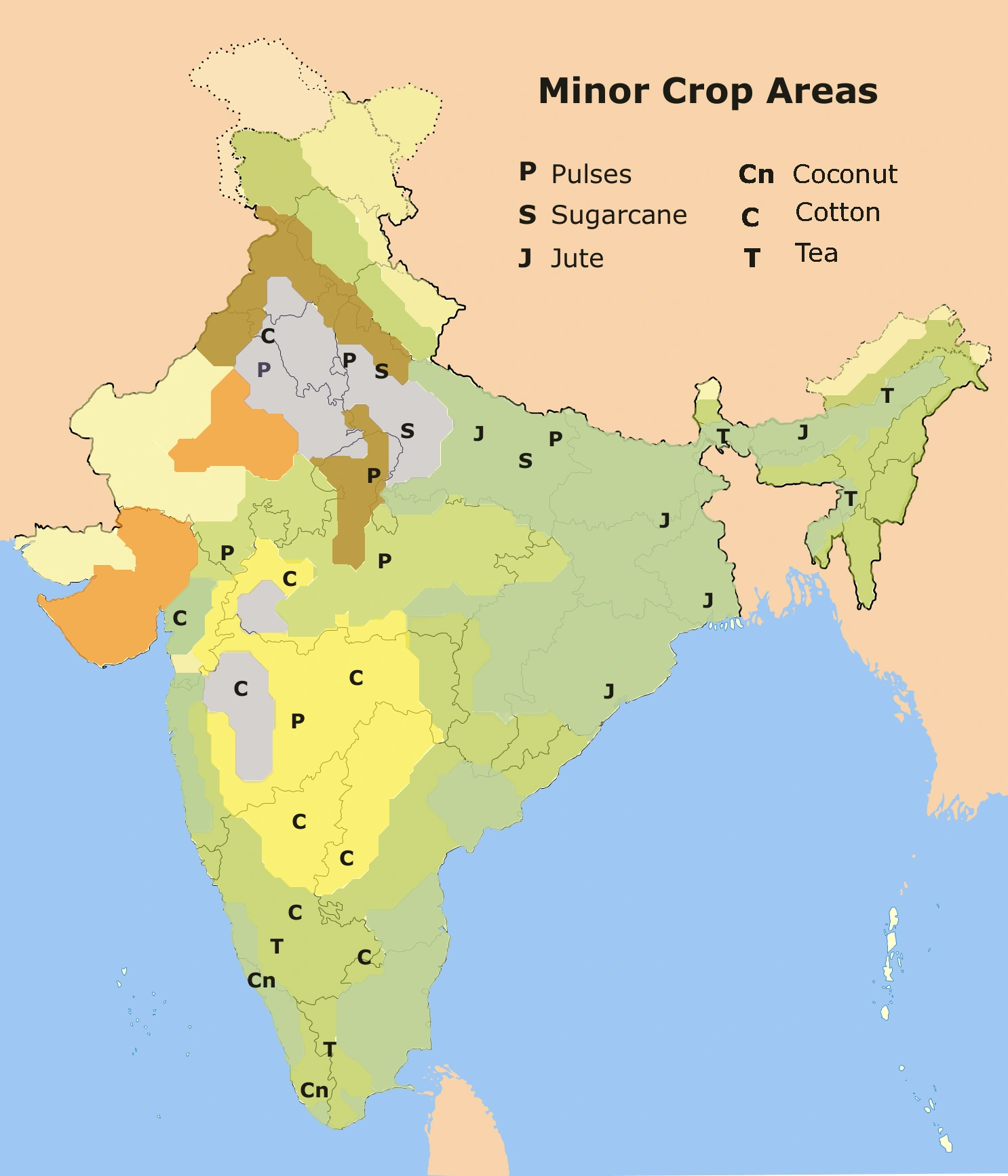
Map study
Selected crop regions of India: identify the legend symbols before comparing patterns. Symbols do not imply exclusive growing areas or current production totals.
- Read the source legend, scale and reference period before comparing regions.
- Connect spatial patterns to the processes discussed in this topic; this map is a study reference, not live operational data.
Credit: Amog · CC BY-SA 2.5 · sourceConverted to WebP on an opaque white background; proportionally resized without cropping. Original cartography and legend retained.
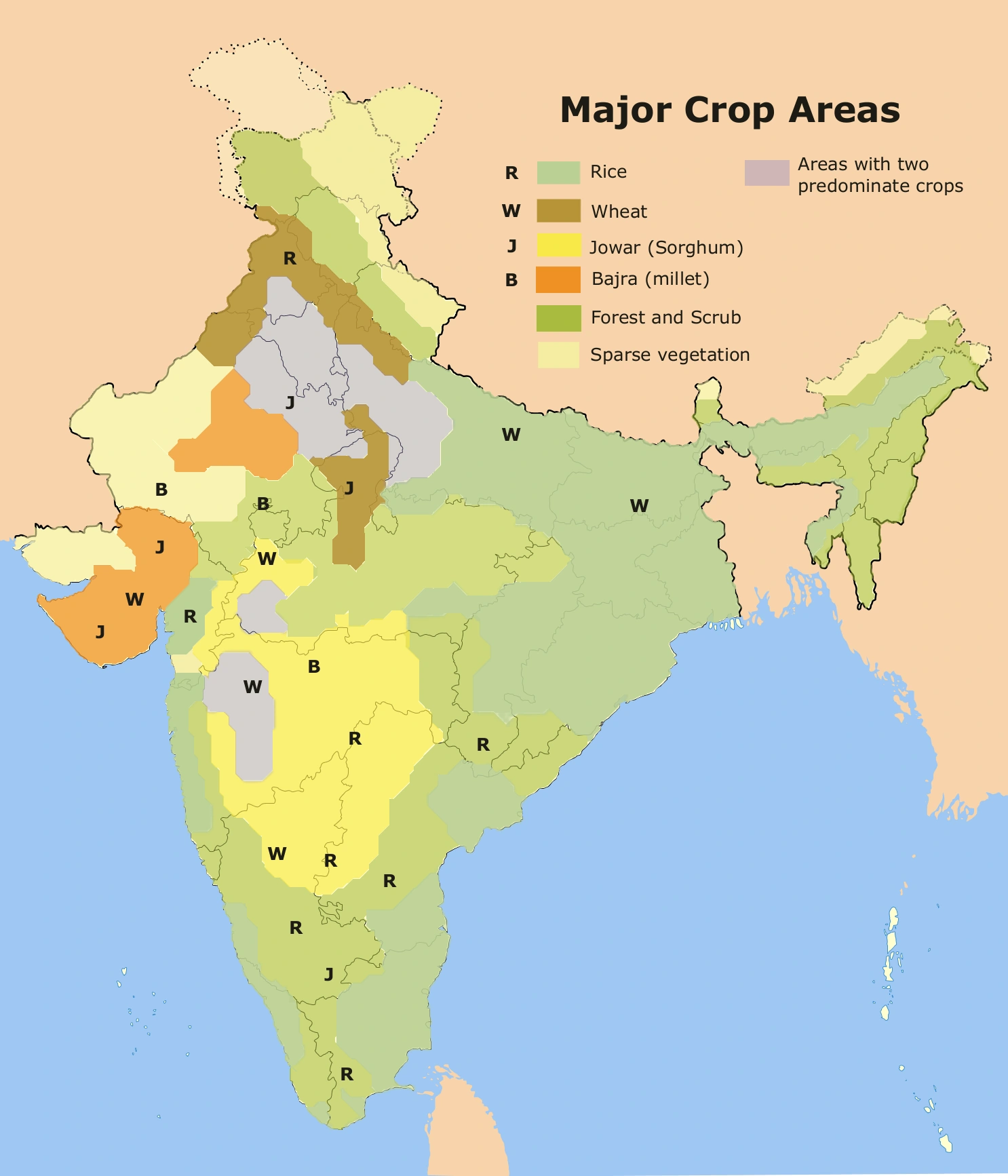
Map study
Major crop regions of India: relate crop belts to rainfall, soils, temperature and irrigation. Schematic historical reference, not current production rankings.
- Read the source legend, scale and reference period before comparing regions.
- Connect spatial patterns to the processes discussed in this topic; this map is a study reference, not live operational data.
Credit: Amog · CC BY-SA 2.5 · sourceConverted to WebP on an opaque white background; proportionally resized without cropping. Original cartography and legend retained.
1. Scope and economic significance
Food processing covers physical, chemical and biological operations that make food suitable for storage, consumption or further manufacturing. Primary processing includes cleaning, grading, milling, chilling and pasteurisation. Secondary processing converts ingredients into products such as bread, cheese, fruit pulp and edible oils. Tertiary or advanced processing produces ready-to-eat meals and other convenience foods. These categories overlap: processing intensity is not itself a measure of nutritional quality.
India has a broad raw-material base spanning cereals, pulses, horticulture, milk, livestock and fisheries. However, high production does not automatically translate into processing competitiveness. Seasonality, dispersed smallholder production, inconsistent quality and inadequate logistics can prevent factories from obtaining dependable supplies. The sector therefore requires coordinated development of farms, aggregation systems, transport, laboratories and markets.
For GS-III, its significance lies in connecting agricultural productivity with value addition. Processing can absorb seasonal surpluses, extend marketing periods and create demand for specified varieties. Rural facilities generate non-farm employment in packaging, maintenance, transport and quality testing. Women-led self-help groups and microenterprises can participate in local products, provided access to technology, working capital and remunerative markets accompanies training.
- Farm-income channel: lower avoidable losses, additional outlets and quality-linked prices, rather than an assured increase in every farmer’s income.
- Macroeconomic channel: manufacturing growth, diversified exports and stronger agricultural supply chains.
- Consumer channel: safer handling, greater availability across seasons and convenience, subject to effective regulation.
2. Supply-chain architecture and location factors
A processing value chain begins before harvest. Suitable seeds, production protocols and harvest timing determine recovery rates, taste and safety. Collection centres then aggregate output and undertake grading, weighing and preliminary handling. Depending on the commodity, produce requires drying, pre-cooling, chilling or rapid delivery. Processing, packaging, warehousing, distribution and retail complete the chain. Traceability should connect these stages so that unsafe batches can be identified and recalled.
Location decisions reflect raw-material perishability, transport costs, water, power, labour and market access. Milk chilling centres need proximity to producers, while consumer-oriented bakeries often locate near cities. Tomato-pulp plants benefit from concentrated production and rapid procurement during harvest. Seafood processing requires hygienic landing centres, ice, refrigeration and export logistics. A single infrastructure model cannot serve all commodities.
Cold-chain development must be integrated rather than reduced to constructing cold stores. Packhouses, pre-cooling, refrigerated transport and destination handling must match each commodity’s temperature and humidity requirements. Cereals instead require moisture control, scientific storage and pest management. Infrastructure utilisation, energy reliability and maintenance capabilities matter as much as installed capacity.
- Backward linkages: farmer producer organisations, cooperatives, collection centres, extension and transparent procurement agreements.
- Forward linkages: wholesalers, retailers, institutional buyers, e-commerce and export channels.
- Supporting services: accredited testing, packaging design, insurance, finance, digital records and skilled technicians.
From farm output to a safe, marketable product
- 1. Plan varieties and production around credible market demand
- 2. Aggregate through transparent procurement and farmer institutions
- 3. Grade, test and apply commodity-specific post-harvest handling
- 4. Process under validated hygiene and quality controls
- 5. Package, label and maintain batch traceability
- 6. Distribute through appropriate storage and transport
- 7. Monitor consumer feedback, recalls and by-product utilisation
3. Structural constraints and reform priorities
Small and fragmented holdings raise aggregation and transaction costs. Processors may need uniform varieties and predictable volumes, while farmers need price transparency and timely payment. Farmer producer organisations can bridge this gap, but require professional management, working capital and credible buyers. Procurement contracts should clearly specify grades, testing methods, payment schedules and dispute resolution, without transferring disproportionate production or rejection risks to farmers.
Microenterprises commonly face outdated equipment, weak bookkeeping, limited collateral and difficulty meeting packaging and labelling requirements. Capital subsidies cannot substitute for viable demand or cash flow. Credit appraisal should consider business performance and supply relationships, while common facilities can make laboratories, dryers and packaging lines affordable. Training must cover machine operation, hygiene, energy efficiency and entrepreneurship.
Unpredictable trade restrictions, variable raw-material prices and fragmented market arrangements can discourage investment. State agricultural-market reforms should facilitate lawful direct procurement and competition while retaining transparent weighing, payment protection and accessible grievance redress. Export competitiveness also requires compliance with destination-country pesticide-residue, contaminant and sanitary standards; low prices alone cannot overcome rejected consignments.
Policy evaluation needs careful measurement. Food loss during harvesting, storage and handling differs from food waste at retail or consumption. Commodity-specific loss estimates vary by methodology and supply-chain stage. Claims that a fixed share of all Indian food is wasted should therefore be avoided. Outcomes should include reduced losses, capacity utilisation, farmer realisations, stable employment and commercially sustainable enterprises.
| Commodity | Critical requirement | Processing opportunity | Principal risk |
|---|---|---|---|
| Milk | Rapid chilling and hygienic collection | Pasteurised milk, cheese and milk powder | Microbial contamination and cold-chain breaks |
| Fruits and vegetables | Grading, suitable handling and rapid aggregation | Pulp, dehydration and frozen products | Seasonal gluts and short shelf life |
| Cereals and pulses | Drying and scientific storage | Milling, flour and ready-to-cook mixes | Moisture damage, pests and contamination |
| Fish and seafood | Ice, hygienic handling and uninterrupted refrigeration | Frozen and value-added seafood | Spoilage and export-standard non-compliance |
| Oilseeds | Quality testing and suitable storage | Oil extraction and refining | Variable oil recovery and raw-material prices |
4. Institutions, schemes and regulation
Pradhan Mantri Kisan SAMPADA Yojana supports supply-chain infrastructure and processing capacity through specified components. Its interventions have included integrated cold chains, agro-processing clusters, creation or expansion of processing capacity, and food-safety and quality-assurance infrastructure. Component availability and eligibility should be checked against current guidelines. The older Mega Food Parks model sought common infrastructure with collection and primary-processing links; operational performance matters more than the number of sanctioned projects.
PM Formalisation of Micro Food Processing Enterprises, or PMFME, targets the formalisation and competitiveness of micro food-processing businesses. Its design includes a credit-linked capital subsidy of 35% of eligible project cost, capped at ₹10 lakh per individual unit, subject to conditions. It also supports group infrastructure, capacity building and branding. The One District One Product approach encourages specialised local value chains rather than implying that only one agricultural commodity may be produced in a district.
The Production Linked Incentive Scheme for Food Processing Industry promotes selected product categories, investment and sales growth, with support for Indian brands abroad. Operation Greens originally focused on tomato, onion and potato value chains; short-term interventions were extended to other fruits and vegetables under the TOP to TOTAL approach. Neither initiative substitutes for functioning local markets and dependable logistics.
FSSAI establishes science-based standards and regulates food businesses through licensing or registration, standards, labelling and enforcement arrangements. State authorities play an important implementation role. APEDA supports scheduled agricultural and processed-food exports, while MPEDA supports marine-product exports. Legal Metrology requirements, environmental approvals and relevant packaging rules also apply. Coordination should simplify compliance without diluting consumer protection.
5. Inclusive, nutritious and sustainable development
A successful strategy should develop commodity-specific clusters around viable production catchments, connect them to markets and strengthen farmer ownership or bargaining power. Shared facilities need competent operators, maintenance budgets and realistic user charges. Public support is most defensible where it addresses infrastructure gaps, food safety, skill shortages or exclusion, rather than sustaining permanently unviable plants.
Processing can improve safety and nutrition through pasteurisation, fermentation and appropriate fortification. Conversely, some heavily marketed products contain excessive salt, sugar or unhealthy fats. Industrial promotion should therefore be aligned with evidence-based nutrition policy, truthful labelling and safe formulation. Millet products illustrate the opportunity, but their nutritional value depends on ingredients and processing, not merely on a millet label.
Environmental priorities include water recycling, effluent treatment, renewable energy, efficient refrigeration and responsible packaging. By-products such as fruit pomace, rice bran and whey can become inputs for other products, subject to safety and commercial feasibility. Climate-resilient sourcing and diversified procurement reduce disruption. The central reform objective is a competitive value chain that shares gains with producers while delivering safe, affordable food.
- Assess projects through farmer participation, utilisation, loss reduction, quality compliance and employment outcomes.
- Combine enterprise promotion with nutrition safeguards and resource-efficiency standards.
- Prioritise reliable institutions and services alongside physical infrastructure.
Real-world case studies
Amul: farmer institutions supporting processing
The Kaira cooperative, established in Anand in 1946, and the Gujarat Cooperative Milk Marketing Federation, established in 1973, demonstrate how village procurement, professional processing and collective marketing can reinforce each other. The model combines a regular outlet for milk with chilling, product diversification and a national brand. Its lesson is institutional: infrastructure performs better when procurement incentives, producer participation and market development are aligned.
Sahyadri Farms, Maharashtra: aggregation and market integration
Sahyadri Farms, established in 2011 in the Nashik region, illustrates a farmer-producer-company approach to horticultural aggregation, packhouses, processing and marketing. Its grape and other horticultural value chains highlight the importance of residue management, traceability and consistent quality. The broader lesson is that farmer aggregation must be accompanied by professional operations and market access; legal incorporation alone is insufficient.
Previous year questions
UPSC Mains 2017 · GS-III
What are the reasons for poor acceptance of cost-effective small processing units? How will food processing help to uplift the socio-economic status of poor farmers?
- Examine finance, technology, skills, infrastructure and marketing constraints.
- Explain reduced losses, value addition, employment and diversified income.
- Emphasise aggregation, common facilities and viable buyer linkages.
UPSC Mains 2020 · GS-III
What are the challenges and opportunities of the food processing sector in the country? How can the income of farmers be substantially increased by encouraging food processing?
- Connect India's production base and consumer demand with processing opportunities.
- Discuss supply fragmentation, logistics, standards and investment constraints.
- Explain farmer participation, transparent procurement and quality-linked returns.
Practice questions
Practice MCQ 1
With reference to food-processing institutions, consider the following statements: 1. FSSAI functions under the Ministry of Food Processing Industries. 2. APEDA supports exports of scheduled agricultural and processed-food products. Which of the statements given above is/are correct?
- A. 1 only
- B. 2 only
- C. Both 1 and 2
- D. Neither 1 nor 2
Practice MCQ 2
Which of the following best explains why constructing a cold store alone may fail to reduce losses in a horticultural value chain?
- A. All horticultural produce requires identical storage temperatures.
- B. Refrigeration eliminates the need for grading.
- C. Missing pre-cooling, transport and handling links can compromise product quality.
- D. Cold storage necessarily prevents farmers from selling fresh produce.
Practice MCQ 3
Consider the following interventions: 1. Transparent grade-based procurement 2. Batch-level traceability 3. Common testing and packaging facilities. Which can improve the competitiveness of small food-processing enterprises?
- A. 1 and 2 only
- B. 2 and 3 only
- C. 1 and 3 only
- D. 1, 2 and 3
Mains practice · Food processing can raise farm incomes only when infrastructure investment is matched by institutional reform. Discuss with reference to smallholder participation, food safety and market access. (250 words)
- Introduce processing as a farm-to-market value chain.
- Explain the limits of stand-alone factories and cold stores.
- Discuss FPOs, cooperatives, transparent contracts and timely payments.
- Link PMFME and infrastructure support to finance, skills and viable demand.
- Address traceability, testing, nutrition and environmental safeguards.
- Conclude with measurable outcomes: farmer realisations, utilisation, lower losses and sustainable jobs.
Further reading
- Ministry of Food Processing Industries: Annual Report and scheme guidelines, mofpi.gov.in.
- FSSAI: Food Safety and Standards Act, 2006, regulations and food-business guidance, fssai.gov.in.
- Economic Survey of India: Agriculture and Food Management chapter, indiabudget.gov.in.
- APEDA: Export guidance and product information, apeda.gov.in.
- NCERT, Fundamentals of Human Geography: Secondary Activities.
Preparing for UPSC Civil Services? Get classroom teaching, answer-writing evaluation and mentorship at Pragnya IAS Academy, Ashok Nagar — see why aspirants choose us for IAS coaching in Hyderabad.