
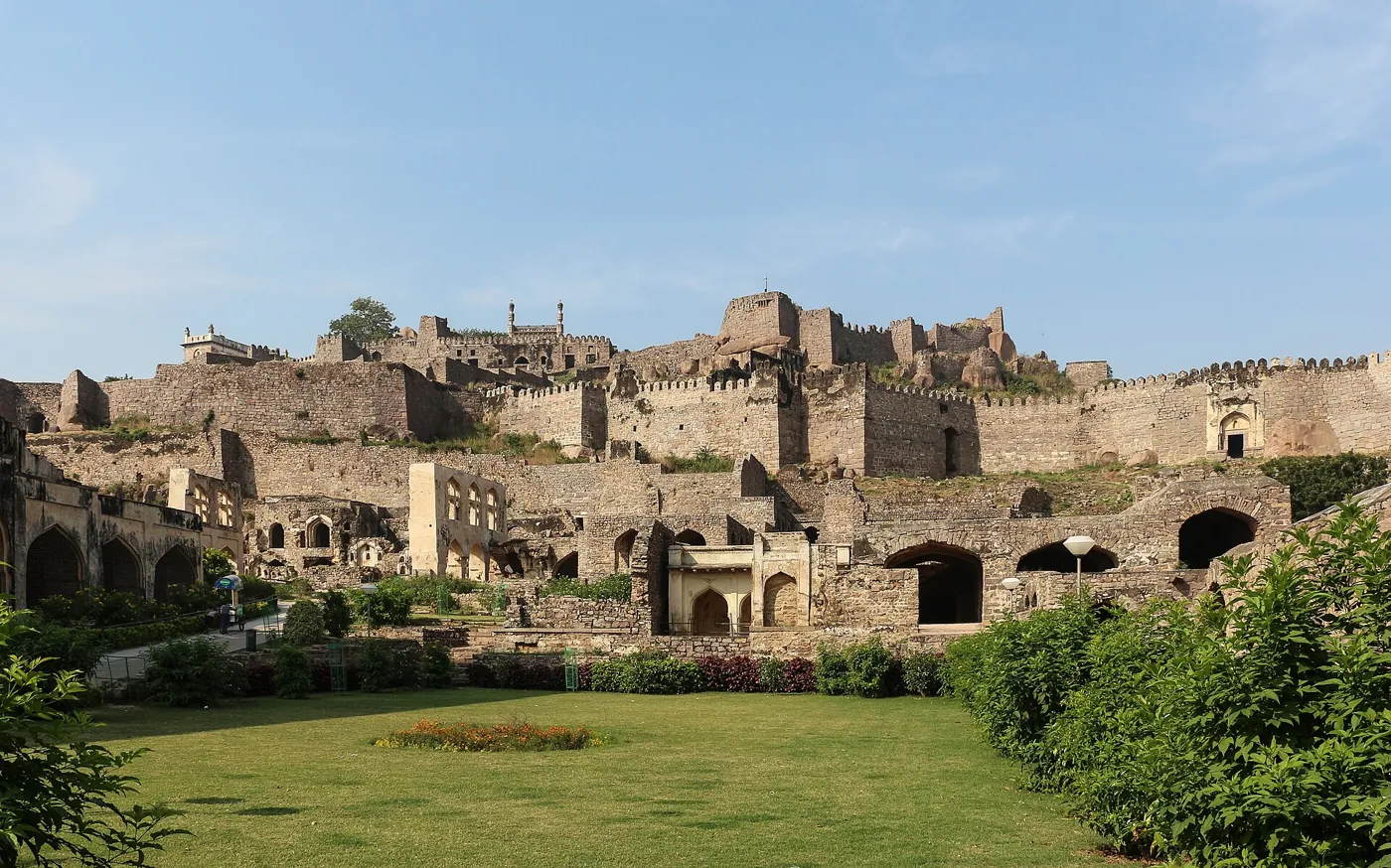
Golconda: fortified political centre in present-day Telangana.
Credit: Bernard Gagnon · CC BY-SA 3.0 · source

Dynastic tombs: material heritage of the Golconda sultans in Telangana.
Credit: Alaka123 · CC BY-SA 4.0 · source
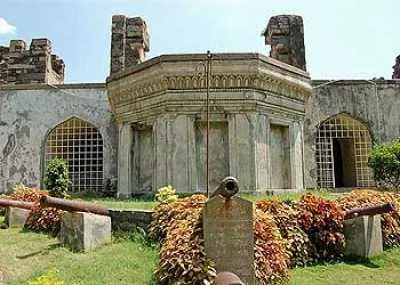
Kondapalli: strategic fort on the inland–coast corridor.
Credit: Quest prithvi · Public domain · source
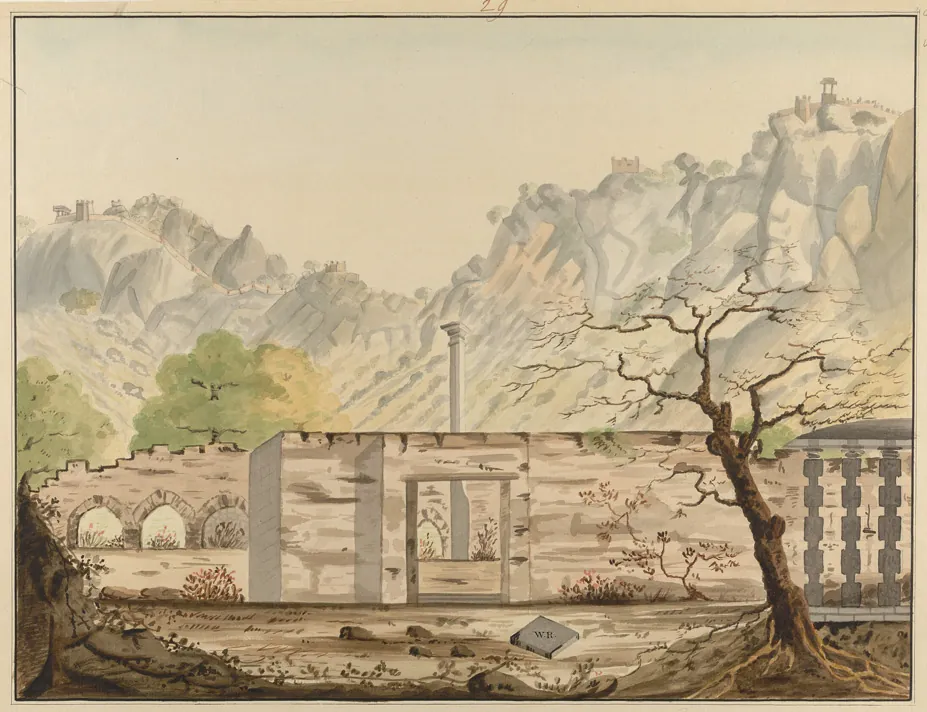
Kondaveedu: coastal Andhra stronghold captured by Ibrahim’s forces.
Credit: R., William (fl. 1784-1816) · Public domain · source

Machilipatnam: present-day setting of the historical port, not a reconstruction of its old harbour.
Credit: Satyach73 · CC BY-SA 4.0 · source
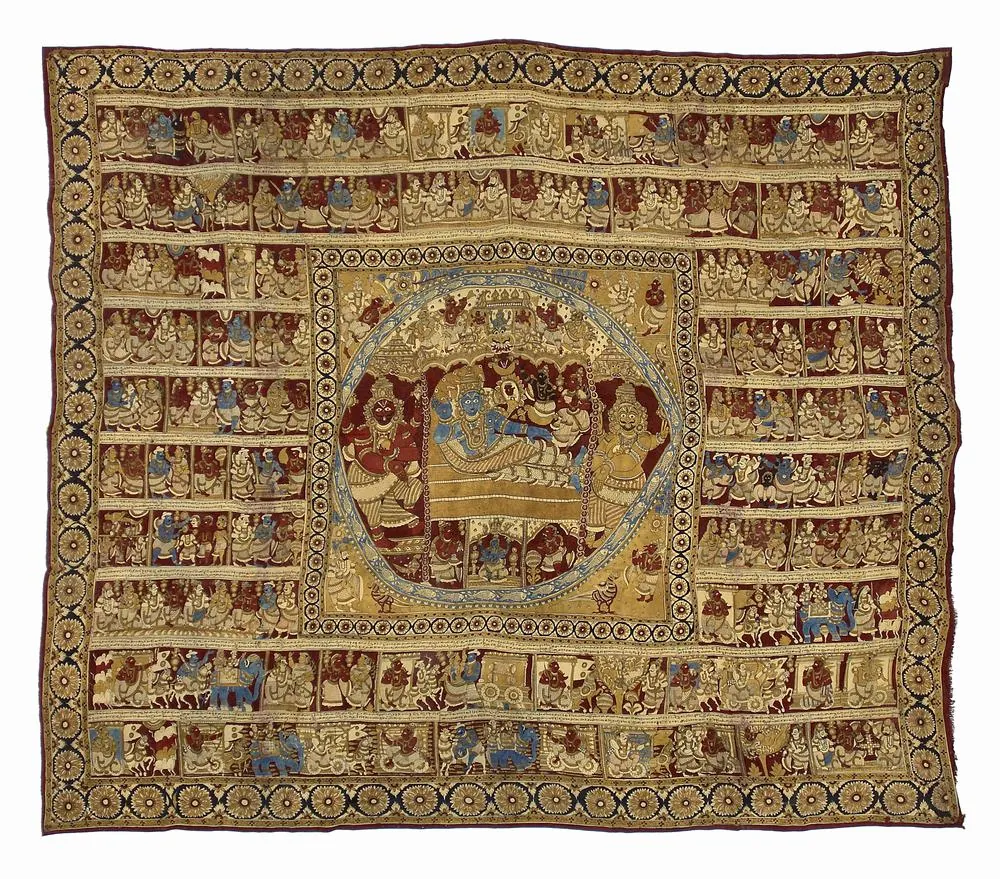
Kalamkari: textile craft illustrating a wider coastal production tradition, not a dated export consignment.
Credit: The British Museum · CC BY-SA 4.0 · source
1. Qutb Shahi state formation and coastal Andhra
Sultan Quli’s establishment of the Qutb Shahi dynasty is conventionally dated to 1518, although the separation from Bahmani authority was a process rather than an instantaneous administrative break. Golconda and Hyderabad, the dynasty’s principal political centres, are in present-day Telangana. Its importance to Andhra history rests on the extension of authority into the coastal country and the integration of that region with inland military and commercial networks. Coastal Andhra was not acquired as one uniform block: campaigns, competing claims and accommodation with local authorities shaped the kingdom’s changing reach.
Under Ibrahim Qutb Shah, whose reign ran from 1550 to 1580, the kingdom expanded its influence over important coastal centres and the country around Kondaveedu. Forts secured routes and revenue, while local officers and landed interests connected the sultan’s court with the countryside. Persianate monarchy therefore operated through a regional social environment rather than replacing it wholesale. For APPSC analysis, explain this as layered government: the court claimed sovereignty, but implementation depended on intermediaries, accounting practices and locally rooted power. Political incorporation and cultural interaction proceeded together without eliminating conflict.
- 1518 is the conventional foundation date, not the date of conquest of all coastal Andhra.
- Distinguish the Telangana capitals from the Andhra territories they governed.
- Use forts, revenue and regional service groups to explain state formation.
Timeline
1518
Conventional foundation of Sultan Quli’s Qutb Shahi dynasty.
1550–80
Ibrahim Qutb Shah’s reign: coastal expansion and Telugu literary patronage.
1605–06
Early Dutch Masulipatnam establishment; VOCsite lists Nizampatnam in 1606.
1611
English factory established at Masulipatnam; early English trade also at Nizampatnam.
1669
French factory established at Masulipatnam.
1687
Aurangzeb conquered Golconda, ending Qutb Shahi sovereignty.
1723 and 1731
Yanam’s official history distinguishes an initial French post and renewed authorisation.
1724
Asaf Jah I consolidated autonomous power after defeating Mubariz Khan.
1753
Salabat Jang assigned coastal revenues for Bussy’s French force.
1759
Forde captured Masulipatnam, weakening French coastal power.
12 August 1765
Shah Alam II granted the Company an imperial farman for the Northern Circars.
12 November 1766
Nizam Ali Khan’s treaty recognised Company claims, subject to obligations.
1800
Subsidiary treaty transferred the Ceded Districts to finance the Company force.
1800–07
Munro served as Principal Collector in the Ceded Districts.
2. Masulipatnam: textiles, merchants and the sea
Masulipatnam, now Machilipatnam in Andhra Pradesh, was a major commercial outlet of the Golconda kingdom. Its importance came from connections with textile-producing settlements, inland markets and shipping across the Bay of Bengal and beyond. Cotton cloth, including dyed and printed varieties, was central to European procurement, but trade involved Asian merchants and shipping networks that predated the companies. The coast supplied goods wanted in Southeast Asian markets as well as in Europe. Consequently, the port should be understood as a junction in several trading circuits, not simply as a European gateway into an isolated region.
The commercial chain joined cultivators, spinners, weavers, dyers, brokers, financiers and exporters. Advances and contracts could organise production for distant buyers, while customs and permissions made commerce a source of political income. Neither the sultan nor a foreign company controlled every stage. Merchants negotiated with officials, and producers faced changing demands for quantity, design and delivery. Company records illuminate these negotiations but privilege the buyer’s perspective. A balanced economic answer asks who supplied credit, who bore production risks and how political disturbances affected trade, rather than assuming that export growth benefited everyone equally.
- Masulipatnam and Machilipatnam name the same port.
- Factory meant a trading establishment with agents and warehouses, not a mechanised mill.
- Textile procurement linked coastal workshops to inland finance and overseas demand.
- European entry expanded competition within existing Asian commerce.
From licensed commerce to a territorial revenue state
- 1. Existing textile production and Asian trade attract European buyers.
- 2. Indian rulers authorise factories; brokers and advances connect companies to producers.
- 3. Succession struggles and European rivalry create demand for paid military assistance.
- 4. Coastal revenue assignments help maintain forces; military victories alter bargaining power.
- 5. Imperial farmans and treaties strengthen Company territorial claims in 1765–66 and 1800.
- 6. Collectors, surveys and revenue settlements turn claims into everyday colonial administration.
3. Telugu patronage within a multilingual kingdom
Qutb Shahi cultural life combined Persian and Dakhni traditions with support for Telugu literary activity. Ibrahim Qutb Shah is especially associated with Telugu patronage and appears in Telugu literary memory as Malikibharama. Addanki Gangadhara dedicated his Tapatisamvaranopakhyanamu to him, providing a concrete literary example of this relationship. Patronage was also exercised by officers and other influential households, so the court was one node in a wider network. Such evidence challenges any simple equation between a dynasty’s religious identity and the language or literary tradition it could support.
Patronage served several purposes: it rewarded learning, advertised generosity and situated rulers within regional conventions of kingship. Telugu expertise was useful to a government ruling Telugu-speaking populations, but literature cannot be reduced to administrative convenience alone. Poets negotiated honour, livelihood and aesthetic ambition through their dedications. At the same time, a celebrated dedication does not demonstrate equal access to resources across society. In a mains answer, connect multilingual literary exchange to political accommodation while preserving differences among Persian courtly production, Telugu narrative poetry, devotional composition and performance traditions transmitted beyond the royal court.
- Ibrahim’s Telugu patronage is distinct from Muhammad Quli’s association with the founding of Hyderabad.
- Gangadhara’s Tapatisamvaranopakhyanamu is a specific example of a Telugu dedication.
- Cultural interaction did not erase political competition or social hierarchy.
| Place or region | Power or figure | Chronological anchor | Significance or caution |
|---|---|---|---|
| Masulipatnam | Qutb Shahis and Asian merchants | Sixteenth–seventeenth centuries | Textile port integrated with inland production and overseas commerce. |
| Masulipatnam | Dutch company | 1605–06 | VOCsite uses 1605; alternative chronologies use 1606. |
| Masulipatnam | English company | 1611 | A commercial factory, not immediate territorial sovereignty. |
| Nizampatnam | Dutch and English companies | Dutch listing: 1606; English trade: 1611 | Petapoeli or Pettapolli in older records; not an exclusively Dutch station. |
| Bheemunipatnam | Dutch company | Seventeenth century | Northern coastal establishment; also written Bimilipatnam. |
| Masulipatnam | French company | 1669 | Commercial foothold preceded eighteenth-century military expansion. |
| Yanam | French company | 1723; renewed permission 1731 | Now in Puducherry; initial establishment and later occupation differ. |
| Northern Circars | Bussy, Forde, Shah Alam II and Nizam Ali | 1753; 1759; 1765–66 | Revenue assignment, military victory, imperial grant and treaty are distinct stages. |
| Ceded Districts | Nizam Ali Khan and Thomas Munro | 1800; 1800–07 | Subsidiary-force financing followed by direct revenue administration. |
4. Kshetrayya and Ramadasu: composition, performance and memory
Kshetrayya is conventionally placed in the seventeenth-century Telugu cultural world and associated with Muvva, now Movva in Andhra Pradesh. The padams attributed to him commonly address Muvva Gopala, a form of Krishna, and use the language of love, longing and intimate disagreement. Their literary voice, musical treatment and expressive possibilities made them important in dance and performance repertoires. His association with the Qutb Shahi age belongs in a regional cultural account, but precise itineraries, court visits and claims that every surviving padam had one author require caution.
Bhakta Ramadasu, remembered as Kancherla Gopanna, is associated with Rama devotion, the Dasarathi Satakamu and devotional songs. The received account connects his service as a revenue officer, expenditure on the Bhadrachalam temple and imprisonment under Abul Hasan Qutb Shah, also called Tana Shah. Bhadrachalam and Golconda are in present-day Telangana. The story that Rama and Lakshmana personally repaid the ruler and obtained Gopanna’s release is devotional tradition, not an independently established transaction. Historical study can respect its religious significance while distinguishing evidence for cultural influence from miraculous episodes and disputed biographical details.
- Kshetrayya: padams, Muvva Gopala and expressive performance.
- Ramadasu: Rama devotion, kirtanas and the Dasarathi Satakamu.
- Kamath’s 2019 study challenges the conventional single-author biography of Kshetrayya.
- Avoid exact song totals, disputed life dates and precise imprisonment durations.
5. Dutch, English and French factories on the Andhra coast
The Dutch East India Company established a Masulipatnam post in the opening years of the seventeenth century: VOCsite dates it to 1605, while 1606 also appears in historical chronologies. Its listing separately dates Petapoeli, identified with Nizampatnam, to 1606. The Dutch also maintained an establishment at Bheemunipatnam, north of Visakhapatnam, which linked them to the northern coastal economy. The English established a Masulipatnam factory in 1611 and also traded at Nizampatnam. These overlapping networks caution against assigning each port permanently and exclusively to a single European power.
The French established a factory at Masulipatnam in 1669. At Yanam, the Government of Puducherry’s history records an initial post in 1723, abandonment in 1727 and authorisation for a loge in 1731; its extended narrative also mentions a later reoccupation. The safest chronology distinguishes initial establishment from renewed permission and subsequent possession instead of treating one date as every stage. Yanam is today part of the Union Territory of Puducherry, geographically surrounded by the Andhra coastal region. Factories depended initially on Indian permissions, commercial intermediaries and access to established production centres.
- Dutch: associate Masulipatnam, Nizampatnam and Bheemunipatnam with their coastal network.
- English: 1611 anchors the Masulipatnam establishment; Nizampatnam was also an early station.
- French: distinguish Masulipatnam, 1669, from Yanam’s eighteenth-century development.
- Yanam’s current administrative identity is Puducherry, not Andhra Pradesh.
6. From Golconda’s fall to the rise of the Asaf Jahis
Aurangzeb’s conquest of Golconda in 1687 ended Qutb Shahi sovereignty and incorporated its territories into the Mughal imperial structure. It did not establish Asaf Jahi rule immediately. The intervening Mughal phase matters because later Nizams derived offices, titles and claims of legitimacy from imperial institutions. Warfare and the difficulty of governing the Deccan from the imperial centre strengthened the practical role of provincial commanders and revenue authorities. Thus, the eighteenth-century emergence of Hyderabad must be explained through the weakening of effective central supervision, not as a direct dynastic succession in 1687.
Nizam-ul-Mulk, Asaf Jah I, consolidated autonomous authority in 1724 after defeating Mubariz Khan at Shakarkhelda. This is the conventional founding date of Asaf Jahi rule. His regime retained a nominal relationship with the Mughal emperor while controlling regional affairs in practice. After his death in 1748, succession struggles gave European companies opportunities to intervene in Deccan politics. French support for claimants and Bussy’s military presence made access to land revenue an urgent political question. The connection between armed service and fiscal assignments explains why coastal territories became bargaining assets for powers based inland.
- 1687: Qutb Shahi sovereignty ends; 1724: Asaf Jahi autonomy consolidates.
- Asaf Jah I and Abul Hasan Qutb Shah belonged to different dynasties.
- De facto autonomy could coexist with nominal imperial allegiance.
- Do not confuse the foundation of the Asaf Jahi state with later British subsidiary control.
7. The Northern Circars: military occupation and layered legal claims
In 1753 Salabat Jang assigned coastal revenues to support the French force associated with Bussy. The frequently used phrase French acquisition of the Northern Circars must therefore be read in its military-financial setting, not as a modern transfer of a uniformly administered province. The 1753 assignment is generally described as four Circars; lists of the wider Northern Circars commonly include Chicacole, Rajahmundry, Ellore, Mustafanagar or Kondapalli, and Guntur. Their historical boundaries do not coincide neatly with present-day districts. Distinguish the revenue assignment from later British claims to the wider group.
Colonel Francis Forde’s capture of Masulipatnam in 1759 broke the French strategic position on this coast. Military success, however, did not by itself settle every claim to sovereignty or revenue. Shah Alam II issued the Company an imperial farman dated 12 August 1765, and Nizam Ali Khan recognised the arrangement through the treaty of 12 November 1766, with financial and military obligations. Further negotiation followed in 1768, and Guntur came under Company control only later, in 1788. The sequence demonstrates overlapping imperial, regional and military authority rather than one complete transfer on a single day.
- 1753: French military maintenance drew on coastal revenues.
- 1759: Forde captured Masulipatnam.
- 12 August 1765: Shah Alam II’s farman supplied an imperial title.
- 12 November 1766: the treaty secured the Nizam’s recognition; implementation remained uneven.
8. The 1800 treaty and the making of the Ceded Districts
The Ceded Districts resulted from a different transaction from the acquisition of the Northern Circars. Under Nizam Ali Khan, Asaf Jah II, Hyderabad’s subsidiary relationship with the Company was strengthened in 1798 and recast by the treaty of 1800. The Nizam ceded territories to meet the expense of the subsidiary force, replacing dependence on cash payments with a territorial revenue base. Much of the land concerned had come to him through the Mysore settlements of 1792 and 1799. Military protection therefore carried a fiscal cost that enlarged Company territory while narrowing the Nizam’s practical independence.
The cession is closely associated with Rayalaseema, but its original territorial extent should not be equated with the boundaries of today’s Andhra Pradesh districts. Bellary, now Ballari in Karnataka, was an important part of the historical administrative setting, and local arrangements and boundaries changed subsequently. Nor did the 1800 agreement transfer every territory later called Kurnool in precisely its later administrative form. For examination answers, use the broad regional identification and the treaty’s military-financial logic rather than an anachronistic district list. Company administration then sought to convert acquired claims into regular, enforceable revenue.
- Northern Circars and Ceded Districts arose from separate agreements in different periods.
- The 1800 cession financed subsidiary military obligations.
- Distinguish the 1798 strengthening of the alliance from the 1800 territorial settlement.
- Rayalaseema is the principal Andhra regional association, not an exact historical boundary map.
9. Munro’s ryotwari: direct settlement and its limitations
Thomas Munro served as Principal Collector of the Ceded Districts from 1800 to 1807. His administration is associated with curbing the power of poligars and developing ryotwari revenue arrangements through direct dealings with cultivators. In principle, the individual ryot was the revenue-paying holder, rather than a zamindar permanently assessed for a large estate. Survey, estimates of productive capacity and official records supported the assessment process. Munro did not invent direct assessment without predecessors: his earlier experience and the wider work of Company officials helped shape an evolving administrative system.
Direct settlement did not mean low taxation, freedom from intermediaries in everyday life or modern absolute ownership. Village officers, moneylenders and revenue personnel continued to affect cultivators’ bargaining position, while official estimates could exceed what uncertain harvests could sustain. Munro’s favourable regional memory is evidence of a remembered administrative relationship, not proof that every assessment was equitable. A strong conclusion connects political conquest with fiscal penetration: the Company wanted dependable income, and ryotwari expanded its knowledge of landholders and cultivation. Evaluate the system through both its stated recognition of cultivators and the burdens of colonial revenue demand.
- Munro’s Ceded Districts tenure: 1800–07.
- Ryotwari’s defining principle was settlement with the individual cultivator.
- Contrast it with zamindari settlement without claiming all coastal land had one tenure.
- Assess implementation, revenue pressure and agrarian risk alongside administrative intention.
Real-world case studies
Masulipatnam: the changing meaning of a factory
Compare the English factory of 1611 with Forde’s capture of the town in 1759. The first depended on commercial permission within an Indian kingdom; the second belonged to an armed struggle over strategic access and political influence. Their separation by nearly a century and a half is important: territorial conquest was not a legal consequence automatically contained in the first trading permit. To explain the transition, connect company finance and military capacity with Deccan succession disputes and alliances involving Indian rulers.
Ramadasu: reading a devotional narrative historically
The received account of Gopanna’s imprisonment and divine rescue preserves powerful themes of devotion, just rule and the relationship between sacred obligation and public money. The historian should identify Rama and Lakshmana’s repayment as tradition while discussing the wider association of Ramadasu with Bhadrachalam’s temple and Telugu devotional song. Avoid converting a frequently repeated prison duration or exact payment into an established archival fact. Bhadrachalam’s present location in Telangana does not diminish the circulation of this repertoire across Telugu-speaking regions.
Munro: recognition of the ryot and expansion of state power
A direct settlement could be presented as protecting the cultivator from a revenue-paying zamindar, yet it also gave the colonial administration more immediate access to agrarian income. These outcomes are not mutually exclusive. Compare the institutional principle with the cultivator’s practical position under uncertain harvests, assessment demands and dependence on credit. Munro’s remembered personal accessibility and the structural pressures of Company rule should be examined separately. This approach produces a stronger evaluation than either uncritical celebration or the assumption that all revenue arrangements operated identically.
Previous year questions
No source-linked PYQ is available here yet. Use the practice questions below.
Practice questions
Practice MCQ 1 · Easy
Which sequence correctly traces political change in the Deccan?
- Asaf Jahi rise → Qutb Shahi foundation → Golconda’s fall
- Qutb Shahi foundation → Golconda’s fall → Asaf Jahi rise
- Golconda’s fall → Asaf Jahi rise → Qutb Shahi foundation
- Qutb Shahi foundation → Asaf Jahi rise → Golconda’s fall
Practice MCQ 2 · Easy
Which pair correctly matches a cultural figure and a principal devotional association?
- Kshetrayya — Muvva Gopala
- Ramadasu — exclusive authorship of Kshetrayya’s padams
- Addanki Gangadhara — the 1765 farman
- Ibrahim Qutb Shah — the 1800 treaty
Practice MCQ 3 · Moderate
Consider the statements: 1. The English Masulipatnam factory dates to 1611. 2. Nizampatnam was connected only with Dutch trade. 3. A company factory originally meant a trading establishment. Which are correct?
- 1 and 2 only
- 2 and 3 only
- 1 and 3 only
- 1, 2 and 3
Practice MCQ 4 · Moderate
Which statement best distinguishes stages in the acquisition of the Northern Circars?
- Bussy issued Shah Alam II’s farman in 1753.
- The 1800 cession was the same transaction as the 1765 farman.
- Forde’s victory in 1759 immediately settled every regional revenue claim.
- The imperial farman of 1765 and the Nizam’s treaty of 1766 supplied different layers of recognition.
Practice MCQ 5 · Moderate
Which statement about Yanam is the most accurate?
- It is presently a district of Andhra Pradesh.
- Its official history records an initial French post in 1723 and renewed authorisation in 1731.
- It was the seat of Sultan Quli’s government in 1518.
- Its French factory was identical with the English factory of 1611.
Practice MCQ 6 · Moderate
Consider the statements: 1. The 1800 cession helped finance a subsidiary force. 2. Munro served in the Ceded Districts during 1800–07. 3. Ryotwari guaranteed a permanently fixed demand on a zamindar. Which are correct?
- 1 and 2 only
- 2 and 3 only
- 1 and 3 only
- 1, 2 and 3
Mains practice · Explain how Qutb Shahi rule connected coastal Andhra’s commercial economy with a multilingual cultural order.
- Locate the Telangana capitals and explain the gradual incorporation of Andhra coastal territories.
- Connect Masulipatnam’s textile exports with Asian merchants, credit and production networks.
- Use Ibrahim Qutb Shah and Gangadhara’s dedication as specific evidence of Telugu patronage.
- Discuss Kshetrayya’s attributed padams and Ramadasu’s devotional repertoire without treating disputed biography as certain.
- Conclude that interaction across languages and religions coexisted with hierarchy and political conflict.
Mains practice · The Company’s acquisition of Andhra territories was a sequence of military and fiscal bargains rather than a single conquest. Discuss with reference to 1753–1800.
- Begin with Bussy’s force and the revenue assignment of 1753.
- Explain the significance and limits of Forde’s capture of Masulipatnam in 1759.
- Separate Shah Alam II’s farman of 12 August 1765 from the Nizam’s treaty of 1766.
- Mention subsequent arrangements and Guntur’s later transfer to avoid assuming instantaneous control.
- Contrast the Northern Circars process with the 1800 cession for subsidiary-force maintenance.
- Conclude with the interaction of military power, layered legitimacy and revenue needs.
Mains practice · Assess Munro’s ryotwari administration in the Ceded Districts, distinguishing its institutional principle from its agrarian consequences.
- Identify the 1800 cession and Munro’s tenure in 1800–07.
- Explain direct settlement with the ryot and contrast it with zamindari revenue responsibility.
- Relate administrative consolidation to the curbing of poligar power and improved land records.
- Evaluate assessment pressures, uncertain harvests and continuing dependence on local officials and credit.
- Distinguish Munro’s favourable regional memory from evidence about the system’s distributional effects.
Further reading
- https://teluguhistory.org/en/dynasties/qutb-shahis/
- https://www.vocsite.nl/geschiedenis/handelsposten/coromandel/
- https://yanam.gov.in/history/
- https://journals.sagepub.com/doi/10.1177/0019464619852264
- https://archive.org/stream/cu31924081223376/cu31924081223376_djvu.txt
- https://teluguhistory.org/en/eras/nizams-british/
- https://teluguhistory.org/en/people/thomas-munro/
Preparing for APPSC Group 1 or Group 2? See the APPSC Groups coaching course at Pragnya IAS Academy for fees, batches and registration.
Long study hours taking a toll? Try the free breathing exercise and self check-in in Pragnya’s student wellness programme for UPSC aspirants.