

Hinduja Hospital's Medical Relief Camp at Bhuj after the 2001 Gujarat Earthquakes
Credit: Vm1207 · CC BY-SA 4.0 · source

ഓഗസ്റ്റ് 15 നു മലപ്പുറം മേൽമുറിയിലുണ്ടായ വെള്ളപ്പൊക്കം
Credit: Akbarali · CC BY-SA 3.0 · source
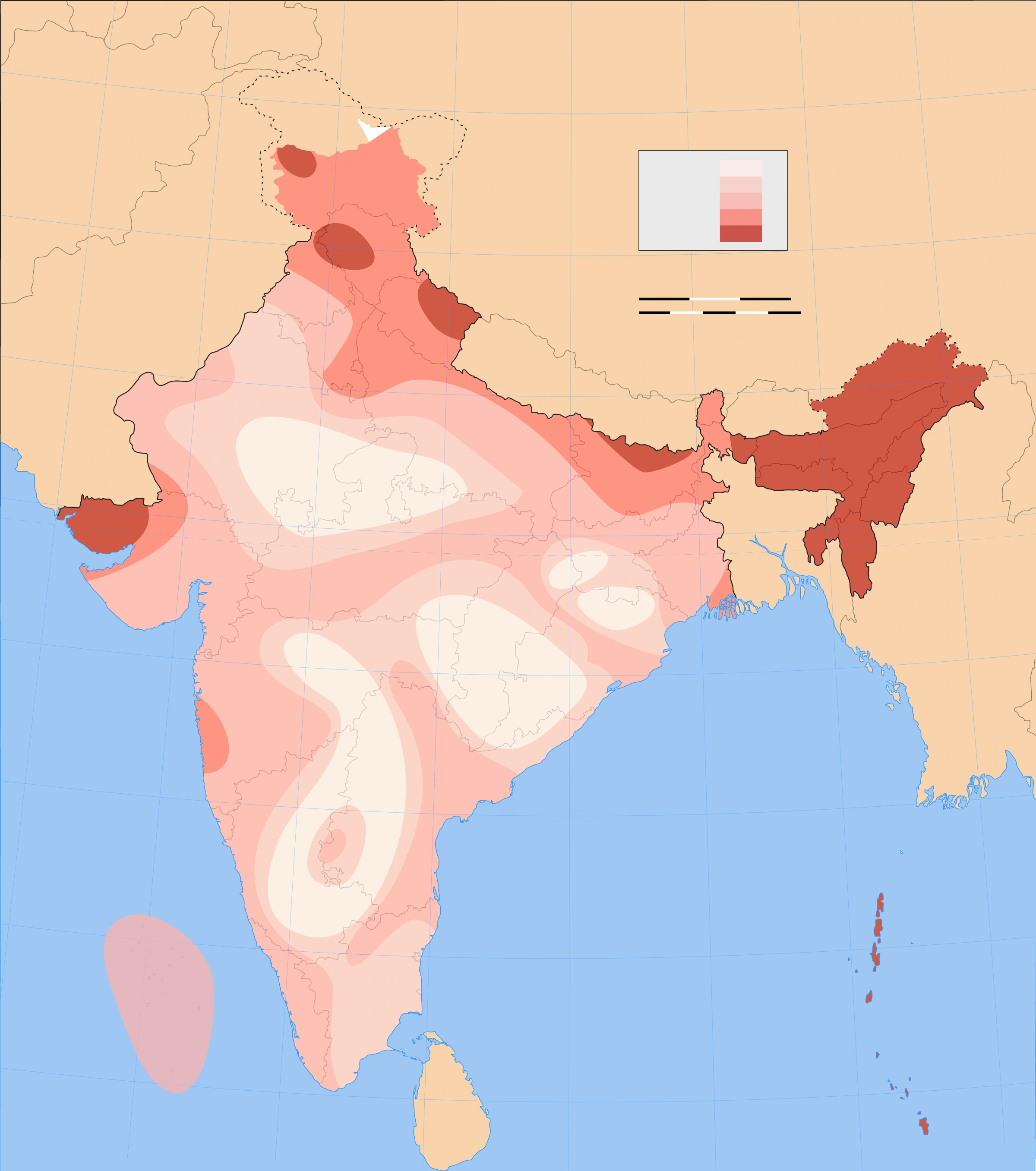
Map study
India seismic reference zones: compare the Himalayan belt, northeast and peninsula. Consult current BIS and official local guidance for engineering or safety decisions.
- Read the source legend and reference date before interpreting the map.
- Use spatial patterns to support topic revision; verify current official boundaries, designations and warnings separately.
Credit: Planemad · CC BY-SA 3.0 · sourceConverted to WebP on an opaque white background; proportionally resized without cropping. Original cartography and legend retained.
1. Meaning and place in the disaster cycle
Build Back Better, commonly abbreviated as BBB, is the use of recovery, rehabilitation and reconstruction after a disaster to increase resilience by integrating disaster risk reduction into the restoration of infrastructure and societal systems and the revitalisation of livelihoods, economies and the environment. This UNDRR formulation makes BBB wider than stronger buildings: a structurally safe house is insufficient if its occupants lose employment, cannot access healthcare or remain exposed to flooding.
The disaster management cycle includes prevention, mitigation, preparedness, response and recovery. BBB connects recovery with prevention and mitigation, turning lessons from an actual disaster into corrective action. Recovery restores and improves livelihoods, health, services and assets; rehabilitation re-establishes basic services and facilities; reconstruction involves medium- and long-term rebuilding. These activities overlap rather than occur in a rigid sequence.
The counterfactual is rebuilding risk: replacing damaged assets in the same hazardous locations, using the same deficient designs and reproducing unequal access to resources. BBB instead asks what failed, who suffered disproportionately, what future hazards are plausible and which changes can prevent comparable losses. Recovery planning should therefore begin before disasters, when institutional roles, financing arrangements and safety requirements can be agreed without emergency pressures.
- Build back safer: reduce structural, locational and systemic risks.
- Build back inclusively: address unequal vulnerability and barriers to assistance.
- Build back sustainably: protect ecosystems and account for future climate conditions.
Timeline
2001
Gujarat earthquake reconstruction prompts major institutional and housing-recovery initiatives.
2005
India enacts the Disaster Management Act.
2015
Sendai Framework explicitly incorporates Build Back Better into Priority 4.
2018–2019
Kerala’s flood recovery advances resilience-oriented rebuilding; India’s revised National Disaster Management Plan is issued in 2019.
2. International framework and Indian policy architecture
The Sendai Framework, adopted in March 2015 for the period 2015–2030, places BBB within Priority 4: enhancing disaster preparedness for effective response and building back better in recovery, rehabilitation and reconstruction. The other priorities concern understanding risk, strengthening risk governance and investing in resilience. BBB thus depends on measures across the framework, not only on post-disaster construction.
The Disaster Management Act, 2005 provides India’s statutory framework for disaster management, including rehabilitation and reconstruction. The National Policy on Disaster Management, 2009 and National Disaster Management Plan, 2019 support a shift from relief-centred administration towards prevention, preparedness and resilience. NDMA sets national policy and guidelines, while state authorities, departments, district administrations and local governments have crucial planning and implementation responsibilities.
A Post-Disaster Needs Assessment distinguishes damage to physical assets, losses in economic flows and recovery needs. Recovery needs are not identical to asset replacement costs because safer reconstruction and livelihood restoration may require additional investment. Technical standards include the National Building Code of India, 2016 and applicable BIS standards such as IS 1893 for earthquake-resistant design criteria and IS 13920 for ductile detailing of reinforced concrete structures. Standards become effective through incorporation into regulations, skilled construction, supervision and enforcement.
- State Disaster Response Fund and National Disaster Response Fund assistance is governed by prescribed relief norms; it should not be treated as automatic financing for all long-term reconstruction.
- Recovery financing may combine approved reconstruction support, departmental budgets, housing programmes, insurance and multilateral assistance, subject to their eligibility rules.
Risk-informed recovery process
- 1. Prepare recovery institutions, data and financing arrangements before disasters
- 2. Assess damage, losses, needs and differential vulnerability
- 3. Agree recovery priorities through community consultation
- 4. Select safer locations, designs and livelihood measures
- 5. Mobilise finance and implement with technical support
- 6. Audit quality, monitor outcomes and update risk plans
3. Translating BBB into reconstruction decisions
Risk-informed siting comes first. Multi-hazard assessments should examine floodplains, unstable slopes, storm-surge zones, earthquake risks and cascading failures. Climate projections matter because historical rainfall or flood levels may underestimate future risk. Relocation can be necessary where risk cannot reasonably be reduced, but it should follow transparent assessment and meaningful consultation, with secure tenure, basic services and access to livelihoods.
Resilient construction requires appropriate design, quality materials, trained masons and independent checks. Hospitals, schools, water systems, electricity networks and communication facilities deserve priority because their failure multiplies losses. Retrofitting viable structures may be preferable to demolition. Reconstruction must also address functional continuity through backup power, redundant routes, safe equipment and maintenance arrangements.
Economic and social recovery includes restoring tools, livestock, market access, working capital, documentation, education and healthcare. Assistance should recognise tenants, informal workers, women-headed households, older persons and persons with disabilities rather than rely exclusively on formal property ownership. Accessible shelters and public buildings, grievance mechanisms and transparent beneficiary lists help prevent exclusion.
Environmental recovery requires safe debris handling, protection of wetlands and drainage channels, slope stabilisation and restoration of suitable coastal ecosystems. Nature-based solutions can complement engineered protection but cannot replace evacuation systems or structurally safe buildings. Recovery should evaluate whole-life costs: a cheaper initial design may impose higher maintenance expenses and repeated disaster losses.
- Use staged housing grants linked to verified safety milestones, while providing technical assistance to poorer households.
- Restore interconnected services together: housing without water, transport or schools is incomplete recovery.
- Publish risk maps, expenditure and construction progress in accessible formats.
| Dimension | Replacement-oriented recovery | Build Back Better |
|---|---|---|
| Location | Rebuild on the existing site without reassessment | Evaluate multi-hazard exposure and feasible alternatives |
| Construction | Restore the previous specification | Apply appropriate safety standards and quality assurance |
| Livelihoods | Focus mainly on physical assets | Restore income, markets, skills and social protection |
| Inclusion | Prioritise documented property owners | Provide pathways for tenants, landless people and vulnerable groups |
| Performance | Count assets and expenditure | Measure reduced risk and sustained recovery |
4. Implementation dilemmas and safeguards
Speed and safety can conflict. Prolonged temporary shelter undermines health and livelihoods, but hurried rebuilding may lock in unsafe locations for decades. A phased approach can restore essential services quickly while reserving major investment decisions for adequate assessment. Pre-approved resilient designs, framework contracts and trained local technical teams reduce delays without removing scrutiny.
Owner-driven reconstruction can preserve local preferences, improve accountability and generate employment. However, cash transfers alone do not ensure safe construction. Households require clear designs, engineering advice, reliable material supply and inspections. Landless families and tenants need separate solutions because assistance tied to land titles can deepen inequality.
Relocation also creates a safety–livelihood trade-off. Moving fishing communities far inland may reduce tsunami exposure but increase travel costs and disrupt access to landing sites. Similarly, distant urban resettlement can sever employment networks. Recovery decisions should therefore compare in-situ risk reduction with relocation and assess social costs, not just physical exposure.
BBB is vulnerable to fragmented departmental mandates, weak municipal capacity, contractor-driven priorities and politically visible projects that neglect maintenance. Safeguards include participatory planning, social audits, independent technical audits, transparent procurement and time-bound grievance redress. Reconstruction should not become a pretext for dispossession or environmentally damaging infrastructure.
- Measure outcomes through safer occupancy, restored incomes and service reliability, not merely expenditure or buildings completed.
- Disaggregate results by gender, disability, income and tenure status.
- Reassess residual risk: no reconstruction programme can eliminate every hazard.
5. Lessons for India and an exam-ready approach
The 2001 Gujarat earthquake illustrates how a major disaster can trigger institutional and construction-sector reform. The Gujarat State Disaster Management Authority was established in February 2001. Reconstruction combined substantial owner-driven housing assistance with technical support, training and urban planning interventions. The lesson is that household agency must be supported by public institutions and safety assurance.
After the 2018 Kerala floods and landslides, the Rebuild Kerala Initiative sought a resilient recovery rather than simple asset replacement. Its policy direction linked reconstruction with water management, resilient roads and institutional reform. The case highlights why flood recovery needs basin-scale thinking: rebuilding an individual road or bridge is insufficient if drainage, catchment changes and upstream–downstream relationships are ignored.
For a GS-III answer, organise BBB around risk-informed location, resilient design, livelihood restoration, inclusion, ecosystem recovery and accountable governance. Distinguish intended reforms from demonstrated outcomes. A credible way forward combines pre-disaster recovery planning, local technical capacity, flexible but auditable finance and public monitoring. The ultimate test is whether the next hazard produces fewer casualties, smaller losses and quicker recovery.
- Suggested indicators: compliance with safety standards, duration of service disruption, livelihood recovery time and inclusion of vulnerable households.
- Core conclusion: recovery expenditure should create a resilience dividend rather than reproduce pre-disaster vulnerability.
Real-world case studies
Gujarat earthquake, 2001
Owner-driven housing reconstruction was supported by financial assistance and technical guidance. Urban rebuilding also involved planning interventions. The transferable lesson is to combine household choice with enforceable safety standards, institutional coordination and assistance for households unable to navigate reconstruction independently.
Kerala floods, 2018
The Rebuild Kerala Initiative promoted resilient recovery across sectors rather than isolated repairs. Its relevance lies in integrating infrastructure reconstruction with water management and governance reform. Assessing actual success requires monitoring implementation, maintenance and subsequent risk reduction.
Previous year questions
UPSC Mains 2020 · GS-III
Discuss the recent measures initiated in disaster management by the Government of India departing from the earlier reactive approach.
- Explain the shift from response and relief towards prevention, mitigation and preparedness.
- Discuss institutions, risk-informed planning, early warning and capacity building.
- Connect resilient recovery and Build Back Better with the Sendai Framework.
- Identify implementation gaps in local capacity, enforcement and finance.
Practice questions
Practice MCQ 1
Build Back Better is explicitly associated with which priority of the Sendai Framework?
- A. Priority 1: Understanding disaster risk
- B. Priority 2: Strengthening disaster risk governance
- C. Priority 3: Investing in disaster risk reduction for resilience
- D. Priority 4: Enhancing preparedness and building back better in recovery, rehabilitation and reconstruction
Practice MCQ 2
Consider the following statements: 1. Recovery needs are necessarily equal to the replacement value of damaged assets. 2. Livelihood restoration forms part of Build Back Better. 3. Relocation is mandatory in every BBB programme. Which statements are correct?
- A. 1 and 2 only
- B. 2 only
- C. 2 and 3 only
- D. 1, 2 and 3
Practice MCQ 3
Which intervention best demonstrates Build Back Better following an urban flood?
- A. Replacing all drains at their previous capacity without assessment
- B. Reconstructing houses rapidly while postponing water supply indefinitely
- C. Combining risk-informed housing, catchment-sensitive drainage and livelihood support
- D. Moving all low-income residents outside the city without consultation
Mains practice · “Build Back Better is a governance and development agenda, not merely a construction standard.” Discuss with reference to post-disaster recovery in India. Suggest safeguards against exclusion and the reproduction of risk. (250 words)
- Define BBB and connect it with Sendai Priority 4.
- Explain risk-informed siting, safe construction and continuity of essential services.
- Include livelihoods, tenure, disability access and ecosystem protection.
- Use Gujarat or Kerala as an illustration without assuming uniform success.
- Address speed–safety and relocation–livelihood trade-offs.
- Recommend community participation, technical audits, grievance redress and outcome monitoring.
Further reading
- UNDRR: Sendai Framework for Disaster Risk Reduction 2015–2030.
- UNDRR Terminology: Build back better.
- NDMA: National Disaster Management Plan, 2019.
- Government of India: Disaster Management Act, 2005, available on India Code.
- Bureau of Indian Standards: National Building Code of India, 2016.
- Government of Kerala: Rebuild Kerala Development Programme.
Preparing for UPSC Civil Services? Get classroom teaching, answer-writing evaluation and mentorship at Pragnya IAS Academy, Ashok Nagar — see why aspirants choose us for IAS coaching in Hyderabad.