
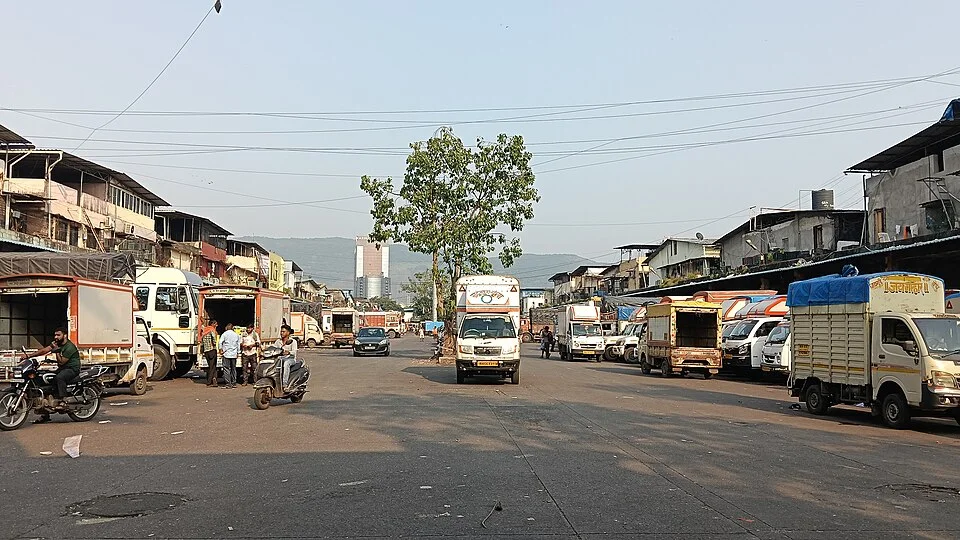
Fruit market at APMC Market, Turbhe, illustrating an Indian regulated agricultural market setting.
Credit: Sntshkumar750 · CC BY-SA 4.0 · sourceResized and converted to WebP; uncropped.
1. Meaning, constitutional position and original purpose
An APMC is a statutory committee established under a State agricultural marketing law to administer a notified market area and regulate transactions in specified agricultural produce. The committee manages a principal market yard and, where provided, sub-market yards. State legislation determines its composition, powers, revenue sources and relationship with the State Agricultural Marketing Board. Farmer representatives, traders and government nominees may participate, but there is no single uniform national institutional model.
The constitutional framework is important. Entry 14 of the State List concerns agriculture, and Entry 28 covers markets and fairs. Entry 33 of the Concurrent List covers trade and commerce in, and production, supply and distribution of, foodstuffs and specified agricultural raw materials. Agricultural marketing therefore involves overlapping constitutional considerations; it should not be reduced to the claim that every aspect belongs exclusively to one level of government.
Regulated markets developed to counter exploitative practices such as manipulated weighing, arbitrary deductions, delayed payments and collusion between village moneylenders and produce buyers. Small farmers often sell immediately after harvest because they need cash and lack storage. APMC regulation sought to replace opaque transactions with supervised auctions, standard weights, licensed intermediaries and enforceable payment arrangements.
- A mandi is a marketplace; an APMC is the statutory institution regulating the market under the applicable law.
- An APMC Act generally specifies notified commodities, market areas, licensing rules, permissible charges and dispute-resolution mechanisms.
Timeline
2003
The Union circulated a Model APMC Act to guide State agricultural marketing reforms.
2006
Bihar repealed its APMC legislation.
14 April 2016
e-NAM was launched to connect participating agricultural markets electronically.
2017
The Model Agricultural Produce and Livestock Marketing Act proposed a broader competitive marketing framework.
2020–2021
Three Union farm laws were enacted in 2020 and repealed in 2021.
2. How the regulated market system works
Under the traditional model, farmers bring produce to a regulated market yard, where licensed traders participate in bidding. Produce is inspected, auctioned, weighed and delivered, followed by settlement of payment. Commission agents, commonly called arhatiyas in northern India, may organise sales, connect farmers with buyers and provide informal credit. Their role differs across commodities and States, and they are not automatically the final purchasers of produce.
Market fees are statutory levies imposed under State legislation, while commission charges compensate intermediaries for specified services. These are distinct from each other and from other applicable levies. Rates, liability and the stage of collection vary. Although a buyer may legally pay a fee, part of its economic burden can be transmitted to farmers through lower bids or to consumers through higher prices. Market revenue is intended to support roads, auction platforms, sanitation, weighing facilities and other services.
In many traditional State frameworks, notified produce had to be traded through regulated arrangements, with restrictions on competing market channels. Reforms have progressively permitted private markets, direct purchase, electronic trading and other alternatives in several States. Therefore, neither compulsory mandi sale nor unrestricted outside-mandi trade can be assumed to apply uniformly across India.
MSP is an administered support price announced by the Union government for designated crops. Procurement is the actual purchase of produce by government agencies under relevant arrangements. Procurement may occur in APMC yards, but an ordinary private auction does not guarantee an MSP-linked price. Farmers’ realised prices depend on quality, demand, arrivals, bargaining power and access to procurement.
Typical regulated mandi transaction
- 1. Farmer brings produce to the market
- 2. Produce is inspected, graded or assayed
- 3. Eligible buyers submit bids
- 4. Sale is concluded and produce weighed
- 5. Applicable fees and service charges are recorded
- 6. Payment is settled and produce dispatched
3. Economic contribution and structural weaknesses
A functioning regulated market aggregates produce and attracts buyers, reducing the cost of searching for trading partners. Open auctions can generate reference prices for surrounding villages. Dispute settlement, verified weighing and payment supervision are particularly valuable where small producers face much larger buyers. Mandis also support transporters, labourers, processors and procurement agencies, making them important nodes in agricultural supply chains.
However, regulation can become an entry barrier. Restrictive licensing, limited trading space and entrenched relationships may protect existing traders rather than farmers. Where only a few buyers operate, oligopsony can emerge: numerous sellers face a small group of purchasers with substantial market power. Informal credit tied to compulsory sale through a particular intermediary can further weaken farmers’ freedom to choose buyers.
Infrastructure deficiencies also matter. Inadequate drying, grading, assaying, cold storage and scientific warehousing discourage quality-based pricing and increase losses. Long distances to market impose disproportionately high costs on farmers with small marketable surpluses. Multiple handling stages and overlapping charges may increase marketing costs without adding corresponding value.
Nevertheless, the entire gap between farm-gate and retail prices is not necessarily exploitation. Transport, processing, storage, spoilage risk and retail services involve genuine costs. Similarly, food inflation cannot be attributed to APMCs alone: weather shocks, seasonality, demand changes and trade policy also influence prices. The policy objective should be competitive, accountable markets rather than assuming either regulation or deregulation is sufficient by itself.
| Concept | Main function | Important distinction |
|---|---|---|
| APMC | Regulates agricultural markets under State law | Does not itself guarantee MSP |
| MSP | Announces a support price for designated crops | Announcement is not universal procurement |
| Government procurement | Purchases produce through designated agencies | May use mandi premises but is a separate operation |
| e-NAM | Enables electronic agricultural trading | Networks participating markets rather than replacing all APMCs |
| FPO | Aggregates farmers for business activities | Can improve bargaining power across different marketing channels |
4. Reform architecture: model laws, e-NAM and the farm laws
The Union circulated the Model APMC Act, 2003 to encourage State-level reforms, including private markets, direct marketing and a framework for contract farming. The Model Agricultural Produce and Livestock Marketing (Promotion and Facilitation) Act, 2017 proposed wider competition, unified licensing and a single-point market-fee approach. Model legislation is advisory: its provisions become operative only through the appropriate State legislative or administrative action.
e-NAM was launched in 2016 as a pan-India electronic trading portal connecting participating agricultural markets. The Small Farmers’ Agribusiness Consortium is its lead implementing agency under the Union agriculture ministry. The platform aims to improve transparent bidding, price information and electronic payment. It does not abolish APMCs, and uploading mandi prices is not equivalent to achieving fully integrated national trade.
Effective remote trading requires reliable assaying, standardised grades, trusted delivery, accessible logistics and enforceable settlement. State reforms facilitating electronic trading, unified licensing and single-point market-fee collection support integration. Without these complementary arrangements, a digital platform may reproduce a local auction electronically without substantially expanding the buyer base.
The Farmers’ Produce Trade and Commerce (Promotion and Facilitation) Act, 2020 sought to facilitate trade outside specified APMC market premises and prohibited State APMC fees on transactions in the defined trade area. It did not formally abolish APMCs. Following sustained farmer protests, this law and the other two farm laws were repealed in 2021. The repealed legislation must not be described as the current nationwide marketing framework.
5. Priorities for an inclusive agrarian market
Reform should combine competition with farmer protection. Transparent trader entry, accountable market committees, publicly displayed charges and time-bound payment enforcement can improve existing mandis. At the same time, farmers need meaningful alternatives through private markets, farmer-consumer markets, processors and direct institutional buyers. Regulatory neutrality requires comparable protection against fraud and default across channels rather than privileged treatment for one marketplace.
Farmer Producer Organisations can aggregate small lots, negotiate transport, undertake grading and bargain with larger buyers. Their success requires working capital, professional management and market linkages, not registration alone. Warehouse receipt finance, including electronic negotiable warehouse receipts through the regulated warehousing system, can help eligible farmers avoid immediate distress sales, though storage and financing costs must be considered.
Investment in rural roads, market yards, assaying laboratories, cold chains and accessible price information is essential. Reform outcomes should be judged by farmers’ net realisation after marketing costs, payment reliability, buyer participation and inclusion of smallholders. The central principle is to create several credible routes to market while retaining enforceable safeguards.
APMCs: Market Regulation and Price Discovery
The supplied metadata identifies a fruit market at APMC Market, Turbhe, making it directly relevant to Agricultural Produce Market Committees. APMCs are statutory bodies established under State agricultural marketing laws. Their functions commonly include regulating market participants, organising trading arrangements, collecting authorised market charges and providing infrastructure. The institutional objective is to reduce exploitative practices and improve price discovery, but a market’s APMC designation alone does not establish that auctions are competitive, payments are timely or farmers receive remunerative prices.
Fruit marketing highlights why regulation must be assessed alongside physical infrastructure and competition. Perishability limits farmers’ ability to postpone sales, while grading, storage, transport and handling influence saleable quality and bargaining power. Transparent bidding and reliable weighing can improve transactions; restrictive entry or trader collusion can undermine these gains. For India, reform therefore involves both institutional rules and investment in marketing services, rather than a simple choice between regulated and unregulated trade. This image’s metadata establishes the market context only: it cannot verify actual auction procedures, fee structures, infrastructure quality or farmer outcomes at Turbhe.
- APMC is a regulatory institution; MSP is an administered support price. An APMC sale does not automatically involve MSP or government procurement.
- e-NAM links participating agricultural markets electronically; meaningful integration also requires assaying, settlement and logistics, not merely online price display.
- Agricultural markets are governed principally through State legislation, so licensing, permitted trading channels and market charges vary. Avoid treating one market as representative of every State.
Real-world case studies
Karnataka: electronic integration within regulated markets
Karnataka’s Rashtriya e Market Services, established in 2014 as a joint venture involving the State government, developed a Unified Market Platform linking regulated markets. Its experience illustrates how electronic auctions, licensing reform and improved market procedures can work together. Digital integration does not require abolishing market institutions.
Bihar: the limits of repeal alone
Bihar repealed its APMC Act in 2006, allowing trade without the former APMC structure. Persistent weaknesses in organised markets, storage and competitive buyer access demonstrate that removing a statutory monopoly does not automatically generate private infrastructure or stronger farmer bargaining power.
Previous year questions
UPSC Mains 2014 · GS-III
There is a view that APMCs established under State Acts have impeded agricultural development and contributed to food inflation in India. Critically examine.
- Explain the protective rationale for regulated markets.
- Examine licensing barriers, trader collusion, charges and infrastructure gaps.
- Distinguish avoidable marketing margins from legitimate supply-chain costs.
- Recognise other drivers of food inflation.
- Recommend competition, infrastructure and accountable regulation.
Practice questions
Practice MCQ 1
Consider the following statements: 1. APMCs are constituted under a single Union law applicable uniformly across India. 2. Sale in an APMC market automatically guarantees MSP. 3. State legislation determines the powers and functions of APMCs. Which of the statements given above is/are correct?
- A. 1 and 2 only
- B. 3 only
- C. 2 and 3 only
- D. 1, 2 and 3
Practice MCQ 2
Which of the following best describes e-NAM?
- A. A scheme guaranteeing MSP for every electronic transaction
- B. A Union authority replacing State APMCs
- C. An electronic platform networking participating agricultural markets
- D. A programme restricted to government foodgrain procurement
Practice MCQ 3
Consider the following statements: 1. The Model APMC Act, 2003 automatically replaced State marketing laws. 2. The Union’s three farm laws enacted in 2020 were repealed in 2021. 3. Assaying and reliable logistics can improve inter-market electronic trading. Which of the statements given above are correct?
- A. 1 and 2 only
- B. 2 and 3 only
- C. 1 and 3 only
- D. 1, 2 and 3
Mains practice · Agricultural marketing reform requires more than choosing between APMC regulation and deregulation. Discuss with reference to competition, infrastructure and smallholder protection. Answer in 250 words.
- Introduce the original protective role of APMCs.
- Explain oligopsony, entry barriers and weaknesses in price discovery.
- Use Karnataka and Bihar to distinguish institutional reform from repeal alone.
- Discuss e-NAM, assaying, logistics and payment enforcement.
- Examine FPO aggregation and warehouse receipt finance.
- Conclude with competitive marketing channels supported by accountable regulation.
Further reading
- NCERT, Indian Economic Development: Rural Development.
- Ministry of Agriculture and Farmers Welfare: Model APMC Act, 2003 and Model Agricultural Produce and Livestock Marketing Act, 2017.
- e-NAM official portal: enam.gov.in.
- India Code: Constitution of India, Seventh Schedule; Farm Laws Repeal Act, 2021.
- Committee on Doubling Farmers’ Income reports: agricultural marketing and post-production management.
- Warehousing Development and Regulatory Authority: official material on electronic negotiable warehouse receipts.
- https://commons.wikimedia.org/wiki/File:Fruit_Market,_APMC_Market,_Turbhe.jpg
Preparing for UPSC Civil Services? Get classroom teaching, answer-writing evaluation and mentorship at Pragnya IAS Academy, Ashok Nagar — see why aspirants choose us for IAS coaching in Hyderabad.