
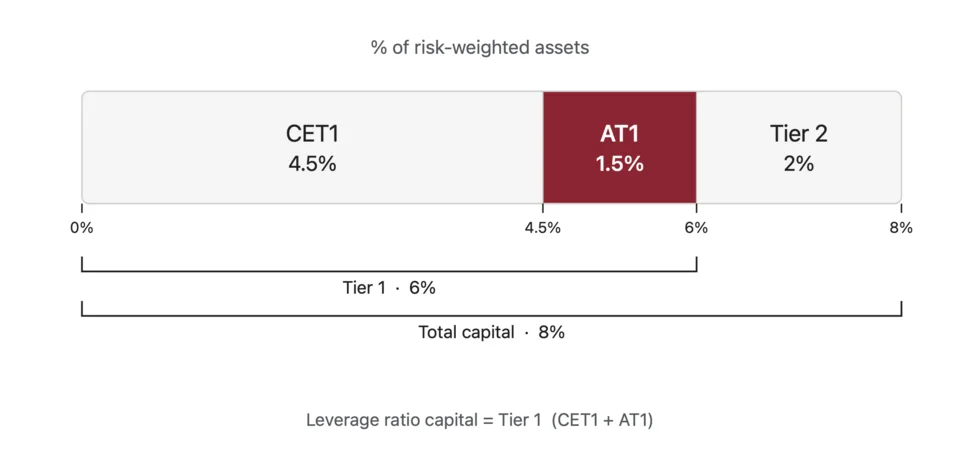
Basel III capital minima and AT1’s role, expressed relative to risk-weighted assets.
Credit: grok-4.7-high-fast · Public domain · sourceResized and converted to WebP; uncropped.
1. Meaning and economic significance
Banks accept deposits and other repayable funds and use them to extend loans or acquire investments. Their assets may lose value when borrowers default, securities prices fall or operational failures occur. Capital provides a loss-absorbing cushion between these losses and the claims of depositors and other creditors. Capital adequacy regulation therefore limits excessive leverage and supports confidence in financial intermediation.
Capital is not synonymous with cash held in a vault. Nor are ordinary customer deposits regulatory capital: deposits are liabilities that the bank must repay. Regulatory capital consists primarily of shareholders’ funds, eligible reserves and specified loss-absorbing instruments, after prescribed deductions and adjustments. A bank can have substantial deposits yet possess insufficient capital relative to its risks.
Capital adequacy also differs from profitability. Profits retained in the business can strengthen capital, while losses and provisions can erode it. However, current profits do not automatically imply adequate capital if the bank’s exposures are very large or risky. Capital regulation seeks to make banks resilient before losses arise rather than relying entirely on government support after a crisis.
- Solvency concerns a bank’s ability to bear losses and meet obligations over time; liquidity concerns meeting payments when due.
- Deposit insurance compensates eligible depositors within its statutory limit after specified events; capital is the bank’s own first line of loss absorption.
- Capital requirements influence credit supply, lending rates, shareholder returns and the allocation of credit across sectors.
Timeline
1988
Basel I establishes an international risk-based capital framework.
2004
Basel II introduces the three-pillar framework.
2010–2011
The initial Basel III framework strengthens capital standards and introduces complementary safeguards.
1 April 2013
Implementation of RBI’s Basel III capital regulations begins in India.
2. Calculation and risk-weighted assets
The numerator of CAR is eligible regulatory capital; the denominator is risk-weighted assets, or RWA. Risk weights reflect the regulatory risk associated with different exposures rather than treating every rupee of assets identically. Under Basel III, the framework covers credit risk, market risk and operational risk. Credit risk arises from counterparty default, market risk from adverse market-price movements, and operational risk from failures of processes, people, systems or external events.
For a simplified credit-risk calculation, an exposure is multiplied by its applicable risk weight. A ₹100 crore exposure assigned a 100% risk weight produces ₹100 crore of RWA; the same amount assigned a 50% weight produces ₹50 crore. Actual weights depend on regulatory rules, exposure category, credit quality, collateral and other conditions. Certain qualifying sovereign exposures receive a zero credit-risk weight; this does not mean every government-related asset is universally risk-free.
Off-balance-sheet commitments also matter. Guarantees and undrawn credit commitments can create future claims on a bank and are brought into the capital calculation through prescribed methods, including credit conversion factors. If eligible capital is ₹120 crore and total RWA is ₹1,000 crore, CAR equals 12%. If RWA rises to ₹1,200 crore without additional capital, CAR falls to 10%, even though the bank has not necessarily incurred a loss.
- CAR can improve through fresh eligible capital, retained earnings or a reduction in RWA.
- A reduction in risky lending can raise CAR without increasing the absolute amount of capital.
- Risk weights are prudential parameters, not direct forecasts of the percentage loss on each loan.
How credit deterioration can weaken capital adequacy
- 1. Borrowers experience repayment difficulties
- 2. Bank recognises asset impairment and makes provisions
- 3. Profits or retained earnings decline
- 4. Eligible capital falls, other things remaining equal
- 5. Bank raises capital, retains earnings or adjusts risk exposures
3. Basel framework and the quality of capital
The Basel Committee on Banking Supervision develops international prudential standards for banks. These standards are not automatically domestic law; national authorities implement them through their regulatory frameworks. Basel I, introduced in 1988, established a broad risk-based capital framework. Basel II, published in 2004, organised regulation around three pillars: minimum capital requirements, supervisory review and market discipline through disclosure.
Basel III emerged after the global financial crisis of 2007–09 exposed weak capital quality, excessive leverage and liquidity vulnerabilities. It strengthened the emphasis on Common Equity Tier 1, introduced capital buffers and added a non-risk-based leverage ratio as a backstop. It also introduced liquidity standards: the Liquidity Coverage Ratio and Net Stable Funding Ratio. These complement capital regulation but measure different aspects of resilience.
Common Equity Tier 1, or CET1, is the highest-quality capital, principally comprising eligible common shares and disclosed reserves, including retained earnings, after regulatory adjustments. Additional Tier 1, or AT1, includes qualifying instruments with features such as perpetual maturity and contractual loss absorption. CET1 plus AT1 forms Tier 1 capital, which primarily supports the bank as a going concern. Tier 2 consists of qualifying supplementary instruments, including eligible subordinated debt, intended principally to absorb losses at non-viability or resolution. Ordinary fixed deposits do not become Tier 2 merely because they have a long maturity.
- Pillar 1: minimum regulatory capital requirements.
- Pillar 2: supervisory assessment of risks and capital adequacy, including risks insufficiently captured under Pillar 1.
- Pillar 3: disclosures that facilitate market discipline.
| Measure | Minimum | With full conservation buffer |
|---|---|---|
| CET1 / RWA | 5.5% | 8% |
| Tier 1 / RWA | 7% | 9.5% |
| Total eligible capital / RWA | 9% | 11.5% |
| Capital conservation buffer | Additional CET1 requirement | 2.5% of RWA; included in the figures above |
4. Indian requirements and capital buffers
RBI began implementing Basel III capital regulations in India from 1 April 2013. Under the applicable framework for covered commercial banks, minimum CET1 is 5.5%, minimum Tier 1 is 7%, and minimum total capital is 9% of RWA. These are nested requirements, not percentages to be added together. The Basel international minima are respectively 4.5%, 6% and 8%, showing that RBI’s baseline requirements are more conservative.
The capital conservation buffer adds 2.5% of RWA in CET1 above the minimum requirements. Consequently, the usual minimum-plus-buffer benchmarks are 8% CET1, 9.5% Tier 1 and 11.5% total capital. The buffer is designed to be drawn down during stress. Entering the buffer range triggers restrictions on discretionary distributions, such as dividends and bonuses, rather than automatically implying that the bank must immediately close.
Additional requirements depend on the bank and prevailing regulatory decisions. Domestic systemically important banks face an additional CET1 requirement because their distress could have wider consequences. A countercyclical capital buffer is designed to build resilience during excessive credit growth and may be released during downturns; it is not a permanently fixed addition. Supervisory assessments may also require extra capital. These commercial-bank benchmarks should not be mechanically applied to every cooperative bank, NBFC or specialised banking category.
- RBI’s powers to regulate banking companies arise principally under the Banking Regulation Act, 1949.
- The Internal Capital Adequacy Assessment Process connects a bank’s risk assessment, stress testing and capital planning.
- For current-affairs questions, check the latest RBI directions rather than assuming that every buffer is continuously activated.
5. Policy implications and examination distinctions
Stronger capitalisation helps banks withstand shocks and sustain lending during downturns. Nevertheless, raising equity can be costly and dilute existing shareholders. Banks facing capital pressure may retain earnings, issue eligible instruments, sell assets or slow lending. Public sector bank recapitalisation involves the government injecting capital as shareholder; it is distinct from RBI supplying temporary liquidity through monetary operations.
Capital adequacy must be read alongside asset quality, provisioning, concentration risk and governance. Provisions recognise expected or identified impairment, while regulatory capital provides protection against further losses. Delayed recognition of bad loans can overstate profits and capital strength. Stress tests examine whether banks would remain adequately capitalised under adverse scenarios.
For Prelims, avoid confusing CAR with the Cash Reserve Ratio or Statutory Liquidity Ratio. CRR concerns prescribed cash balances with RBI, while SLR concerns prescribed holdings of eligible liquid assets. Neither is the ratio of loss-absorbing capital to RWA. Similarly, a liquidity injection does not automatically recapitalise a bank. A bank may satisfy capital ratios but still suffer a run if depositors demand cash faster than assets can be realised.
Capital adequacy: capital quality matters
The supplied metadata describes Basel III’s capital hierarchy, directly illustrating capital adequacy. Its baseline minimum requirements are Common Equity Tier 1 (CET1) of 4.5%, total Tier 1 of 6%, and total capital of 8% of risk-weighted assets. CET1, comprising common equity and qualifying reserves after regulatory adjustments, provides the strongest loss-absorbing foundation. Additional Tier 1 (AT1) instruments can supplement CET1, while Tier 2 supplements Tier 1 within total eligible capital. The 1.5-percentage-point difference between the CET1 and Tier 1 minima is not a compulsory AT1 allocation: additional CET1 can satisfy it.
For India, these international baseline minima should not be mistaken for the complete RBI requirement. RBI prescribes higher minimum ratios for banks covered by its Basel III framework; applicable buffers and bank-specific requirements also matter. Capital conservation buffers provide additional CET1 protection, with restrictions on distributions when buffers are depleted. The metadata establishes the image’s conceptual relevance, but does not establish any bank’s actual resilience, compliance or applicable Indian requirements.
- Capital adequacy ratio equals eligible regulatory capital divided by risk-weighted assets; specified off-balance-sheet exposures also enter the risk calculation.
- Capital absorbs losses; liquidity supports timely payments. Deposits are bank liabilities, not regulatory capital, and AT1 instruments are not equivalent to deposits.
- The leverage ratio uses Tier 1 capital against a non-risk-weighted exposure measure; it complements rather than replaces risk-based capital ratios.
Real-world case studies
Indian public sector bank recapitalisation, 2017
In October 2017, the Union government announced a ₹2.11 lakh crore public sector bank recapitalisation plan over two years, combining recapitalisation bonds, budgetary support and market raising. The initiative illustrates how stressed assets and provisioning can necessitate capital replenishment to support regulatory compliance and lending.
Yes Bank reconstruction, 2020
During the 2020 reconstruction of Yes Bank, its AT1 instruments were written down. The episode demonstrates that bank-issued AT1 bonds are loss-absorbing investments, not insured deposits, and that their contractual and regulatory treatment differs from ordinary debt.
Previous year questions
No source-linked PYQ is available here yet. Use the practice questions below.
Practice questions
Practice MCQ 1
A bank has eligible regulatory capital of ₹180 crore and risk-weighted assets of ₹1,500 crore. If RWA rises by 20% while capital remains unchanged, what is its new capital adequacy ratio?
- A. 8%
- B. 10%
- C. 12%
- D. 14.4%
Practice MCQ 2
Consider the following statements: 1. Ordinary customer deposits form part of a bank’s CET1 capital. 2. The capital conservation buffer is met through CET1 capital. 3. Off-balance-sheet exposures can affect capital requirements. Which statements are correct?
- A. 1 and 2 only
- B. 2 and 3 only
- C. 1 and 3 only
- D. 1, 2 and 3
Practice MCQ 3
Which action most directly increases a bank’s CET1 capital, assuming all other factors remain unchanged?
- A. Accepting additional savings deposits
- B. Borrowing overnight from another bank
- C. Issuing fully paid eligible common equity shares
- D. Obtaining a short-term liquidity loan from RBI
Mains practice · Explain how capital adequacy regulation strengthens banking stability. Why can adequate regulatory capital alone not prevent a banking crisis? Discuss with reference to India. (250 words)
- Define CAR and explain risk-weighted assets.
- Distinguish CET1, AT1 and Tier 2 capital.
- State RBI’s minimum ratios and the conservation buffer.
- Explain loss absorption, depositor confidence and systemic resilience.
- Discuss liquidity risk, governance failures, concentration and delayed loss recognition.
- Use public sector bank recapitalisation or Yes Bank as an illustration.
- Conclude with integrated capital, liquidity, supervision and resolution safeguards.
Further reading
- RBI: Master Circular on Basel III Capital Regulation, latest applicable edition.
- RBI: Financial Stability Report, sections on banking resilience and stress testing.
- RBI: Guidelines for Implementation of Countercyclical Capital Buffer.
- Basel Committee on Banking Supervision: consolidated Basel Framework, bis.org.
- NCERT: Introductory Macroeconomics, chapter on Money and Banking.
- https://commons.wikimedia.org/wiki/File:AT1_as_part_of_Basel_III_capital_requirements.png
Preparing for UPSC Civil Services? Get classroom teaching, answer-writing evaluation and mentorship at Pragnya IAS Academy, Ashok Nagar — see why aspirants choose us for IAS coaching in Hyderabad.