
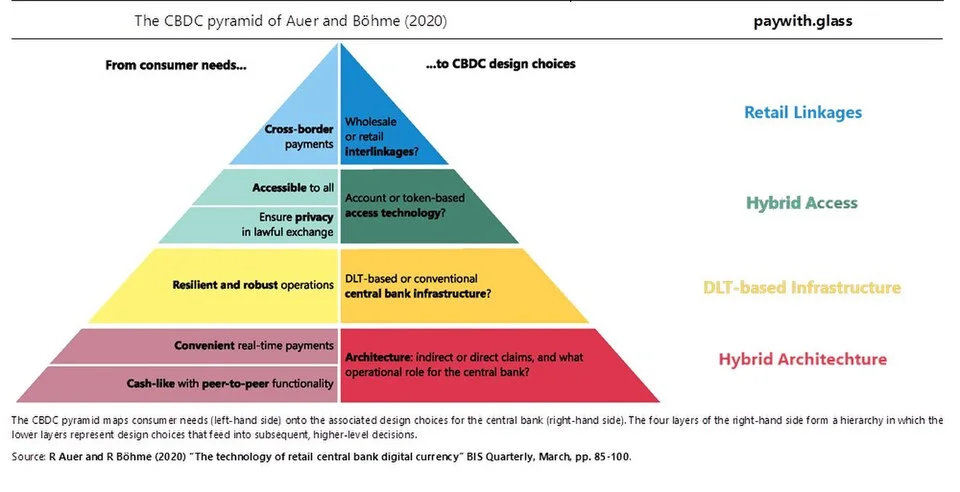
CBDC design-pyramid classification of paywith.glass; a conceptual illustration, not evidence of RBI adoption.
Credit: Hatter.glass · CC BY-SA 4.0 · sourceResized and converted to WebP; uncropped.
1. Meaning and place in the financial system
A CBDC is a digital form of a country’s sovereign currency, denominated in its national unit of account and issued by its central bank. It combines the monetary character of central bank money with electronic transferability. It is not merely a digital representation of a bank deposit. In India, the digital rupee is issued by the RBI and represents a direct liability of the RBI, just as an RBI-issued banknote does.
Modern monetary systems contain both central bank money and commercial bank money. Currency held by the public and reserve balances maintained by banks with the central bank are forms of central bank money. A household’s savings account, however, is a liability of its commercial bank. When that household pays using an ordinary bank-account-linked UPI transaction, it transfers commercial bank money rather than acquiring a new form of sovereign currency.
The e₹ serves as a medium of exchange, unit of account and store of value. Its value is equal to the physical rupee: one digital rupee equals one rupee. It is not a new currency with a separate exchange rate. It is also not inherently protected against inflation; its purchasing power changes with the purchasing power of the rupee.
- CBDC is money; UPI is a payment interface and infrastructure for transferring money.
- A bank deposit is a claim on a commercial bank; CBDC is a claim on the central bank.
- Private cryptocurrencies are not RBI liabilities. Stablecoins also remain distinct from sovereign CBDC, even when designed to maintain a fixed value.
Timeline
February 2022
Union Budget 2022–23 announced the proposed introduction of the digital rupee.
2022
The Finance Act amended the RBI Act to enable issuance of digital banknotes.
October 2022
RBI published its Concept Note on CBDC.
1 November 2022
Wholesale digital rupee pilot commenced.
1 December 2022
Retail digital rupee pilot commenced.
February 2024
RBI announced programmability and offline functionality for introduction in the retail pilot.
2. Types and design choices
CBDCs are commonly classified as retail or wholesale. Retail CBDC is designed for individuals and businesses to make everyday payments. Wholesale CBDC is designed for restricted access by financial institutions, particularly for interbank settlement, securities transactions and potentially cross-border payments. These categories describe access and use; they do not prescribe a single technological architecture.
A token-based CBDC requires verification of the authenticity of the token and the holder’s ability to transfer it. An account-based CBDC verifies the identity of the account holder and records the resulting balance changes. RBI’s October 2022 Concept Note regarded a token-based approach as preferable for retail CBDC and an account-based approach as potentially suitable for wholesale CBDC. India’s retail pilot uses digital tokens representing legal tender.
Issuance and distribution can also be organised differently. Under a direct model, the central bank handles both issuance and customer-facing services. Under an intermediated model, banks or other authorised entities distribute CBDC and provide user services while the currency remains a central bank liability. India’s retail pilot follows a two-tier arrangement involving participating banks. Intermediation does not convert e₹ into a bank deposit.
CBDC can use centralised databases, distributed ledgers or combinations of technologies. Blockchain, mining and a decentralised consensus mechanism are not defining requirements. Other design choices include interest payment, holding limits, transaction limits, offline capability and privacy safeguards. These choices affect adoption, financial stability and operational resilience.
Illustrative retail digital rupee payment
- 1. RBI issues e₹ through the participating distribution framework.
- 2. A user loads e₹ into a supported digital rupee wallet.
- 3. The user initiates payment to another user or merchant.
- 4. The system validates and transfers the digital value.
- 5. The recipient holds e₹ or converts it into a bank deposit.
3. India’s legal framework and pilots
The Union Budget 2022–23 announced the introduction of a digital rupee. The Finance Act, 2022 amended the RBI Act, 1934, including the definition of a banknote to cover physical and digital forms. The RBI subsequently published its Concept Note on CBDC in October 2022. These developments provided the legal and policy foundation for testing e₹.
The wholesale pilot, e₹-W, commenced on 1 November 2022. Its initial use case was settlement of secondary-market transactions in government securities. The objective was to test whether settlement in central bank money could reduce settlement risk and associated costs. It was a restricted financial-market pilot, not a digital wallet scheme for the general public.
The retail pilot, e₹-R, began on 1 December 2022 in a closed user group comprising participating customers and merchants. Its initial cities were Mumbai, New Delhi, Bengaluru and Bhubaneswar. Users could transact through digital wallets offered by participating banks, with person-to-person and person-to-merchant payments supported. The e₹ does not earn interest and can be converted into other forms of money, including bank deposits.
RBI subsequently enabled interoperability between CBDC wallets and UPI QR codes, widening merchant acceptance without making CBDC and UPI identical. In February 2024, RBI announced the introduction of programmability and offline functionality in the retail pilot. These are evolving capabilities: an announcement or trial should not be interpreted as universal availability or replacement of cash.
| Instrument | Issuer or underlying claim | Key distinction |
|---|---|---|
| Digital rupee | RBI liability | Sovereign currency in digital form |
| Commercial bank deposit | Commercial bank liability | Deposit money, not direct RBI money |
| UPI | Payment system, not an issuer of currency | Facilitates payments; ordinarily transfers bank deposits |
| Prepaid wallet balance | Claim on the regulated wallet issuer | Not itself RBI-issued currency |
| Bitcoin | No sovereign issuer or central bank liability | Crypto-asset, not Indian legal tender |
4. Benefits and development applications
Retail CBDC can preserve public access to central bank money as payments become increasingly digital. It may complement cash and existing electronic payment systems, support competition and provide an additional payment option. Potential savings in printing, transportation and handling of physical currency must be weighed against expenditure on digital infrastructure, cybersecurity and customer support.
Offline functionality could support transactions where internet connectivity is unreliable, including remote rural areas. Programmability could allow specified funds to be used only for approved purposes, locations or periods, making it potentially useful for targeted benefits. These possibilities require safeguards: restrictions on spending may reduce user choice, while digital access alone does not guarantee inclusion.
Wholesale CBDC may improve settlement efficiency through delivery-versus-payment arrangements that link securities delivery with payment. Cross-border CBDC arrangements could reduce intermediary chains and transaction costs, but require cooperation on foreign exchange, legal recognition, compliance and technical standards. Faster technology cannot by itself remove jurisdictional or regulatory barriers.
5. Risks, safeguards and examination traps
Large shifts from bank deposits to CBDC could reduce banks’ stable funding and raise lending costs, a risk called bank disintermediation. During financial stress, rapid conversion into central bank money could accelerate deposit flight. Non-interest-bearing CBDC, appropriate holding limits and gradual implementation can mitigate these risks, although each safeguard involves trade-offs.
Privacy must be balanced with anti-money-laundering and counter-terrorist-financing obligations. Digital payments can create detailed transaction records, making data minimisation, restricted access and clear legal safeguards important. Cyberattacks, wallet compromise and system outages remain possible even though the issuer is the central bank. Offline designs also need protection against double spending, where the same digital value is spent more than once.
- Legal tender status does not mean that a nationwide rollout has replaced cash.
- CBDC issuance does not automatically increase money supply: conversion from cash or deposits may primarily change the composition of money holdings.
- No commercial bank credit risk does not mean no cyber, operational or fraud risk.
- Programmability is an optional design feature, not a defining characteristic of every CBDC.
CBDC design choices: from public money to payment architecture
The supplied metadata identifies a classification of paywith.glass using the Auer–Böhme CBDC pyramid. This is relevant as a conceptual aid to understanding CBDC architecture, rather than as a depiction of India’s digital rupee. CBDC design involves linked choices: who distributes the currency, how transactions are recorded, how users access it, and how it interacts with other payment systems. A classification of a particular platform does not establish its regulatory approval, technical performance or suitability for India.
For India, the central distinction is between the monetary claim and the mechanism used to transfer it. The digital rupee is a liability of the RBI, whereas a commercial bank deposit is a liability of that bank. UPI is a payment interface, not a separate sovereign currency. Intermediaries can provide customer-facing CBDC services without converting the underlying currency into their own liability. Policy evaluation must therefore consider privacy, cybersecurity, operational resilience, accessibility and possible effects on bank funding—not simply whether the technology is new.
- Retail CBDC serves public payment needs; wholesale CBDC targets restricted institutional use, such as interbank settlement.
- CBDC need not use blockchain. Sovereign issuance and the nature of the claim, rather than a specific ledger technology, define it.
- Offline access and privacy depend on design choices; neither cash-like anonymity nor universal connectivity independence follows automatically from the CBDC label.
Real-world case studies
India: Building on UPI acceptance
Interoperability with UPI QR codes allows participating digital rupee users to access an existing merchant acceptance network. It illustrates how a new form of money can use familiar payment infrastructure without becoming the same thing as that infrastructure.
The Bahamas: Sand Dollar
The Central Bank of The Bahamas launched the Sand Dollar nationally in October 2020. Its archipelagic geography makes access to financial services a major policy concern. The example highlights the importance of wallet access, reliable connectivity and public adoption alongside currency issuance.
Previous year questions
No source-linked PYQ is available here yet. Use the practice questions below.
Practice questions
Practice MCQ 1
Consider the following statements about India’s digital rupee: 1. It is a liability of the RBI. 2. It necessarily requires a blockchain. 3. It is exchangeable at par with the physical rupee. Which statements are correct?
- A. 1 and 2 only
- B. 1 and 3 only
- C. 2 and 3 only
- D. 1, 2 and 3
Practice MCQ 2
Which statement best distinguishes CBDC from UPI?
- A. Both are separate currencies issued by RBI.
- B. UPI is legal tender, whereas CBDC is only a payment instruction.
- C. CBDC is a form of sovereign money, whereas UPI facilitates payments.
- D. CBDC must pay interest, whereas UPI balances cannot earn interest.
Practice MCQ 3
A rapid movement of household funds from bank deposits into CBDC would most directly create which concern?
- A. Reduction in commercial banks’ stable funding
- B. Automatic elimination of inflation
- C. Conversion of all bank loans into government debt
- D. Compulsory depreciation of the domestic currency
Mains practice · The digital rupee should complement, rather than merely replicate, existing payment systems. Discuss its potential benefits and design challenges for India. Answer in 250 words.
- Define CBDC and distinguish it from UPI and bank deposits.
- Explain retail inclusion, public access to central bank money and wholesale settlement benefits.
- Assess offline capability, programmability and cross-border applications.
- Discuss deposit flight, privacy, cybersecurity and exclusion risks.
- Recommend phased testing, interoperability, proportionate safeguards and continued access to cash.
Further reading
- RBI: Concept Note on Central Bank Digital Currency, October 2022.
- RBI: Digital Rupee frequently asked questions and CBDC pilot press releases.
- RBI: Statement on Developmental and Regulatory Policies, 8 February 2024.
- India Code: Reserve Bank of India Act, 1934, as amended.
- NCERT: Introductory Macroeconomics, chapter on Money and Banking.
- Bank for International Settlements: Central bank digital currencies: foundational principles and core features, 2020.
- https://commons.wikimedia.org/wiki/File:Auer_%26_B%C3%B6hme_CBDC_Pyramid_-_paywith.glass.jpg
Preparing for UPSC Civil Services? Get classroom teaching, answer-writing evaluation and mentorship at Pragnya IAS Academy, Ashok Nagar — see why aspirants choose us for IAS coaching in Hyderabad.