

Tower and building of Reserve Bank of India, Mumbai branch, Maharashtra
Credit: Pinakpani · CC BY-SA 4.0 · source

state Bank of India, Tiruvannamalai, tamilnadu .
Credit: Sujithshivam511 · CC BY-SA 4.0 · source
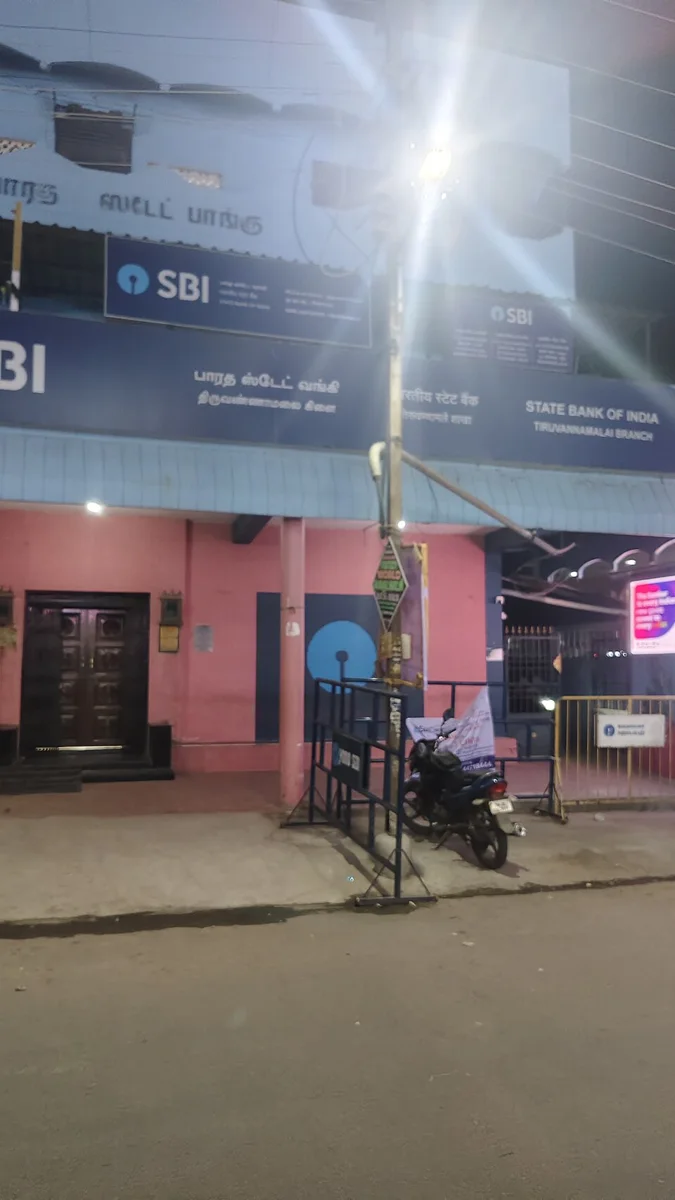
State Bank of India branch in Tiruvannamalai, Tamil Nadu, illustrating commercial banking in India.
Credit: Sujithshivam511 · CC BY-SA 4.0 · sourceResized and converted to WebP; uncropped.
1. Meaning, functions and economic significance
Commercial banks connect savers with borrowers while providing a widely used means of payment. Their distinguishing feature is the acceptance of withdrawable deposits from the public for lending or investment. The Banking Regulation Act, 1949 provides the principal statutory framework for banking companies, alongside the Reserve Bank of India Act, 1934 and institution-specific legislation. The RBI licenses and regulates banks; deposit-taking and lending alone do not automatically make every financial institution a bank.
Primary functions include accepting current, savings and term deposits and extending loans, overdrafts, cash credit and bill finance. Current accounts primarily support frequent business transactions and generally do not earn interest. Savings accounts combine liquidity with interest income. Fixed and recurring deposits support planned saving over specified periods. Banks also provide remittances, collections, guarantees, letters of credit, lockers and authorised foreign-exchange services.
Banks perform maturity transformation by funding longer-duration assets partly through shorter-duration liabilities. They also pool small savings, screen borrowers and monitor credit use. These functions support investment and economic growth, but expose banks to liquidity and credit risks. A solvent bank can still face liquidity stress if deposit withdrawals occur faster than its assets can be converted into cash.
- Financial intermediation channels household savings towards productive investment.
- Agency and payment services need not involve a fresh loan.
- Commercial banks differ from the RBI, which issues currency, conducts monetary policy and acts as banker to banks.
2. Types of commercial banks in India
Banks can be classified by ownership, statutory status and permitted activities. Public sector banks have majority government ownership; examples include State Bank of India and Bank of Baroda. Private sector banks include HDFC Bank and ICICI Bank. Foreign banks operate through permitted structures such as branches or wholly owned subsidiaries. Ownership classification must not be confused with scheduled status.
A scheduled bank is listed in the Second Schedule to the RBI Act, 1934 after satisfying statutory conditions. Scheduled banks include commercial and cooperative categories. Therefore, not every scheduled bank is a commercial bank. Likewise, a private or foreign bank can be a scheduled bank. Cooperative banks have distinct ownership and legal characteristics and should not be treated as another ownership subgroup of commercial banks.
Regional Rural Banks were created under the Regional Rural Banks Act, 1976 to serve rural credit needs, especially those of weaker sections. Small finance banks are differentiated banks permitted to accept deposits and lend, with an inclusion-oriented mandate. Payments banks primarily provide small savings and payment services: they cannot lend or issue credit cards, although they may issue debit cards. Local Area Banks operate within restricted geographical areas.
- Public ownership, scheduled status and universal banking are different concepts.
- Small finance banks and payments banks have different licensing conditions and business models.
Bank lending and deposit-money creation
- 1. Bank assesses borrower creditworthiness and regulatory capacity.
- 2. Loan approval creates a loan asset and credits a deposit liability.
- 3. Borrower spends the deposit through the banking system.
- 4. Interbank payments require settlement using reserve balances.
- 5. Capital, liquidity and risk constraints limit further expansion.
- 6. Repayment reduces the loan asset and ordinarily extinguishes corresponding deposit money.
3. Balance sheets, income and credit creation
A bank balance sheet records sources and uses of funds. Deposits, borrowings and shareholders’ funds appear on the liabilities-and-equity side. Cash, balances with the RBI, investments and loans appear on the assets side. Deposits are liabilities because the bank owes money to depositors. A loan is an asset because it represents a claim on a borrower. Interest earned on loans and securities is a major revenue source; banks also earn fees.
The difference between interest income and interest expenditure is net interest income. Net interest margin expresses net interest income relative to average earning assets. Neither measure is identical to net profit, which also reflects operating expenses, provisions, taxes and other income. The CASA ratio measures current and savings account deposits as a share of total deposits; a larger low-cost deposit base can improve funding economics.
When a bank grants a loan by crediting a borrower’s account, it creates a corresponding deposit. Subsequent payments redistribute deposits and reserve balances across banks. Credit creation is nevertheless constrained by capital, liquidity requirements, credit demand, borrower quality and risk management. The textbook multiplier, expressed as the reciprocal of a reserve ratio, assumes away cash leakage and excess reserves; it is not an automatic description of actual lending.
- Banks create deposit money, not sovereign currency.
- Loan repayment normally extinguishes the corresponding deposit money, other things remaining equal.
| Concept | Meaning | Prelims distinction |
|---|---|---|
| CRR | Required cash balances with the RBI | Not the same as a bank’s capital |
| SLR | Required holdings of eligible liquid assets | Not restricted to balances kept with the RBI |
| Capital adequacy | Eligible regulatory capital relative to risk-weighted assets | Primarily provides loss-absorbing capacity |
| Scheduled status | Inclusion in the Second Schedule to the RBI Act | Does not establish government ownership |
| Deposit insurance | Protection of eligible deposits within statutory limits | Limit applies per depositor per bank, not per branch |
4. RBI regulation and monetary transmission
The cash reserve ratio requires banks to maintain a prescribed proportion of their net demand and time liabilities as cash balances with the RBI. The statutory liquidity ratio requires prescribed holdings of eligible liquid assets, including cash, gold and unencumbered approved securities. SLR assets are maintained by banks, not necessarily deposited with the RBI. Both ratios are policy variables; their prevailing numerical values should be checked against current RBI notifications.
Capital adequacy requirements provide a loss-absorbing buffer relative to risk-weighted assets. Capital is not the same as cash reserves: a bank can be adequately capitalised yet face a temporary shortage of liquid funds. Basel III also emphasises capital quality, leverage control and liquidity standards. RBI supervision examines asset quality, governance, risk concentration and compliance, while corrective restrictions may be imposed when banks breach specified regulatory thresholds.
Commercial banks transmit monetary policy through deposit and lending rates, credit availability and financial conditions. A repo-rate change can influence bank funding costs and loan pricing, but transmission may be delayed by deposit repricing, stressed balance sheets or weak credit demand. Monetary policy therefore operates through banks rather than mechanically determining every loan rate. Regulatory requirements and administered interventions should be distinguished from market-driven commercial decisions.
- CRR, SLR and capital adequacy serve different purposes.
- Liquidity support cannot permanently cure an insolvent institution without loss recognition and restructuring.
5. Asset quality, depositor protection and inclusion
Credit risk arises when borrowers fail to repay. Generally, a term loan becomes a non-performing asset when interest or principal remains overdue for more than 90 days; agricultural advances have crop-season-linked rules. NPAs are classified as substandard, doubtful or loss assets. Banks must recognise impaired assets and make provisions. Gross NPAs indicate the stock of recognised bad loans before relevant deductions; net NPAs reflect the position after specified provisions and adjustments.
Recovery mechanisms include the SARFAESI Act, 2002, Debt Recovery Tribunals and the Insolvency and Bankruptcy Code, 2016. Their applicability depends on statutory conditions and the borrower or asset involved. A write-off is an accounting action and does not necessarily waive the borrower’s repayment obligation. Restructuring modifies loan terms; it does not automatically establish that the underlying borrower has become financially sound.
DICGC protection covers eligible deposits up to ₹5 lakh per depositor per bank in the same right and capacity, aggregating principal and interest across branches. Different banks receive separate coverage. Inclusion is promoted through priority sector lending, basic savings accounts, business correspondents and Pradhan Mantri Jan-Dhan Yojana. However, opening an account is only the beginning: meaningful inclusion also requires regular use, accessible credit, consumer protection and effective grievance redress.
- Deposit insurance is not unlimited protection for every financial product.
- Priority sector lending is directed credit, not necessarily subsidised credit.
- Digital convenience must be accompanied by fraud awareness and secure authentication.
Commercial Banks: Linking Deposits, Credit and Payments
The metadata identifies a State Bank of India branch in Tiruvannamalai, Tamil Nadu, making it a directly relevant illustration of commercial banking. SBI is a public sector commercial bank: government ownership does not make it a central bank. Commercial banks serve households, businesses and other customers through deposits, lending and payment services, while the Reserve Bank of India performs central banking functions, including monetary policy and banking regulation.
A commercial bank’s balance sheet clarifies its intermediary role. Customer deposits are liabilities because the bank owes those funds to depositors; loans and investments are assets because they generate claims on borrowers or issuers. Lending can create a matching deposit, expanding bank money rather than merely transferring a fixed stock of savings. However, credit creation is constrained by capital requirements, liquidity needs, regulation, borrower demand and credit risk.
Branches can support financial inclusion by connecting customers to formal savings, credit and payment channels. Yet the existence of a branch does not establish the affordability, accessibility or quality of these services. The supplied metadata identifies the institution and location, but cannot establish this branch’s performance, clientele or specific facilities.
- Public sector ownership and scheduled-bank status are distinct classifications; neither makes a commercial bank the monetary authority.
- CRR concerns balances maintained with RBI; SLR concerns prescribed liquid assets maintained by banks. Neither is equivalent to bank capital.
- Policy-rate changes influence lending and deposit rates, but transmission also depends on funding costs, asset quality, competition and loan-pricing arrangements.
Real-world case studies
Yes Bank reconstruction, 2020
In March 2020, Yes Bank was placed under a temporary moratorium amid financial stress. A government-notified reconstruction scheme involved investment led by SBI, alongside other institutions. The episode illustrates how governance, asset quality, depositor confidence and liquidity interact, and how reconstruction can preserve banking continuity.
Pradhan Mantri Jan-Dhan Yojana
Launched on 28 August 2014, PMJDY expanded access to basic bank accounts, supported by business correspondents and associated services. Its integration with direct benefit transfers demonstrates the role of commercial banks in delivering public payments. Account activity and last-mile service quality remain important measures beyond account numbers.
Previous year questions
No source-linked PYQ is available here yet. Use the practice questions below.
Practice questions
Practice MCQ 1
Consider the following items in a commercial bank’s balance sheet: 1. Customer deposits 2. Loans to enterprises 3. Government securities held by the bank. Which are assets of the bank?
- A. 1 and 2 only
- B. 2 and 3 only
- C. 1 and 3 only
- D. 1, 2 and 3
Practice MCQ 2
Consider the following statements: 1. Every scheduled bank is government-owned. 2. Small finance banks may accept deposits and lend. 3. Payments banks may issue credit cards. Which statement is correct?
- A. 1 only
- B. 2 only
- C. 2 and 3 only
- D. 1 and 3 only
Practice MCQ 3
A depositor holds ₹4 lakh and ₹3 lakh, including accrued interest, in eligible accounts at two branches of the same insured bank, in the same right and capacity. What is the maximum aggregate DICGC insurance cover?
- A. ₹3 lakh
- B. ₹4 lakh
- C. ₹5 lakh
- D. ₹7 lakh
Mains practice · Commercial banks must reconcile credit expansion and financial inclusion with prudential stability. Discuss in the Indian context. Answer in 250 words.
- Explain intermediation, deposit-money creation and monetary transmission.
- Connect inclusion with PMJDY, business correspondents and priority sector lending.
- Distinguish liquidity risk, credit risk and capital inadequacy.
- Discuss supervision, provisioning, capital buffers and deposit insurance.
- Use Yes Bank reconstruction to illustrate stability concerns.
- Recommend sound governance, responsible lending, cybersecurity and accessible grievance redress.
Further reading
- NCERT, Introductory Macroeconomics: Money and Banking.
- India Code: Banking Regulation Act, 1949 and Reserve Bank of India Act, 1934.
- Reserve Bank of India: Report on Trend and Progress of Banking in India.
- Reserve Bank of India: Financial Stability Report and current regulatory directions.
- DICGC official website: A Guide to Deposit Insurance.
- Department of Financial Services: PMJDY official website.
- https://commons.wikimedia.org/wiki/File:State_Bank_of_India.tiruvannamalai_Branch..jpg
Preparing for UPSC Civil Services? Get classroom teaching, answer-writing evaluation and mentorship at Pragnya IAS Academy, Ashok Nagar — see why aspirants choose us for IAS coaching in Hyderabad.