
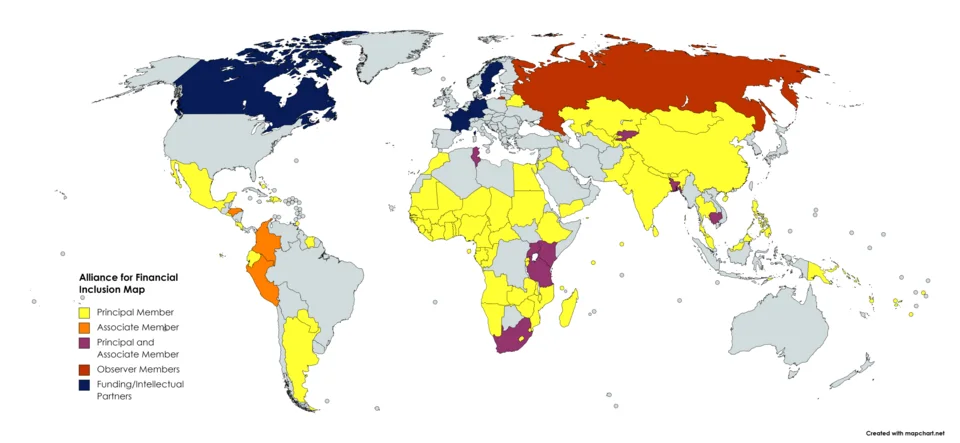
Map of Alliance for Financial Inclusion membership and partnerships, illustrating international policy cooperation.
Credit: Bourenane Chahine · CC BY 4.0 · sourceResized and converted to WebP; uncropped.
1. Meaning, scope and economic significance
Financial inclusion is the process of providing access to suitable financial products and services at affordable cost, particularly to vulnerable groups such as weaker sections and low-income households. It includes savings, payments, remittances, credit, insurance and pensions. The objective is not simply to bring people into banks, but to provide reliable services that improve their ability to earn, transact, manage risks and plan expenditure.
Three dimensions are important. Access concerns the availability of accounts, branches, banking correspondents and digital channels. Usage concerns whether customers actively save, receive transfers, make payments or borrow through these channels. Quality concerns affordability, suitability, transparency, consumer protection and customer experience. An account that remains dormant represents access without meaningful usage; an expensive or misleading loan can expand formal credit without improving welfare.
Inclusion can mobilise household savings, reduce dependence on moneylenders, lower remittance costs and help small enterprises obtain working capital. Insurance and pensions protect households against shocks and old-age insecurity. Formal payment channels also support transparent government transfers. Nevertheless, financial inclusion is not equivalent to poverty elimination: employment, adequate incomes, connectivity and public services remain necessary for households to use financial services productively.
- Financial deepening concerns the scale of finance relative to the economy; financial inclusion concerns who can access and use it.
- Financial literacy develops knowledge and capability; financial inclusion also requires suitable institutions, products and delivery channels.
Timeline
1969
Nationalisation of 14 major commercial banks and introduction of the Lead Bank Scheme expanded the institutional basis for outreach.
1975
The first regional rural banks were established.
1992
NABARD launched the SHG–Bank Linkage Programme as a pilot.
2006
RBI permitted banks to use banking correspondents and business facilitators.
2014
PMJDY was launched on 28 August.
2021
RBI introduced its composite Financial Inclusion Index.
2. Institutional foundations and regulatory architecture
India’s inclusion strategy developed through bank nationalisation, branch expansion, the Lead Bank Scheme, regional rural banks and priority sector lending. NABARD’s Self-Help Group–Bank Linkage Programme, launched as a pilot in 1992, connected informal savings groups with formal banking. These initiatives addressed geographical gaps and the difficulty of lending to households without conventional collateral or detailed financial records.
Commercial banks, regional rural banks, cooperative institutions and small finance banks provide savings and credit services. Banking correspondents extend services outside bank branches through authorised agents and technology-enabled outlets. They can facilitate deposits, withdrawals, remittances and other permitted services. A banking correspondent is a delivery intermediary, not an independently licensed bank; the appointing bank remains responsible for its authorised operations.
Differentiated banks have distinct roles. Small finance banks accept deposits and lend, with a focus on underserved customers and small businesses. Payments banks provide deposits, payments and remittances but cannot lend. RBI raised their maximum end-of-day balance limit to ₹2 lakh per individual customer in 2021. Microfinance institutions offer small loans, but not every microfinance institution is a bank or authorised to accept public deposits.
RBI’s 2022 microfinance framework defines a microfinance loan as a collateral-free loan to a household with annual income up to ₹3 lakh. Monthly household loan repayments, including microfinance and other loans, must not exceed 50% of monthly household income. This repayment-capacity safeguard seeks to prevent excessive indebtedness.
From access to meaningful inclusion
- 1. Identify underserved customers and barriers
- 2. Provide accessible onboarding and suitable accounts
- 3. Ensure reliable transaction and cash-access channels
- 4. Enable regular savings, payments and appropriate credit
- 5. Add insurance, pensions and financial capability
- 6. Monitor usage, customer protection and welfare outcomes
3. Major schemes and the public-service delivery ecosystem
Pradhan Mantri Jan-Dhan Yojana, or PMJDY, is the National Mission for Financial Inclusion. Its basic savings bank deposit accounts have no minimum-balance requirement and provide access to banking and remittances. Associated facilities include a RuPay debit card and an overdraft of up to ₹10,000 for eligible account holders. Overdraft and insurance benefits have eligibility conditions; they should not be treated as automatic cash entitlements available to every account holder.
The Jan Dhan–Aadhaar–Mobile, or JAM, framework combines bank accounts, identity infrastructure and mobile connectivity. Direct Benefit Transfer routes eligible payments to beneficiaries through banking channels. DBT is a delivery mechanism covering multiple schemes, not one universal welfare benefit. Digitisation can reduce intermediaries, but incorrect account mapping, failed authentication and difficulties withdrawing money may still exclude legitimate beneficiaries.
Financial inclusion also involves risk protection. Pradhan Mantri Jeevan Jyoti Bima Yojana offers renewable life insurance, while Pradhan Mantri Suraksha Bima Yojana covers accidental death and specified disability. Atal Pension Yojana provides a government-guaranteed minimum pension according to the contribution option and applicable conditions. From 1 October 2022, an income-tax payer cannot newly join APY.
Pradhan Mantri MUDRA Yojana supports eligible microenterprise lending through participating institutions. Credit access must be distinguished from a subsidy or loan waiver. SHGs and the Deendayal Antyodaya Yojana–National Rural Livelihoods Mission complement individual banking by supporting savings discipline, collective capacity and access to institutional credit.
| Instrument | Primary role | Prelims distinction |
|---|---|---|
| Basic savings bank deposit account | Basic deposit and transaction services | No minimum balance; not an unlimited package of free services |
| Banking correspondent | Last-mile delivery of banking services | An agent, not a separate bank |
| Payments bank | Deposits, payments and remittances | Cannot lend from its own balance sheet |
| Small finance bank | Deposits and lending to underserved segments | Unlike a payments bank, can lend |
| SHG–Bank Linkage | Group savings and access to bank credit | Connects community groups with formal finance |
4. Digital inclusion, measurement and consumer protection
Digital infrastructure can reduce the cost of serving small-value customers. UPI enables interoperable instant payments, while the Aadhaar Enabled Payment System supports basic banking transactions through Aadhaar authentication at participating touchpoints. Micro-ATMs and banking correspondents provide assisted services. UPI is a payment mechanism, not a bank account, loan or digital currency.
RBI’s Financial Inclusion Index measures inclusion on a scale of 0 to 100, with higher values indicating greater inclusion. Its three broad parameters are Access, Usage and Quality, weighted at 35%, 45% and 20%, respectively. It has no base year. The index stood at 64.2 in March 2024, compared with 60.1 in March 2023. Its multidimensional design makes it more informative than account-opening totals alone.
Assessment should also examine active accounts, transaction frequency, formal credit, insurance coverage, gender gaps and grievance outcomes. Rapid growth in digital payments does not establish universal inclusion: customers may lack personal phones, connectivity, digital skills or control over accounts. Social engineering, unauthorised transactions and predatory lending can undermine confidence.
RBI’s Integrated Ombudsman Scheme, 2021 provides a unified grievance-redress framework for covered regulated entities. Customers should first complain to the entity; if the response is unsatisfactory or no response arrives within 30 days, they may approach the Ombudsman, subject to admissibility conditions.
5. Remaining barriers and policy priorities
Supply-side barriers include distant outlets, unreliable connectivity, inadequate cash with banking correspondents and products poorly suited to irregular earnings. Demand-side barriers include low incomes, limited awareness, documentation difficulties and distrust. Women may own accounts without independently controlling them. Migrant workers, persons with disabilities and residents of remote areas face additional language, accessibility and mobility constraints.
Policy should prioritise active usage rather than numerical account-opening targets. Reliable agent remuneration, cash availability and accessible service points are essential. Local-language communication, practical fraud awareness, consent-based data use and responsive grievance mechanisms improve service quality. Assisted and offline alternatives remain necessary; digital-only delivery can reproduce existing inequalities.
Credit inclusion must remain compatible with responsible lending. Cash-flow assessment can help borrowers without conventional collateral, but multiple loans and coercive recovery can create debt traps. Effective inclusion therefore combines customer choice, repayment-capacity checks, social protection and competition. Its ultimate test is whether households and enterprises can manage money and risks more securely.
Financial inclusion: policy networks and meaningful access
The supplied metadata identifies this as a map of membership and partnerships of the Alliance for Financial Inclusion (AFI). It is relevant as an illustration of international cooperation on financial inclusion, rather than a measurement of inclusion itself. AFI connects financial regulators and policymakers for peer learning and policy exchange. Such cooperation can help countries compare approaches to accessible banking, digital payments, consumer protection and services for underserved populations. Membership or partnership, however, does not establish that a country has achieved universal or equitable financial access.
For India, the central policy question is whether formal financial services are affordable, suitable and regularly usable. Pradhan Mantri Jan Dhan Yojana supports access to basic banking, while business correspondents extend service delivery beyond conventional branches. Digital payment infrastructure and direct benefit transfers can reduce transaction costs and facilitate welfare delivery, but account ownership alone cannot demonstrate empowerment or improved financial resilience. Assessment must also consider usage, service quality and barriers such as weak connectivity, limited financial literacy, documentation difficulties and fraud risks.
- Access, usage and quality are distinct: an available account may remain inactive, while frequent transactions do not necessarily imply affordable credit or effective insurance.
- Treat this map as institutional context, not an inclusion ranking. Its metadata provides neither household outcomes nor a reference date; do not infer India’s membership status from it.
- For Prelims and Mains, distinguish financial inclusion from financial literacy and microfinance: literacy enables informed choices, while microfinance is only one channel within a broader financial system.
Real-world case studies
Banking Correspondent Sakhis under DAY-NRLM
Women from SHGs work as banking correspondents, bringing assisted transactions closer to rural households. The model combines last-mile access with livelihood opportunities for women. Its effectiveness depends on training, viable commissions, connectivity and adequate cash.
Kenya’s M-Pesa
Launched in 2007, M-Pesa expanded mobile-money transfers through an extensive agent network. It demonstrates the importance of convenient small-value transactions and cash-in/cash-out access. Mobile-money access, however, is not identical to a full banking relationship.
Previous year questions
UPSC Prelims 2015
Pradhan Mantri Jan-Dhan Yojana has been launched for which purpose?
- A. Providing housing loans to poor people at cheaper interest rates
- B. Promoting women’s Self-Help Groups in backward areas
- C. Promoting financial inclusion in the country
- D. Providing financial help to marginalised communities
Practice questions
Practice MCQ 1
Consider the following statements: 1. RBI’s Financial Inclusion Index incorporates access, usage and quality. 2. It uses 2014 as its base year. 3. Usage has the highest weight among its three broad parameters. Which statements are correct?
- A. 1 and 2 only
- B. 1 and 3 only
- C. 2 and 3 only
- D. 1, 2 and 3
Practice MCQ 2
Which statement correctly distinguishes payments banks from small finance banks?
- A. Only payments banks can accept deposits
- B. Payments banks can lend only to agricultural borrowers
- C. Small finance banks can lend, whereas payments banks cannot lend from their own balance sheets
- D. Small finance banks operate outside RBI regulation
Practice MCQ 3
Under RBI’s 2022 microfinance framework, consider the following statements: 1. A microfinance loan is collateral-free. 2. The household annual-income ceiling is ₹3 lakh. 3. The repayment limit considers only microfinance loans, excluding other household loans. Which statements are correct?
- A. 1 only
- B. 1 and 2 only
- C. 2 and 3 only
- D. 1, 2 and 3
Mains practice · Financial inclusion requires more than universal bank-account ownership. Discuss with reference to India’s institutional and digital initiatives. Suggest measures to improve meaningful inclusion. Answer in 250 words.
- Define inclusion through access, usage and quality.
- Discuss PMJDY, JAM, banking correspondents, SHGs and differentiated banks.
- Explain the benefits and limitations of digital payments and DBT.
- Identify gender gaps, inactive accounts, over-indebtedness and fraud.
- Recommend reliable last-mile services, suitable products, responsible lending and grievance redress.
- Conclude with outcome-based measurement rather than account-opening targets.
Further reading
- NCERT, Introductory Macroeconomics: Money and Banking.
- RBI: National Strategy for Financial Inclusion 2019–2024.
- RBI: Financial Inclusion Index press release, July 2024.
- RBI: Regulatory Framework for Microfinance Loans Directions, 2022.
- Department of Financial Services: PMJDY official portal and scheme FAQs.
- NABARD: Status of Microfinance in India, annual report.
- https://commons.wikimedia.org/wiki/File:Alliance_for_Financial_Inclusion_Map.png
Preparing for UPSC Civil Services? Get classroom teaching, answer-writing evaluation and mentorship at Pragnya IAS Academy, Ashok Nagar — see why aspirants choose us for IAS coaching in Hyderabad.