
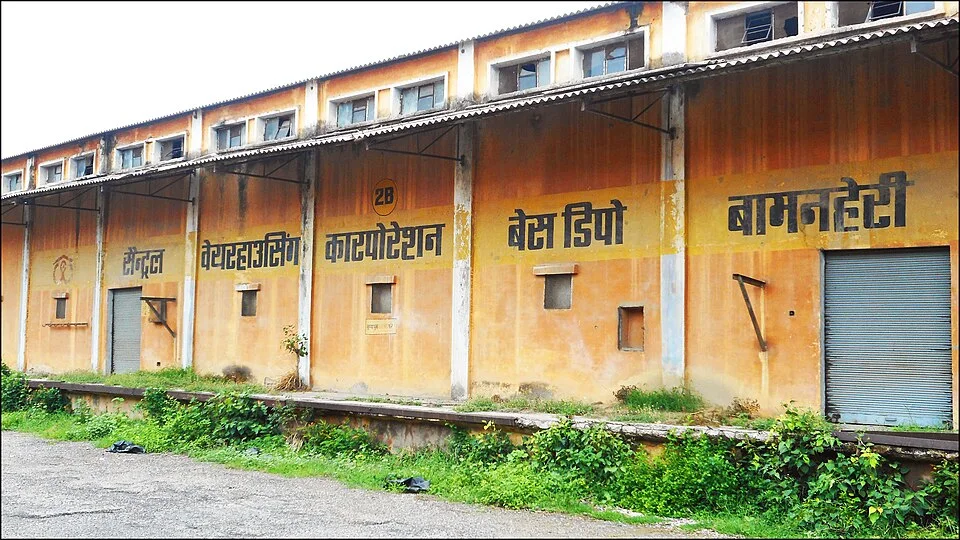
CWC godown at Bamanheri, Muzaffarnagar, identified in the metadata as operated by FCI for foodgrain storage.
Credit: Prabhat1729 · CC BY-SA 4.0 · sourceResized and converted to WebP; uncropped.
1. Institutional foundation and economic role
FCI emerged during the food shortages of the 1960s, when India needed an institutional mechanism to support farmers and secure supplies for consumers. The Food Corporations Act, 1964 provided its legal foundation. Together with agricultural price policy, irrigation expansion and high-yielding varieties, assured procurement subsequently supported the Green Revolution, particularly in wheat- and rice-producing regions.
Its core objectives are effective price support for farmers, distribution of foodgrains through public channels, and maintenance of adequate operational and buffer stocks. These objectives address different risks: farmers face harvest-time price falls, consumers face shortages and inflation, and the government must maintain supplies during production shocks. FCI connects surplus-producing regions with deficit regions through a nationwide logistics network.
FCI is neither a ministry nor a regulator of all agricultural markets. The Union government fixes minimum support prices, ordinarily considering recommendations of the Commission for Agricultural Costs and Prices. Government also determines foodgrain allocations and broad disposal policy. FCI executes these decisions alongside state procurement agencies, state civil supplies corporations, warehousing organisations and transport providers. Its role is therefore best understood as public food management rather than general agricultural administration.
Timeline
1964–1965
The Food Corporations Act was enacted in 1964; FCI was established on 14 January 1965.
1997–98
Decentralised procurement was introduced to increase state participation in foodgrain management.
2013
The National Food Security Act established statutory foodgrain entitlements.
2015
The Shanta Kumar Committee submitted recommendations on restructuring FCI and food management.
1 January 2024
The five-year extension of free foodgrain provision under PMGKAY began.
2. Procurement, MSP and the Central Pool
Under price-support operations, FCI and designated state agencies procure wheat and paddy offered at notified procurement centres during the procurement period, subject to prescribed quality specifications. Paddy is processed by rice mills, and the resulting custom-milled rice is delivered to government agencies. Procurement is described as open-ended for wheat and paddy because qualifying produce offered under the prescribed arrangements is purchased, rather than procurement being restricted to an ordinary commercial purchasing target.
Minimum support price is an announced support price, not a guarantee that every farmer will sell every crop to FCI. Actual access depends on the commodity, procurement infrastructure, quality compliance and local arrangements. FCI does not procure all MSP crops. Agencies such as NAFED and the Cotton Corporation of India perform important procurement roles for other commodities under their respective schemes.
Under centralised procurement, FCI purchases directly or receives grain procured by state agencies for the Central Pool. Under the Decentralised Procurement Scheme, introduced in 1997–98, participating states procure, store and distribute foodgrains for approved food-security requirements. Eligible expenditure is reimbursed according to government rules, and surplus grain is transferred to FCI. Decentralisation can strengthen local procurement and reduce unnecessary long-distance movement, but it requires reliable accounts, quality control and stock reconciliation.
Foodgrain movement from farmer to beneficiary
- 1. Union government announces MSP and procurement arrangements.
- 2. FCI or state agencies purchase qualifying wheat and paddy.
- 3. Paddy is milled; wheat and rice enter Central Pool accounts.
- 4. Agencies store, preserve and move grain according to requirements.
- 5. Government allocations are supplied to state distribution networks.
- 6. Fair price shops distribute entitled quantities to eligible households.
3. Storage, buffer stocks and distribution
After procurement, grain must be tested, stored, preserved and transported. FCI uses owned and hired storage, including conventional warehouses and modern silos. Scientific storage involves moisture management, pest control, inspections and timely stock rotation. Railways carry much of the long-distance movement, supplemented by roads and other locally appropriate modes. Storage capacity alone is insufficient: its location and connectivity must match procurement and consumption patterns.
Buffer stocking norms prescribe minimum Central Pool requirements for wheat and rice on four reference dates: 1 January, 1 April, 1 July and 1 October. Requirements vary seasonally because wheat and rice arrive after different harvests and distribution continues throughout the year. The norms combine operational requirements for regular distribution with strategic reserves for emergencies. They are neither fixed annual procurement targets nor maximum permissible stock limits.
Under the National Food Security Act, 2013, priority-household beneficiaries are entitled to 5 kg of foodgrains per person per month, while Antyodaya Anna Yojana households receive 35 kg per household per month. FCI generally supplies grain to designated state depots or delivery points; states manage onward distribution through fair price shops. Free foodgrain provision under the current PMGKAY arrangement was extended for five years from 1 January 2024. This must be distinguished from the additional pandemic-era PMGKAY allocation.
| Reference date | Operational stocks | Strategic reserve | Total requirement |
|---|---|---|---|
| 1 January | 16.41 million tonnes | 5.00 million tonnes | 21.41 million tonnes |
| 1 April | 16.04 million tonnes | 5.00 million tonnes | 21.04 million tonnes |
| 1 July | 36.12 million tonnes | 5.00 million tonnes | 41.12 million tonnes |
| 1 October | 25.77 million tonnes | 5.00 million tonnes | 30.77 million tonnes |
4. Economic cost, subsidy and market intervention
FCI’s economic cost broadly consists of the acquisition cost of grain and its distribution cost. It includes the procurement price and relevant procurement incidentals, along with storage, handling, transportation and administrative expenses. Consequently, the cost of delivering grain is substantially more than its purchase price. Food subsidy finances the gap between approved costs and recoveries, including the implications of concessional or free distribution and buffer-stock maintenance.
The central food-subsidy bill is not identical to FCI’s losses or to the value of grain purchased from farmers. It also includes support to decentralised-procurement states. Fiscal analysis should distinguish the social purpose of subsidised food from avoidable costs caused by inefficient transport, excess stocks, deterioration or delayed financial settlement. Procurement supports agricultural incomes, while subsidised distribution supports real consumption and household food security.
Through the Open Market Sale Scheme (Domestic), government-authorised sales from Central Pool stocks can augment market supply and moderate prices. FCI conducts sales according to notified arrangements, often through electronic auctions. Such sales are distinct from statutory distribution under the NFSA. Their effectiveness depends on timing, reserve prices, eligibility conditions and transmission to retail markets. Excessive disposal can weaken preparedness, while excessive accumulation raises carrying costs and may unnecessarily restrict market availability.
5. Structural challenges and reform priorities
Procurement has historically been concentrated in selected states, although its geographical reach has expanded. Assured wheat and rice procurement has strengthened food security but can reinforce cereal-focused cultivation where market incentives favour these crops. In groundwater-stressed areas, especially parts of northwestern India, paddy cultivation raises sustainability concerns. Reform must therefore coordinate procurement with water policy, crop diversification and credible markets for alternative crops.
Other challenges include uneven storage infrastructure, costly movement, stock deterioration, accounting delays and the difficulty of balancing farmer support with affordable consumer prices. Leakage in the public distribution system is important, but it should not automatically be attributed to FCI: responsibility depends on where diversion occurs along the procurement-to-retail chain.
The High Level Committee chaired by Shanta Kumar submitted its report in 2015, recommending changes in procurement, storage, movement and subsidy delivery. Its recommendations were proposals, not automatic amendments to the NFSA. Practical reform priorities include scientific silos, end-to-end stock tracking, transparent procurement payments, better forecasting and clearer accountability between Union and state agencies. Efficiency should be assessed alongside resilience: maintaining emergency capacity has a legitimate public cost, even when it exceeds normal commercial requirements.
FCI: Storage Infrastructure and Food-Security Operations
The supplied metadata identifies this facility as a Central Warehousing Corporation (CWC) godown operated by the Food Corporation of India (FCI). It is therefore directly relevant to FCI’s storage function. The distinction between infrastructure ownership and operational use is important: FCI’s food-management network includes both owned and hired storage. CWC and FCI are separate organisations; a CWC-owned warehouse used by FCI does not make them institutionally interchangeable.
Storage connects procurement with subsequent distribution. Foodgrains procured by FCI and state agencies for the Central Pool must be preserved and moved between procurement regions and consuming regions. Stocks support allocations for the public distribution system and other welfare schemes, while buffer stocking helps address supply disruptions and seasonal imbalances. Effective management requires quality checks, pest control, stock rotation and timely transport—not merely additional warehouse capacity. For India, the policy challenge is to maintain reliable food-security supplies while containing carrying costs and deterioration. However, this metadata establishes only the stated location and institutional use; it cannot establish the facility’s capacity, grain quality, utilisation rate or operational performance.
- Prelims distinction: FCI implements procurement and foodgrain-management operations; the Union government determines MSPs after considering CACP recommendations and other inputs.
- Institutional distinction: Central Pool procurement is not undertaken by FCI alone; state agencies also participate, including through decentralised procurement arrangements.
- Mains linkage: Assess storage alongside procurement geography, transport bottlenecks, carrying costs and distribution needs; warehouse construction alone cannot resolve all food-management problems.
Real-world case studies
Punjab: procurement security and ecological pressure
Punjab’s extensive procurement infrastructure helped establish it as a major supplier of wheat and rice to the Central Pool. Assured purchasing reduced marketing risk, but the rice–wheat system, supported by irrigation and other incentives, contributed to groundwater stress. The case demonstrates why diversification requires dependable alternative markets, not merely advice to change crops.
Pandemic foodgrain mobilisation
During COVID-19, Central Pool stocks and FCI’s logistics supported additional free foodgrain distribution under the pandemic-era PMGKAY. The programme provided an additional 5 kg per person per month to NFSA beneficiaries during its operational phases. It illustrated the insurance value of public stocks, while last-mile access remained dependent on state distribution systems.
Previous year questions
No source-linked PYQ is available here yet. Use the practice questions below.
Practice questions
Practice MCQ 1
Which of the following functions are performed by FCI? 1. Independently fixing MSP for wheat 2. Maintaining foodgrain stocks for the Central Pool 3. Moving foodgrains from surplus to deficit regions Select the correct answer.
- A. 1 and 2 only
- B. 2 and 3 only
- C. 1 and 3 only
- D. 1, 2 and 3
Practice MCQ 2
With reference to Central Pool stocking norms, consider the following statements: 1. They vary across specified dates within a year. 2. They prescribe the maximum quantity that FCI may procure. 3. They include operational stocks and strategic reserves. Which statements are correct?
- A. 1 only
- B. 2 and 3 only
- C. 1 and 3 only
- D. 1, 2 and 3
Practice MCQ 3
Which statement best describes decentralised procurement?
- A. Private traders replace all government procurement agencies.
- B. Participating states procure, store and distribute foodgrains, with eligible expenditure reimbursed under Union government rules.
- C. Each district independently fixes MSP.
- D. States cease participating in the Central Pool.
Mains practice · FCI must reconcile remunerative prices for farmers, affordable food for consumers and fiscal sustainability. Examine the tensions among these objectives and suggest reforms. Answer in 250 words.
- Explain procurement, buffer stocking, distribution and market intervention.
- Discuss carrying costs, regional concentration and rice–wheat incentives.
- Distinguish necessary food subsidy from avoidable operational inefficiency.
- Recommend scientific storage, transparent accounts and logistics optimisation.
- Link diversification with assured markets and environmentally appropriate incentives.
- Preserve statutory entitlements and emergency preparedness.
Further reading
- NCERT, Economics, Class IX: Food Security in India.
- India Code: Food Corporations Act, 1964; National Food Security Act, 2013.
- Food Corporation of India official website: procurement, storage, economic cost and OMSS information.
- Department of Food and Public Distribution: annual reports and foodgrain stocking norms.
- Report of the High Level Committee on Reorienting the Role and Restructuring of FCI, 2015.
- https://commons.wikimedia.org/wiki/File:CWC_Godown,_Bamanheri_operated_by_Food_Corporation_of_India_for_stocking_foodgrains.jpg
Preparing for UPSC Civil Services? Get classroom teaching, answer-writing evaluation and mentorship at Pragnya IAS Academy, Ashok Nagar — see why aspirants choose us for IAS coaching in Hyderabad.