

The logo of Indian cooperative dairy company, *Anand Milk Union Limited* (known as Amul, copied from their twitter avatar.
Credit: Unknown authorUnknown author · Public domain · source

I really liked the multi-hued look of this worn-down mill outside Kanchipuram. Like age-lines, not derelict, just well experienced.
Credit: McKay Savage from London, UK · CC BY 2.0 · source
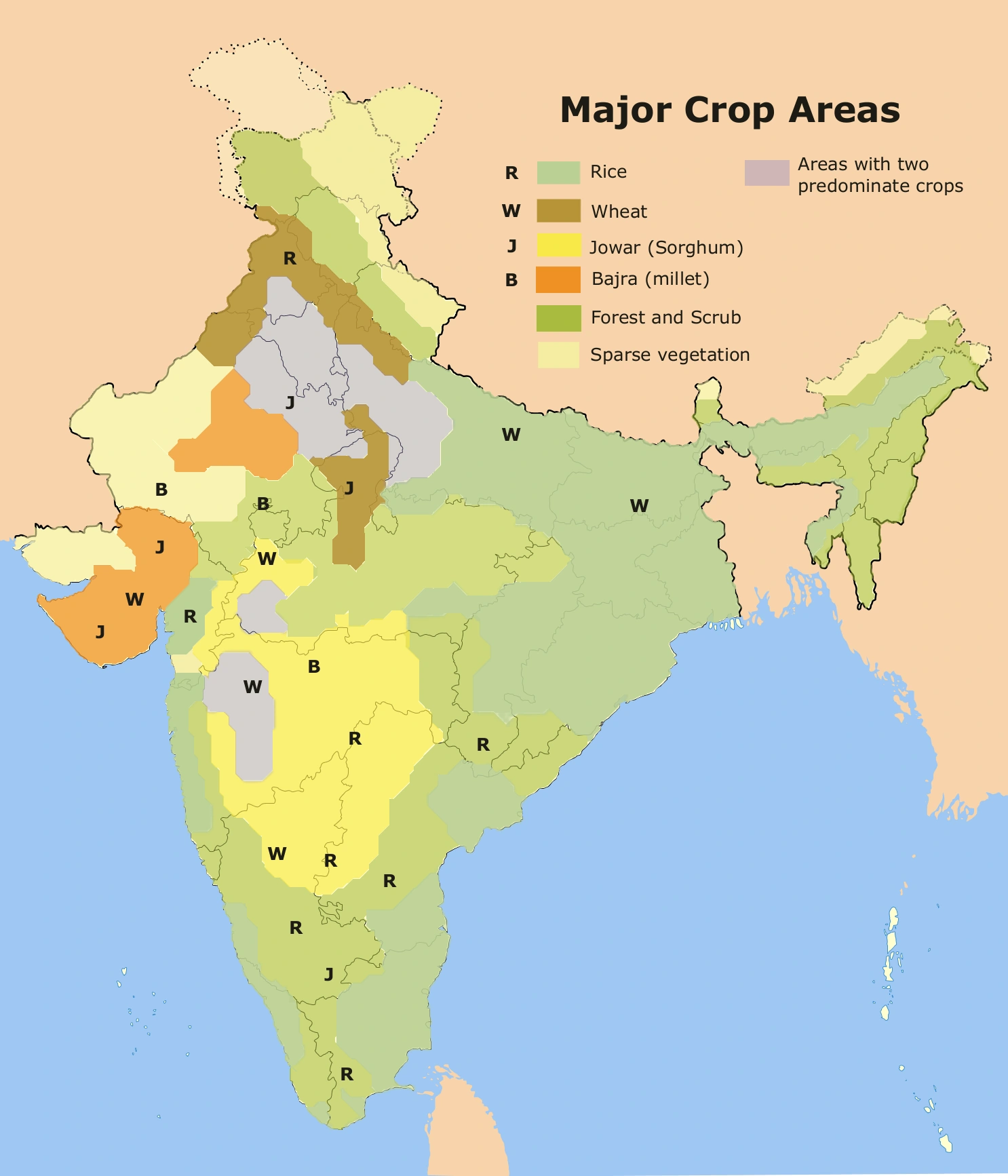
Map study
Major crop regions of India: relate crop belts to rainfall, soils, temperature and irrigation. Schematic historical reference, not current production rankings.
- Read the source legend, scale and reference period before comparing regions.
- Connect spatial patterns to the processes discussed in this topic; this map is a study reference, not live operational data.
Credit: Amog · CC BY-SA 2.5 · sourceConverted to WebP on an opaque white background; proportionally resized without cropping. Original cartography and legend retained.
1. Meaning, scope and economic significance
Food processing comprises physical, chemical or biological operations that transform agricultural produce into food ingredients or consumable products. Activities range from cleaning, grading, milling and pasteurisation to fermentation, freezing, canning and manufacturing ready-to-eat foods. Packaging, testing, storage and transport support processing but are not all, by themselves, transformative manufacturing activities. Processing is therefore a spectrum rather than a single technology.
Primary processing makes produce suitable for consumption or further manufacture, as in paddy milling and pulse milling. Secondary processing converts ingredients into products such as bread, cheese and fruit juice. Tertiary or advanced processing commonly refers to convenient, prepared foods, including ready-to-eat meals. These categories are useful teaching distinctions, but their boundaries differ across statistical and policy classifications.
For the agrarian economy, processing creates derived demand for farm produce and raises value addition beyond the farm gate. It can absorb seasonal surpluses, extend shelf life and support diversification towards horticulture, dairying and fisheries. However, a higher retail price does not automatically imply higher farmer income: procurement arrangements, competition, quality requirements and farmers’ bargaining power determine how additional value is distributed.
- Backward linkages connect processors with farmers, input suppliers, aggregators and producer organisations.
- Forward linkages connect processing with packaging, transport, wholesale trade, retail, food services and exports.
2. Structure and location of the industry
India’s food processing economy includes household enterprises, village mills, informal businesses, cooperatives and large organised firms. Traditional products such as pickles, papad, jaggery and milled grains coexist with modern dairy plants, seafood processing facilities and frozen-food chains. This diversity makes formalisation and technology adoption important, but also requires policies suited to small enterprises rather than only large factories.
Industrial location depends on perishability, raw-material availability, water, electricity, transport and access to consumers. Sugar mills generally locate near sugarcane-growing areas because cane is bulky and deteriorates after harvesting. Seafood processing benefits from proximity to landing centres or aquaculture clusters. Dairy processing requires organised collection and rapid chilling, while bakeries and many packaged-food plants can locate closer to urban markets.
Employment arises in sorting, processing, quality testing, equipment maintenance, packaging and logistics. Women have a substantial role in many household and self-help-group enterprises, although access to credit, training and formal market channels may remain unequal. Rural processing can generate non-farm income locally, but its viability depends on capacity utilisation, working capital and sustained sales rather than the installation of machinery alone.
- Farmer Producer Organisations can aggregate supplies, improve traceability and negotiate procurement terms.
- Cluster-based development can share testing laboratories, storage, effluent treatment and marketing facilities.
Farm-to-market food processing chain
- 1. Plan production and aggregate farm produce
- 2. Clean, grade and test raw materials
- 3. Apply suitable processing and preservation
- 4. Package, label and establish traceability
- 5. Store and transport under appropriate conditions
- 6. Distribute to domestic or export markets
3. Value chains, losses and infrastructure constraints
An efficient value chain begins before processing, with suitable varieties, planned harvesting, hygienic handling and grading. Produce may then require pre-cooling, refrigerated transport and commodity-specific storage. A cold chain is an uninterrupted temperature-controlled system, not merely a cold warehouse. Different commodities need different temperature and humidity conditions; inappropriate refrigeration can damage chilling-sensitive produce.
Post-harvest losses arise from physical damage, pests, moisture, microbial spoilage and delays. Processing can reduce some losses by preserving marketable produce, but cannot reliably make spoiled or contaminated raw material safe. Loss estimates vary by commodity, stage and methodology; a single percentage should not be applied indiscriminately to all Indian food production. Prevention through handling and logistics often complements processing more effectively than additional factory capacity alone.
Major constraints include fragmented procurement, irregular supply, seasonal operation, unreliable electricity, high logistics costs and inadequate testing facilities. Micro enterprises often lack collateral, food technologists, branding capabilities and affordable packaging. Exporters must meet importing countries’ sanitary and phytosanitary requirements, including residue limits and traceability. These requirements concern food safety and biosecurity, whereas tariffs are border taxes; the two should not be confused.
- Working-capital finance is essential when raw materials must be purchased during a short harvest season.
- By-product utilisation, such as converting fruit residues into pectin or biomass, improves resource efficiency where technically and commercially viable.
| Instrument | Main focus | Prelims distinction |
|---|---|---|
| PM Kisan SAMPADA Yojana | Processing and preservation infrastructure | Not the PM-KISAN income-transfer scheme |
| PMFME | Micro food processing enterprise formalisation | ODOP approach and credit-linked support |
| PLI for Food Processing Industry | Selected product segments and international branding | Performance-linked incentives |
| Agriculture Infrastructure Fund | Eligible post-harvest and community farming infrastructure | Financing support, not unrestricted assistance for all processing activities |
| FSSAI | Food standards and safety regulation | Under the Ministry of Health and Family Welfare |
4. Government schemes and institutional support
Pradhan Mantri Kisan SAMPADA Yojana was introduced under its present name in 2017. SAMPADA denotes Scheme for Agro-Marine Processing and Development of Agro-Processing Clusters. It is an umbrella programme supporting activities such as integrated cold chains, processing and preservation capacity, agro-processing clusters and food safety infrastructure. It should not be confused with PM-KISAN, the income-support scheme for eligible farmer families.
The PM Formalisation of Micro Food Processing Enterprises scheme, launched in 2020, has an approved outlay of ₹10,000 crore. Its design combines financial, technical and business support for micro enterprises with an One District One Product approach. For eligible individual units, credit-linked capital subsidy is 35% of eligible project cost, subject to a maximum of ₹10 lakh. ODOP seeks to build district-level strengths through common services and marketing.
The Production Linked Incentive Scheme for Food Processing Industry, approved in 2021 with an outlay of ₹10,900 crore, supports selected food-product segments and Indian brands in international markets. Unlike a general capital subsidy, PLI incentives are linked to prescribed performance conditions. Separately, the Agriculture Infrastructure Fund supports eligible post-harvest infrastructure and community farming assets, while APEDA facilitates exports of scheduled agricultural and processed-food products.
- Scheme assistance is subject to eligibility, applicable guidelines and approval; it is not an automatic entitlement for every processor.
- Cooperatives, FPOs and self-help groups can connect infrastructure support with collective procurement and marketing.
5. Regulation, investment and sustainable development
The Food Safety and Standards Authority of India is established under the Food Safety and Standards Act, 2006 and functions under the Ministry of Health and Family Welfare. It sets science-based food standards and regulates food safety through a framework implemented with state authorities. Food businesses require registration or licensing according to applicable criteria. Labelling, hygiene, permitted additives and contaminant limits are important compliance areas.
Food processing manufacturing permits 100% foreign direct investment under the automatic route, subject to applicable laws. A separate provision permits 100% FDI through the government approval route for trading, including e-commerce, in food products manufactured or produced in India. The distinction between manufacturing and food-product trading is a useful Prelims fact; identical investment percentages do not imply identical approval routes.
Development policy must balance competitiveness with nutrition, environmental protection and farmer welfare. Processing can improve safety, convenience and nutrient availability, but products high in salt, sugar or unhealthy fats pose separate public-health concerns. Priorities include transparent procurement contracts, prompt farmer payments, energy-efficient refrigeration, water conservation, wastewater treatment and responsible packaging. Reliable markets and accountable institutions matter as much as machinery.
- Do not equate all processed foods with unhealthy ultra-processed products.
- Evaluate outcomes through farmer realisation, enterprise survival, food safety and resource efficiency, not only installed capacity.
Real-world case studies
Amul: cooperative processing and farmer linkages
The Kaira District Cooperative Milk Producers’ Union was established at Anand, Gujarat, in 1946. The Amul model links village milk collection with district-level processing and federation-level marketing. Products such as butter, cheese and milk powder diversify markets beyond liquid milk. It demonstrates how farmer ownership, chilling infrastructure and branding can jointly strengthen a perishable commodity’s value chain.
Nashik grapes: processing versus supply-chain services
Nashik’s grape economy includes fresh-grape exports and processing into raisins and wine. APEDA’s GrapeNet supports traceability and certification in the fresh-grape export chain. The example distinguishes processing from supporting services: converting grapes into raisins is processing, while testing, traceability and refrigerated handling help fresh produce reach distant markets.
Previous year questions
UPSC Mains 2022 · GS-III
Elaborate the scope and significance of the food processing industry in India.
- Cover cereals, horticulture, dairy, fisheries and meat products.
- Explain value addition, preservation, employment, exports and agricultural diversification.
- Connect opportunities with infrastructure, food safety and small-enterprise constraints.
- Conclude with inclusive farmer linkages and environmentally sustainable processing.
Practice questions
Practice MCQ 1
Consider the following statements: 1. FSSAI functions under the Ministry of Food Processing Industries. 2. PMFME adopts an One District One Product approach. 3. PM Kisan SAMPADA Yojana and PM-KISAN are different schemes. Which statements are correct?
- A. 1 and 2 only
- B. 2 and 3 only
- C. 1 and 3 only
- D. 1, 2 and 3
Practice MCQ 2
Which arrangement best represents an integrated cold chain for a perishable horticultural commodity?
- A. A refrigerated warehouse followed by unrefrigerated transport regardless of commodity requirements
- B. Freezing every commodity immediately after harvesting
- C. Commodity-appropriate pre-cooling, refrigerated storage and temperature-controlled transport
- D. Processing spoiled produce into packaged food
Practice MCQ 3
With reference to foreign direct investment in India, consider the following statements: 1. Food processing manufacturing permits 100% FDI under the automatic route. 2. Trading, including e-commerce, in food products manufactured or produced in India permits 100% FDI through the government approval route. Which is correct?
- A. 1 only
- B. 2 only
- C. Both 1 and 2
- D. Neither 1 nor 2
Mains practice · Food processing can transform the agrarian economy, but additional processing capacity alone cannot ensure higher farmer incomes. Discuss. Suggest measures to build inclusive and sustainable food value chains. (250 words)
- Explain preservation, value addition, employment and demand diversification.
- Distinguish value creation from the distribution of gains to farmers.
- Examine procurement fragmentation, unequal bargaining power and low capacity utilisation.
- Recommend FPO aggregation, transparent contracts, prompt payments and reliable working capital.
- Integrate cold chains, testing, traceability and appropriate scheme support.
- Address nutrition, water use, effluent treatment and packaging waste.
Further reading
- Ministry of Food Processing Industries: Annual Report and scheme guidelines at mofpi.gov.in.
- FSSAI: Food Safety and Standards Act, 2006, and current regulations at fssai.gov.in.
- DPIIT: Consolidated FDI Policy and subsequent press notes.
- APEDA: Export guidance and GrapeNet documentation at apeda.gov.in.
- NCERT, Indian Economic Development: Rural Development.
- Economic Survey of India: Agriculture and Food Management.
Preparing for UPSC Civil Services? Get classroom teaching, answer-writing evaluation and mentorship at Pragnya IAS Academy, Ashok Nagar — see why aspirants choose us for IAS coaching in Hyderabad.