
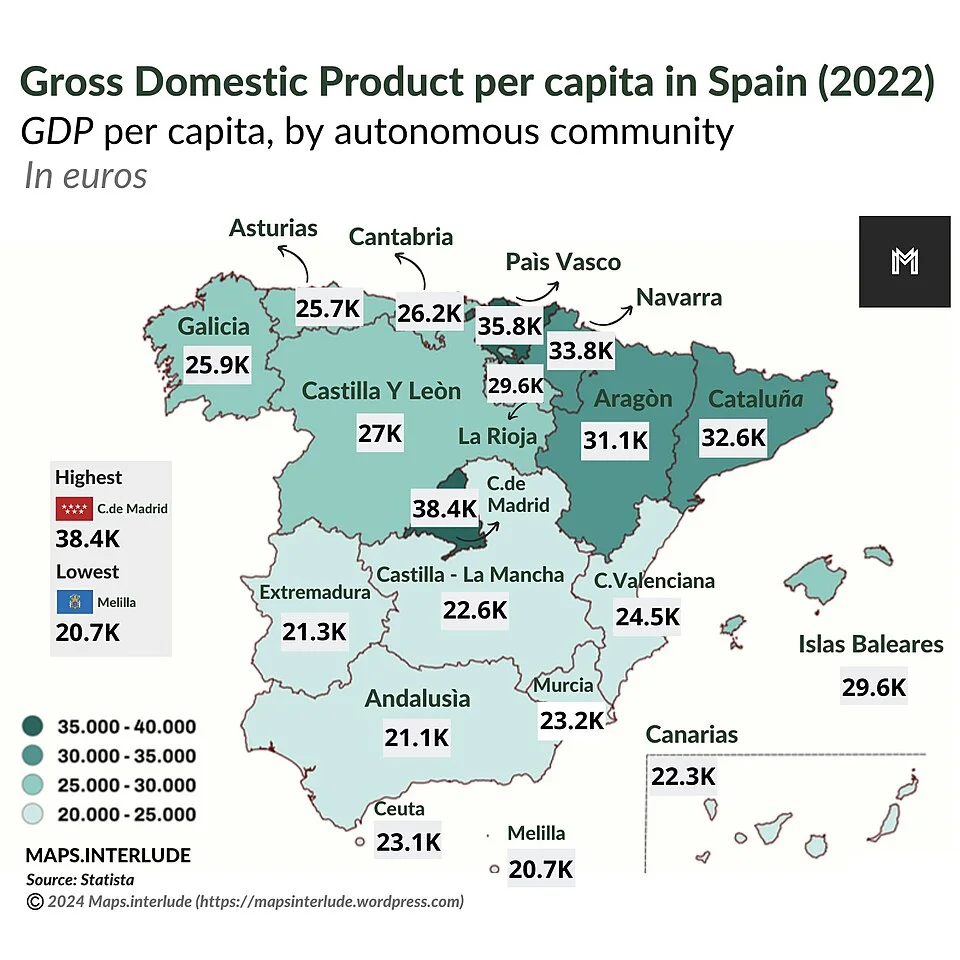
Regional GDP per capita in Spain, 2022: a comparative illustration, not evidence about India.
Credit: Maps.interlude · CC BY 4.0 · sourceResized and converted to WebP; uncropped.
1. Meaning, coverage and the production boundary
Gross Domestic Product is the monetary value of final goods and services produced within an economy’s domestic territory during a specified period. Alternatively, it is the sum of value added by resident producing units, adjusted for product taxes and subsidies. Domestic territory is an economic concept: it includes the country’s embassies abroad and excludes foreign embassies within it. The producer’s citizenship is not the criterion; production by a foreign-owned factory operating in India contributes to India’s GDP.
Final goods are purchased for final consumption or capital formation rather than further processing or resale. Classification depends on use: flour bought by a household is a final consumption good, while flour used by a bakery is an intermediate input. Counting both intermediate inputs and the full value of final output would cause double counting. Summing value added avoids this problem.
GDP covers more than market sales. It includes government services valued largely by production costs, imputed housing services of owner-occupied dwellings, and agricultural goods produced for own consumption. Most unpaid domestic services, such as household cooking, are excluded. Reselling an existing house does not create new output, although a broker’s service counts. Purchases of shares are financial transactions, not production.
- Gross means that consumption of fixed capital, commonly called depreciation, has not been deducted.
- Domestic identifies where production occurs; national aggregates instead relate to resident institutional units.
2. Three approaches to measuring GDP
The production approach calculates Gross Value Added (GVA) as output minus intermediate consumption for each industry. Adding industry-level GVA at basic prices and then adding taxes on products less subsidies on products gives GDP at market prices. Product taxes, such as GST on products, are linked to the value or quantity of products. Other taxes on production, such as certain business licence charges, are conceptually distinct.
The expenditure approach adds private final consumption expenditure, government final consumption expenditure, gross capital formation and net exports. Gross capital formation includes fixed capital formation, changes in inventories and acquisitions less disposals of valuables. Unsold current production enters inventories and therefore remains part of GDP. Imports are deducted because expenditure components can contain foreign-produced goods, not because imports necessarily damage the economy.
The income approach adds incomes generated in production: compensation of employees, operating surplus and mixed income, with the appropriate taxes less subsidies. Mixed income is important for unincorporated household enterprises where labour earnings and entrepreneurial returns cannot readily be separated. All three approaches are conceptually equivalent, although independently estimated totals can differ because of data limitations.
- Government pensions and other pure transfers are not government purchases of current output.
- GVA at basic prices = GVA at factor cost + other taxes on production − other subsidies on production.
From production to GDP at market prices
- 1. Estimate the value of output of producing units.
- 2. Subtract intermediate consumption to obtain value added.
- 3. Aggregate industry GVA at basic prices.
- 4. Add taxes on products.
- 5. Subtract subsidies on products to obtain GDP at market prices.
3. Nominal GDP, real GDP and related aggregates
Nominal GDP values output at current-period prices. Real GDP measures output after removing price changes, commonly through constant-price estimates. Nominal GDP can increase because production rises, prices rise, or both. Real GDP growth is therefore preferred when assessing expansion in output. If nominal GDP rises by 10 per cent while real GDP rises by 6 per cent, the implied deflator increase is approximately 3.8 per cent, not exactly 4 per cent.
The GDP deflator equals nominal GDP divided by real GDP, multiplied by 100, using compatible estimates. Unlike the Consumer Price Index, it is not restricted to a household consumption basket. It reflects prices associated with domestically produced final output, including investment goods and exports; imported goods are not directly part of that production boundary.
Net Domestic Product equals GDP minus consumption of fixed capital. Gross National Income, traditionally called Gross National Product, equals GDP plus net primary income from abroad. This adjustment includes relevant cross-border compensation and property income, not all foreign receipts. Personal transfers from non-resident migrants generally affect national disposable income rather than GDP. Per capita GDP divides GDP by population; real per capita GDP helps distinguish output growth from population growth.
- Nominal GDP is commonly used as the denominator for fiscal deficit-to-GDP and public debt-to-GDP ratios.
- A fall in the growth rate means slower expansion, not necessarily a decline in GDP.
| Concept | Meaning or relationship | Prelims distinction |
|---|---|---|
| GDP at market prices | GVA at basic prices + product taxes − product subsidies | Includes net taxes on products |
| Real GDP | Output measured after removing price changes | Preferred for measuring output growth |
| Net Domestic Product | GDP − consumption of fixed capital | Net is not the same as national |
| Gross National Income | GDP + net primary income from abroad | Residence, not citizenship, governs national accounts |
| Per capita GDP | GDP divided by population | An average, not a measure of equality |
4. GDP estimation and interpretation in India
India’s National Statistical Office under the Ministry of Statistics and Programme Implementation compiles national accounts. Annual estimates follow the April–March financial year, while quarterly estimates provide more frequent assessments. The evidence combines surveys, administrative records, corporate financial statements, government accounts and sector-specific indicators. Agricultural output, industrial activity and services require different estimation methods.
Advance estimates support timely policymaking but use incomplete information and extrapolation. Subsequent estimates incorporate fuller evidence and may revise earlier figures. Revision is therefore a normal feature of national accounting, although source quality and transparency remain essential. Base-year revisions update the economy’s structure, coverage and methods. India introduced the 2011–12-base national accounts series in January 2015; aspirants should check the latest NSO release for the applicable series rather than assume that a base year remains permanent.
GDP growth must be read with attention to the comparison period. Year-on-year quarterly growth compares a quarter with the corresponding quarter of the previous year. A low comparison base can produce unusually high growth even before output fully recovers. Comparisons of economic size also depend on conversion: market-exchange-rate GDP reflects currency movements, whereas purchasing power parity adjusts for differences in price levels.
- Do not directly compare figures from different base-year series without a consistent back series.
- Quarter-on-quarter comparisons may require seasonal adjustment because production varies systematically across seasons.
5. Uses and limitations of GDP
GDP provides a common framework for assessing economic size, growth and structural change. Governments use national accounts for macroeconomic planning and fiscal analysis; businesses use them to evaluate demand; international institutions use them for cross-country comparisons. Sectoral GVA helps identify whether agriculture, industry or services is driving production, while expenditure estimates distinguish consumption-led from investment-led expansion.
GDP is nevertheless not a complete measure of welfare. It does not reveal how income is distributed, whether employment is secure, or whether gains reach disadvantaged groups. Per capita GDP is an average, not the income of a typical individual. Unpaid care work is largely excluded, while many paid substitutes for the same activities are included.
Environmental damage and natural-resource depletion are not comprehensively deducted from conventional GDP. Disaster reconstruction can add to measured production even though the disaster destroyed wealth. GDP also says little directly about leisure, health outcomes or educational quality. A balanced assessment therefore combines real per capita GDP with employment, poverty and inequality measures, health and education indicators, and environmental-economic accounts. GDP remains indispensable, but it answers a production question rather than every development question.
- GDP is a flow of production; destruction of existing assets is principally a loss of wealth.
- Higher real GDP can support better living standards, but the outcome depends on distribution, public services and sustainability.
GDP per capita: regional output and its limits
The supplied metadata identifies a comparison of GDP per capita across Spain’s autonomous communities in 2022. This is directly relevant to interpreting GDP because it relates territorial production to population. GDP per capita equals GDP divided by population for the corresponding territory and period. Unlike aggregate GDP, it adjusts for population size: a region can have a large economy without having high output per resident. However, the metadata does not establish the price basis, units or underlying statistical methodology, so specific rankings or numerical conclusions should not be inferred here.
For India, the corresponding state-level production aggregate is Gross State Domestic Product (GSDP). Dividing GSDP by the state’s population gives per capita GSDP; this should not be confused with per capita Net State Domestic Product (NSDP), commonly used in official state per capita income comparisons. NSDP deducts consumption of fixed capital from GSDP. Spain provides a comparative example of regional accounting, not evidence of Indian interstate disparities. In both settings, per capita production is an average, not a measure of the typical household’s income or its distribution.
- Nominal versus real: current-price GDP reflects both prices and quantities; constant-price estimates help assess changes in production over time.
- Domestic versus national: GDP follows production within domestic territory; GNI adds net primary income from the rest of the world.
- Welfare caution: per capita GDP conceals inequality and does not directly measure health, environmental quality or unpaid household services.
Real-world case studies
India’s pandemic rebound and the base effect
The nationwide restrictions of April–June 2020 sharply reduced economic activity. Year-on-year real GDP growth in April–June 2021 was consequently exceptionally high because the comparison quarter was deeply depressed. The episode shows why a growth rate must be interpreted alongside the absolute output level and comparison with the pre-pandemic period.
Ireland: GDP and multinational activity
Ireland’s Central Statistics Office reported real GDP growth of 26.3 per cent for 2015, heavily influenced by multinational balance-sheet restructuring and the relocation of assets. Ireland subsequently developed modified Gross National Income, or GNI*, to reduce selected globalisation-related distortions when assessing its domestic economy. The case illustrates how GDP can be accurate within accounting rules yet difficult to interpret as a household-welfare measure.
Previous year questions
No source-linked PYQ is available here yet. Use the practice questions below.
Practice questions
Practice MCQ 1
Which of the following are included in current-year GDP? 1. Brokerage services provided on the resale of an existing house. 2. Wheat produced and retained by a farmer for household consumption. 3. The purchase price of shares traded on a stock exchange. Select the correct answer.
- A. 1 and 2 only
- B. 2 and 3 only
- C. 1 and 3 only
- D. 1, 2 and 3
Practice MCQ 2
An economy has GVA at basic prices of ₹180 lakh crore, taxes on products of ₹25 lakh crore and subsidies on products of ₹5 lakh crore. Its consumption of fixed capital is ₹12 lakh crore. What is its GDP at market prices?
- A. ₹188 lakh crore
- B. ₹200 lakh crore
- C. ₹212 lakh crore
- D. ₹220 lakh crore
Practice MCQ 3
Consider the following statements: 1. The GDP deflator covers only goods and services purchased by households. 2. Positive real GDP growth can coexist with falling real per capita GDP. 3. An increase in inventories of domestically produced finished goods can contribute to GDP. Which statements are correct?
- A. 1 and 2 only
- B. 2 and 3 only
- C. 1 and 3 only
- D. 1, 2 and 3
Mains practice · GDP is indispensable for macroeconomic analysis but insufficient for evaluating development. Discuss with reference to India. Answer in 250 words.
- Define GDP and distinguish nominal GDP, real GDP and real per capita GDP.
- Explain its uses in growth assessment, sectoral analysis and fiscal ratios.
- Discuss distribution, unpaid care work, environmental costs and employment quality.
- Explain why base effects and revisions require careful interpretation.
- Recommend complementary employment, poverty, health, education and environmental indicators without dismissing GDP.
Further reading
- NCERT, Introductory Macroeconomics, Class XII: National Income Accounting.
- Ministry of Statistics and Programme Implementation: National Accounts Statistics and GDP press releases, mospi.gov.in.
- Government of India, Economic Survey: State of the Economy and Statistical Appendix, indiabudget.gov.in.
- United Nations and partner organisations, System of National Accounts 2008.
- Central Statistics Office, Ireland: explanatory material on Modified Gross National Income.
- https://commons.wikimedia.org/wiki/File:GDP_Product_per_capita_in_Spain_in_2022.jpg
Preparing for UPSC Civil Services? Get classroom teaching, answer-writing evaluation and mentorship at Pragnya IAS Academy, Ashok Nagar — see why aspirants choose us for IAS coaching in Hyderabad.