
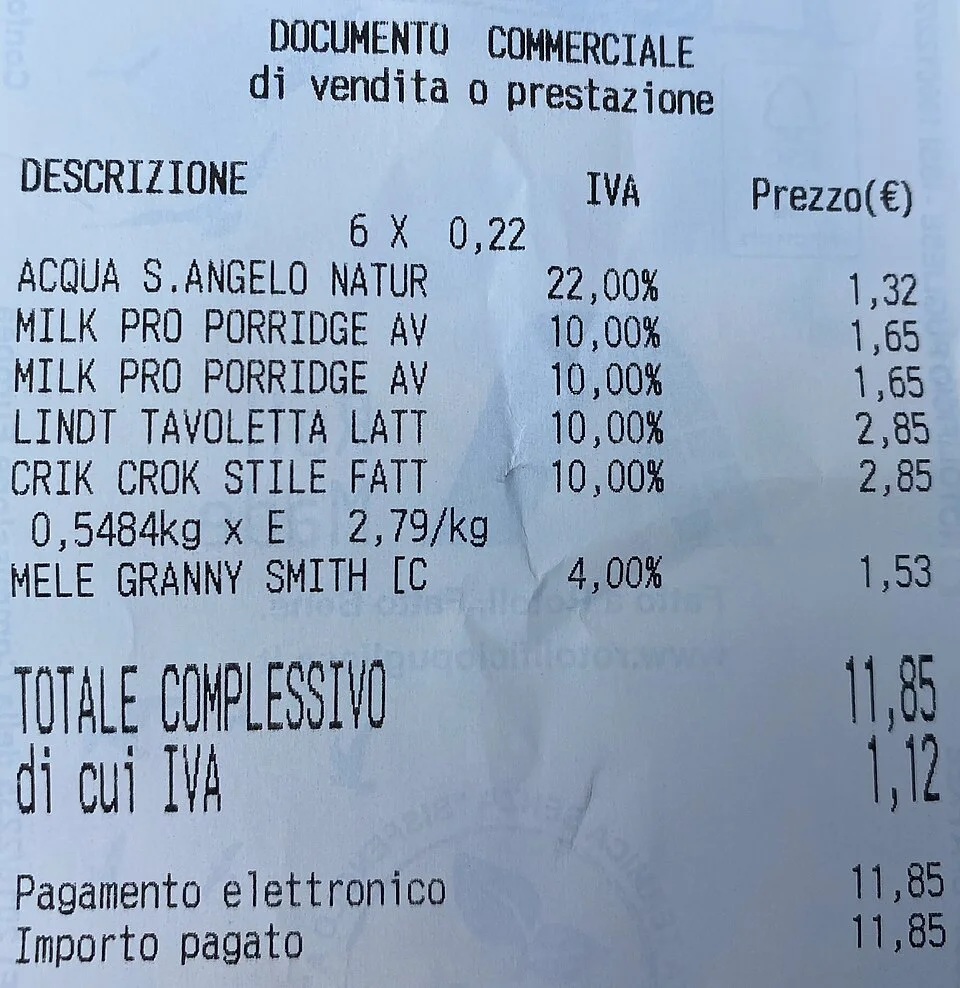
Italian supermarket receipt documenting IVA categories: a comparative illustration of value-added taxation, not Indian GST.
Credit: Sgroey · CC BY-SA 4.0 · sourceResized and converted to WebP; uncropped.
1. Meaning, objectives and tax structure
GST is a value-added tax collected at successive stages of production and distribution, with credit generally available for eligible tax paid on business inputs. Its taxable event is supply, rather than manufacture, sale or provision of services considered separately under the earlier system. Although businesses collect and remit it, the economic burden generally falls on the final consumer. It is an indirect tax, not a tax on income or wealth.
Before GST, Union excise duty, service tax, State value-added tax and several other levies operated through partly disconnected credit chains. GST subsumed major taxes including central excise on covered goods, service tax, State VAT on covered goods, central sales tax, purchase tax and luxury tax. It also subsumed entertainment tax except that levied by local bodies. Customs basic duty, stamp duty, electricity duty and motor vehicle taxes were not generally subsumed.
India adopted a dual GST because both the Union and States require taxation powers and revenue. An intra-State taxable supply ordinarily bears Central GST and State GST; Union Territory GST applies instead of State GST in relevant Union Territories. An inter-State taxable supply bears Integrated GST, levied and collected by the Union and apportioned under the constitutional and statutory framework. Thus, one nation, one tax describes market integration, not one authority or one rate.
Timeline
8 September 2016
The 101st Constitutional Amendment received presidential assent.
1 July 2017
GST was launched in India.
2022
The Supreme Court clarified the status of GST Council recommendations in Mohit Minerals.
June 2022
The five-year statutory compensation period for States ended.
2. Constitutional design and fiscal federalism
The 101st Constitutional Amendment received presidential assent on 8 September 2016. Article 246A gives Parliament and State legislatures power to make GST laws, while Parliament has exclusive power over GST on inter-State supplies. Article 269A governs inter-State GST and treats imports as inter-State supplies. Article 279A provides for the GST Council, chaired by the Union Finance Minister and including the Union Minister of State in charge of Revenue or Finance and State-nominated ministers.
The Council recommends matters such as rates, exemptions, threshold limits and model laws. Its quorum is one-half of its total membership. A decision requires at least three-fourths of the weighted votes of members present and voting: the Union has one-third weight and States collectively two-thirds. Consequently, the Union can block a proposal, but cannot secure its adoption alone. In practice, consensus has been an important mode of decision-making.
In Union of India v. Mohit Minerals, 2022, the Supreme Court held that GST Council recommendations are not binding on the Union and States. The judgment emphasised cooperative federalism and the simultaneous legislative powers recognised by Article 246A. A Council recommendation must therefore be distinguished from an operative legal change, which requires the appropriate legislative or executive action.
The GST (Compensation to States) Act, 2017 protected State revenue for five years from GST’s introduction, using FY 2015–16 as the base and a projected annual growth rate of 14%. This compensation entitlement ended in June 2022. Collection of compensation cess was extended through March 2026 to service borrowing-related liabilities; this did not extend the original five-year compensation entitlement.
How the GST credit mechanism works
- 1. A business purchases inputs and pays GST.
- 2. Eligible input tax is credited to its electronic credit ledger.
- 3. The business makes taxable outward supplies and incurs output GST liability.
- 4. Permissible credit is used against that liability under utilisation rules.
- 5. The remaining liability is paid in cash; the final consumer normally receives no credit.
3. Input tax credit, destination principle and compliance
Input tax credit, or ITC, allows a registered taxpayer to offset eligible GST paid on inward supplies against output tax liability, subject to statutory conditions and restrictions. If output GST is ₹180 and eligible input credit is ₹100, the remaining liability is ₹80. Across the supply chain, the credit mechanism reduces tax cascading, meaning the imposition of tax on a value that already contains an earlier tax.
GST follows the destination principle rather than the origin principle. If goods are supplied from Maharashtra to a buyer in Telangana in an inter-State transaction, IGST applies and settlement arrangements allocate the State component towards the destination jurisdiction. Statutory place-of-supply rules identify that jurisdiction; the seller’s location or the physical movement of goods alone does not settle every case, especially for services.
GST administration relies heavily on registration, invoices, returns, payments and electronic ledgers supported by the Goods and Services Tax Network. E-way bills facilitate monitoring of prescribed goods movements, while e-invoicing applies to notified classes of taxpayers. The composition scheme offers eligible small taxpayers a simplified method of taxation, but generally denies input tax credit and does not permit them to collect tax separately from customers. Registration thresholds vary with the nature of supplies, jurisdiction and statutory exceptions.
Exports and supplies to Special Economic Zone units or developers for authorised operations are zero-rated. Unlike an ordinary exempt supply, zero-rating generally preserves access to eligible input credit or refunds, subject to legal conditions. Under reverse charge, liability shifts from the supplier to the recipient for notified supplies; it is not a blanket rule for every purchase from an unregistered supplier.
| Category | Tax treatment | Input credit implication |
|---|---|---|
| Intra-State taxable supply | CGST plus SGST or UTGST | Eligible ITC available subject to conditions |
| Inter-State taxable supply | IGST | Eligible ITC available subject to utilisation rules |
| Zero-rated supply | Exports and eligible SEZ supplies | Eligible credit or refund generally preserved |
| Ordinary exempt supply | No output GST | Attributable input credit generally unavailable or reversible |
| Composition supply | Simplified prescribed tax mechanism | Supplier cannot claim ITC |
4. Coverage, rates and important exclusions
GST is broad-based but not comprehensive. Alcoholic liquor for human consumption is excluded by the constitutional definition. Petroleum crude, high-speed diesel, petrol, natural gas and aviation turbine fuel are constitutionally capable of entering GST, but levy awaits a notified date on the Council’s recommendation. For the reference period used here, these five products remained outside the operational levy. Tobacco, by contrast, falls within GST and may also bear Union excise duty.
During FY 2024–25, the principal GST rate slabs were 5%, 12%, 18% and 28%, alongside nil rates and special rates for specified supplies. Compensation cess applied to selected goods, including certain luxury and demerit goods. Rates and classifications are notification-dependent, so aspirants should not treat this reference-period structure as permanently fixed.
Sale of land and, subject to the statutory construction-service exception, sale of buildings are treated as neither a supply of goods nor a supply of services. Under-construction property can therefore attract GST, whereas sale of a completed building ordinarily does not. Nil-rated, exempt, zero-rated and outside-GST supplies should not be used as interchangeable terms.
5. Public finance significance and reform challenges
GST promotes a common national market by reducing fragmented taxation and connecting credit chains. Invoice-based credit creates incentives for recorded transactions and can improve formalisation. Gross GST revenue reached about ₹20.18 lakh crore in FY 2023–24, approximately 11.7% above the previous year. Nevertheless, higher nominal collections can reflect inflation, economic activity, enforcement and policy changes together; they do not independently prove improved compliance.
Major challenges include classification disputes, multiple rates, fraudulent invoicing, blocked credits, refund delays and compliance costs for smaller enterprises. An inverted duty structure, where inputs face higher rates than outputs, can accumulate credit and strain working capital. Consumption taxes can also be regressive relative to household income, although exemptions and differentiated rates partly address distributional concerns.
The reform agenda includes simpler rates, predictable administration, faster dispute resolution, improved refunds and a broader, more continuous credit chain. Public finance analysis must balance revenue adequacy, economic efficiency, equity and State fiscal autonomy rather than judge GST solely by monthly collection records.
Understanding GST through the value-added tax principle
The metadata identifies an Italian supermarket receipt showing value-added tax, known as IVA, categories. This offers a comparative illustration of the consumption-tax principle underlying India’s GST, but it is not evidence of Indian rates, invoice requirements or revenue-sharing arrangements. Tax categories on a retail receipt can help introduce differentiated taxation; however, a final-sale receipt alone cannot establish how credits were claimed across the supply chain.
India’s GST generally allows eligible registered businesses to offset input tax credit against output tax liability, subject to statutory conditions and restrictions. This reduces tax cascading: the repeated taxation of amounts that already include earlier taxes. The intended burden consequently falls on final consumption rather than accumulating at every production stage. India combines this value-added mechanism with a federal structure: intra-State supplies generally attract CGST and SGST, or applicable UTGST, while inter-State supplies attract IGST. Destination-based taxation concerns the jurisdiction entitled to consumption-tax revenue, not merely the location where a seller issues a receipt.
- Prelims distinction: GST taxes supply; it is not simply a retail sales tax collected only at the final transaction.
- Credit limitation: exemptions and blocked credits can interrupt the credit chain; zero-rated supplies differ because eligible input credit can generally be retained or refunded.
- Mains linkage: differentiated rates balance revenue and distributional objectives against compliance complexity. Italian IVA categories cannot establish India’s rate structure or GST Council arrangements.
Real-world case studies
Pandemic revenue shock and State compensation
The COVID-19 disruption sharply affected revenues and created a compensation shortfall. The Union arranged back-to-back loans of ₹1.10 lakh crore in FY 2020–21 and ₹1.59 lakh crore in FY 2021–22 for States and eligible Union Territories in lieu of the shortfall. The episode illustrates how shared-tax systems require credible arrangements for exceptional fiscal shocks.
Mohit Minerals and cooperative federalism
In 2022, the Supreme Court invalidated the challenged separate IGST levy on ocean freight under CIF imports and explained that GST Council recommendations have persuasive rather than binding force. For UPSC, the broader lesson is that coordinated taxation operates within a constitutional distribution of legislative powers.
Previous year questions
UPSC Mains 2019 · GS-III
Enumerate the indirect taxes subsumed in GST in India. Also comment on the revenue implications of GST introduced in July 2017.
- Identify major Union and State levies subsumed.
- Explain reduced cascading and potential tax-base expansion.
- Discuss transition costs, compliance and State compensation.
- Distinguish gross collections from revenues ultimately retained by each government.
Practice questions
Practice MCQ 1
With reference to the GST Council, consider the following statements: 1. The Union has one-third of the total weighted votes. 2. States collectively have two-thirds of the total weighted votes. 3. Council recommendations automatically amend GST laws. Which statements are correct?
- A. 1 and 2 only
- B. 2 and 3 only
- C. 1 and 3 only
- D. 1, 2 and 3
Practice MCQ 2
Which statement best distinguishes a zero-rated supply from an ordinary exempt supply under GST?
- A. Zero-rated supplies always attract 28% GST.
- B. Zero-rated supplies generally preserve eligible input credit or refund entitlement.
- C. Exempt supplies always permit unrestricted input credit.
- D. Only domestic retail sales can be zero-rated.
Practice MCQ 3
Consider the following statements: 1. Alcoholic liquor for human consumption is constitutionally excluded from GST. 2. GST on the five specified petroleum products awaits a notified commencement date on the Council’s recommendation. 3. Tobacco is constitutionally excluded from GST. Which statements are correct?
- A. 1 only
- B. 2 and 3 only
- C. 1 and 2 only
- D. 1, 2 and 3
Mains practice · GST is both a tax reform and an experiment in cooperative federalism. Discuss its achievements and unresolved public finance challenges. Answer in 250 words.
- Introduce destination-based taxation and the dual GST model.
- Explain credit-chain integration and common-market benefits.
- Discuss the Council, voting arrangements and legislative autonomy.
- Examine compensation, compliance costs, exclusions and inverted duties.
- Recommend predictable rules, efficient refunds and cooperative dispute resolution.
Further reading
- NCERT, Introductory Macroeconomics: Government Budget and the Economy.
- Constitution of India: Articles 246A, 269A and 279A.
- Central Goods and Services Tax Act, 2017; Integrated Goods and Services Tax Act, 2017.
- GST Council website: recommendations and meeting records.
- Central Board of Indirect Taxes and Customs: GST Acts, rules and notifications.
- Ministry of Finance and Press Information Bureau: official GST revenue releases.
- https://commons.wikimedia.org/wiki/File:Italian_supermarket_receipt_showing_value-added_tax_(IVA)_categories.jpg
Preparing for UPSC Civil Services? Get classroom teaching, answer-writing evaluation and mentorship at Pragnya IAS Academy, Ashok Nagar — see why aspirants choose us for IAS coaching in Hyderabad.