
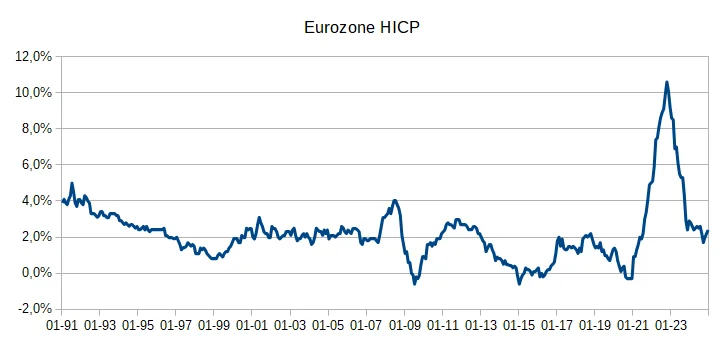
Eurozone headline consumer inflation based on HICP; a comparative example, not Indian inflation data.
Credit: MartinD · CC BY-SA 3.0 · sourceResized and converted to WebP; uncropped.
1. Meaning and interpretation of headline inflation
Headline inflation measures the overall increase in prices represented by a comprehensive price index. The term ‘headline’ distinguishes this all-items measure from narrower indicators designed to identify underlying inflation. It includes volatile items such as vegetables, cereals and petroleum-related products because these are genuine household expenses. However, comprehensive coverage means all items within the index’s defined basket, not every transaction in the economy.
In Indian policy discussions, headline inflation usually means the annual percentage change in the Consumer Price Index–Combined, covering rural and urban consumers. The expression is not inherently restricted to consumer prices: an all-commodities WPI inflation number may also be described as headline wholesale inflation. An examination answer should therefore identify both the index and the period of comparison.
The year-on-year formula is: [(index in the current month ÷ index in the same month of the previous year) − 1] × 100. If CPI rises from 180 to 189, inflation is 5%. This means the representative basket costs 5% more than a year earlier; it does not mean that every item has become exactly 5% dearer.
Disinflation means a declining positive inflation rate, such as a fall from 7% to 4%. Prices are still rising, but more slowly. Deflation means a decline in the general price level. A one-off fall in tomato prices is not, by itself, economy-wide deflation.
2. Measurement in India: basket, weights and coverage
The National Statistical Office under the Ministry of Statistics and Programme Implementation compiles CPI–Rural, CPI–Urban and CPI–Combined. CPI tracks retail prices of goods and services purchased by households. WPI, compiled by the Office of the Economic Adviser under the Department for Promotion of Industry and Internal Trade, tracks goods prices at wholesale or producer-related stages and does not cover services.
In the CPI series with base year 2012=100, expenditure weights were derived from the National Sample Survey’s 2011–12 consumer expenditure survey. The six major groups are food and beverages; pan, tobacco and intoxicants; clothing and footwear; housing; fuel and light; and miscellaneous. Miscellaneous includes services such as education, health, and transport and communication. Housing is represented in the urban basket, not the rural basket.
Weights determine how strongly component price changes influence the aggregate index. Food and beverages account for 45.86% of CPI–Combined in this series, compared with 54.18% in CPI–Rural and 36.29% in CPI–Urban. Consequently, food shocks can strongly affect headline inflation, especially the rural measure. These weights are specific to this base-year series and should not be assumed to remain unchanged after rebasing.
CPI–Combined is not a simple arithmetic average of rural and urban inflation rates. It aggregates the underlying indices using prescribed weights. Similarly, an individual household’s experienced inflation may differ from the official average because spending patterns vary by income, location and household composition. A family spending heavily on food or medical care may face greater inflation than the headline figure suggests.
How an external energy shock can affect headline inflation
- 1. International crude oil prices rise
- 2. Domestic import costs increase, subject to exchange-rate movements
- 3. Domestic fuel prices adjust depending on taxes and pricing decisions
- 4. Transport and production costs increase
- 5. Direct and indirect price effects raise headline CPI inflation
- 6. Policy assesses persistence, expectations and second-round effects
3. Why headline inflation changes
Demand-pull inflation occurs when aggregate demand expands faster than the economy’s ability to supply goods and services. Strong consumption, investment or public expenditure can create such pressure when spare capacity is limited. Cost-push inflation arises from higher input costs, including energy, wages, transport or imported materials. Actual inflation episodes often combine demand and supply influences.
India’s headline CPI is particularly sensitive to food supply conditions. Uneven monsoons, heatwaves, crop disease, low reservoir levels and transport disruptions can raise food prices. Global crude oil prices and exchange-rate movements affect imported energy costs, although domestic taxes, administered prices and firms’ pricing decisions influence pass-through. Fuel costs can also indirectly raise prices of goods transported over long distances.
The base effect is crucial for interpreting year-on-year inflation. When the corresponding month of the previous year had unusually high prices, current annual inflation can decline even if prices rise relative to the immediately preceding month. A low comparison base can produce the opposite result. Month-on-month changes provide additional information, but seasonal patterns must be considered.
Inflation persistence depends partly on expectations and second-round effects. A temporary food shock can become more widespread if workers demand compensating wage increases and firms repeatedly raise selling prices. Analysts therefore examine component contributions, the breadth of price increases, seasonal momentum and expectations rather than relying only on one headline number.
| Indicator | Coverage | Principal use or limitation |
|---|---|---|
| Headline CPI inflation | All goods and services in the consumer basket | Measures broad retail inflation; India’s monetary policy benchmark |
| Core CPI inflation | Typically CPI excluding food and fuel | Helps assess underlying pressures; definitions can vary |
| WPI inflation | Goods at wholesale or producer-related pricing stages | Tracks goods-price pressures; excludes services |
| Consumer Food Price Index inflation | Selected food subgroups within CPI | Tracks consumer food-price movements, not overall inflation |
| GDP deflator inflation | Prices of domestically produced final goods and services | Broad output-price measure derived from nominal and real GDP |
4. Headline inflation and monetary policy
The Reserve Bank of India Act, 1934, as amended in 2016, provides the statutory framework for flexible inflation targeting. The Central Government determines the inflation target in consultation with the RBI once every five years. For April 2021–March 2026, it notified a 4% target with a tolerance band of 2–6%. The target relates to CPI inflation, not WPI or a core inflation measure.
Under the notified failure criteria, average inflation remaining above the upper tolerance limit or below the lower limit for any three consecutive quarters constitutes failure to meet the target. The RBI must then report to the Central Government the reasons, proposed remedial measures and the estimated time required to return inflation to target. One monthly reading outside the band does not by itself trigger this condition.
The Monetary Policy Committee uses the policy repo rate to influence financial conditions, demand and inflation expectations, with transmission occurring over time. Higher interest rates cannot directly produce vegetables or crude oil. Nevertheless, monetary policy may need to prevent supply shocks from generating persistent, economy-wide inflation. Core inflation helps assess underlying pressure, but the household-relevant headline measure remains the target.
A coordinated response may include buffer-stock releases, improved logistics, suitable trade measures and measures to expand supply. Such interventions involve trade-offs: export restrictions may temporarily help consumers but weaken producer incentives. Sustainable price stability requires credible monetary policy alongside productive capacity, resilient supply chains and sound fiscal management.
5. Economic significance and examination traps
Inflation reduces the purchasing power of money when nominal incomes do not rise equally fast. It can particularly hurt poorer households because essential consumption absorbs a large share of their budgets. Unexpected inflation can benefit fixed-rate borrowers and disadvantage lenders, while sustained uncertainty can distort saving and investment decisions. The approximate real interest rate equals the nominal interest rate minus inflation.
For Prelims, distinguish headline inflation from core inflation, CPI from WPI, and inflation from the price level. A decline in wholesale inflation does not guarantee an immediate decline in consumer inflation because baskets, weights and pricing stages differ. Also distinguish the Consumer Food Price Index from the broader food and beverages group: they do not have identical coverage.
- Core inflation is an analytical measure; its precise exclusions can vary across studies.
- A component’s effect depends on both its price movement and its weight, not its inflation rate alone.
- A favourable base effect is not necessarily evidence of weakening current price momentum.
Headline inflation: comparing broad consumer-price measures
The supplied metadata identifies this chart as Eurozone headline consumer inflation, sourced from an ECB data series. It is directly relevant as a comparative example of inflation measured across a broad consumer basket. The Harmonised Index of Consumer Prices (HICP) supports comparable measurement across European countries. Headline inflation includes food and energy rather than removing them because their prices can be volatile. It therefore captures price pressures that households actually face, although an aggregate index does not describe every household’s experience.
For India, the corresponding reference for headline retail inflation is generally the year-on-year change in CPI–Combined, covering rural and urban consumers. Eurozone HICP illustrates the concept but cannot establish India’s inflation rate, consumption weights or policy conditions. Changes in headline inflation reflect both component price movements and their weights; a sharp rise in a heavily weighted category can materially affect the aggregate. The metadata alone does not establish the chart’s time coverage or individual observations, so no trend, turning point or numerical comparison should be inferred from it.
- Headline versus core: headline retains all basket components; core typically excludes food and energy, with definitions varying across measures.
- Inflation versus price level: falling positive inflation means prices are rising more slowly, not falling. Negative inflation indicates a decline in the measured price level.
- Policy interpretation: base effects can alter year-on-year headline inflation without a comparable change in current momentum. Indian analysis should distinguish supply shocks from persistent, broad-based price pressures.
Real-world case studies
India’s tomato-price shock, 2023
Adverse weather and supply disruptions sharply increased tomato prices during mid-2023. CPI–Combined inflation rose from 4.87% in June to 7.44% in July. Vegetables contributed substantially to the acceleration, demonstrating how volatile food prices can drive headline inflation even without a comparable rise across all categories. Government agencies undertook subsidised tomato sales, while subsequent supply normalisation helped ease the shock.
India’s inflation-target failure reporting, 2022
Average CPI inflation exceeded 6% in each of the first three calendar quarters of 2022, activating the statutory reporting requirement. The MPC held an additional meeting on 3 November 2022 to discuss and draft the required report. The episode illustrates the distinction between a single monthly breach and the three-consecutive-quarter failure criterion.
Previous year questions
UPSC Prelims 2020
Consider the statements: 1. Food has a higher weight in CPI than in WPI. 2. WPI does not capture service-price changes, whereas CPI does. 3. RBI has adopted WPI as its key inflation measure for monetary policy. Which statements are correct?
- A. 1 and 2 only
- B. 2 only
- C. 3 only
- D. 1, 2 and 3
Practice questions
Practice MCQ 1
An economy’s headline inflation declines from 8% to 5%, while remaining positive. Which conclusion necessarily follows?
- A. The general price level has declined
- B. All food prices have declined
- C. The general price level is rising more slowly
- D. Real household incomes have increased
Practice MCQ 2
Consider the statements: 1. A high year-earlier comparison base can lower year-on-year inflation even when the index increases month-on-month. 2. Headline inflation excludes volatile food and fuel prices. 3. A household’s experienced inflation can differ from official CPI inflation. Which are correct?
- A. 1 and 2 only
- B. 1 and 3 only
- C. 2 and 3 only
- D. 1, 2 and 3
Practice MCQ 3
Under India’s notified inflation-target failure criteria, which situation constitutes failure to meet the target?
- A. One monthly CPI reading exceeds the upper tolerance limit
- B. WPI inflation exceeds CPI inflation for three months
- C. Average CPI inflation exceeds the upper tolerance limit for three consecutive quarters
- D. Core inflation exceeds headline inflation for one quarter
Mains practice · Why does headline inflation remain central to India’s monetary policy despite the volatility of food and fuel prices? Discuss the limitations of monetary policy in controlling supply-driven inflation. Answer in 250 words.
- Define headline inflation and distinguish it from core inflation.
- Explain household relevance, food expenditure weights and purchasing-power effects.
- Discuss expectations, second-round effects and policy credibility.
- Explain why interest rates cannot directly resolve harvest failures or imported energy shortages.
- Identify complementary supply, logistics, buffer-stock and fiscal measures.
- Conclude with flexible inflation targeting and the need to distinguish temporary shocks from persistence.
Further reading
- NCERT, Introductory Macroeconomics: National Income Accounting; Money and Banking.
- MoSPI: Consumer Price Index methodology, base 2012=100, and monthly CPI press releases.
- Reserve Bank of India: Monetary Policy Reports and Monetary Policy Committee resolutions.
- Reserve Bank of India Act, 1934: Sections 45ZA and 45ZN.
- Government of India: Inflation-target notification dated 31 March 2021.
- Office of the Economic Adviser, DPIIT: Wholesale Price Index methodology and releases.
- https://commons.wikimedia.org/wiki/File:HICP_Eurozone.png
Preparing for UPSC Civil Services? Get classroom teaching, answer-writing evaluation and mentorship at Pragnya IAS Academy, Ashok Nagar — see why aspirants choose us for IAS coaching in Hyderabad.