
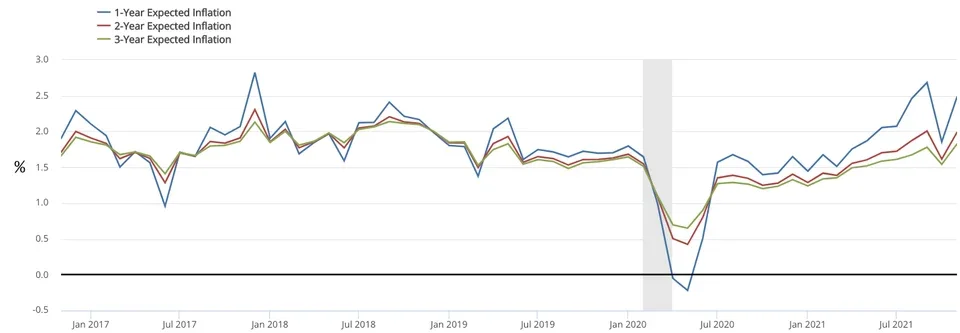
Illustrative material on inflation expectations; the supplied metadata does not specify a measure or period.
Credit: FRED · Public domain · sourceResized and converted to WebP; uncropped.
1. Meaning and economic significance
Inflation expectations refer to the rate of increase in the general price level that households, firms, investors and professional forecasters anticipate over a future period. They differ from current inflation perceptions, which describe what people believe has already happened to prices, and from official inflation, which is calculated using a specified basket and weights. Expectations also differ across horizons: a family’s outlook for the next three months may respond strongly to vegetable prices, while its longer-term outlook may depend more on confidence in economic policy.
Inflation means a rise in the general price level, not merely a rise in the price of one commodity. However, people often form their expectations from frequently purchased items such as milk, vegetables, fuel and transport. Consequently, perceived and expected inflation can differ substantially from published CPI inflation. Differences in household consumption baskets, location, income and information also matter.
Expectations affect decisions taken today because many economic contracts concern the future. Workers negotiate wages for the coming year, firms set prices before knowing all future costs, and lenders assess the purchasing power of future repayments. Expected inflation therefore helps connect current decisions with future inflation outcomes. It is an explanatory variable, not a substitute for observing actual prices.
- Inflation expectation: belief about future price increases.
- Inflation perception: assessment of current or recent price increases.
- Inflation uncertainty: lack of confidence about the future inflation outcome; it is distinct from the expected rate itself.
2. How expectations are formed and anchored
Adaptive expectations are formed largely from past experience. If inflation has remained high, people may expect it to stay high even after the original shock subsides. Rational expectations, in economic models, use available relevant information, including anticipated policy responses. Rationality does not imply perfect foresight: unexpected shocks still produce forecasting errors. In practice, limited attention, imperfect information and personal experience mean that actual expectations need not match either simple model.
Expectations are anchored when medium- and long-term inflation beliefs remain broadly consistent with a credible inflation objective. A temporary increase in onion or crude-oil prices can then raise near-term expectations without materially altering the longer-term outlook. Unanchoring occurs when people increasingly expect inflation to remain above or below the objective, or become less confident that policy will restore stability.
Central bank credibility depends on more than announcing a target. Consistent policy action, clear communication, operational capacity and a record of controlling inflation are important. Fiscal sustainability and effective supply management also support confidence. Anchoring does not mean every household reports the target number; survey responses can show persistent differences from official inflation. Policymakers assess changes, persistence, disagreement and sensitivity to shocks rather than relying on one survey reading alone.
- Backward-looking behaviour can make inflation persistent after the initial shock disappears.
- Forward-looking behaviour allows credible policy announcements to influence decisions before all policy effects materialise.
- Large differences between respondents indicate disagreement, but do not by themselves prove that every respondent is highly uncertain.
How a temporary shock can become persistent inflation
- 1. Food or fuel supply shock raises selected prices
- 2. Households and firms revise inflation expectations upward
- 3. Wage demands and anticipated input costs increase
- 4. Firms revise prices across a wider range of goods and services
- 5. Second-round effects increase inflation persistence
- 6. Credible policy and easing supply pressures help interrupt the feedback
3. Transmission to prices, wages and real interest rates
Expected inflation can affect aggregate demand. If households anticipate rapid price increases, some may bring forward purchases of durable goods. Others may reduce spending because they expect purchasing power to weaken or uncertainty to rise. The net effect depends on income, credit access, interest rates and the nature of the expected shock. It is therefore incorrect to assume that higher inflation expectations always increase consumption.
On the supply side, workers may seek higher nominal wages to protect real earnings, while firms may raise selling prices in anticipation of higher wages and input costs. If these adjustments reinforce each other, a wage-price spiral can develop. However, its strength depends on bargaining power, labour-market conditions, productivity and firms’ ability to pass on costs. In an economy with extensive informal employment, adjustment may also occur through lower real wages and reduced consumption.
Expectations influence borrowing and saving through the real interest rate. Approximately, the ex ante real interest rate equals the nominal interest rate minus expected inflation. A deposit yielding 7 per cent with expected inflation of 5 per cent offers an expected real return of roughly 2 per cent before taxes. If expected inflation rises while the nominal rate stays unchanged, the expected real return falls. This differs from the ex post real return, which uses inflation actually realised.
A supply shock initially raises particular prices. Its first-round effect becomes a broader second-round effect when wage negotiations, price revisions and other contracts incorporate higher expected inflation. Monetary policy cannot produce additional food or oil, but it can restrain demand pressures and reduce the risk that a temporary shock becomes persistent generalised inflation.
- Fisher relationship: nominal interest rates approximately reflect real interest rates plus expected inflation.
- Unexpected inflation can redistribute purchasing power between borrowers and lenders under fixed nominal contracts.
- In expectations-augmented Phillips-curve analysis, inflation depends partly on expected inflation, economic slack and supply shocks.
| Concept | Meaning | Illustration |
|---|---|---|
| Actual inflation | Observed change in an official price index | Year-on-year CPI inflation |
| Perceived inflation | An individual’s assessment of recent price increases | A household notices higher grocery bills |
| Expected inflation | Anticipated future increase in the general price level | A worker expects prices to rise over the next year |
| Anchored expectations | Longer-term beliefs remain consistent with the policy objective | A temporary fuel shock does not change the longer-term outlook materially |
| Inflation uncertainty | Uncertainty surrounding future inflation outcomes | A firm cannot confidently predict next year’s cost increases |
4. Measuring expectations in India
The RBI’s Inflation Expectations Survey of Households gathers qualitative and quantitative assessments from urban households. It covers current perceptions and expectations for three months and one year ahead, including assessments of overall prices and major product groups. Its coverage and respondents’ personal consumption experiences must be considered when interpreting results; it is not a direct forecast of the official CPI series or a complete representation of every Indian household.
The RBI’s Survey of Professional Forecasters provides another perspective through forecasts by specialists. Business surveys offer information about anticipated input costs, selling prices and demand. These sources answer different questions: households reveal lived price experiences, firms reveal prospective pricing behaviour, and professional forecasters provide model- and information-based projections.
Financial-market indicators can supplement surveys. In sufficiently developed markets, the difference between comparable nominal and inflation-indexed bond yields provides a break-even inflation measure. However, this spread also reflects inflation-risk and liquidity premiums, so it is not a pure measure of expected inflation. For India, market-based measures require particular caution because the depth and liquidity of relevant instruments are limited.
- Read survey direction and persistence alongside its numerical level.
- Distinguish expectations of the inflation rate from expectations that prices will simply rise.
- A decline in expected inflation usually means expected prices rise more slowly, not that the price level falls.
5. Monetary policy relevance and examination traps
The 2016 amendments to the Reserve Bank of India Act, 1934 established the statutory basis for India’s flexible inflation-targeting framework and Monetary Policy Committee. The primary objective of monetary policy is maintaining price stability while keeping in mind the objective of growth. For the notified period from 1 April 2021 to 31 March 2026, the inflation target was 4 per cent, with a lower tolerance limit of 2 per cent and an upper limit of 6 per cent. The target variable is headline CPI inflation.
Policy rates, liquidity conditions and communication influence expectations through borrowing costs, demand and confidence in the inflation objective. Supply-side actions, such as improving food logistics or releasing buffer stocks, may complement monetary policy when shortages drive prices. A credible response can limit second-round effects without pretending that interest-rate changes directly remove physical supply constraints.
For Prelims, distinguish disinflation from deflation: disinflation is a decline in the inflation rate, whereas deflation is a fall in the general price level. Similarly, lower actual inflation does not guarantee an immediate decline in expectations. Expectations can respond with a lag, especially after repeated price shocks. Anchored expectations improve policy effectiveness, but neither guarantee zero inflation volatility nor eliminate the need for policy action.
- The 2–6 per cent tolerance band should not be confused with a choice of any permanent target within that band.
- A central bank considers expectations alongside realised inflation, output conditions and the inflation outlook.
- Expectations are a channel of monetary transmission, not a price index.
How inflation expectations shape price dynamics
Inflation expectations concern future price increases, not the inflation rate currently measured by a price index. They affect decisions today: workers may seek higher nominal wages, firms may revise prices, and households may alter spending or saving. These responses can transmit an initial supply shock into broader inflation, although this is not automatic. Expectations are anchored when longer-term beliefs remain consistent with the monetary authority’s inflation objective despite temporary price fluctuations.
In India, repeated food and fuel price shocks can influence household beliefs and wage or price-setting decisions. The Reserve Bank of India uses surveys and other information to assess expectations, but household perceptions, professional forecasts and market-based indicators are not interchangeable. Survey responses depend on respondents’ consumption baskets, experiences and question wording; market indicators may also reflect risk and liquidity premia. Credible policy communication and action can help prevent temporary shocks from becoming persistent inflation. The supplied image metadata identifies the subject only; it cannot establish a trend, survey population or policy effect.
- Distinguish levels from rates: expecting lower inflation means expecting slower price increases, not necessarily falling prices.
- For spending and saving decisions, the expected real interest rate is approximately the nominal rate minus expected inflation; realised inflation determines the ex-post real rate.
- For Mains, separate first-round supply effects from second-round wage and pricing responses. Monetary policy cannot directly produce food or fuel, but it can influence demand and expectations.
Real-world case studies
India: food-price shocks and household expectations
Food and beverages carry about 45.9 per cent weight in the all-India CPI Combined basket with base year 2012. Repeated food-price shocks therefore affect both measured inflation and highly visible household purchases. RBI analysis frequently examines whether such shocks influence household expectations and spread to broader pricing behaviour. The lesson is to distinguish an immediate food-price increase from persistent second-round effects.
United States: the Volcker disinflation
Under Federal Reserve Chairman Paul Volcker, who took office in 1979, strong monetary tightening helped bring down the high inflation inherited from the 1970s. The adjustment involved severe economic costs, including recession and unemployment. It illustrates that restoring credibility after prolonged high inflation can be costly, and that expectations generally respond to sustained policy action rather than announcements alone.
Previous year questions
No source-linked PYQ is available here yet. Use the practice questions below.
Practice questions
Practice MCQ 1
A bank deposit offers a nominal annual interest rate of 7 per cent. Expected inflation rises from 4 per cent to 6 per cent, while the deposit rate remains unchanged. What happens to the approximate ex ante real interest rate?
- A. It rises from 3 per cent to 5 per cent.
- B. It falls from 3 per cent to 1 per cent.
- C. It remains unchanged at 7 per cent.
- D. It necessarily becomes negative.
Practice MCQ 2
With reference to inflation expectations, consider the following statements: 1. Anchored longer-term expectations can coexist with rising short-term expectations. 2. Rational expectations imply that inflation forecasts are always correct. 3. A break-even inflation measure may include liquidity and inflation-risk premiums. Which of the statements given above are correct?
- A. 1 and 2 only
- B. 2 and 3 only
- C. 1 and 3 only
- D. 1, 2 and 3
Practice MCQ 3
Which of the following best illustrates a second-round effect of an inflationary supply shock?
- A. A crop failure immediately raises the price of the affected vegetable.
- B. An increase in international crude-oil prices raises the cost of imported crude.
- C. Higher freight charges directly increase the delivered cost of a commodity.
- D. Persistent fuel-price increases lead to higher wage demands and widespread price revisions.
Mains practice · Inflation expectations can convert temporary price shocks into persistent inflation. Explain this mechanism and discuss the challenges of anchoring expectations in India. Answer in 250 words.
- Define inflation expectations and distinguish short-term from longer-term anchoring.
- Explain wage bargaining, firms’ price setting, real interest rates and second-round effects.
- Discuss India’s large food weight, recurrent supply shocks and heterogeneous household experiences.
- Explain the roles and limitations of household surveys, professional forecasts and market indicators.
- Assess credible monetary policy, communication and complementary supply-side measures.
- Conclude that expectations matter, but their effects depend on demand, bargaining power and policy credibility.
Further reading
- RBI: Monetary Policy Report, chapters on inflation outlook and expectations.
- RBI: Inflation Expectations Survey of Households, survey releases and methodology.
- RBI: Survey of Professional Forecasters on Macroeconomic Indicators.
- Reserve Bank of India Act, 1934: Chapter IIIF on monetary policy.
- NCERT: Introductory Macroeconomics, Money and Banking.
- MoSPI: Consumer Price Index releases and methodology.
- https://commons.wikimedia.org/wiki/File:Inflation_expectations.webp
Preparing for UPSC Civil Services? Get classroom teaching, answer-writing evaluation and mentorship at Pragnya IAS Academy, Ashok Nagar — see why aspirants choose us for IAS coaching in Hyderabad.