
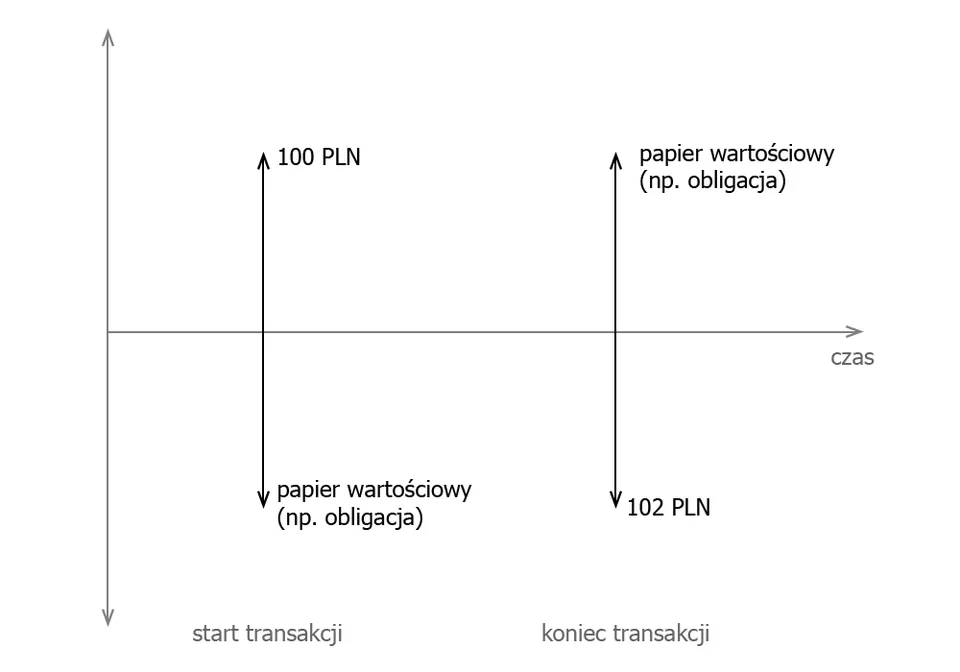
Illustrative schematic of transaction flows in a repo; not an RBI-specific policy diagram.
Credit: zespół uczestników projektu Wiki-Ekonomia · Public domain · sourceResized and converted to WebP; uncropped.
1. Meaning and mechanics of the repo rate
A repurchase agreement, or repo, combines two transactions: securities are sold today and repurchased on an agreed future date. In an RBI liquidity-injecting repo, an eligible bank receives funds against eligible securities, principally government securities, and undertakes to repurchase them. The difference between the initial and repurchase prices represents the interest cost. Economically, the transaction functions as collateralised borrowing by the bank rather than a permanent sale of its investment portfolio.
The policy repo rate is the rate associated with the RBI’s overnight liquidity provision under the Liquidity Adjustment Facility, or LAF. It provides the central reference point for the monetary policy interest-rate structure. However, the RBI also conducts variable-rate repo auctions and operations of different maturities. Their auction-determined rates should not be confused with the policy rate decided by the Monetary Policy Committee.
For illustration, if a bank borrows ₹100 crore for one day at an assumed annualised repo rate of 6 per cent, a simplified actual/365 calculation gives interest of approximately ₹1.64 lakh. This is only a numerical illustration, not a statement of the current policy rate. Access depends on eligibility, available collateral and the terms of the RBI operation; it is not an unlimited unsecured borrowing facility.
- From the borrowing bank’s perspective: temporary funds are obtained against securities.
- From the RBI’s perspective: a repo operation injects liquidity into the banking system.
- At maturity, repayment and the reversal of the securities transaction withdraw the liquidity originally supplied.
Timeline
June 2000
The full-fledged Liquidity Adjustment Facility began operating, strengthening the use of repo and reverse repo operations.
2016
Statutory amendments established the flexible inflation-targeting framework and MPC; the first MPC resolution was issued in October.
October 2019
External-benchmark linkage became mandatory for specified new floating-rate bank loans.
April 2022
The Standing Deposit Facility became the floor of the LAF corridor.
2. Monetary Policy Committee and inflation targeting
The Reserve Bank of India Act, 1934, was amended in 2016 to give statutory backing to the flexible inflation-targeting framework and the Monetary Policy Committee, or MPC. Section 45ZB provides for the MPC. Its six members comprise three RBI representatives, including the Governor, and three members appointed by the Central Government. Each member has one vote; the Governor has a casting vote in a tie. The MPC must meet at least four times annually, although six scheduled meetings a year are the usual practice.
The primary objective of monetary policy is maintaining price stability while keeping in mind the objective of growth. The Central Government, in consultation with the RBI, determines the inflation target once every five years. For April 2021–March 2026, the notified target was 4 per cent headline Consumer Price Index inflation, with a lower tolerance limit of 2 per cent and an upper limit of 6 per cent. These limits are not separate targets: the midpoint remains the policy anchor.
Under the notified failure conditions, average inflation staying above the upper limit or below the lower limit for three consecutive quarters triggers an accountability requirement. The RBI must report to the Central Government the reasons, proposed remedial measures and estimated time for returning inflation to target. Repo decisions therefore respond to the inflation outlook, expectations and growth conditions, rather than mechanically following one month’s inflation reading.
- A rate increase generally signals monetary tightening; a reduction generally signals monetary easing.
- An unchanged repo rate does not imply unchanged monetary conditions: liquidity, expectations and market rates can still shift.
- The MPC determines the policy rate, while the RBI manages operational liquidity and implements monetary policy.
Typical transmission of a repo-rate increase
- 1. MPC raises the policy repo rate
- 2. RBI operations guide overnight market rates towards the higher policy rate
- 3. Bank funding costs, lending rates and market yields adjust
- 4. Interest-sensitive consumption and investment moderate
- 5. Demand pressure and inflation expectations soften
- 6. Inflation tends to moderate with a lag, other factors remaining unchanged
3. Repo rate within the liquidity corridor
The RBI’s operational objective is to keep the weighted average call rate, or WACR, close to the policy repo rate. The call-money market involves overnight unsecured borrowing and lending among eligible institutions. Repo auctions, liquidity absorption operations and other tools help reconcile banking-system liquidity with this interest-rate objective. A repo-rate announcement and a liquidity injection are therefore distinct: the former changes the policy price of money, while the latter supplies funds through an operation.
The Standing Deposit Facility, or SDF, introduced in April 2022, allows eligible banks to place funds with the RBI without the RBI providing collateral. It replaced the fixed-rate reverse repo as the floor of the LAF corridor. The Marginal Standing Facility, or MSF, provides an overnight borrowing backstop for eligible banks and forms the upper bound. Under the normal corridor configuration, the SDF is 25 basis points below the repo rate and the MSF is 25 basis points above it, although the RBI can change the configuration.
The reverse repo remains an absorption instrument, but it is incorrect to describe the fixed-rate reverse repo as the current corridor floor merely because older textbooks do so. Likewise, Bank Rate is not the principal policy signalling rate. It is aligned with the MSF rate and is used as a reference for certain statutory penalties. The Cash Reserve Ratio and Statutory Liquidity Ratio are reserve requirements, not interest rates.
- One basis point equals 0.01 percentage point; a 50-basis-point increase means a rise of 0.50 percentage point.
- Repo injects liquidity; reverse repo absorbs liquidity against securities; SDF absorbs liquidity without collateral.
- Open market operations involve outright purchases or sales of government securities, unlike the reversal built into a repo.
| Instrument | Function | Key distinction |
|---|---|---|
| Policy repo rate | Reference rate for collateralised overnight RBI liquidity | Principal monetary policy signalling rate |
| Standing Deposit Facility | Absorbs funds placed with the RBI | Uncollateralised absorption; corridor floor |
| Marginal Standing Facility | Overnight liquidity backstop for eligible banks | Corridor ceiling; permits limited use of SLR holdings under prescribed rules |
| Fixed-rate reverse repo | Absorbs liquidity against securities | No longer the corridor floor after SDF introduction |
| Bank Rate | Reference rate with statutory and penal applications | Aligned with the MSF rate |
4. Transmission to loans, demand and inflation
Monetary transmission begins when a repo-rate change affects overnight and other short-term market rates. These changes influence banks’ funding costs, deposit pricing, lending rates and bond yields. Higher borrowing costs tend to moderate consumption financed by credit and business investment. Weaker demand can reduce pricing pressure, while a credible anti-inflation response can anchor expectations. Exchange-rate and asset-price channels may also operate, but their direction and strength depend on domestic and global conditions.
Transmission is neither instantaneous nor one-for-one. Banks finance lending substantially through deposits, many of which reprice only on maturity. Existing fixed-rate loans need not change when the repo rate changes. Floating-rate loans reset according to their contractual benchmark and reset schedule. Credit risk premiums, competition, banking-system liquidity, loan demand and bank balance-sheet health also influence the final lending rate.
From October 1, 2019, the RBI required banks, excluding regional rural banks, to link new floating-rate personal or retail loans and loans to micro and small enterprises to an external benchmark. The requirement was extended to medium enterprises from April 1, 2020. Permitted benchmarks include the policy repo rate and specified market benchmarks published by Financial Benchmarks India Private Limited. Thus, external-benchmark lending does not mean every covered loan must use the repo rate, although repo-linked lending is prominent.
- For repo-linked loans, a rate rise can increase the instalment, extend the loan tenure, or produce a combination, subject to applicable rules and contractual terms.
- Deposit rates may rise during tightening, benefiting some savers, while existing fixed-rate bond prices generally fall when market yields rise.
5. Policy limitations and examination distinctions
The repo rate primarily influences demand and expectations; it cannot directly produce food, remove transport bottlenecks or lower international crude-oil prices. Nevertheless, monetary tightening can limit the spread of an initial supply shock into broader prices and wages. Policy therefore involves judging the persistence of inflation against the costs of weaker output and employment. Fiscal measures, supply management and structural reforms may need to complement monetary policy.
For examination purposes, separate the nominal repo rate from a real interest rate, which adjusts a nominal rate for inflation or expected inflation. Also distinguish policy intent from actual outcomes: a repo cut seeks to support credit and demand, but weak borrower confidence or stressed banks can blunt its effect. Monetary easing does not guarantee higher investment, nor does tightening guarantee an immediate fall in measured inflation.
- A repo cut does not itself reduce CRR or SLR; these require separate decisions.
- The repo rate is an RBI policy rate, not the interest rate charged directly to households.
- Avoid memorising undated rate figures: verify the latest MPC resolution before the examination.
How a Repo Transaction Supports the Policy Repo Rate
The metadata describes a schematic of flows in a repo transaction. A repo combines a sale of securities with an agreement to repurchase them later at a predetermined price. Economically, it functions as collateralised borrowing: one party obtains cash against securities, while the other temporarily supplies funds. The difference between the sale and repurchase prices, relative to the cash advanced and transaction duration, determines the repo interest rate.
For India, this mechanism helps explain how the RBI supplies liquidity to eligible banks against eligible securities. However, a generic repo schematic does not establish the RBI’s operational rules, eligible collateral or prevailing policy rate. The policy repo rate is set by the Monetary Policy Committee and acts as a monetary-policy signal. Its transmission to deposit and lending rates depends on liquidity conditions, banks’ funding structures and credit demand; a policy-rate change therefore does not produce an immediate, identical change in every loan rate.
- Distinguish the instrument from its price: a repo is the transaction; the repo rate is the annualised interest rate associated with it.
- Liquidity injection is not permanent money creation: the repurchase leg reverses the initial cash transfer unless liquidity is renewed through further operations.
- For Prelims, the SDF absorbs liquidity without collateral; the MSF supplies overnight liquidity. Neither should be confused with the policy repo rate.
Real-world case studies
Pandemic easing in India, 2020
The RBI reduced the repo rate from 5.15 per cent to 4.40 per cent in March 2020 and to 4.00 per cent in May. These reductions accompanied liquidity measures and regulatory interventions responding to the pandemic shock. The episode illustrates that the policy rate is normally used alongside other instruments rather than in isolation.
Inflation-related tightening, 2022–23
Between May 2022 and February 2023, the MPC raised the repo rate from 4.00 per cent to 6.50 per cent, a cumulative increase of 250 basis points. Inflation pressures included commodity shocks and domestic price pressures. Repo-linked borrowers experienced faster loan repricing, demonstrating how benchmark design affects transmission.
Previous year questions
No source-linked PYQ is available here yet. Use the practice questions below.
Practice questions
Practice MCQ 1
With reference to an RBI repo operation that injects liquidity, consider the following statements: 1. The bank receives funds against eligible securities. 2. The transaction includes an agreement to reverse the securities sale. 3. The operation necessarily reduces the Cash Reserve Ratio. Which statements are correct?
- A. 1 and 2 only
- B. 2 and 3 only
- C. 1 and 3 only
- D. 1, 2 and 3
Practice MCQ 2
Which facility replaced the fixed-rate reverse repo as the floor of the RBI’s liquidity adjustment corridor in April 2022?
- A. Marginal Standing Facility
- B. Standing Deposit Facility
- C. Cash Reserve Ratio
- D. Bank Rate
Practice MCQ 3
A reduction of 25 basis points in the policy repo rate necessarily implies which of the following?
- A. Every existing home-loan rate falls immediately by 0.25 percentage point
- B. The policy repo rate falls by 0.25 percentage point
- C. Banks must reduce their statutory liquidity holdings
- D. Consumer price inflation falls in the following month
Mains practice · Explain how changes in the repo rate influence inflation and economic activity in India. Why may monetary transmission remain incomplete? Answer in 250 words.
- Define the repo rate and locate it within the MPC-led inflation-targeting framework.
- Trace transmission through money-market rates, bank funding, lending rates, demand and expectations.
- Explain the WACR operating target and the supporting role of liquidity management.
- Discuss deposit repricing, fixed-rate contracts, credit risk, bank health and weak credit demand.
- Assess external-benchmark lending as a transmission improvement.
- Conclude with policy lags and the need for complementary responses to supply-side inflation.
Further reading
- NCERT, Introductory Macroeconomics: Money and Banking.
- Reserve Bank of India Act, 1934, Chapter IIIF: Monetary Policy.
- RBI Monetary Policy Reports and Monetary Policy Committee resolutions: rbi.org.in.
- RBI, Standing Deposit Facility circular, April 8, 2022.
- RBI, External Benchmark Based Lending circular, September 4, 2019.
- RBI Annual Report: chapters on monetary policy and financial markets.
- https://commons.wikimedia.org/wiki/File:Repo_wykres_przyci%C4%99ty.png
Preparing for UPSC Civil Services? Get classroom teaching, answer-writing evaluation and mentorship at Pragnya IAS Academy, Ashok Nagar — see why aspirants choose us for IAS coaching in Hyderabad.