
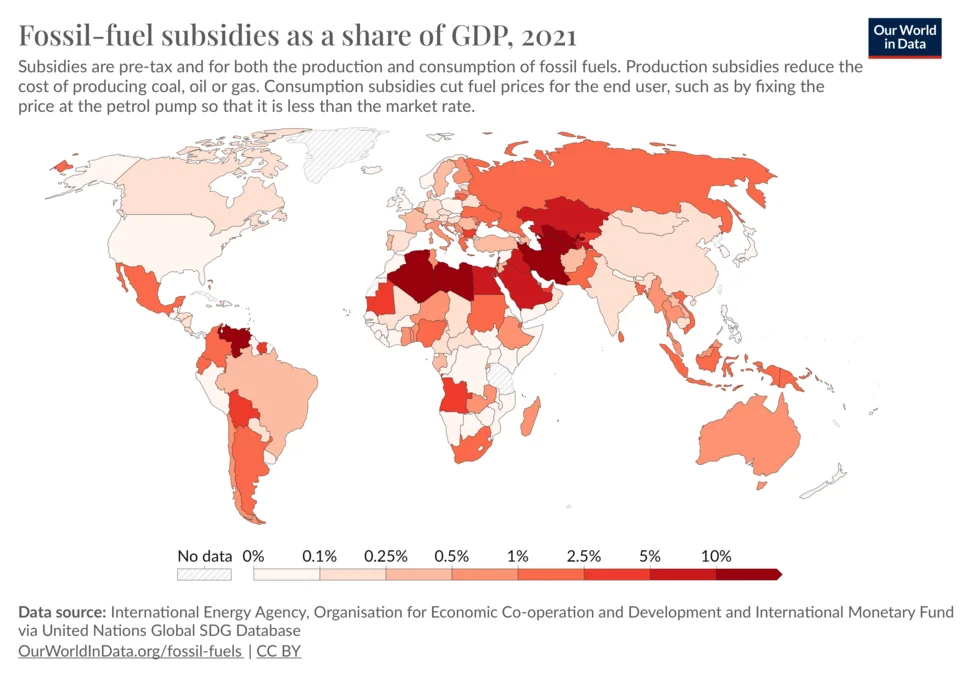
Fossil-fuel pre-tax subsidies as a share of GDP, 2021: comparative context for energy subsidies.
Credit: International Energy Agency, Organisation for Economic Co-operation and Development and International Monetary Fund via United Nations Global SDG Database · CC BY 4.0 · sourceResized and converted to WebP; uncropped.
1. Meaning, rationale and classification
A subsidy changes the price or return associated with an economic activity through government support. It may take the form of a cash payment, reimbursement to a supplier, subsidised credit, a tax concession or provision of a service below cost. In economic analysis, the concept is broader than the subsidy expenditure explicitly shown in a budget. Free or underpriced electricity, for instance, may involve costs borne initially by a public utility rather than an immediately visible government payment.
The main justifications are redistribution, provision of essential consumption, correction of market failures and support during shocks. Poor households may be unable to afford adequate nutrition even when food markets function. Activities generating positive externalities, such as vaccination or clean-energy adoption, may receive less private investment than is socially desirable. Temporary support can also cushion sharp increases in international commodity prices.
Subsidies may be consumer-oriented, such as subsidised food, or producer-oriented, such as assistance for equipment. Explicit subsidies are identifiable expenditure items; implicit subsidies arise through arrangements such as underpricing public services. Universal support covers all eligible users of a product, whereas targeted support is restricted by income, social category, location or another criterion. These classifications overlap: a targeted consumer subsidy may still be paid to the supplying enterprise.
- Price subsidy: lowers the price paid for a specified product.
- Income support: increases purchasing power without necessarily fixing the price of a particular product.
- Interest subvention: government bears part of the interest burden on an eligible loan.
2. Major subsidies in India
Food subsidy supports the procurement, storage, movement and distribution of foodgrains. The Food Corporation of India and participating state agencies undertake these operations. Broadly, subsidy meets the gap between the relevant economic cost and the receipts from distribution, alongside eligible operational and buffer-stock costs. Procurement at minimum support prices is linked to this system, but MSP itself is a price-support instrument rather than a cash transfer to every cultivator.
The National Food Security Act, 2013 provides coverage for up to 75 per cent of the rural population and 50 per cent of the urban population. Priority households are entitled to 5 kg of foodgrains per person per month; Antyodaya Anna Yojana households receive 35 kg per household per month. From January 2024, free foodgrains under the present Pradhan Mantri Garib Kalyan Anna Yojana arrangement were continued for five years. This should not be confused with the additional pandemic-period grain allocation.
Fertiliser subsidy makes selected fertilisers available below the price that would prevail without government assistance. Urea has a government-controlled maximum retail price. Under the Nutrient Based Subsidy scheme, introduced in 2010, subsidy rates are linked to the nutrient content of notified phosphatic and potassic fertilisers. Their selling prices are determined by companies subject to government oversight, including monitoring of price reasonableness. Urea remains outside NBS.
Petroleum subsidy policy has changed considerably over time. PAHAL uses bank transfers for eligible domestic LPG subsidy, while Pradhan Mantri Ujjwala Yojana focuses on LPG access for women from poor households. Connection assistance and recurring refill support are distinct. At the state level, agricultural electricity subsidies, transport concessions and interest support are also important.
Evaluating a subsidy
- 1. Identify the welfare objective or market failure
- 2. Define eligible beneficiaries and likely exclusion risks
- 3. Choose price support, cash, in-kind provision or another instrument
- 4. Estimate fiscal cost and distributional incidence
- 5. Establish delivery, audit and grievance systems
- 6. Review outcomes and modify poorly performing support
3. Budgetary treatment and economic effects
Major recurring subsidies appear under revenue expenditure in the Union Budget. Other things remaining equal, an increase raises revenue expenditure and can widen both the revenue deficit and fiscal deficit. However, the effect depends on whether the government raises revenue or reduces another expenditure item. Borrowing used to finance subsidies may increase future interest payments, creating pressure on subsequent budgets.
The amount printed in a budget is not always a complete measure of the economic subsidy. Payment arrears, losses absorbed by public enterprises, concessional guarantees and borrowing by implementing agencies can defer or obscure the immediate budgetary burden. Fiscal analysis should therefore examine actual expenditure, outstanding liabilities and the financial position of public utilities, not merely budget estimates. Tax concessions are also conceptually distinct from direct expenditure subsidies.
Subsidies affect allocation and distribution. Cheaper fertiliser may raise agricultural output, but an excessive price advantage for urea can encourage imbalanced nutrient application. Free or flat-rate farm electricity can weaken incentives to conserve groundwater. A general fuel subsidy may disproportionately benefit households consuming more fuel. The ultimate incidence depends on consumption, access and market conditions, not simply on the beneficiary named in the scheme.
Nevertheless, subsidy reduction is not automatically welfare-improving. Abrupt withdrawal may increase food and transport costs, reduce farm margins or harm households facing limited alternatives. Assessment should compare the social benefit of support with its fiscal cost and opportunity cost, including expenditure forgone on irrigation, public health, education or infrastructure.
| Arrangement | Immediate payment or delivery channel | Key distinction |
|---|---|---|
| Food subsidy | Support to FCI and participating state agencies | Consumers receive foodgrains rather than the entire subsidy amount in cash |
| Urea subsidy | Payments to eligible suppliers | Urea has a controlled MRP and is outside NBS |
| Nutrient Based Subsidy | Support for notified phosphatic and potassic fertilisers | Subsidy is linked to nutrient content |
| LPG DBT | Transfer to eligible consumers’ bank accounts | Eligibility and subsidy amount depend on prevailing policy |
| Agricultural electricity subsidy | State support to electricity distribution utilities | Utility losses and delayed compensation require separate scrutiny |
4. Targeting, delivery and subsidy reform
Targeting seeks to reduce inclusion errors, where ineligible people receive support, without increasing exclusion errors, where eligible people are left out. Beneficiary databases, transparent eligibility rules, periodic verification and accessible grievance mechanisms are therefore as important as digital authentication. Migrant workers, people with disabilities and households facing connectivity or banking problems need workable alternatives.
Direct Benefit Transfer can reduce diversion and duplicate claims, but different schemes use different arrangements. Under fertiliser DBT, subsidy is released to manufacturers or importers after retail sales are recorded through point-of-sale systems. It is not a general transfer of fertiliser subsidy into farmers’ bank accounts. Under LPG DBT, eligible subsidy is transferred to the consumer’s bank account.
Cash gives households flexibility and may reduce physical handling costs. In-kind support can protect access to essential goods when markets are thin, supplies are unreliable or prices rise rapidly. Reform should therefore be context-specific. Portability, social audits, reliable stocks, timely payments and inflation-sensitive benefit design can matter more than choosing cash or goods as an absolute principle.
5. WTO rules and examination distinctions
The WTO Agreement on Agriculture classifies domestic agricultural support according to its design and trade-distorting effects. Amber Box support is generally subject to reduction disciplines and applicable exemptions or thresholds. Green Box measures must meet specified conditions, including no or minimal trade distortion. Blue Box support is associated with production-limiting programmes. These are legal categories, not rankings of social desirability.
Article 6.2 provides special treatment for certain developing-country measures, including agricultural input subsidies generally available to low-income or resource-poor producers. Consequently, every Indian farm subsidy cannot automatically be labelled prohibited or trade-distorting. Public stockholding for food security raises additional questions about procurement at administered prices, calculation of support and the conditional interim protection agreed at Bali in 2013.
For Prelims, distinguish an instrument from its objective and recipient. A farm income transfer, a fertiliser price subsidy, procurement at MSP and subsidised crop credit may all support agriculture, but operate differently. Likewise, revenue expenditure is not synonymous with waste, and digital delivery does not by itself prove that a programme is well targeted.
Energy Subsidies: Measuring Support and Assessing Trade-offs
The supplied metadata identifies a comparison of fossil-fuel pre-tax subsidies relative to GDP. Such subsidies generally arise when consumer energy prices fall below supply costs, with the gap borne through budgetary transfers or other arrangements. Expressing support as a share of GDP helps compare its scale across economies, but does not reveal the absolute amount, beneficiaries or effectiveness. Pre-tax measures should not be confused with broader estimates that also count unpriced environmental damage and forgone consumption taxes.
For India, this provides comparative context for analysing fuel affordability, targeted LPG assistance and the fiscal consequences of shielding consumers from energy-price shocks. It is not, by itself, evidence of any particular Indian subsidy programme or expenditure. Energy support can protect vulnerable households, yet broad price suppression may disproportionately benefit larger consumers and weaken incentives for conservation. Reform therefore requires attention to targeting, reliable transfers, access to alternatives and transparent accounting. A direct benefit transfer changes the delivery mechanism; it does not necessarily eliminate the subsidy.
- Measurement: A subsidy-to-GDP ratio can change because subsidy expenditure changes, GDP changes, or both; it is not the subsidy’s share of government spending.
- Fiscal accounting: Explicit budget subsidies differ from costs absorbed by public enterprises or deferred through payment arrears; the latter can obscure the full fiscal burden.
- Evidence and evaluation: The metadata alone does not establish country rankings or methodology. Assess distributional benefits, fiscal costs and environmental effects separately rather than treating every subsidy as either wasteful or welfare-enhancing.
Real-world case studies
One Nation One Ration Card
Nationwide interstate portability under One Nation One Ration Card enables eligible NFSA beneficiaries to obtain their foodgrain entitlement from participating fair price shops outside their home location. This is particularly relevant to migrant workers. It improves the usability of an existing in-kind subsidy rather than creating an additional entitlement. Authentication failures, awareness and availability of stocks remain important implementation concerns.
Punjab: electricity support and groundwater
Punjab illustrates the interaction between subsidised agricultural electricity, assured procurement and water-intensive paddy cultivation. Low marginal pumping costs can encourage groundwater extraction. However, effective reform must address farm incomes and cropping incentives together through diversification, reliable power supply, water-saving practices and procurement alternatives.
Previous year questions
No source-linked PYQ is available here yet. Use the practice questions below.
Practice questions
Practice MCQ 1
Consider the following statements: 1. Urea is covered under India’s Nutrient Based Subsidy scheme. 2. Under fertiliser DBT, subsidy is released to manufacturers or importers based on recorded retail sales. Which of the statements given above is/are correct?
- A. 1 only
- B. 2 only
- C. Both 1 and 2
- D. Neither 1 nor 2
Practice MCQ 2
Other things remaining equal, an increase in a subsidy recorded as revenue expenditure would directly:
- A. Increase the revenue deficit and fiscal deficit
- B. Increase capital receipts and reduce the fiscal deficit
- C. Reduce revenue expenditure
- D. Leave the revenue deficit unchanged
Practice MCQ 3
Which of the following best describes an exclusion error in a targeted subsidy programme?
- A. An ineligible household receives the benefit
- B. An eligible household fails to receive the benefit
- C. The government replaces a price subsidy with cash
- D. The subsidy is paid to a supplying enterprise
Mains practice · Subsidy reform should improve welfare outcomes rather than merely reduce expenditure. Discuss with reference to food, fertiliser and agricultural electricity subsidies. Answer in 250 words.
- Explain redistribution, food security and market-failure rationales.
- Examine leakage, exclusion, fiscal liabilities and unequal incidence.
- Connect fertiliser pricing with nutrient imbalance and electricity pricing with groundwater extraction.
- Distinguish consumer cash transfers from supplier-based fertiliser DBT.
- Recommend portability, transparent accounting, grievance redress and gradual reform with compensatory support.
- Assess success through welfare, environmental and fiscal outcomes together.
Further reading
- NCERT, Introductory Macroeconomics: Government Budget and the Economy.
- Union Budget, Expenditure Profile: statements on subsidies and subsidy-related schemes.
- Department of Food and Public Distribution: NFSA, PMGKAY and One Nation One Ration Card.
- Department of Fertilizers: Nutrient Based Subsidy and Direct Benefit Transfer.
- Ministry of Petroleum and Natural Gas: PAHAL and Pradhan Mantri Ujjwala Yojana.
- WTO: Agreement on Agriculture, domestic support explanations and public stockholding decisions.
- https://commons.wikimedia.org/wiki/File:Fossil-fuel-subsidies-gdp-2021.png
Preparing for UPSC Civil Services? Get classroom teaching, answer-writing evaluation and mentorship at Pragnya IAS Academy, Ashok Nagar — see why aspirants choose us for IAS coaching in Hyderabad.