
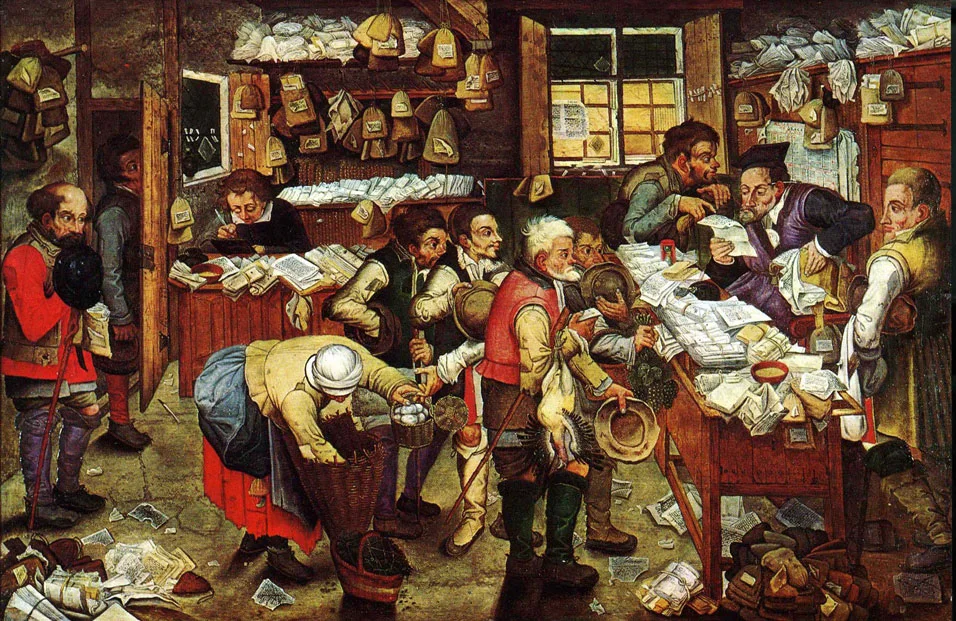
Paying the Tax, attributed in the metadata to Pieter Brueghel the Younger: a European comparative illustration of taxation.
Credit: Pieter Brueghel the Younger · Public domain · sourceResized and converted to WebP; uncropped.
1. Nature, purposes and principles of taxation
A tax is a compulsory payment imposed by a public authority under law, without a direct quid pro quo. Tax revenue finances public goods, infrastructure, welfare and administration. Unlike borrowing, it does not create a repayment liability for government. Fees are associated with particular services or regulatory functions, although an exact equivalence between the amount paid and the benefit received is not always necessary.
Taxation serves allocation, redistribution and stabilisation objectives. Taxes on tobacco can discourage consumption with adverse health effects; progressive income taxation can reduce post-tax inequality. During an economic slowdown, income-tax receipts ordinarily decline as incomes fall, cushioning disposable income. This automatic stabiliser operates without a fresh policy decision, unlike a discretionary tax-rate reduction.
Adam Smith’s classical canons are equality, certainty, convenience and economy. Modern tax design also emphasises simplicity, neutrality, transparency and revenue productivity. Horizontal equity requires similar treatment of people with comparable ability to pay; vertical equity permits different treatment of taxpayers with different capacities. A sound system balances these goals because stronger redistribution, administrative simplicity and economic efficiency do not always coincide.
- Tax base: the income, transaction, consumption, wealth or property on which tax is imposed.
- Tax rate: the liability applicable to a unit of the tax base.
- Tax expenditure: revenue forgone through exemptions, deductions, concessions or preferential rates relative to a benchmark tax structure.
Timeline
1991
The Tax Reforms Committee chaired by Raja J. Chelliah was established, contributing to reforms in rates, bases and administration.
2005
Most states introduced value-added tax on goods, replacing their earlier sales-tax systems.
2016
The 101st Constitutional Amendment created the constitutional framework for GST.
1 July 2017
GST was introduced in India.
2022
The Supreme Court clarified the non-binding character of GST Council recommendations in Mohit Minerals.
2. Classification, burden and behavioural effects
Direct taxes are imposed on income, profits or assets, with statutory liability resting on the assessed person. Indian examples include personal income tax and corporation tax. Indirect taxes are imposed on supplies, production or transactions and may be passed through prices; GST, customs duties and Union excise duties are examples. This classification does not establish who ultimately bears the economic burden: even a corporate tax can affect shareholders, workers and consumers.
A progressive tax has an average tax rate that rises with the tax base; a proportional tax maintains a constant average rate; a regressive tax takes a declining proportion as the base rises. Consumption taxes may be regressive relative to income because poorer households consume a larger share of their income. Exemptions for essentials and targeted public transfers can moderate this effect. A higher tax payment in rupees alone does not prove progressivity.
Ad valorem taxes are calculated as a percentage of value, whereas specific taxes are charged per physical unit. The division of a tax burden between buyers and sellers depends on relative elasticities: the less elastic side generally bears more. Taxation can also produce deadweight loss by discouraging mutually beneficial transactions. Corrective taxes may instead improve efficiency where market prices fail to reflect pollution or other external costs.
- Marginal tax rate applies to an additional unit of taxable income; average tax rate is total tax divided by the relevant income base.
- Tax evasion is illegal concealment or misreporting. Tax avoidance exploits legal arrangements, but abusive arrangements may be challenged through anti-avoidance provisions.
Simplified GST credit mechanism
- 1. A registered business purchases taxable inputs and receives a valid tax invoice.
- 2. It makes an outward taxable supply and calculates output GST.
- 3. It establishes eligible input tax credit subject to statutory conditions.
- 4. Eligible credit is set off against output liability under prescribed utilisation rules.
- 5. The remaining liability is discharged and the transaction is reported in returns.
3. Constitutional powers and fiscal federalism
Article 265 requires legal authority for taxation. Legislative competence is distributed through the Constitution and its Seventh Schedule. Parliament taxes income other than agricultural income, while states have competence over agricultural income. Parliament levies customs duties; states levy taxes such as those on vehicles and electricity within constitutional limits. Municipal property taxation depends on authority conferred through state legislation.
GST introduced a special arrangement. Article 246A gives Parliament and state legislatures power to legislate on GST, while Parliament has exclusive power over GST on inter-State supplies. Article 269A governs the levy and collection of inter-State GST and its apportionment. Article 279A establishes the GST Council. In Union of India v. Mohit Minerals, 2022, the Supreme Court held that Council recommendations are not binding, emphasising cooperative federalism.
The Finance Commission, constituted under Article 280, recommends the distribution of shareable Union taxes between the Union and states and among states. Gross Union tax revenue is not identical to the divisible pool. Cesses levied for specific purposes and Union surcharges are excluded from this pool. Consequently, an increase in their share can limit states’ automatic access to growing Union tax receipts.
- A cess is imposed for a specified purpose; a surcharge is an additional charge on an existing tax.
- In GST Council voting, the Union carries one-third of the total weighted votes and states collectively carry two-thirds; a decision requires at least three-fourths of weighted votes cast.
| Concepts | Distinction | Exam implication |
|---|---|---|
| Impact and incidence | Initial payment obligation versus ultimate economic burden | The person remitting tax need not bear its full burden. |
| Progressive and proportional | Rising versus constant average tax rate | Compare rates relative to the base, not absolute payments. |
| Zero-rated and exempt | Zero-rating preserves eligible credit benefits; exemption generally breaks the credit chain | Exports are zero-rated, not simply exempt. |
| Buoyancy and elasticity | Buoyancy includes policy effects; elasticity adjusts for them | Strong buoyancy alone does not prove improved compliance. |
| Gross tax revenue and divisible pool | The divisible pool excludes constitutionally specified items | Not every rupee collected by the Union is shareable with states. |
4. GST: operation, coverage and limitations
GST is a value-added tax operating through successive stages of supply. Eligible input tax credit allows a registered business to offset tax paid on inputs against output tax liability, subject to statutory conditions. This reduces cascading, or tax on tax. On an intra-State taxable supply, CGST and SGST generally apply; UTGST applies instead of SGST in specified Union territories. Inter-State supplies and imports attract IGST under the applicable framework.
As a destination-based tax, GST assigns revenue to the jurisdiction of consumption rather than production. Exports and qualifying supplies to Special Economic Zone units or developers are zero-rated. Zero-rating is not the same as exemption: zero-rated supplies can preserve eligible input-credit and refund benefits, whereas credit attributable to exempt supplies is generally unavailable or reversed.
GST did not subsume every indirect tax. Alcoholic liquor for human consumption is constitutionally outside GST. GST levy on petroleum crude, high-speed diesel, petrol, natural gas and aviation turbine fuel awaits the prescribed notification following a Council recommendation. Electricity duty, stamp duties and basic customs duty remain outside the GST framework. Composition arrangements simplify compliance for eligible small taxpayers but generally deny input tax credit.
- Common exam trap: GST is levied on supply, not merely on manufacture or sale.
- GST on imports does not eliminate basic customs duty.
- Tobacco can attract both GST and Union excise duty.
5. Revenue indicators and reform priorities
The tax-to-GDP ratio measures tax collections relative to economic output. Comparisons must specify whether they cover the Union alone or general government, including states. Tax buoyancy is the percentage change in tax revenue divided by the percentage change in nominal GDP. A value above one indicates faster revenue growth than nominal GDP. Tax elasticity attempts to isolate responsiveness after removing discretionary tax-policy changes.
A broader base, fewer unjustified exemptions and predictable administration can improve collections without repeatedly raising rates. Digital returns, information matching and invoice trails can deter evasion, but compliance costs, refund delays and litigation can burden firms. Tax deducted at source and tax collected at source are collection mechanisms, not separate taxes. Effective reform combines enforcement with taxpayer services, privacy protection and accessible dispute resolution.
- Interpret rising revenue carefully: inflation, economic recovery, policy changes and improved compliance can all contribute.
- The Laffer curve illustrates that very high rates may erode the tax base; it does not establish that every tax cut raises revenue.
Tax Collection, Incidence and Public Authority
The supplied title identifies a European painting concerned with tax payment or collection. It offers a comparative entry point into taxation as an exercise of public authority, not evidence about Indian fiscal institutions. The metadata alone cannot establish the tax involved, its legal basis, collection procedures or the burden on taxpayers. Its educational value is illustrative rather than documentary.
In India, Article 265 requires authority of law for both the levy and collection of a tax. Taxation must therefore be distinguished from voluntary contributions and from government borrowing, which creates repayment obligations. Taxes finance public services, support redistribution and can discourage activities with social costs. However, the person legally responsible for remitting a tax need not ultimately bear its economic burden. Producers may pass part of an indirect tax to consumers through prices, while market conditions determine how much is shifted.
- Legal liability versus economic incidence: statutory responsibility identifies who pays the government; relative demand and supply elasticities help explain who ultimately bears the burden.
- Direct versus indirect taxes: personal income tax and GST illustrate the distinction, but classification alone does not establish whether a tax system is progressive or regressive.
- Indian fiscal federalism: Parliament and State Legislatures exercise constitutionally allocated taxing powers. GST involves shared powers; the GST Council recommends policy but does not itself enact tax laws.
Real-world case studies
India: GST and the common market
GST subsumed several central and state indirect taxes, including service tax and most state VAT. Its credit mechanism reduced cascading across many goods and services. However, excluded products, blocked credits and compliance requirements show why a common tax framework does not automatically create a completely seamless credit chain.
Sweden: carbon taxation
Sweden introduced a carbon tax in 1991. It illustrates a corrective tax that puts a price on fossil-fuel emissions rather than taxing only income or transactions. Its design has evolved alongside other climate instruments, demonstrating the importance of coverage, distributional effects and complementary policies.
Previous year questions
UPSC Prelims 2017
Which advantages were associated with implementing GST? 1. Replacing multiple Union and state taxes and creating a national common market. 2. Drastically reducing the current account deficit and increasing foreign exchange reserves. 3. Enormously increasing economic growth and enabling India to overtake China in the near future.
- A. 1 only
- B. 2 and 3 only
- C. 1 and 3 only
- D. 1, 2 and 3
Practice questions
Practice MCQ 1
Consider the following statements: 1. Economic tax incidence is determined solely by the identity of the statutory taxpayer. 2. The less price-elastic side of a market generally bears a larger tax burden. Which is correct?
- A. 1 only
- B. 2 only
- C. Both 1 and 2
- D. Neither 1 nor 2
Practice MCQ 2
Consider the following statements: 1. Exports under GST are zero-rated. 2. Basic customs duty was subsumed under GST. 3. Alcoholic liquor for human consumption is outside GST. Which statements are correct?
- A. 1 and 2 only
- B. 2 and 3 only
- C. 1 and 3 only
- D. 1, 2 and 3
Practice MCQ 3
Tax receipts rise by 12% while nominal GDP rises by 8%. Which conclusion is justified?
- A. Tax buoyancy is 0.67.
- B. Tax buoyancy is 1.5.
- C. Tax elasticity must be 1.5.
- D. The tax-rate increase must have been 4 percentage points.
Mains practice · A good tax system must reconcile revenue adequacy, equity, efficiency and federal balance. Discuss with reference to India. Answer in 250 words.
- Define the four objectives and explain potential trade-offs.
- Discuss progressive direct taxes and the distributional effects of consumption taxes.
- Explain base broadening, exemption rationalisation and compliance simplification.
- Assess GST credit chains, exclusions and small-business compliance costs.
- Examine tax devolution, cesses, surcharges and cooperative federalism.
- Conclude with predictable rules, effective administration and taxpayer safeguards.
Further reading
- NCERT, Introductory Macroeconomics: Government Budget and the Economy.
- Constitution of India: Articles 246A, 265, 269A, 270, 271, 279A and 280; Seventh Schedule.
- Union Budget: Receipt Budget and statement on the revenue impact of tax incentives.
- Central Board of Indirect Taxes and Customs: GST Acts, rules and official guidance, cbic.gov.in.
- GST Council: constitutional provisions and official recommendations, gstcouncil.gov.in.
- Economic Survey: fiscal developments and public finance.
- https://commons.wikimedia.org/wiki/File:Pieter_Brueghel_the_Younger,_%27Paying_the_Tax_(The_Tax_Collector)%27_oil_on_panel,_1620-1640._USC_Fisher_Museum_of_Art.jpg
Preparing for UPSC Civil Services? Get classroom teaching, answer-writing evaluation and mentorship at Pragnya IAS Academy, Ashok Nagar — see why aspirants choose us for IAS coaching in Hyderabad.