
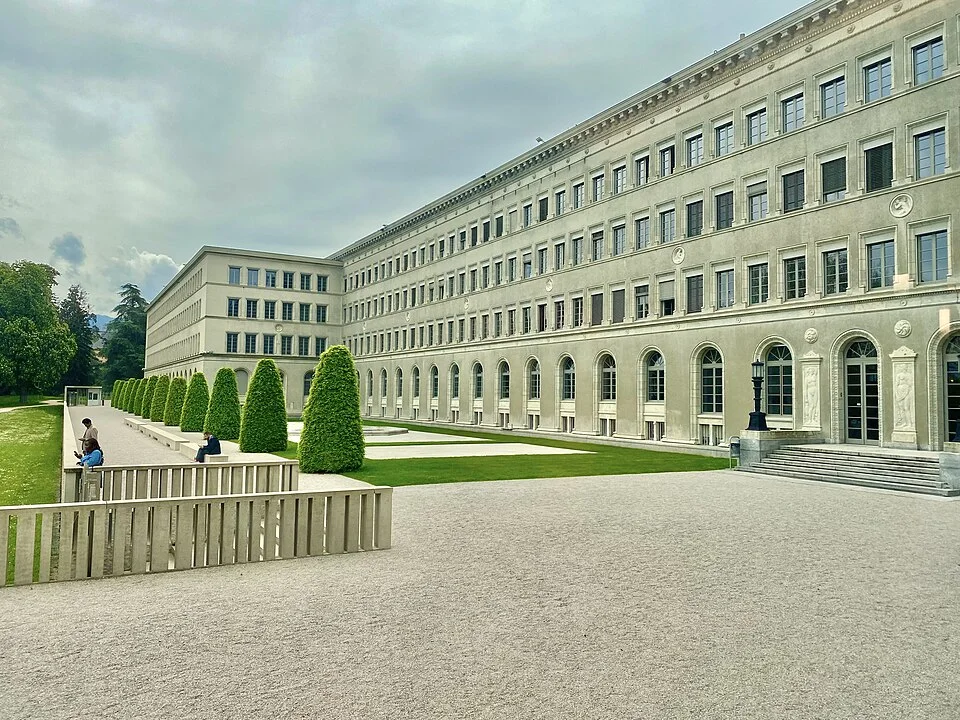
Centre William Rappard in Geneva, Switzerland, headquarters of the WTO.
Credit: Jérémy Toma · CC BY-SA 4.0 · sourceResized and converted to WebP; uncropped.
1. Origins, mandate and institutional structure
The General Agreement on Tariffs and Trade (GATT), signed in 1947 and provisionally applied from 1948, provided the principal framework for reducing tariffs after the Second World War. The Uruguay Round, conducted during 1986–1994, expanded negotiations beyond merchandise trade to services and intellectual property. Its outcome included the Marrakesh Agreement establishing the WTO. GATT did not simply disappear: GATT 1994 remains the central agreement governing trade in goods within the WTO framework.
The WTO administers covered agreements, supports negotiations, handles trade disputes, monitors trade policies through the Trade Policy Review Mechanism and provides technical assistance. Unlike the IMF and World Bank, it does not provide balance-of-payments loans or development project finance. Its objective is a predictable, rules-based trading system, not the immediate abolition of every tariff or regulatory restriction.
Below the Ministerial Conference, the General Council conducts regular business. It also meets as the Dispute Settlement Body and the Trade Policy Review Body. Separate councils oversee goods, services and intellectual property. Most WTO agreements bind all members; certain plurilateral agreements, such as the Agreement on Government Procurement, bind only their parties. India is not a party to that agreement.
Timeline
1947–1948
GATT was signed in 1947 and provisionally applied from 1948.
1986–1994
The Uruguay Round negotiated the framework that established the WTO.
1 January 1995
The WTO came into existence.
2001
The Doha Development Agenda was launched; the Doha Declaration on TRIPS and Public Health was adopted.
2013–2017
The Bali package included public-stockholding provisions and the Trade Facilitation Agreement; the latter entered into force in 2017.
December 2019
The Appellate Body became unable to hear new appeals because of vacancies.
2. Core principles and permissible exceptions
Most-favoured-nation treatment means that a trade advantage granted to one member must ordinarily be extended immediately and unconditionally to other members. It does not mean selecting a specially favoured trading partner. National treatment addresses discrimination inside the domestic market: once imported goods have entered, internal taxes and regulations should not protect domestic like products against them. Ordinary customs duties at the border are therefore not, by themselves, violations of national treatment.
Tariff bindings are commitments not to raise tariffs above scheduled ceilings. An applied tariff may be lower than the bound rate; consequently, raising an applied tariff does not automatically breach WTO rules. Transparency requires publication of trade measures and notifications under relevant agreements. Quantitative restrictions are generally prohibited under GATT, subject to specified exceptions.
Non-discrimination has qualified exceptions. Customs unions and free trade areas can receive preferential treatment under applicable WTO conditions. The Enabling Clause permits certain preferences for developing countries. General exceptions accommodate measures necessary for objectives such as protecting human, animal or plant life, provided their conditions are met and they are not disguised trade restrictions. Security exceptions and balance-of-payments provisions also exist. WTO rules thus constrain protectionism without eliminating legitimate public regulation.
Ordinary WTO dispute-settlement sequence
- 1. A member requests consultations
- 2. A panel is established if consultations fail
- 3. The panel examines the dispute and issues its report
- 4. Appeal may follow, but the Appellate Body is currently non-functional
- 5. An adopted ruling requires implementation
- 6. Continued non-compliance may lead to authorised suspension of concessions
3. Major agreements and trade remedies
The General Agreement on Trade in Services (GATS) recognises four modes of supply: cross-border supply, consumption abroad, commercial presence and presence of natural persons. Indian software delivered remotely illustrates Mode 1; a foreign tourist consuming services in India illustrates Mode 2; an overseas bank branch illustrates Mode 3; and temporary movement of a professional to supply a service illustrates Mode 4. Mode 4 is not a general right to permanent migration. Market-access and national-treatment obligations depend substantially on members’ scheduled commitments.
The Agreement on Trade-Related Aspects of Intellectual Property Rights (TRIPS) establishes minimum standards for intellectual property protection. Patent protection must generally be available for at least 20 years from filing. The 2001 Doha Declaration on TRIPS and Public Health affirmed members’ ability to use flexibilities, including compulsory licensing, to protect public health. The Agreement on Trade-Related Investment Measures (TRIMs) disciplines measures such as mandatory local-content requirements inconsistent with specified GATT obligations; it is not a comprehensive investment-protection treaty.
The Sanitary and Phytosanitary Measures Agreement addresses food safety and animal and plant health measures, emphasising scientific principles and risk assessment. The Technical Barriers to Trade Agreement covers technical regulations, standards and conformity-assessment procedures outside the SPS domain. The Trade Facilitation Agreement, effective from 22 February 2017, seeks faster movement, release and clearance of goods, including goods in transit.
Anti-dumping duties address dumping that causes material injury, following an investigation. Countervailing duties offset qualifying subsidies causing injury. Safeguards respond to increased imports causing or threatening serious injury, even without unfair pricing or subsidies. These instruments have distinct legal tests and should not be treated as interchangeable protectionist taxes.
| Category | Defining feature | WTO treatment |
|---|---|---|
| Amber Box | Trade-distorting support, including qualifying price support | Subject to applicable AMS disciplines and exemptions |
| Green Box | Support meeting Annex 2 conditions, such as qualifying research or infrastructure expenditure | Exempt from reduction commitments |
| Blue Box | Qualifying direct payments under production-limiting programmes | Exempt from reduction commitments |
| Article 6.2 | Specified developing-country investment and input subsidies | Exempt from domestic-support reduction commitments |
| De minimis | Support below applicable production-value thresholds | Excluded from Current Total AMS under specified conditions |
4. Agriculture, food security and India
The Agreement on Agriculture has three pillars: market access, domestic support and export competition. Domestic support is commonly explained through boxes. Amber Box measures are considered trade-distorting and are subject to relevant limits or reduction commitments. Green Box support must satisfy specified conditions, including no or minimal trade-distorting effects, and is exempt from reduction commitments. Blue Box support comprises qualifying direct payments under production-limiting programmes. Agriculture has no formally defined Red Box.
The Aggregate Measurement of Support (AMS) measures specified trade-distorting support. De minimis thresholds generally equal 5% of the relevant value of production for developed members and 10% for developing members, calculated separately for product-specific and non-product-specific support. Article 6.2 additionally exempts certain developing-country measures, including generally available agricultural investment subsidies and input subsidies generally available to low-income or resource-poor producers.
India’s procurement at administered prices and distribution through food-security programmes raise questions about market price support accounting. The use of fixed external reference prices based on 1986–1988 can produce large calculated support when compared with present administered prices. The 2013 Bali public-stockholding decision created a conditional peace clause for qualifying programmes of developing countries. A 2014 General Council decision clarified that protection would continue until a permanent solution is agreed and adopted. It is not an unconditional exemption for every agricultural subsidy or every WTO obligation.
India seeks a permanent public-stockholding solution, safeguards for vulnerable farmers and correction of historical subsidy asymmetries. The 2015 Nairobi decision addressed agricultural export subsidies with different implementation arrangements. Keep the developing-country G-33, associated with food security and agricultural flexibility, distinct from the G20 grouping of major economies.
5. Dispute settlement and contemporary reform challenges
WTO dispute settlement ordinarily proceeds from consultations to panel examination and possible appeal. Panel reports are generally adopted through negative consensus: adoption is blocked only if all members agree against it. The system therefore differs from ordinary consensus-based negotiations. The WTO does not normally impose fines; persistent non-compliance can ultimately lead to authorised suspension of concessions, subject to procedures.
Since December 2019, the Appellate Body has lacked the minimum membership needed to hear new appeals. Panels continue operating, but appeals into the non-functioning mechanism can prevent final resolution. Some members use interim appeal arbitration arrangements; these are not a universal replacement for the Appellate Body.
Reform debates concern agricultural subsidies, industrial subsidies, development flexibilities, digital trade, environmental measures and the effectiveness of consensus-based negotiations. Developing-country status is generally self-designated, but access to particular benefits can depend on agreement-specific provisions; least-developed-country status follows the United Nations classification. For India, the central challenge is preserving policy space for development while maintaining predictable market access for competitive exports.
WTO: Institutional Framework and India’s Trade Interests
The metadata identifies the Centre William Rappard as the WTO’s headquarters, making this an institutional illustration rather than evidence of trade outcomes. The WTO is a member-driven organisation: its Secretariat supports negotiations and administration but does not independently set countries’ trade policies. The Ministerial Conference is its highest decision-making body; the General Council conducts business between ministerial meetings and also meets as the Dispute Settlement Body and Trade Policy Review Body.
For India, WTO commitments shape the policy space available for agricultural support, food security, manufacturing and services exports. The Agreement on Agriculture distinguishes support according to its characteristics and potential trade effects; not every agricultural subsidy is prohibited. GATS concerns trade in services, including specified forms of temporary movement of service suppliers, rather than a general right to immigration. TRIPS establishes minimum intellectual-property standards while retaining public-health flexibilities. WTO rules therefore combine market-access commitments with conditions, exceptions and development-related provisions; they are not a mandate for unrestricted free trade.
- Non-discrimination has two distinct dimensions: most-favoured-nation treatment compares trading partners; national treatment compares foreign and domestic products or suppliers under the relevant agreement.
- Trade remedies are not interchangeable: anti-dumping addresses dumping, countervailing duties address subsidised imports, and safeguards address qualifying import surges, subject to applicable injury tests and procedures.
- Trade policy reviews promote transparency; they do not adjudicate disputes. For Mains, distinguish formal legal commitments from negotiating positions, implementation capacity and the practical enforceability of dispute rulings.
Real-world case studies
India’s solar domestic-content dispute
In India — Solar Cells, DS456, the United States challenged domestic-content requirements for certain solar cells and modules under India’s solar programme. WTO rulings adopted in 2016 found the challenged requirements inconsistent with national treatment and TRIMs obligations. The case illustrates that a renewable-energy objective does not automatically justify discrimination against imported equipment.
India’s use of the public-stockholding peace clause
In its notification for marketing year 2018–2019, India reported rice support exceeding the applicable 10% de minimis threshold and invoked the Bali peace clause. The example connects administered procurement prices, WTO support calculations and food-security policy. Protection depends on meeting the decision’s conditions, including transparency requirements.
Previous year questions
No source-linked PYQ is available here yet. Use the practice questions below.
Practice questions
Practice MCQ 1
With reference to WTO principles, consider the following statements: 1. Most-favoured-nation treatment ordinarily requires extending a trade advantage granted to one member to other members. 2. National treatment prohibits all customs duties on imported goods. 3. An applied tariff may be lower than its bound rate. Which statements are correct?
- A. 1 and 2 only
- B. 2 and 3 only
- C. 1 and 3 only
- D. 1, 2 and 3
Practice MCQ 2
Which of the following correctly describes Blue Box agricultural support?
- A. All subsidies provided by developing countries
- B. Qualifying direct payments under production-limiting programmes
- C. Export subsidies without any expenditure ceiling
- D. Government expenditure exclusively on agricultural research
Practice MCQ 3
An Indian consultant temporarily travels to another WTO member to provide a contracted service. This most directly illustrates which GATS mode?
- A. Mode 1: Cross-border supply
- B. Mode 2: Consumption abroad
- C. Mode 3: Commercial presence
- D. Mode 4: Presence of natural persons
Mains practice · A functioning WTO is important for India, but its rules must accommodate developmental priorities. Discuss with reference to agriculture and dispute settlement. Answer in 250 words.
- Explain the value of predictable market access and rules against unilateral discrimination.
- Discuss agricultural subsidy asymmetries and the 1986–1988 reference-price issue.
- Explain public stockholding, the conditional peace clause and the demand for a permanent solution.
- Assess how Appellate Body paralysis weakens enforceability.
- Recommend an effective appeals mechanism, transparent support rules and targeted development flexibilities.
Further reading
- WTO: Understanding the WTO, available at wto.org.
- WTO legal texts: GATT 1994, GATS, TRIPS and Agreement on Agriculture.
- WTO: Bali Decision on Public Stockholding for Food Security Purposes and the General Council Decision of 27 November 2014.
- Department of Commerce, Government of India: WTO-related documents and annual reports.
- NCERT, Indian Economic Development: Liberalisation, Privatisation and Globalisation: An Appraisal.
- https://commons.wikimedia.org/wiki/File:Centre_William-Rappard_1.jpg
Preparing for UPSC Civil Services? Get classroom teaching, answer-writing evaluation and mentorship at Pragnya IAS Academy, Ashok Nagar — see why aspirants choose us for IAS coaching in Hyderabad.