
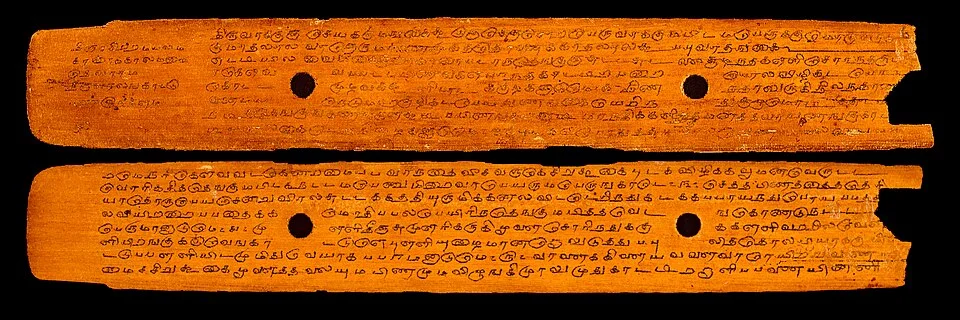
Later palm-leaf copy of the Tevaram, illustrating the transmission of Tamil Shaiva devotional hymns.
Credit: Ms Sarah Welch · CC0 · sourceResized and converted to WebP; uncropped.
Origins and the early southern traditions
Bhakti was not a religion founded at a particular moment. Devotional ideas occur in the Bhagavad Gita, while Puranic traditions, especially those associated with Vishnu, Krishna and Shiva, supplied narratives and theological frameworks. Medieval devotional movements made these relationships emotionally immediate through songs, pilgrimage and collective worship. They should therefore be understood as overlapping regional developments, not as a uniform movement that simply replaced earlier religious practices.
Between approximately the sixth and ninth centuries, Tamil poet-saints articulated powerful forms of devotion. The traditional canon recognises twelve Alvars devoted to Vishnu and sixty-three Nayanars devoted to Shiva. They travelled to sacred places, praised particular deities and linked religious experience to the Tamil landscape. Some compositions sharply criticised Jain and Buddhist traditions, revealing competition for patronage and religious authority in early medieval southern India.
Important Nayanars included Appar, Sambandar and Sundarar, whose hymns form the core of the Tevaram. Alvar compositions were collected in the Nalayira Divya Prabandham, a corpus of about four thousand verses. Andal, the only woman among the twelve Alvars, composed the Tiruppavai. Karaikkal Ammaiyar was an important woman Shaiva saint. Their works demonstrate women's presence in devotional literary traditions, although such participation did not eliminate patriarchal restrictions.
These traditions subsequently became closely connected with temples and royal patronage. Chola rulers supported Shaiva temples and the institutional recitation of hymns. Bhakti could therefore challenge particular religious authorities while also strengthening temple-centred worship, sacred geography and landed institutions.
Timeline
Approximately sixth–ninth centuries
Alvar and Nayanar poetry flourishes in the Tamil region.
Eleventh–twelfth centuries
Ramanuja develops Vishishtadvaita and strengthens Sri Vaishnava traditions.
Twelfth century
Basavanna and other Kannada vachana composers articulate Virashaiva devotion.
Thirteenth century
Madhva teaches Dvaita; Jnaneshwar composes the Jnaneshwari.
Fifteenth–sixteenth centuries
Kabir, Guru Nanak, Shankaradeva, Chaitanya and other teachers shape distinct regional devotional currents.
1604
Guru Arjan compiles the Adi Granth, incorporating Sikh Gurus' hymns and compositions of several other devotional figures.
Philosophy, forms of devotion and institutions
Saguna and nirguna are useful analytical categories, but their boundaries are not absolute. Saguna traditions address a personal deity with attributes, commonly Vishnu and his incarnations Rama and Krishna, or Shiva. Worship may involve images, temple rituals and accounts of divine exploits. Nirguna traditions emphasise a divine reality beyond physical form and often question image worship, external observances and exclusive religious identities. The same divine name can nevertheless appear in different theological settings.
Ramanuja, active in the eleventh and twelfth centuries, systematised Vishishtadvaita, or qualified non-dualism. In this understanding, souls and the material world are real and dependent on Brahman, identified with Narayana. Devotion and surrender, or prapatti, became central to Sri Vaishnava religious life. Madhva, the thirteenth-century teacher associated with Udupi, taught Dvaita, maintaining a fundamental distinction between God and individual souls. These philosophical schools should not be confused with the simpler contrast between saguna and nirguna poetry.
Vallabhacharya taught Shuddhadvaita and developed the Krishna-centred Pushtimarg, emphasising divine grace and loving service. Chaitanya's followers developed the theology of achintya-bhedabheda, or inconceivable difference and non-difference. Such diversity shows that bhakti was compatible with elaborate theology as well as accessible vernacular expression.
The twelfth-century Virashaiva or Lingayat movement in Karnataka, associated with Basavanna, Allama Prabhu and Akka Mahadevi, articulated devotion to Shiva through Kannada vachanas. Its teachers challenged caste distinctions and ritual privilege while valuing work and sharing. Although commonly studied alongside Bhakti, it possessed distinctive institutions and practices, including devotion centred on the personal linga.
A common pattern of devotional transmission, not a universal sequence
- 1. A teacher expresses devotion through songs, teaching and personal example
- 2. Followers transmit compositions orally in regional languages
- 3. Singing, pilgrimage and congregations widen participation
- 4. Communities develop institutions and compile authoritative texts
- 5. Later generations preserve, reinterpret and sometimes systematise the tradition
Northern and eastern devotional currents
Ramananda is associated with the spread of Rama devotion in northern India and with traditions of spiritual accessibility across caste boundaries. His dates and the historical reliability of disciple lists remain debated. Later hagiographies link several major saints to him, but these accounts should not be treated as conclusive contemporary evidence. Kabir, generally placed in the fifteenth century, emerged from the weaving milieu of Banaras and criticised both Brahmanical and Islamic ritual formalism.
Kabir's verses emphasise an inward search for the divine, the importance of the true guru and the inadequacy of religious labels without ethical transformation. His use of the name Ram need not indicate devotion to the epic prince of Ayodhya; it frequently denotes a formless divine. His compositions survive in several textual traditions, including the Bijak and the Guru Granth Sahib. Ravidas, associated with leatherworking communities, likewise affirmed spiritual dignity beyond caste and imagined Begumpura, a city free from sorrow and oppressive inequality.
Guru Nanak, born in 1469 at Talwandi, now Nankana Sahib in Pakistan, taught devotion to one God, remembrance of the divine name, honest work and sharing. He established a community at Kartarpur. His teachings must be understood within the emergence of the distinct Sikh tradition, not reduced to a simple mixture of Hinduism and Islam. Sangat and communal eating became important expressions of fellowship and equality under the Sikh Gurus.
In Bengal and Odisha, Chaitanya popularised ecstatic Krishna devotion and collective singing, or sankirtana, with Puri becoming an important centre. In Assam, Shankaradeva propagated Ekasarana devotion to Vishnu-Krishna. Namghars and satras became centres of worship, cultural activity and community life; Borgeets and Ankiya Naat enriched Assamese music and theatre.
| Saint or group | Region | Literary association | Devotional focus |
|---|---|---|---|
| Alvars | Tamil region | Nalayira Divya Prabandham | Vishnu |
| Basavanna | Karnataka | Kannada vachanas | Shiva |
| Kabir | Northern India | Bijak; verses in the Guru Granth Sahib | Formless divine |
| Shankaradeva | Assam | Borgeets; Ankiya Naat | Vishnu-Krishna |
| Tulsidas | Northern India | Ramcharitmanas in Awadhi | Rama |
| Tukaram | Maharashtra | Marathi abhangs | Vithoba |
Western India, vernacular literature and women devotees
Maharashtra's Varkari tradition centred on Vithoba at Pandharpur and recurring pilgrimage. Jnaneshwar's thirteenth-century Jnaneshwari presented the Bhagavad Gita in Marathi. Namdev's songs circulated beyond Maharashtra, and some entered the Guru Granth Sahib. Eknath and Tukaram further enriched Marathi devotional literature. Tukaram is particularly associated with abhangs, devotional verses that combine intense personal faith with criticism of hypocrisy and social pretension.
Saints from socially marginalised communities, including Chokhamela, brought experiences of exclusion into devotional expression. Janabai, associated with Namdev's household, represented everyday labour as a setting for divine companionship. Their poetry widened the social range of religious literature, although the persistence of caste restrictions demonstrates the gap between spiritual equality and everyday social practice.
In northern and western India, Mirabai expressed devotion to Krishna through songs that challenged expectations surrounding marriage, royal status and female obedience. Surdas is associated with Braj-language Krishna poetry, especially accounts of Krishna's childhood. Tulsidas composed the Ramcharitmanas in Awadhi during the sixteenth century. Its influence illustrates that devotional literature could greatly expand access to sacred narratives without necessarily rejecting established social norms.
Social significance, sources and examination approach
Bhakti expanded religious participation through regional languages, memorable verse and collective performance. It offered alternative grounds for spiritual authority: devotion, experience and ethical conduct could matter more than scholarship or birth. Yet saints differed considerably in their positions on caste, images, scripture and household life. Some rejected ritual privilege; others operated within temples and accepted significant elements of the existing social order.
Bhakti and Sufi traditions interacted through shared social environments, musical practices and vocabularies of love and remembrance. This interaction should not obscure their different theological lineages. Nor should Bhakti be explained solely as a reaction to Islamic rule: the Tamil traditions clearly predated the Delhi Sultanate. Political patronage, commercial networks, artisan communities and pilgrimage routes all shaped regional devotional cultures.
Sources include poems, inscriptions, temple records and hagiographies, or biographies of saints. Many compositions circulated orally before compilation, while later sectarian traditions sometimes attributed additional works to revered figures. For Prelims, prioritise reliable saint-region-language-deity pairings and distinguish a saint's teaching from later institutional developments. Avoid universal statements claiming that every Bhakti saint rejected caste, image worship, Sanskrit or household life.
Tevaram: Tamil Devotion, Poetry and Temple Worship
The Tevaram is directly relevant to the southern antecedents of the Bhakti movement. Its hymns to Shiva, associated principally with Appar, Sambandar and Sundarar, form the first seven books of the Tamil Shaiva canon, the Tirumurai. These compositions express devotion through praise, emotional attachment and engagement with sacred places. Their use of Tamil shows how regional languages became authoritative vehicles of religious expression, rather than merely translations of Sanskrit traditions.
The supplied metadata identifies this object as a later palm-leaf manuscript of hymns rooted in early medieval devotion and subsequently compiled into a canonical collection. Composition, compilation and manuscript copying must therefore be distinguished: this copy is evidence of textual transmission, not an original manuscript from the saints’ lifetimes. The metadata also describes musical guidance, connecting the text with sung worship. In Indian history, this combination of poetry, performance and temple institutions helps explain Bhakti’s durability. It also cautions against treating all Bhakti as opposition to temples or organised religion.
- Distinguish Nayanars, associated with Tamil Shaiva devotion, from Alvars, associated with Tamil Vaishnava devotion; both are important southern Bhakti traditions.
- Shiva-centred hymns illustrate devotion to a named deity; the saguna–nirguna distinction is useful but does not exhaust regional theological differences.
- Vernacular participation did not automatically abolish caste hierarchy. Assess devotional ideals, social practices and institutional patronage separately rather than assuming uniform social equality.
Real-world case studies
Pandharpur pilgrimage and the Varkari tradition
The recurring wari pilgrimage to Pandharpur in Maharashtra brings devotees together around Vithoba, saint poetry and collective singing. Palkhi processions associated with Jnaneshwar and Tukaram illustrate the continuing institutional life of medieval devotional traditions. Shared devotion created spaces of fellowship, but should not be equated with the disappearance of caste inequality.
Assam's satras and namghars
The institutions associated with Shankaradeva and his successors connected religious instruction with music, drama and community gathering. Satras on Majuli became notable centres of this heritage. Sattriya, recognised by the Sangeet Natak Akademi as a classical dance tradition in 2000, demonstrates Bhakti's enduring contribution to Indian performing arts.
Previous year questions
No source-linked PYQ is available here yet. Use the practice questions below.
Practice questions
Practice MCQ 1
Consider the following pairs: 1. Andal — Tiruppavai; 2. Basavanna — Kannada vachanas; 3. Tulsidas — Jnaneshwari. Which of the pairs given above are correctly matched?
- A. 1 and 2 only
- B. 2 and 3 only
- C. 1 and 3 only
- D. 1, 2 and 3
Practice MCQ 2
With reference to medieval devotional traditions, consider the following statements: 1. The Tamil Alvars and Nayanars predated the establishment of the Delhi Sultanate. 2. Every Bhakti tradition rejected image worship. 3. Devotional compositions circulated through oral performance as well as written compilations. Which of the statements given above are correct?
- A. 1 only
- B. 2 and 3 only
- C. 1 and 3 only
- D. 1, 2 and 3
Practice MCQ 3
Namghars, Borgeets and Ankiya Naat are most closely associated with which of the following?
- A. Shankaradeva's devotional tradition in Assam
- B. Ramanuja's philosophical tradition in Tamil Nadu
- C. Kabir's devotional tradition in Banaras
- D. Basavanna's movement in Karnataka
Mains practice · The Bhakti movement widened religious participation without uniformly overturning the social order. Discuss with regional examples. Answer in 250 words.
- Introduce Bhakti as diverse regional traditions rather than a centrally organised movement.
- Explain vernacular expression, congregational singing and devotion-based spiritual authority.
- Use Kabir, Ravidas and Chokhamela to examine critiques of hierarchy and exclusion.
- Discuss women's voices through Andal, Akka Mahadevi, Janabai and Mirabai.
- Contrast radical criticism with temple patronage, institutionalisation and continuing caste practices.
- Conclude that cultural and spiritual accessibility did not necessarily produce structural social equality.
Further reading
- NCERT, Themes in Indian History, Part II: Bhakti-Sufi Traditions.
- NCERT, Our Pasts–II: Devotional Paths to the Divine.
- Satish Chandra, Medieval India: From Sultanat to the Mughals, Parts I and II.
- Sangeet Natak Akademi, official resources on Sattriya dance: sangeetnatak.gov.in.
- https://commons.wikimedia.org/wiki/File:11th_century_Tevaram,_18th_century_palm_leaf_manuscript.jpg
Preparing for UPSC Civil Services? Get classroom teaching, answer-writing evaluation and mentorship at Pragnya IAS Academy, Ashok Nagar — see why aspirants choose us for IAS coaching in Hyderabad.