

Dadabhai Naoroji, 1892.
Credit: R.M. Richardson & Co · Public domain · source

East India House in Leadenhall Street, London as drawn by Thomas Hosmer Shepherd, c.1817.
Credit: Thomas Hosmer Shepherd · Public domain · source
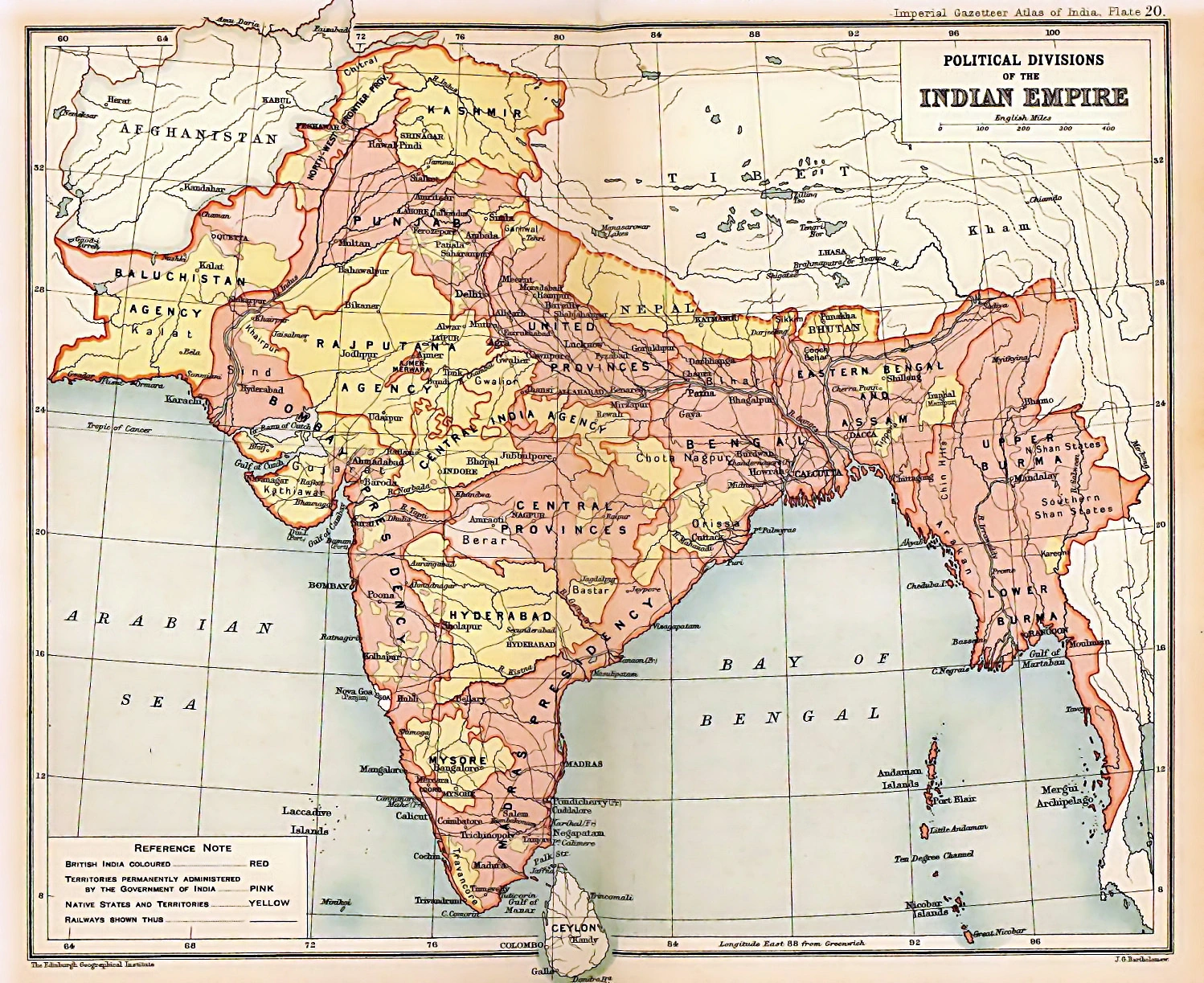
Map study
British Indian Empire in 1909: historical provinces and princely states, not contemporary Indian state boundaries.
- Read the source date and legend before interpreting territorial extent.
- Compare core regions, neighbouring powers and geographic barriers; historical borders and influence are approximate and changed over time.
Credit: Edinburgh Geographical Institute; J. G. Bartholomew and Sons · Public domain · sourceConverted to WebP on an opaque white background; proportionally resized without cropping. Original cartography and legend retained.
Meaning and historical background
In nationalist economic analysis, the drain of wealth meant a persistent transfer of income and resources from India to Britain for which India received no corresponding material return. It was not simply the export of goods or the existence of foreign trade. An ordinary export can finance imports or create a financial claim abroad. The objection arose when Indian goods, taxes and savings supported payments benefiting the ruling country without generating equivalent purchasing power or productive assets within India.
Before establishing territorial power, European trading companies generally had to bring bullion or other means of payment to purchase Indian textiles and other commodities. The Company's victory at Plassey in 1757 widened opportunities for extracting political payments and private fortunes. The acquisition of the Diwani in 1765 marked a major institutional change: revenues collected in Bengal, Bihar and Orissa could now finance the Company's purchases of Indian goods for shipment abroad.
The Company's commercial term investment could therefore mean goods purchased with Indian revenues for export, not investment in Indian factories or infrastructure. After the transfer of government to the Crown in 1858, the channels changed but did not disappear. Salaries, pensions, debt servicing, military charges and official expenditure in Britain sustained continuing transfers. Distinguishing the early Company phase from the later bureaucratic and financial phase helps explain the drain as a changing institutional process.
Timeline
1757
The Battle of Plassey strengthens Company influence in Bengal and opens greater opportunities for political extraction.
1765
The Company acquires the Diwani of Bengal, Bihar and Orissa, enabling revenue-financed export purchases.
1858
Government passes from the Company to the Crown; official and financial channels of external transfer continue.
1867
Naoroji presents England's Debt to India, an important early formulation of his drain argument.
1901
Publication of Naoroji's Poverty and Un-British Rule in India.
1902–1904
R. C. Dutt publishes his major economic histories of British India.
Economic nationalists and the drain theory
Dadabhai Naoroji developed the most influential explanation of the drain through speeches, calculations and writings from the 1860s onward. His paper England's Debt to India, presented in 1867, helped formulate the argument, while Poverty and Un-British Rule in India, published in 1901, brought together his mature critique. He argued that India's poverty could not be explained merely by population pressure or supposed Indian backwardness; the economic consequences of foreign government had to be examined.
Naoroji stressed the difference between domestic and foreign rulers. Income appropriated by a ruler who lived and spent within India could circulate within the country, although its distribution remained unequal. Income remitted abroad was removed from that circulation. European officials often earned in India, saved abroad and retired in Britain. Exclusion of Indians from senior employment therefore caused both a financial loss and a loss of administrative experience and opportunity.
R. C. Dutt placed the drain within a broader economic history involving land revenue, trade policy, agriculture and industrial decline. M. G. Ranade emphasised industrial development and the need to overcome structural economic weakness. These writers differed in emphasis and calculation, but together established an economic critique of colonialism based on budgets, official statistics and parliamentary evidence. Their work made poverty a political question rather than an unavoidable natural condition.
Revenue-financed export purchases under Company rule
- 1. The Company collects territorial revenues in India.
- 2. Part of these revenues finances purchases of Indian goods.
- 3. The goods are exported and sold abroad.
- 4. Overseas proceeds accrue to the Company rather than returning as equivalent imports for India.
- 5. Indian resources support accumulation abroad instead of remaining available for domestic use.
Principal channels and the machinery of transfer
Under Company rule, territorial revenues financed export purchases, while gifts, payments and private fortunes accumulated by Company servants also moved abroad. Under Crown rule, nationalists focused on Home Charges: expenditure incurred in Britain but charged to India. Major components included pensions and furlough allowances, interest on sterling debt, India Office expenditure and the purchase of stores. European officials' private savings and remittances were additional channels and should not all be treated as identical to official Home Charges.
Military expenditure was another contentious area. Economic nationalists objected when Indian revenues bore costs serving wider British imperial interests rather than India's own requirements. Foreign business profits and interest payments also figured in discussions of the drain. However, an important analytical distinction is necessary: interest on genuinely productive foreign investment is not automatically an uncompensated transfer. Critics questioned the terms of borrowing, guarantees, allocation of risk and whether the benefits justified the burdens imposed.
Council Bills provided an important mechanism for settling Britain's obligations connected with India. The Secretary of State sold bills in London for sterling; holders could receive rupees from Indian treasuries. Merchants and banks used these bills in settling payments for Indian exports. The sterling proceeds helped meet Home Charges in Britain, while corresponding rupee payments came from Indian resources. The bills were a financial instrument, not a separate commodity export or an independent category of taxation.
Consequently, India's excess of merchandise exports over imports could help finance official charges and private remittances abroad. Nationalists called attention to this unrequited component of exports. For examination purposes, however, an export surplus alone does not prove a drain: the full balance of payments also includes services, income payments, capital movements and transfers of bullion.
| Concept | Meaning | Examination distinction |
|---|---|---|
| Drain of wealth | External transfer without an equivalent return to India | Broader than direct plunder |
| Home Charges | Expenditure in Britain charged to Indian revenues | A major official channel, not the entire drain |
| Council Bills | Sterling-purchased bills payable in rupees in India | A settlement mechanism, not a separate tax |
| Export surplus | Merchandise exports exceeding merchandise imports | Not by itself proof of national enrichment or drain |
| Deindustrialisation | Decline of industrial activities and artisan employment | Related to, but distinct from, external resource transfer |
Economic consequences and debates over measurement
The central nationalist argument concerned capital formation. Resources transferred abroad were unavailable for investment in irrigation, agricultural improvement, industry, education or public health within India. The drain also reduced domestic demand and savings. Its burden was especially serious in a low-income economy where land revenue and other taxes absorbed a significant part of many households' cash resources. It thus compounded, rather than single-handedly explained, agrarian distress and economic stagnation.
Drain and deindustrialisation must be distinguished. Deindustrialisation concerned the decline of particular manufacturing activities and changes in employment, especially among artisans facing machine-made imports and altered markets. Drain concerned the external appropriation of income and resources. Colonial trade policy, revenue demands, industrial competition and external transfers could reinforce one another, but they were not interchangeable concepts. Likewise, famines involved crop failures, purchasing-power collapse, market conditions and relief policy; drain was a structural factor, not a complete explanation.
There is no single uncontested numerical estimate. Contemporary calculations varied according to period, the treatment of private remittances, and whether particular payments were regarded as compensation for services or as extraction. Official statistics were also incomplete. British defenders cited administration, security, railways and foreign capital as benefits. A careful assessment asks who paid, who benefited, what alternatives existed, and whether decisions were accountable to Indians, rather than assuming either that every overseas payment was drain or that every payment purchased an equivalent benefit.
Political significance and examination approach
The theory supplied early Indian nationalism with a powerful common explanation for poverty across regional and social divisions. It challenged claims that British rule necessarily brought prosperity and connected everyday economic hardship with decisions about taxation, expenditure and employment. Early Congress demands for Indianisation of higher services, simultaneous civil service examinations in India and Britain, lower military expenditure and greater legislative scrutiny of budgets reflected this critique.
Its political implications deepened over time. If the drain resulted from the priorities of a foreign government, administrative concessions alone could not fully remove it; greater Indian control over public finance and ultimately self-government became logical remedies. For Prelims, focus on Naoroji, the 1765 revenue transition, Home Charges, Council Bills and the meaning of unrequited exports. Avoid equating the drain with only plunder, only land revenue, or a British merchandise trade surplus with India.
Real-world case studies
Bengal after the acquisition of Diwani
After 1765, the Company's revenue authority allowed it to purchase export commodities using taxes collected locally, reducing its need to bring bullion for those purchases. This illustrates the conversion of political control into commercial advantage. Indian producers could receive payment, yet the purchasing funds originated in Indian taxation while the exported goods generated proceeds abroad.
Guaranteed railway companies
Early railway arrangements commonly guaranteed private British investors a return of about 5 per cent, with shortfalls borne by Indian revenues. Imported equipment and overseas financial payments further connected railway development to Britain. Railways provided transport benefits, but their financing raised nationalist objections about public risk and private returns. The case demonstrates why infrastructure benefits and the distribution of costs must be assessed separately.
Previous year questions
No source-linked PYQ is available here yet. Use the practice questions below.
Practice questions
Practice MCQ 1
With reference to the drain of wealth, consider the following statements: 1. The acquisition of Diwani enabled the Company to finance export purchases from Indian revenues. 2. Every merchandise export surplus necessarily constitutes a drain of wealth. 3. Home Charges included pensions payable in Britain from Indian revenues. Which of the statements given above are correct?
- A. 1 and 2 only
- B. 1 and 3 only
- C. 2 and 3 only
- D. 1, 2 and 3
Practice MCQ 2
Council Bills in colonial India's financial system were primarily:
- A. Legislative proposals imposing customs duties
- B. Bonds issued exclusively to Indian cultivators
- C. Bills sold for sterling in London and payable in rupees in India
- D. Currency notes issued by princely states
Practice MCQ 3
Which statement best captures the distinction between drain of wealth and deindustrialisation?
- A. Drain concerns external resource transfer, while deindustrialisation concerns decline in industrial activity.
- B. Drain concerns only agriculture, while deindustrialisation concerns only railways.
- C. Drain began only after 1858, while deindustrialisation ended in 1858.
- D. Both terms refer exclusively to imports of British textiles.
Mains practice · Explain the principal mechanisms of the drain of wealth from colonial India. How did the drain theory contribute to the development of Indian economic nationalism? Answer in 250 words.
- Define drain as transfer without an equivalent economic return, not merely foreign trade.
- Explain the transition from Company revenue-financed purchases to Crown-era official and financial transfers.
- Discuss Home Charges, official remittances, imperial expenditure and Council Bills.
- Connect the drain with reduced capital formation and limited domestic demand, while distinguishing deindustrialisation.
- Assess Naoroji's and Dutt's contributions and acknowledge measurement difficulties.
- Link the critique to Indianisation, budget accountability and demands for self-government.
Further reading
- Dadabhai Naoroji, Poverty and Un-British Rule in India.
- R. C. Dutt, The Economic History of India under Early British Rule and The Economic History of India in the Victorian Age.
- Bipan Chandra, India's Struggle for Independence, chapter on the economic critique of colonialism.
- Bipan Chandra, Modern India, old NCERT textbook.
- NCERT, Our Pasts–III, chapters Ruling the Countryside and Weavers, Iron Smelters and Factory Owners.
Preparing for UPSC Civil Services? Get classroom teaching, answer-writing evaluation and mentorship at Pragnya IAS Academy, Ashok Nagar — see why aspirants choose us for IAS coaching in Hyderabad.