
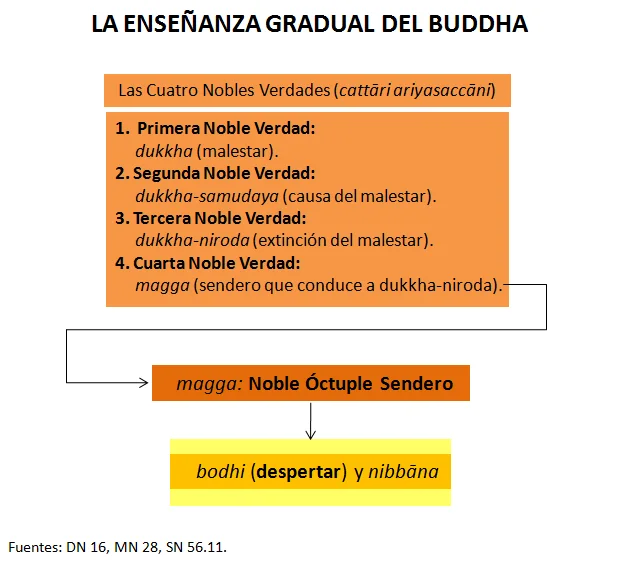
Illustration of the Four Noble Truths, identified by Spanish-language metadata.
Credit: Ramo Moraloj-Kastelo · CC BY-SA 4.0 · sourceResized and converted to WebP; uncropped.
1. Historical setting and textual foundation
Buddhism emerged within the shramana milieu of the middle Ganga plain during the first millennium BCE. Renunciant groups debated action and rebirth, liberation, austerity and the authority of Vedic tradition. Siddhartha Gautama, the Buddha, taught within this wider intellectual environment. His precise dates remain debated; the sixth–fifth centuries BCE are the conventional setting used in many Indian history textbooks.
According to Buddhist tradition, after attaining awakening at Bodh Gaya, the Buddha delivered his first sermon to five former companions at the Deer Park at Isipatana, now Sarnath in Uttar Pradesh. This event is remembered as dharmachakrapravartana, or setting the wheel of dhamma in motion. The sermon rejects indulgence in sensual pleasure and extreme self-mortification, presenting the Middle Way and the Four Noble Truths.
A principal source is the Dhammacakkappavattana Sutta in the Samyutta Nikaya of the Pali Sutta Pitaka. Versions also survive in other Buddhist textual traditions. These canonical collections were transmitted orally before being written down, so their wording should not be treated as a contemporary transcript. The Four Noble Truths nevertheless provide a foundational framework recognised across Buddhist traditions, although their interpretation and prominence vary.
- Sarnath represents the first teaching; Bodh Gaya represents awakening; Kushinagar represents the Buddha’s final passing.
- The Sutta Pitaka contains discourses; the Vinaya Pitaka chiefly concerns monastic discipline.
2. Dukkha and samudaya: the problem and its origin
The first truth concerns dukkha, often translated as suffering, but also conveying dissatisfaction, stress or unsatisfactoriness. The first-sermon account includes birth, ageing, illness and death; association with the disliked; separation from the liked; and not obtaining what one wants. It summarises dukkha through the five aggregates subject to clinging: bodily form, feeling, perception, mental formations and consciousness.
Dukkha does not mean that every moment is painful or that Buddhism denies happiness. Pleasant experiences occur, but they change and cannot provide permanent security. Buddhist analysis distinguishes ordinary pain, dissatisfaction arising from change, and the underlying instability of conditioned existence. The first truth therefore asks the practitioner to understand experience realistically rather than merely adopt a pessimistic attitude.
The second truth, samudaya, identifies craving, or tanha, as the origin of dukkha. The canonical formulation distinguishes craving for sensual pleasures, craving for continued existence or becoming, and craving for non-existence. Craving is described as leading to renewed existence and accompanied by delight and attachment. Its significance lies in compulsive grasping, not simply in having any preference or undertaking purposeful activity.
Craving operates within a wider causal account involving ignorance, feeling, clinging and becoming. It should not be confused with every form of aspiration: wholesome effort towards learning, ethical conduct and liberation remains essential to Buddhist practice. For examination purposes, 'all desire must be destroyed' is less precise than 'craving and attachment must be overcome'.
- Dukkha is the condition to be understood, not a punishment imposed by a creator.
- Samudaya concerns the arising of dukkha; it is not the term for liberation.
Diagnostic logic of the teaching
- 1. Recognise and understand dukkha
- 2. Identify craving and the conditions sustaining it
- 3. Recognise the possibility of cessation
- 4. Cultivate ethics, mental discipline and wisdom through the Eightfold Path
3. Nirodha and magga: cessation and the way to it
The third truth, nirodha, affirms the possibility of cessation through the fading away and relinquishment of craving. This gives the teaching its liberating orientation: because dukkha has causes, freedom from those causes is possible. Nibbana, or nirvana in Sanskrit, is associated with the extinguishing of greed, hatred and delusion and release from the cycle of rebirth.
Nirvana should not be reduced to ordinary death, a heavenly destination, annihilation of an eternal soul, or merger with a universal soul. Buddhist teaching does not accept an enduring self of that kind. Awakening can be realised during life, even though the living liberated person may still experience bodily pain. The Buddha’s final passing is conventionally termed mahaparinirvana.
The fourth truth, magga, identifies the Noble Eightfold Path as the way leading to cessation. Its factors are right view, right intention, right speech, right action, right livelihood, right effort, right mindfulness and right concentration. 'Right' here indicates what is appropriate to liberation, not merely conformity with social convention.
The factors are commonly grouped into three trainings: wisdom comprises view and intention; ethical conduct comprises speech, action and livelihood; concentration or mental discipline comprises effort, mindfulness and concentration. They support one another rather than functioning as eight rigidly successive stages. The Middle Way is therefore a structured discipline, not an instruction to seek a compromise in every situation.
- The Four Noble Truths and the Noble Eightfold Path are not competing lists: the path constitutes the fourth truth.
- Ethical conduct and meditation work with wisdom; meditation alone does not exhaust the path.
| Truth | Core meaning | Task |
|---|---|---|
| Dukkha | Unsatisfactoriness of experience subject to clinging | Fully understand |
| Samudaya | Craving as the origin of dukkha | Abandon |
| Nirodha | Cessation through relinquishing craving | Realise |
| Magga | Noble Eightfold Path leading to cessation | Develop |
4. A practical framework and its philosophical connections
The four truths resemble a diagnostic framework: identify a condition, establish its cause, recognise the possibility of its ending and undertake the remedy. This medical analogy is a useful explanatory aid, but the teaching addresses liberation from samsara rather than bodily treatment alone. Each truth involves a practical obligation: dukkha is to be fully understood, craving abandoned, cessation realised and the path developed.
Impermanence, or anicca, helps explain why changing objects cannot provide lasting satisfaction when grasped as permanent possessions. Not-self, or anatta, challenges identification of the changing aggregates with an enduring, independent self. These teachings support the analysis of dukkha but are not additional Noble Truths.
Dependent origination, or pratityasamutpada, explains arising and cessation through conditions rather than a creator or an unchanging substance. In its standard twelve-link formulation, feeling conditions craving, craving conditions clinging, and clinging conditions becoming. The Four Noble Truths offer a focused account of the problem and its resolution, while dependent origination supplies a broader conditional analysis.
Buddhist karma centres on intentional action. It should not be interpreted as absolute fatalism or as a claim that every painful experience is exclusively caused by past deeds. The emphasis on present cultivation of the path presupposes that conduct, attention and understanding can alter the conditions sustaining dukkha.
- The Three Jewels are Buddha, Dhamma and Sangha; they are distinct from the Four Noble Truths.
- The three characteristics commonly listed are impermanence, dukkha and not-self.
5. Historical significance and examination distinctions
The Four Noble Truths locate liberation in understanding and transforming experience rather than in sacrificial ritual alone. Their framework connects moral responsibility with disciplined inquiry and mental cultivation. It should not, however, be modernised into a purely secular stress-management technique: rebirth, karma and liberation are integral to the traditional setting.
Both Buddhism and Jainism developed within the shramana environment, upheld ethical restraint and sought liberation from rebirth. They differed in major respects: Jainism accepts an enduring jiva, whereas Buddhist analysis rejects an enduring self. The Buddha’s Middle Way also rejects extreme self-mortification as the route to awakening. Comparisons should preserve these distinctions without portraying either tradition as internally uniform.
In later Indian history, Buddhist communities carried these teachings through monasteries, oral instruction, texts and pilgrimage networks. Ashoka’s support helped Buddhism’s institutional expansion, but his publicly proclaimed dhamma should not be equated with a systematic exposition of the Four Noble Truths. His inscriptions emphasise such concerns as restraint, welfare, respect and concord among religious groups.
- Remember the sequence: problem, origin, cessation, path.
- Avoid identifying nirodha with death or magga with ritual sacrifice.
- Distinguish the doctrinal content of Buddhism from the broader ethical language of Ashoka’s dhamma.
Four Noble Truths: Understanding Suffering and Liberation
The supplied metadata identifies this illustration as concerning the Buddha’s Four Noble Truths, making it directly relevant to this teaching. The truths present a practical sequence: dukkha, its arising, its cessation, and the path towards cessation. Dukkha includes suffering, dissatisfaction and the instability of conditioned experience; translating it simply as “pain” narrows its meaning. The second truth identifies craving (tanha) as the origin of dukkha, encompassing attachment to sensory pleasure, continued existence and non-existence. This is more precise than saying Buddhism condemns every aspiration or purposeful effort.
In the Indian Buddhist tradition, these truths are associated with the Buddha’s first sermon at Sarnath. The third truth concerns the cessation of craving and dukkha, closely connected with nirvana; it should not be confused with attaining heaven. The fourth identifies the Noble Eightfold Path, conventionally grouped into ethical conduct, mental discipline and wisdom. This path embodies the Middle Way between sensual indulgence and severe self-mortification. The metadata establishes the illustration’s subject, but not its precise contents, historical age or provenance: it is a teaching aid, not independent archaeological evidence for early Indian Buddhism.
- Keep the frameworks distinct: there are four truths; the fourth truth specifies a path with eight factors, not eight additional truths.
- Remember the practical tasks: understand dukkha, abandon its origin, realise cessation and cultivate the path.
- For Mains, explain the diagnostic structure without calling Buddhism merely pessimistic: identifying suffering is paired with the possibility and practice of liberation.
Real-world case studies
Sarnath: doctrinal memory and archaeological heritage
Sarnath preserves the traditional memory of the first sermon through a major Buddhist archaeological landscape, including the Dhamek Stupa and remains of monasteries. The Ashokan pillar capital discovered here became independent India’s State Emblem. These remains demonstrate the site’s historical importance as a centre of patronage and pilgrimage, but do not independently verify the precise wording of the first sermon.
A first-sermon image from Sarnath
The celebrated fifth-century CE seated Buddha in the Sarnath Archaeological Museum depicts the teaching gesture known as dharmachakra mudra. The pedestal includes a wheel and deer, recalling the Deer Park sermon. It illustrates how Buddhist doctrine was communicated through visual symbols and offers a useful connection between religion and Gupta-period sculpture.
Previous year questions
No source-linked PYQ is available here yet. Use the practice questions below.
Practice questions
Practice MCQ 1
With reference to the Four Noble Truths, consider the following statements: 1. Samudaya concerns the origin of dukkha. 2. Nirodha means the cultivation of the Eightfold Path. 3. Magga concerns the way leading to the cessation of dukkha. Which of the statements given above are correct?
- A. 1 and 2 only
- B. 1 and 3 only
- C. 2 and 3 only
- D. 1, 2 and 3
Practice MCQ 2
Which one of the following correctly groups the factors of the Noble Eightfold Path under ethical conduct?
- A. Right view, right intention and right mindfulness
- B. Right effort, right mindfulness and right concentration
- C. Right speech, right action and right livelihood
- D. Right intention, right effort and right concentration
Practice MCQ 3
Consider the following pairs: 1. Bodh Gaya — Awakening of the Buddha. 2. Sarnath — Traditional setting of the first sermon. 3. Kushinagar — First exposition of the Four Noble Truths. How many of the pairs given above are correctly matched?
- A. Only one
- B. Only two
- C. All three
- D. None
Mains practice · The Four Noble Truths present Buddhism as a practical path of liberation rather than a merely pessimistic account of existence. Explain. Answer in 150 words.
- Introduce the truths in the context of the traditional first sermon at Sarnath.
- Explain dukkha as unsatisfactoriness, not denial of all happiness.
- Identify craving as the origin and cessation as a real possibility.
- Show how the Eightfold Path integrates ethics, mental discipline and wisdom.
- Connect the Middle Way with rejection of indulgence and extreme self-mortification.
- Conclude that understanding the problem serves the goal of liberation.
Further reading
- NCERT, Themes in Indian History, Part I: Thinkers, Beliefs and Buildings.
- NCERT, Our Pasts–I: New Questions and Ideas.
- Dhammacakkappavattana Sutta, Samyutta Nikaya 56.11; translations and parallel texts available through SuttaCentral.
- Archaeological Survey of India: Sarnath site and Archaeological Museum resources.
- Walpola Rahula, What the Buddha Taught.
- https://commons.wikimedia.org/wiki/File:Ensenanza_gradual_del_Buddha_Cuatro_Verdades_Nobles.png
Preparing for UPSC Civil Services? Get classroom teaching, answer-writing evaluation and mentorship at Pragnya IAS Academy, Ashok Nagar — see why aspirants choose us for IAS coaching in Hyderabad.