
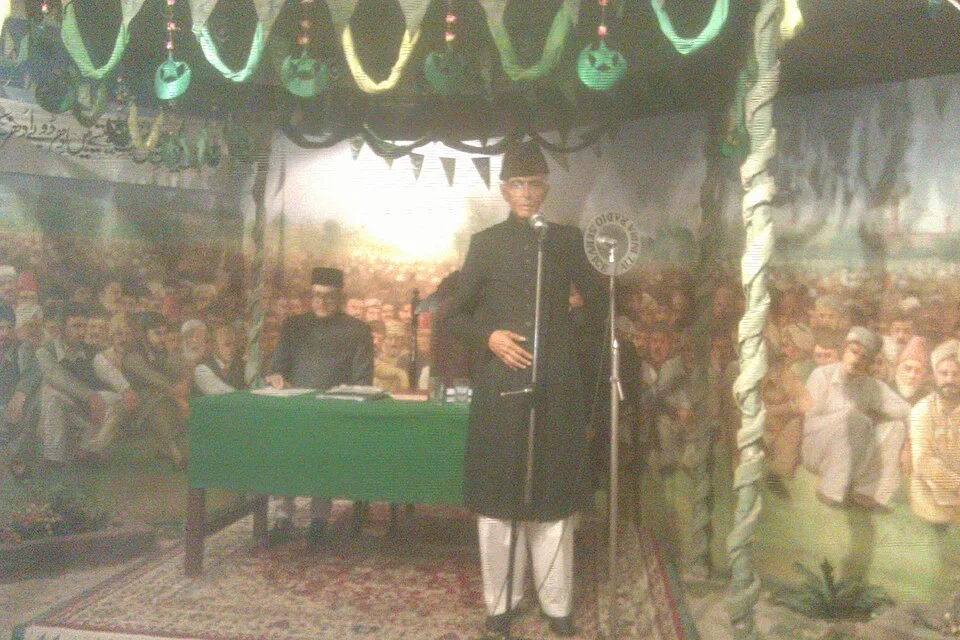
A monument in Pakistan, catalogued as “Pakistan resolution”; a commemorative illustration.
Credit: TANK RAIDER · CC BY-SA 3.0 · sourceResized and converted to WebP; uncropped.
1. Meaning, setting and essential identification
In the history of the Muslim League, the Lahore Resolution refers to the constitutional demand adopted at its Lahore session in March 1940. It proposed that geographically contiguous Muslim-majority areas in the north-western and eastern zones of India should be grouped to constitute independent states. The resolution marked a major departure from seeking Muslim safeguards within a common Indian constitutional framework towards claiming separate political sovereignty.
Muhammad Ali Jinnah presided over the session, but the resolution was moved by A. K. Fazlul Huq, the Premier of Bengal and an important regional political leader. It was supported by leaders including Chaudhry Khaliquzzaman. The venue was Minto Park, where Minar-e-Pakistan was subsequently built to commemorate the event. For examination purposes, distinguish the presiding leader, the mover and the location rather than treating them as interchangeable facts.
A dating qualification is useful: the resolution was introduced on 23 March and formally adopted on 24 March. Pakistan commemorates 23 March as Pakistan Day, and many historical summaries identify it simply as the resolution of 23 March 1940. Neither this commemorative convention nor its later name should obscure the original wording.
Timeline
1909
The Indian Councils Act introduces separate electorates for Muslims.
December 1929
The Congress Lahore session adopts Purna Swaraj as its goal.
1930–1933
Iqbal delivers his Allahabad address in 1930; Rahmat Ali publishes Now or Never in 1933.
1937–1939
Provincial elections, Congress ministries and their wartime resignations reshape Congress–League relations.
23–24 March 1940
Fazlul Huq moves the Lahore Resolution on 23 March; it is adopted on 24 March.
1946
The League legislators’ convention articulates a singular sovereign-state demand; the Cabinet Mission attempts a Union-based settlement.
1947
The 3 June Plan and Indian Independence Act provide the framework for Partition.
2. Background: constitutional safeguards to a separate-state demand
The demand emerged from decades of debate about political representation. The Indian Councils Act, 1909 introduced separate electorates for Muslims. Under this arrangement, Muslim voters elected representatives to seats reserved for Muslims. The Congress–League Lucknow Pact of 1916 accepted separate electorates as part of a negotiated constitutional settlement. These developments institutionalised community-based representation, although they did not make Partition inevitable.
The Nehru Report of 1928 and disagreements over minority safeguards deepened constitutional differences. Jinnah’s Fourteen Points of 1929 emphasised federalism, provincial autonomy, separate electorates and protections for Muslim representation. In his Allahabad address of 1930, Muhammad Iqbal envisaged the consolidation of Muslim-majority north-western areas into a political unit. His proposal should not be equated mechanically with the final territorial arrangement of Pakistan in 1947.
Choudhry Rahmat Ali popularised the name Pakistan in his 1933 pamphlet Now or Never. This was a separate intellectual and political intervention, not the text of the Lahore Resolution. The Government of India Act, 1935 subsequently provided provincial autonomy and envisaged an all-India federation. Provincial autonomy operated from 1937, but the proposed federation never came into existence.
The 1937 provincial elections exposed the League’s limited electoral reach, especially in several Muslim-majority provinces where regional parties were influential. Congress ministries were formed in several provinces, while disputes over coalition formation, representation and alleged discrimination sharpened Congress–League antagonism. After Britain involved India in the Second World War without consulting Indian representatives, Congress ministries resigned in 1939. Jinnah observed 22 December 1939 as a Day of Deliverance. Wartime conditions then provided the setting for the Lahore demand.
Changing constitutional demands: an analytical sequence, not an inevitable progression
- 1. Separate electorates and negotiated community safeguards
- 2. Disagreements over federalism, representation and provincial autonomy
- 3. Political competition following the 1937 elections
- 4. Lahore Resolution demands independent Muslim-majority political units
- 5. Mass mobilisation and competing constitutional proposals
- 6. Failure of compromise and Partition in 1947
3. What the resolution actually demanded
The resolution declared the federal scheme embodied in the Government of India Act, 1935 unsuitable and unacceptable. It argued that no constitutional plan would be workable or acceptable to Muslims unless geographically contiguous units were demarcated into regions, with territorial readjustments where necessary. Muslim-majority areas in the north-western and eastern zones were to be grouped to constitute independent states.
Its most debated wording specified that the constituent units of these states should be autonomous and sovereign. The plural expression ‘states’, combined with the sovereignty of constituent units, left room for different interpretations. It did not explicitly settle whether there would be one Muslim state, more than one state, or another arrangement linking highly autonomous units. Accordingly, it is inaccurate to describe the resolution as a fully worked-out constitution for the Pakistan created in 1947.
The resolution also required adequate, effective and mandatory safeguards for minorities. These were to protect religious, cultural, economic, political, administrative and other rights in consultation with the minorities concerned. The demand applied both to non-Muslims in the proposed Muslim-majority units and to Muslims elsewhere in India. Minority protection was therefore part of the formal text, not merely an issue raised after Partition.
The word Pakistan did not appear in the resolution. Nor did it provide a final boundary map, a timetable for transfer of power or a compulsory population-exchange scheme. Jinnah’s accompanying political argument stressed that Hindus and Muslims constituted distinct nations, but his presidential address and the operative resolution should be treated as related, not identical, historical documents.
| Feature | Congress, 1929 | Muslim League, 1940 |
|---|---|---|
| Presiding leader | Jawaharlal Nehru | Muhammad Ali Jinnah |
| Principal demand | Purna Swaraj or complete independence | Independent states in Muslim-majority north-western and eastern areas |
| Key associated individual | Nehru as Congress president | A. K. Fazlul Huq as mover of the resolution |
| Associated commemoration | 26 January 1930 observed as Independence Day | 23 March commemorated as Pakistan Day |
| Historical significance | Strengthened the complete-independence objective | Established the basis of the League’s subsequent Pakistan campaign |
4. Political significance, opposition and the road to Partition
The resolution gave the League a broad platform around which to mobilise Muslims from regions with different political interests. Leaders in Muslim-majority provinces could interpret it as protection for regional autonomy, while Muslims in minority provinces could view the League as a defender of community-wide interests. This flexibility helped mobilisation, but left difficult questions about territory, minorities and the distribution of power unresolved.
The League’s claim did not command unanimous Muslim support. The All India Azad Muslim Conference, held in Delhi in April 1940 under Allah Bakhsh Soomro’s leadership, opposed the Pakistan demand. The Jamiat Ulama-i-Hind and the Khudai Khidmatgar movement also upheld alternatives based on a united India. Congress rejected the two-nation basis of division, while Sikh leaders had particular concerns about their position in Punjab.
Subsequent negotiations did not follow a straight or predetermined path. The Cabinet Mission Plan of 1946 proposed an Indian Union with limited central subjects and provincial groupings rather than a sovereign Pakistan. At the League legislators’ convention in Delhi in April 1946, the demand was expressed in terms of a sovereign independent state comprising the Muslim-majority north-western and eastern zones, making the singular-state objective clearer.
The breakdown of constitutional compromise, escalating communal violence and British withdrawal eventually led to the 3 June Plan and the Indian Independence Act, 1947. Punjab and Bengal were partitioned, rather than transferred intact. Pakistan therefore emerged through later negotiations and boundary decisions, not through automatic implementation of a detailed territorial blueprint adopted at Lahore.
5. Distinguishing the two Lahore milestones
Lahore hosted two major but fundamentally different national-movement milestones. At the Congress session of December 1929, presided over by Jawaharlal Nehru, Purna Swaraj became the declared objective. Congress subsequently observed 26 January 1930 as Independence Day. This episode belongs to the struggle to end British rule and the transition towards the Civil Disobedience Movement.
The Muslim League’s Lahore session of March 1940, presided over by Jinnah, concerned the future constitutional location of Muslim-majority territories. For Prelims, always identify the organisation, year, presiding leader, mover and operative demand. For Mains, explain the resolution through constitutional disagreements, provincial political interests, competing nationalisms and wartime circumstances rather than presenting Partition as an inevitable consequence of religious difference.
Lahore Resolution: Wording, Interpretation and Historical Significance
Adopted by the All-India Muslim League at Lahore in March 1940, the resolution marked a major shift towards a territorial solution to the question of Muslim political representation. It proposed grouping geographically contiguous Muslim-majority areas in north-western and eastern British India into “Independent States”, with constituent units described as autonomous and sovereign. A. K. Fazlul Huq moved the resolution. Its wording matters: the text did not use the name “Pakistan”, and its plural formulation should not be read as a fully settled blueprint for the state created in 1947.
For modern Indian history, the resolution helps explain how competing claims about nationhood, minority safeguards and constitutional power-sharing contributed to the movement towards Partition. It was a political demand, not an enactment that immediately divided British India. The supplied metadata identifies a monument in Pakistan but leaves its description incomplete; the photograph therefore serves as commemorative context, not direct evidence of the resolution’s wording or proceedings. The monument’s precise identity and inscriptions cannot be established from this metadata.
- Prelims distinction: Congress’s Lahore session of 1929 adopted Purna Swaraj; the Muslim League’s Lahore Resolution belongs to 1940.
- Textual nuance: distinguish the original “Independent States” formulation from later interpretations demanding a single Pakistan.
- Mains approach: explain the resolution alongside subsequent negotiations and political developments; avoid treating Partition as an automatic or inevitable consequence.
Real-world case studies
Bengal: regional autonomy and the limits of the Lahore formula
Fazlul Huq’s role as mover demonstrates the importance of Bengal to the Lahore demand. Yet the resolution did not determine Bengal’s eventual boundaries. A short-lived United Bengal proposal in 1947, associated with H. S. Suhrawardy and Sarat Chandra Bose, failed to secure sufficient support. Bengal was partitioned into West Bengal and East Bengal, the latter becoming part of Pakistan. This illustrates the difference between the broad 1940 demand and the negotiated territorial outcome.
Azad Muslim Conference: an alternative Muslim political position
The April 1940 conference in Delhi, led by Allah Bakhsh Soomro, brought together Muslim organisations opposed to the Pakistan demand. It challenged the claim that religious identity necessarily required separate sovereign states. The episode is useful evidence that Muslim political opinion was diverse and that the League’s claim to exclusive representation developed through political contestation.
Previous year questions
No source-linked PYQ is available here yet. Use the practice questions below.
Practice questions
Practice MCQ 1
With reference to the Lahore Resolution of 1940, consider the following statements: 1. It was moved by A. K. Fazlul Huq. 2. Its operative text explicitly used the word Pakistan. 3. It demanded safeguards for minorities. Which of the statements given above are correct?
- A. 1 and 2 only
- B. 1 and 3 only
- C. 2 and 3 only
- D. 1, 2 and 3
Practice MCQ 2
Which of the following pairs is correctly matched?
- A. Congress Lahore session, 1929 — Presided over by Muhammad Ali Jinnah
- B. Muslim League Lahore session, 1940 — Adoption of Purna Swaraj
- C. Now or Never, 1933 — Choudhry Rahmat Ali
- D. Allahabad address, 1930 — A. K. Fazlul Huq
Practice MCQ 3
Which statement best describes the constitutional content of the Lahore Resolution?
- A. It accepted the federal scheme of the Government of India Act, 1935 without modification.
- B. It specified the final India–Pakistan boundary and required compulsory population exchange.
- C. It demanded independent states in Muslim-majority north-western and eastern areas, with autonomous and sovereign constituent units.
- D. It proposed only separate electorates within a unitary Indian state.
Mains practice · The Lahore Resolution was a decisive political turning point but not a complete blueprint for Partition. Discuss. Answer in 250 words.
- Identify the League session, Jinnah’s presidency and Fazlul Huq’s role.
- Explain the background of constitutional safeguards, provincial autonomy and the 1937 elections.
- Analyse independent states, autonomous and sovereign units, and minority safeguards.
- Highlight the absence of the word Pakistan, final boundaries and a detailed implementation mechanism.
- Discuss regional interests and opposition from advocates of composite nationalism.
- Connect the resolution to the 1946 negotiations and 1947 settlement without treating Partition as inevitable.
Further reading
- NCERT, Themes in Indian History, Part III: Understanding Partition.
- Bipan Chandra and others, India’s Struggle for Independence.
- Sumit Sarkar, Modern India, 1885–1947.
- The Lahore Resolution, March 1940: original text, available through the National Archives of Pakistan.
- UK legislation website, legislation.gov.uk: Indian Independence Act, 1947.
- https://commons.wikimedia.org/wiki/File:Pakistan_resolution.jpg
Preparing for UPSC Civil Services? Get classroom teaching, answer-writing evaluation and mentorship at Pragnya IAS Academy, Ashok Nagar — see why aspirants choose us for IAS coaching in Hyderabad.