
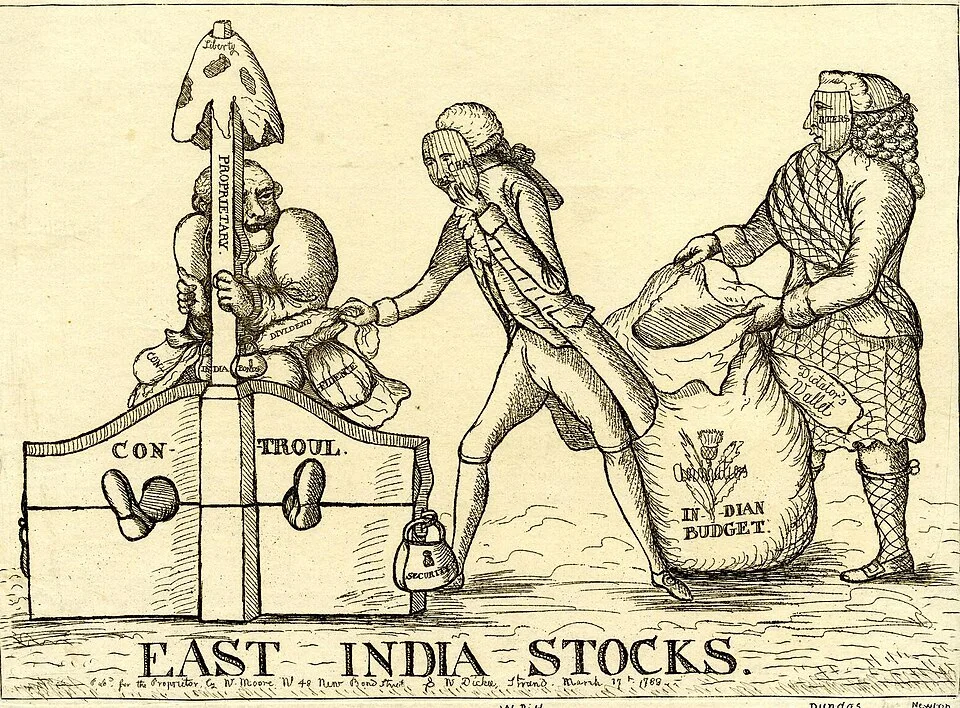
East India Stocks, a 1788 British satirical etching on Pitt-era control of the East India Company.
Credit: Print made by: William Dent Published by: William Moore Published by: J (or W) Dickie · Public domain · sourceResized and converted to WebP; uncropped.
Historical setting: why another regulating law was needed
By the late eighteenth century, the East India Company was both a trading corporation and a territorial power. Its acquisition of the diwani of Bengal, Bihar and Orissa in 1765 gave it access to substantial revenues, while its armies and diplomatic agreements drew Britain into Indian political conflicts. A privately organised company was therefore exercising powers associated with sovereignty. Company debt, allegations of misconduct and the financial consequences of warfare made Indian administration an important issue in British parliamentary politics.
The Regulating Act of 1773 was Parliament’s first major attempt to reorganise this arrangement. It created the Governor-General of Bengal and a four-member council, and provided for a Supreme Court at Calcutta. However, conflict within the council, uncertainty over jurisdiction and weak mechanisms of supervision from Britain persisted. The Bengal government’s authority over Bombay and Madras did not prevent initiatives that could produce costly military commitments. The First Anglo-Maratha War and the Second Anglo-Mysore War illustrated the strategic and financial stakes of presidency-level decisions.
In 1783, Charles James Fox proposed a more sweeping reorganisation of Company government under parliamentary commissioners. The bill passed the House of Commons but failed in the House of Lords amid intense political controversy. William Pitt the Younger subsequently pursued a more acceptable compromise: preserve the Company’s institutional structure but subject its territorial government to effective ministerial supervision.
Timeline
1765
The Company acquired the diwani of Bengal, Bihar and Orissa, greatly expanding its revenue and governmental responsibilities.
1773
The Regulating Act introduced parliamentary regulation of Company government and created the Governor-General of Bengal.
1783
Fox’s India Bill failed in the House of Lords.
1784
Pitt’s India Act established the Board of Control and the framework of dual control.
1786
Further legislation strengthened the Governor-General’s position in relation to the council.
1858
Company government and the Board–Directors system ended with the transfer of Indian government to the Crown.
The British machinery: Board of Control and Court of Directors
The Act established six Commissioners for the Affairs of India, collectively known as the Board of Control. Its membership combined senior ministers with Crown-appointed Privy Councillors. It could superintend, direct and control matters relating to the civil or military government and revenues of the Company’s territorial possessions. This gave the British executive an institutional mechanism for determining Indian policy without assuming all the ordinary tasks of Company management.
The Board could inspect relevant Company records and correspondence, examine proposed dispatches and require changes to political instructions. The Court of Directors remained the regular administrative channel between Britain and the Company’s governments overseas. However, its decisions in matters covered by the Board’s authority were no longer independently final. The arrangement distinguished between commercial management, which remained with the Company, and territorial administration, over which the British government acquired superior supervision.
For confidential political and military business, the Act provided for a Secret Committee consisting of three directors. It served as a channel through which sensitive instructions could reach India without disclosure to the full Court of Directors. This was especially important for questions of war, peace and diplomacy. The committee was not a third independent policymaking authority; its significance lay in enabling confidential governmental direction.
The Company retained substantial patronage, including the ordinary machinery of appointments, although Crown oversight and powers of recall qualified its independence. Pitt’s settlement thus avoided completely displacing the directors and shareholders. Its political achievement was to reconcile public supervision with the survival of a powerful chartered corporation.
Simplified route of ordinary political instructions
- 1. Indian governments send reports and correspondence to Britain
- 2. Court of Directors examines the business and prepares dispatches
- 3. Board of Control reviews political, military and revenue instructions
- 4. Directors transmit approved instructions to India
- 5. Governor-General in Council implements policy and directs subordinate presidencies
Changes in India: Bengal’s authority and restraints on warfare
The Act reduced the Governor-General’s Council in Bengal from four members to three, one of whom was the Commander-in-Chief. The smaller council was intended to make decision-making more workable after the conflicts associated with the earlier structure. Nevertheless, the Governor-General still operated within a council-based government. Aspirants should not attribute to the 1784 Act the exceptional power to override the council that was provided through legislation in 1786.
The authority of the Governor-General in Council over the governments of Bombay and Madras was strengthened, particularly in matters of war, diplomacy and revenue-related administration. Subordinate presidencies were required to obey central directions rather than pursue autonomous political courses. Restrictions on their ability to initiate hostilities or make treaties sought to prevent local decisions from imposing wider military and financial obligations on the Company and Britain.
The legislation declared schemes of conquest and territorial extension contrary to the wish, honour and policy of the British nation. This was a statement of intended restraint, not a reliable description of subsequent colonial practice. Warfare, alliances and annexations continued as British power expanded. For historical analysis, the contrast between the statutory language and later conduct reveals the limits of metropolitan attempts to contain an expanding territorial empire.
| Institution | Principal role | Important distinction |
|---|---|---|
| Board of Control | Supervision of civil, military and revenue affairs | Represented British governmental authority |
| Court of Directors | Commercial management, administrative correspondence and appointments | Continued as the Company’s executive machinery |
| Secret Committee | Transmission of confidential political and military instructions | Consisted of three directors; not an independent governing board |
| Governor-General in Council, Bengal | Central direction of Company government in India | Council reduced to three members |
| Bombay and Madras governments | Presidency administration under strengthened central supervision | Restricted autonomy in war and diplomacy |
Constitutional and economic significance
Pitt’s India Act is associated with the establishment of dual control: the Board of Control represented the British government, while the Court of Directors represented the Company. This did not mean that the two bodies possessed equal authority over every subject. The Board had superior political supervision, whereas the directors retained commercial functions, administrative machinery and extensive patronage. The system made government policy increasingly decisive while leaving implementation largely within Company institutions.
The Act described the Company’s territories as British possessions in India. This terminology is significant because it reflected a clearer assertion of Britain’s public responsibility and political authority over territories governed through a corporate intermediary. Nevertheless, it did not abolish Company rule, make India a directly administered Crown colony or create the later office of Secretary of State for India. Those changes belong principally to the settlement of 1858.
Revenue supervision was essential to the arrangement. Indian land revenues supported armies, civil administration and debt obligations, linking territorial government with the Company’s commercial and financial position. The Act did not introduce a specific land-revenue settlement or abolish the Company’s trade monopoly. Its economic significance lay instead in bringing revenue administration within governmental oversight. The division between a trading company and a territorial state consequently became more explicit, although their finances and institutions remained closely connected.
Limitations, later developments and examination distinctions
Dual control could obscure responsibility. Ministers could influence policy while Company officials carried out instructions, creating opportunities for each institution to shift blame. Communication between Britain and India took months, leaving substantial discretion to officials on the spot. Moreover, stronger supervision from London did not amount to accountability to Indians: the framework was designed to protect British political, strategic and financial interests rather than establish representative government.
The 1786 legislation subsequently allowed the Governor-General, in special circumstances and on personal responsibility, to act against the opinion of the council. It also enabled the offices of Governor-General and Commander-in-Chief to be combined, facilitating Cornwallis’s appointment. Later Charter Acts altered the Company’s commercial role, but the Board–Directors framework survived until 1858, when Company government ended and authority passed to the Crown through a Secretary of State for India assisted by a council.
- 1773: Governor-General of Bengal and the framework for the Supreme Court at Calcutta; not the Board of Control.
- 1784: Board of Control, dual control and stronger subordination of the presidencies.
- 1786: exceptional council-override authority; do not confuse it with the original Pitt’s Act.
- 1833: Governor-General of India and termination of the Company’s remaining commercial activities.
- Bengal’s Dual Government, introduced in 1765, concerned the separation of diwani and nizamat responsibilities; Pitt’s dual control concerned institutions in Britain.
Pitt’s India Act: State Supervision and Company Interests
Pitt’s India Act, 1784 placed the East India Company’s territorial administration under stronger British government supervision without abolishing Company rule. Its Board of Control supervised civil, military and revenue affairs, while the Court of Directors retained the Company’s commercial organisation and substantial administrative responsibilities. This arrangement is commonly called “dual control”: political supervision and corporate management coexisted, rather than Indian government passing directly to the Crown.
The supplied metadata describes a British satire published in 1788, associating Pitt and Dundas with restraints on the Company and references to dividends, bonds and charters. These motifs make it directly relevant to the political and financial tensions surrounding Pitt-era oversight. However, it is a later satirical response, not a neutral diagram of the 1784 Act or evidence of Indian reactions. For Indian history, its value lies in illustrating metropolitan conflict over the institution governing Company territories; it cannot independently establish how the Act affected revenue collection or everyday administration in India.
- Institutional distinction: the Board of Control represented British government supervision; the Court of Directors remained a Company body. Neither should be confused with the Governor-General’s council in India.
- Chronological distinction: the Regulating Act of 1773 preceded Pitt’s framework; direct Crown rule followed in 1858. “Dual control” here is not Bengal’s earlier system of “dual government”.
- Evidence distinction: satire can reveal criticism and anxieties about corporate privileges and state power, but its exaggerations require comparison with statutory provisions and administrative records.
Real-world case studies
Bombay’s Treaty of Surat, 1775
The Bombay government concluded the Treaty of Surat with Raghunath Rao, supporting his claim to the Peshwaship in return for territorial concessions. The intervention helped initiate the First Anglo-Maratha War, which ended with the Treaty of Salbai in 1782. The episode illustrates the dangers of presidency-level diplomacy and the background to stronger central restraints under Pitt’s Act.
Cornwallis and the supplementary legislation of 1786
Cornwallis assumed office as Governor-General in 1786 and also served as Commander-in-Chief. The supplementary legislation enabled stronger executive leadership, including exceptional action against the council’s opinion. His appointment shows that Pitt’s settlement was an evolving framework rather than a complete solution to problems of command and accountability.
Previous year questions
No source-linked PYQ is available here yet. Use the practice questions below.
Practice questions
Practice MCQ 1
With reference to Pitt’s India Act, 1784, consider the following statements: 1. It established a Board of Control to supervise civil, military and revenue affairs. 2. It abolished the Court of Directors. 3. It preserved the Company’s commercial management. Which of the statements given above are correct?
- A. 1 and 2 only
- B. 1 and 3 only
- C. 2 and 3 only
- D. 1, 2 and 3
Practice MCQ 2
Which one of the following best describes the Secret Committee under Pitt’s India Act?
- A. Three directors serving as a channel for confidential political instructions
- B. Three judges exercising appellate jurisdiction over presidency courts
- C. Six ministers responsible exclusively for Company trade
- D. A council of Indian rulers advising the Governor-General
Practice MCQ 3
Which of the following pairs is incorrectly matched?
- A. Regulating Act, 1773 — Creation of the Governor-General of Bengal
- B. Pitt’s India Act, 1784 — Establishment of the Board of Control
- C. Act of 1786 — Exceptional authority to override the Governor-General’s Council
- D. Pitt’s India Act, 1784 — Creation of the Secretary of State for India
Mains practice · Pitt’s India Act, 1784 strengthened British governmental authority without abolishing Company government. Explain the institutional compromise and assess its limitations. Answer in 250 words.
- Introduce the Company’s transformation into a territorial power and the shortcomings of the 1773 framework.
- Explain the Board’s political, military and revenue supervision alongside the directors’ continuing functions.
- Mention the Secret Committee, retention of patronage and stronger authority of Bengal over other presidencies.
- Discuss divided responsibility, communication delays and continuing official discretion.
- Distinguish statutory restraint on conquest from subsequent territorial expansion.
- Conclude with its significance as an intermediate stage between corporate rule and direct Crown government.
Further reading
- NCERT, Our Pasts–III, chapter: From Trade to Territory: The Company Establishes Power.
- Bipan Chandra, History of Modern India, discussion of the organisation of British administration.
- UK Parliament website, historical resources on Parliament and the East India Company.
- East India Company Act, 1784, 24 Geo. III, Session 2, chapter 25: statutory text.
- https://commons.wikimedia.org/wiki/File:East_India_Stocks_(BM_1868,0808.5700).jpg
Preparing for UPSC Civil Services? Get classroom teaching, answer-writing evaluation and mentorship at Pragnya IAS Academy, Ashok Nagar — see why aspirants choose us for IAS coaching in Hyderabad.