
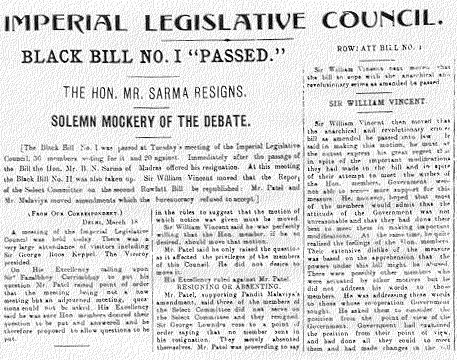
Indian newspaper headlines concerning the Rowlatt Bills, 1919.
Credit: Editors of an Indian newspaper · Public domain · sourceResized and converted to WebP; uncropped.
1. Historical background: wartime repression and post-war expectations
The First World War transformed Indian politics. India supplied soldiers, money and materials to the British war effort, while wartime inflation, shortages and taxation burdened the population. Revolutionary activity, including the Ghadar movement and attempts to obtain foreign assistance against British rule, heightened official anxiety. The Defence of India Act, 1915 authorised exceptional measures against perceived threats, establishing a wartime framework of executive control and special judicial procedures.
Indian expectations moved in the opposite direction. The Home Rule movement had widened demands for self-government, while the Montagu Declaration of 20 August 1917 promised the gradual development of self-governing institutions and progressive realisation of responsible government in India. Many Indians expected wartime restrictions to end after the war and anticipated meaningful constitutional concessions. Instead, the colonial state proposed retaining extraordinary coercive powers alongside limited reforms.
In December 1917, the government appointed a Sedition Committee chaired by Justice Sidney Rowlatt to investigate revolutionary conspiracies and recommend measures to deal with them. Its 1918 report became the basis of the Rowlatt Bills. The resulting legislation illustrated a central contradiction of colonial governance: promises of political participation coexisted with the preservation of exceptional executive authority.
- Contextual link: revolutionary nationalism, wartime emergency legislation and the limited reform agenda must be studied together.
- The committee’s immediate concern was revolutionary conspiracy, not the design of constitutional reforms.
Timeline
1915
Defence of India Act establishes extraordinary wartime powers.
December 1917
Sedition Committee appointed under Justice Sidney Rowlatt.
1918
The committee submits its report on revolutionary conspiracies.
February–March 1919
Satyagraha Sabha formed in Bombay; Rowlatt legislation passed on 18 March.
6 April 1919
Principal nationwide hartal against the Act.
10–13 April 1919
Kitchlew and Satyapal arrested; Jallianwala Bagh massacre follows on 13 April.
18 April 1919
Gandhi suspends the satyagraha.
1922
Rowlatt Act repealed.
2. Provisions, passage and constitutional objections
Two bills based on the committee’s recommendations were introduced in the Imperial Legislative Council in early 1919. One became the Anarchical and Revolutionary Crimes Act, passed on 18 March 1919. Indian members opposed the measure, but the government carried it through the colonial legislature. Muhammad Ali Jinnah resigned from the Council in protest, reflecting opposition extending beyond Gandhi’s emerging satyagraha constituency.
The Act provided exceptional machinery for specified revolutionary offences and preventive action against suspected persons. Its framework included trial before special courts of three High Court judges without a jury and without the ordinary right of appeal. It also permitted restrictions on liberty and detention without ordinary trial, commonly summarised in accounts of the Act as imprisonment of suspects for up to two years. Certain proceedings could be held in camera.
The constitutional objection concerned the displacement of normal safeguards by suspicion-based executive action and exceptional judicial procedures. Indians denounced the legislation as a Black Act. The popular slogan describing the denial of appeal, legal representation and argument expressed the intensity of opposition, but should not be treated as a precise statement of every statutory provision. For examination purposes, the safest emphasis is preventive detention, special trials and curtailed ordinary legal remedies.
The Act should not be confused with either the Defence of India Act, 1915 or the Government of India Act, 1919. The first supplied the wartime background; the second introduced constitutional changes, including provincial dyarchy. The Rowlatt legislation concerned repression and security.
From wartime security policy to mass nationalist opposition
- 1. Wartime emergency powers and fears of revolutionary activity
- 2. Rowlatt Committee recommends continued extraordinary measures
- 3. Legislation passed despite Indian opposition
- 4. Satyagraha pledge, hartals and public mobilisation
- 5. Local violence, Punjab repression and Jallianwala Bagh massacre
- 6. Satyagraha suspended; distrust contributes to the move towards non-cooperation
3. Gandhi’s Rowlatt Satyagraha: methods and mobilisation
Gandhi had already developed a reputation through Champaran in 1917 and the Ahmedabad and Kheda struggles in 1918. These were geographically limited campaigns. Opposition to the Rowlatt Bills offered an opportunity to apply satyagraha to an issue affecting political liberty across British India. In February 1919, he helped establish the Satyagraha Sabha in Bombay, whose members pledged nonviolent resistance to the proposed legislation.
The campaign combined a pledge of civil disobedience with fasting, prayer, public meetings and hartal. Gandhi conceived satyagraha as disciplined resistance grounded in truth and nonviolence, rather than coercion or hostility towards individuals. Selected acts of disobedience were intended to challenge unjust authority while preserving moral restraint. This differed from earlier reliance principally on petitions and legislative criticism, although not all established nationalist leaders supported the new method.
The hartal was initially announced for 30 March and subsequently shifted to 6 April 1919. The changed date did not reach every place in time, and Delhi observed the earlier date. On 6 April, shops closed and meetings and demonstrations occurred in numerous towns. Hindu-Muslim cooperation was conspicuous in several centres, but mobilisation was uneven and should not be described as equally extensive throughout India.
Events also exposed organisational weaknesses. Gandhi was prevented from proceeding to Punjab and sent back after being intercepted at Palwal. News of restrictions and arrests provoked unrest in several places. Violence in centres such as Ahmedabad challenged the campaign’s nonviolent basis. Gandhi suspended the satyagraha on 18 April, recognising that the preparation and discipline required for mass civil disobedience had been insufficient.
| Measure or committee | Date | Principal relevance |
|---|---|---|
| Defence of India Act | 1915 | Emergency wartime powers |
| Rowlatt or Sedition Committee | Appointed 1917 | Investigated revolutionary conspiracies and recommended repressive measures |
| Rowlatt Act | 1919 | Exceptional trials and preventive restrictions |
| Government of India Act | 1919 | Constitutional reform, including provincial dyarchy |
| Hunter Committee | Appointed 1919 | Investigated disturbances, including events in Punjab |
4. Punjab, Jallianwala Bagh and official repression
Punjab was particularly tense because of wartime recruitment pressures, economic distress and a coercive administrative climate. In Amritsar, the arrest and removal of the popular leaders Saifuddin Kitchlew and Satyapal on 10 April triggered protests. Official firing and subsequent mob violence, including attacks on Europeans and public property, intensified the confrontation. These developments form the immediate background to Jallianwala Bagh, but cannot justify the indiscriminate force used there.
On 13 April 1919, the day of Baisakhi, a crowd assembled at Jallianwala Bagh in Amritsar. Those present included political protesters and people visiting during the festival. Brigadier-General Reginald Dyer entered with troops and ordered firing without warning the gathering to disperse. The enclosed ground and restricted exits made escape difficult. The official death toll was 379; Indian estimates were substantially higher.
Martial law was subsequently imposed in parts of Punjab, accompanied by humiliating punishments and other coercive measures. Rabindranath Tagore renounced his knighthood in protest against the Punjab atrocities. The government appointed the Disorders Inquiry Committee, commonly called the Hunter Committee, to investigate the disturbances. Congress also conducted an inquiry. A crucial distinction is that the Rowlatt Committee preceded the Act, whereas the Hunter Committee investigated the later disturbances.
- Reginald Dyer commanded the troops at Jallianwala Bagh; Michael O’Dwyer was Lieutenant-Governor of Punjab.
- The massacre was connected to the wider agitation, but it was not a statutory provision or an automatic legal consequence of the Rowlatt Act.
5. Significance and limits within the national movement
The agitation marked Gandhi’s emergence as a leader capable of mobilising people around an all-India political issue. It broadened the repertoire of nationalism through hartals, public pledges and nonviolent resistance. Defence of civil liberties helped connect legislative criticism with popular action, while cooperation across religious communities suggested possibilities for a wider anti-colonial coalition.
Its limitations were equally consequential. Local grievances shaped participation, communication was imperfect and crowds did not always follow the discipline envisaged by Gandhi. The movement therefore demonstrated both the potential of mass politics and the need for training, organisation and leadership. It should not be confused with the more sustained Non-Cooperation Movement launched in 1920.
The Punjab atrocities and dissatisfaction with official accountability severely damaged the moral legitimacy of British rule. Together with the Khilafat issue and frustration over constitutional reform, they helped prepare the ground for non-cooperation. The Rowlatt Act was repealed in 1922. Its lasting historical importance lies less in its duration than in the political transformation produced by opposition to it.
Rowlatt legislation: repression and public protest
The metadata identifies this image as newspaper headlines about the Rowlatt Bills in India in 1919, making it directly relevant to the legislation’s public reception. The bills emerged from recommendations of the Sedition Committee chaired by Justice Sidney Rowlatt. The resulting Anarchical and Revolutionary Crimes Act carried exceptional powers associated with wartime repression into peacetime. Its provisions for preventive detention and special judicial procedures challenged ordinary safeguards against arbitrary state action. For Indian nationalists, the legislation exposed the contradiction between British promises of constitutional reform and the continued reliance on coercive rule.
Gandhi organised opposition through the Rowlatt Satyagraha, using pledges, hartals and non-violent resistance to turn a legislative controversy into a wider political mobilisation. However, violence during the agitation revealed difficulties in maintaining non-violent discipline, and Gandhi suspended the campaign. Repression in Punjab and the Jallianwala Bagh massacre intensified alienation from colonial authority. Newspaper coverage can help historians investigate how the controversy reached readers, but this metadata alone does not establish the publication’s identity, editorial position, circulation or the wording of individual headlines.
- Distinguish the Rowlatt Bills from the enacted Rowlatt Act; a newspaper reference to proposed legislation does not establish its final legal provisions.
- Do not equate the Rowlatt Satyagraha with Non-Cooperation: the former preceded and helped shape the political conditions for the latter.
- Treat these headlines as evidence of press attention, not proof of uniform Indian opinion or a complete account of the Act’s implementation.
Real-world case studies
Delhi hartal: communication and coordination
Delhi observed a hartal on 30 March 1919 despite the national date being shifted to 6 April. Confrontations and police firing followed. The episode illustrates the difficulty of coordinating a rapidly expanding movement through limited communication networks.
Tagore’s renunciation of knighthood
In his letter to the Viceroy dated 31 May 1919, Rabindranath Tagore repudiated his knighthood following the Punjab atrocities. His action transformed a colonial honour into an instrument of moral protest and demonstrated that opposition extended beyond organised political agitation.
Previous year questions
UPSC Prelims 2015
The Rowlatt Act aimed at what?
- A. Compulsory economic support for the war effort
- B. Imprisonment without trial and summary procedures for trial
- C. Suppression of the Khilafat Movement
- D. Restrictions on freedom of the press
Practice questions
Practice MCQ 1
Consider the following statements: 1. The Rowlatt legislation followed recommendations of the Sedition Committee. 2. The Government of India Act, 1919 and the Rowlatt Act were the same enactment. 3. Indian members opposed the Rowlatt legislation in the Imperial Legislative Council. Which statements are correct?
- A. 1 and 2 only
- B. 2 and 3 only
- C. 1 and 3 only
- D. 1, 2 and 3
Practice MCQ 2
Which is the correct chronological sequence? 1. Appointment of the Rowlatt Committee 2. Principal nationwide anti-Rowlatt hartal 3. Jallianwala Bagh massacre 4. Formation of the Satyagraha Sabha
- A. 1–4–2–3
- B. 4–1–2–3
- C. 1–2–4–3
- D. 1–4–3–2
Practice MCQ 3
Which pair is incorrectly matched?
- A. Sidney Rowlatt — Chairman of the Sedition Committee
- B. Reginald Dyer — Commander responsible for firing at Jallianwala Bagh
- C. Michael O’Dwyer — Lieutenant-Governor of Punjab in April 1919
- D. Hunter Committee — Recommended the Rowlatt legislation
Mains practice · The Rowlatt Satyagraha revealed both the possibilities and the limitations of mass nationalism in India. Discuss. Answer in 250 words.
- Explain the contradiction between post-war reform expectations and continued exceptional repression.
- Discuss Gandhi’s transition from local campaigns to attempted all-India mobilisation.
- Examine hartals, civil liberties and inter-community cooperation.
- Analyse uneven participation, communication problems and outbreaks of violence.
- Connect Punjab repression and Jallianwala Bagh with the erosion of colonial legitimacy.
- Conclude with organisational lessons and the transition towards Non-Cooperation.
Further reading
- NCERT, India and the Contemporary World–II, chapter Nationalism in India.
- NCERT, Themes in Indian History, Part III, chapter Mahatma Gandhi and the Nationalist Movement.
- Bipan Chandra and others, India’s Struggle for Independence.
- M. K. Gandhi, An Autobiography: The Story of My Experiments with Truth, sections on the Rowlatt Satyagraha.
- Report of the Sedition Committee, 1918, and Report of the Disorders Inquiry Committee, 1920.
- https://commons.wikimedia.org/wiki/File:Rowlatt_bills1919.gif
Preparing for UPSC Civil Services? Get classroom teaching, answer-writing evaluation and mentorship at Pragnya IAS Academy, Ashok Nagar — see why aspirants choose us for IAS coaching in Hyderabad.