
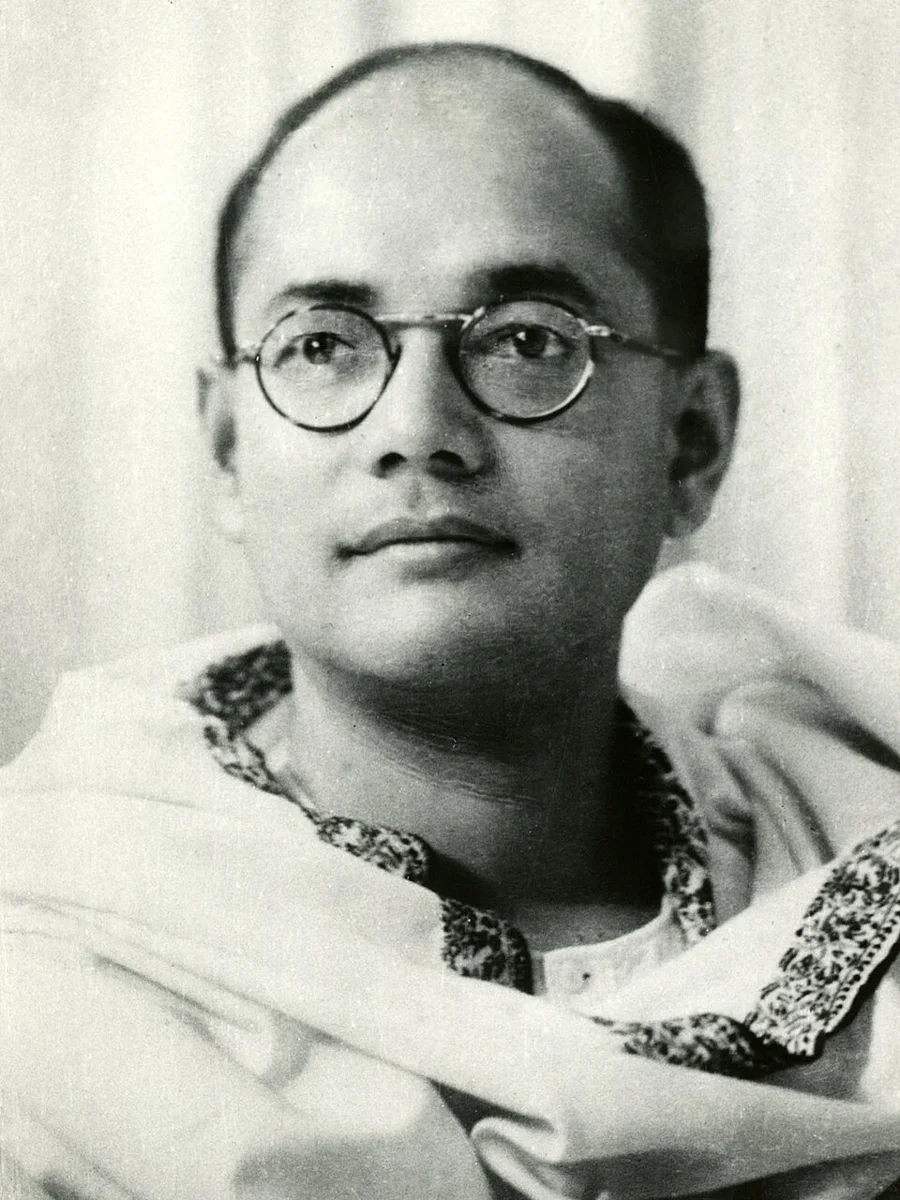
Subhas Chandra Bose, nationalist leader associated with the Forward Bloc and Azad Hind.
Credit: Unknown (Netaji Research Bureau, Calcutta) · Public domain · sourceResized and converted to WebP; uncropped.
Early life and entry into nationalist politics
Subhas Chandra Bose was born in Cuttack to Janakinath Bose and Prabhavati Devi. Educated in Calcutta and later at Cambridge, he qualified for the Indian Civil Service examination in 1920 but resigned in 1921 before entering service. His decision reflected his rejection of a career serving colonial rule. Returning to India during the Non-Cooperation Movement, he entered nationalist politics under Chittaranjan Das, whom he regarded as his political mentor.
Bose worked with Das in Bengal’s nationalist and municipal politics. When Das became mayor of the Calcutta Corporation in 1924, Bose served as its chief executive officer. Arrested that year, he was subsequently detained in Mandalay in Burma. Imprisonment and ill health repeatedly interrupted his political activity, but also strengthened his reputation as an uncompromising opponent of British rule. He later became mayor of Calcutta in 1930.
During the late 1920s, Bose and Jawaharlal Nehru represented a younger, radical current within Congress demanding complete independence rather than dominion status. At the Calcutta Congress of 1928, Bose supported an amendment seeking an immediate commitment to complete independence. Congress formally adopted Purna Swaraj at Lahore in December 1929. Bose’s subsequent writings, including The Indian Struggle, examined the movement’s achievements and strategic limitations.
- Important associations: Chittaranjan Das, Bengal Congress, municipal nationalism and the Congress left wing.
- Do not confuse Bose’s resignation from the ICS with dismissal from an established administrative career.
Timeline
1921
Resigned from the ICS and entered nationalist politics under Chittaranjan Das.
1938–1939
Haripura presidency, National Planning Committee, Tripuri crisis and formation of the Forward Bloc.
January 1941
Escaped from Calcutta and began his journey to Germany.
1942
First INA organised under Mohan Singh.
1943
Bose reached Southeast Asia, reorganised the INA and proclaimed Azad Hind.
1944–1945
INA participated in the advance towards India; military defeat followed. Bose’s death was reported in August 1945.
November–December 1945
First major Red Fort INA trial.
Congress presidency, planning and the Forward Bloc
As Congress president at Haripura in February 1938, Bose linked political freedom with economic reconstruction. He advocated industrialisation, scientific development, state-led planning and the removal of poverty. During his presidency, Congress established the National Planning Committee under Jawaharlal Nehru in 1938. This was an important nationalist precursor to post-independence planning, not the Planning Commission, which was established in 1950.
Bose sought re-election in 1939 and defeated Pattabhi Sitaramayya, the candidate supported by Gandhi. The election preceded the Tripuri session, where conflict over Congress strategy and the composition of the Working Committee became acute. Gandhi described Sitaramayya’s defeat as his own. The Pant resolution at Tripuri called for a Working Committee in accordance with Gandhi’s wishes, making it difficult for Bose to exercise effective leadership without agreement with the dominant Congress group.
Bose favoured a more immediate confrontation with Britain and believed an approaching European war could create an opportunity for Indian independence. Gandhi and other senior leaders differed over timing, methods and organisational direction. Bose resigned in April 1939 and Rajendra Prasad succeeded him. In May, Bose founded the Forward Bloc, initially as a grouping within Congress intended to consolidate left-wing and radical forces.
The disagreement should not be reduced to personal hostility. Bose respected Gandhi’s contribution while rejecting non-violence as an indispensable method under all circumstances. His own outlook combined socialism, secular nationalism, discipline and a powerful central state. His advocacy of concentrated authority and subsequent Axis alliances remain important subjects of critical historical assessment.
- Prelims distinction: Haripura, 1938—first presidency; Tripuri, 1939—re-election and organisational crisis.
- The Forward Bloc was distinct from the Congress Socialist Party, founded in 1934.
From military defeat to political impact
- 1. INA campaigns alongside Japan
- 2. Japanese defeat and INA personnel captured
- 3. Red Fort trials
- 4. Public mobilisation and defence campaign
- 5. Heightened colonial concerns about military loyalty
Escape, overseas alliances and Azad Hind
After detention in 1940 and a hunger strike, Bose was released but kept under surveillance at his Calcutta residence. He escaped in January 1941, travelled through north-western India and Afghanistan, and eventually reached Germany. There he organised the Free India Centre, used Azad Hind Radio for propaganda and supported the formation of an Indian Legion from Indian prisoners of war captured in the European and North African theatres.
Bose sought support from Britain’s wartime enemies because he considered British imperial power the principal obstacle to Indian freedom. These arrangements were tactical in purpose, but cooperation with Nazi Germany and imperial Japan created serious moral and strategic contradictions. Neither power’s wider objectives were equivalent to Indian self-determination. The European Indian Legion must also be distinguished from the Southeast Asian INA.
In 1943, Bose travelled towards Asia through a German-to-Japanese submarine transfer and reached Japan before proceeding to Singapore. Rash Behari Bose transferred leadership of the Indian Independence League to him in July. Subhas Bose then revitalised the INA and expanded recruitment and fundraising among overseas Indians. Rash Behari Bose and Subhas Chandra Bose were different leaders with distinct roles.
On 21 October 1943, Bose proclaimed the Provisional Government of Azad Hind in Singapore, becoming its head and assuming key responsibilities including war and foreign affairs. Japan transferred nominal administration of the Andaman and Nicobar Islands to this government; Bose visited Port Blair in December and announced the names Shaheed and Swaraj for the island groups. Actual Japanese military control substantially limited Azad Hind’s authority.
- Azad Hind was a provisional government; the INA was its armed force.
- Singapore—not Tokyo, Rangoon or Port Blair—was the site of the government’s proclamation.
| Organisation | Principal association | Purpose or location |
|---|---|---|
| Forward Bloc | Subhas Chandra Bose, 1939 | Consolidation of radical nationalist forces |
| Indian Independence League | Rash Behari Bose and later Subhas Bose | Political mobilisation of Indians in Asia |
| First INA | Mohan Singh, 1942 | Military force initially recruited mainly from Indian prisoners of war |
| Reorganised INA | Subhas Chandra Bose, 1943 | Armed campaign from Southeast Asia |
| Indian Legion | Bose’s German initiative | European formation, distinct from the INA |
The INA: organisation, campaign and limitations
The INA originated in 1942 under Captain Mohan Singh, drawing heavily on Indian soldiers captured by Japan during the Malayan campaign and the fall of Singapore. The Indian Independence League and Rash Behari Bose helped provide its political framework. Disagreements between Mohan Singh and Japanese authorities disrupted this first organisation. Subhas Bose therefore did not originally found the INA; he reorganised it into a more effective nationalist military and political instrument in 1943.
Recruitment subsequently included Indian civilians in Southeast Asia as well as prisoners of war. The Rani of Jhansi Regiment, led by Dr Lakshmi Swaminathan, later Lakshmi Sahgal, became a prominent example of women’s military mobilisation. Bose popularised the calls Delhi Chalo and Give me blood, and I will give you freedom. Jai Hind became an enduring nationalist salutation, while the INA emphasised unity across religious and regional divisions.
INA units fought alongside Japanese forces during the 1944 advance towards India, associated with the Imphal campaign and the wider Imphal–Kohima offensive. At Moirang in Manipur, an INA unit under Shaukat Malik raised its flag on 14 April 1944. The advance failed because of Allied resistance, overstretched supply lines, disease, monsoon conditions and inadequate logistics. Retreat through Burma inflicted severe losses. Japan’s surrender in August 1945 ended the INA’s military prospects.
- Moirang is in present-day Manipur; Kohima is in Nagaland.
- The INA’s historical significance was greater politically than its battlefield achievements alone suggest.
Death, INA trials and historical significance
The generally accepted historical account records Bose’s death on 18 August 1945 after an aircraft crash at Taihoku, now Taipei, in Japanese-controlled Taiwan. His death generated prolonged controversy. The Shah Nawaz Committee and Khosla Commission accepted the crash-death account, while the Mukherjee Commission rejected it; the Union government rejected the latter commission’s conclusions in 2006. These differing findings should be distinguished from unsupported disappearance theories.
The INA trials transformed public perceptions of the army. The first major trial at Delhi’s Red Fort in November–December 1945 concerned Shah Nawaz Khan, Prem Kumar Sahgal and Gurbaksh Singh Dhillon, charged with waging war against the King-Emperor and other offences. Congress organised their defence, with Bhulabhai Desai playing the leading legal role and figures including Tej Bahadur Sapru and Jawaharlal Nehru participating. Commander-in-Chief Claude Auchinleck subsequently remitted their sentences of transportation for life.
The trials generated widespread demonstrations and solidarity across political and religious boundaries. Together with post-war unrest and the Royal Indian Navy uprising of February 1946, they heightened British concerns about the reliability of the armed forces. Independence nevertheless resulted from multiple interacting forces: decades of mass mobilisation, wartime economic pressures, international changes and political negotiations. Bose’s contribution belongs within this wider explanation rather than a single-cause account.
- Bose’s enduring contributions include militant anti-colonial mobilisation, overseas Indian participation, secular military solidarity and an emphasis on planning.
Subhas Chandra Bose: Congress Politics and Armed Nationalism
Subhas Chandra Bose’s significance extends beyond his leadership of the Indian National Army (INA). As Congress president at Haripura in 1938, he supported economic planning and a strong anti-imperialist programme. Re-elected at Tripuri in 1939, he faced a political impasse with the Gandhian leadership and subsequently resigned. He then established the Forward Bloc, initially within the Congress, to consolidate left-wing and radical nationalist forces. His differences with Gandhi concerned methods, leadership and the pace of struggle, rather than the objective of independence.
During the Second World War, Bose sought international assistance to challenge British rule. In Southeast Asia, he reorganised and led the INA and headed the Provisional Government of Azad Hind, proclaimed in 1943. The INA’s military campaign did not secure independence, but the subsequent trials of its officers generated widespread political mobilisation in India. His wartime cooperation with Axis powers requires critical assessment: it reflected an anti-colonial strategy but created difficult political and ethical tensions. The supplied metadata identifies Bose; it does not establish the photograph’s date, location or connection to a particular episode.
- Distinguish origins from leadership: Mohan Singh organised the first INA; Bose later reorganised it.
- Azad Hind was a provisional government; the INA was an armed force, not an interchangeable institutional name.
- For Mains, separate battlefield outcomes from political impact; avoid attributing British withdrawal exclusively to Bose or the INA.
Real-world case studies
Rani of Jhansi Regiment
Formed in Southeast Asia in 1943 under Lakshmi Swaminathan, this women’s regiment challenged conventional gender roles through military training and nationalist mobilisation. Its symbolic and organisational importance should not be confused with claims of extensive frontline combat.
Moirang and public memory
The flag-raising at Moirang on 14 April 1944 marked the INA’s presence on Indian soil. The INA memorial complex there illustrates how a limited military advance became an enduring symbol of anti-colonial resistance.
Previous year questions
No source-linked PYQ is available here yet. Use the practice questions below.
Practice questions
Practice MCQ 1
Consider the following statements: 1. The National Planning Committee was established during Bose’s Congress presidency. 2. Bose originally formed the INA in 1942. 3. The Forward Bloc initially emerged within Congress. Which statements are correct?
- A. 1 and 2 only
- B. 1 and 3 only
- C. 2 and 3 only
- D. 1, 2 and 3
Practice MCQ 2
Which sequence is chronologically correct?
- A. Tripuri presidency → Haripura presidency → Escape from India → Azad Hind proclamation
- B. Haripura presidency → Tripuri presidency → Escape from India → Azad Hind proclamation
- C. Haripura presidency → Escape from India → Tripuri presidency → Azad Hind proclamation
- D. Escape from India → Haripura presidency → Azad Hind proclamation → Tripuri presidency
Practice MCQ 3
Which pair is incorrectly matched?
- A. Mohan Singh — First INA
- B. Lakshmi Swaminathan — Rani of Jhansi Regiment
- C. Moirang — INA flag-raising in 1944
- D. Tokyo — Proclamation of the Provisional Government of Azad Hind
Mains practice · The political impact of Subhas Chandra Bose and the INA exceeded their military achievements. Discuss. (250 words)
- Introduce Bose’s alternative strategy of overseas mobilisation and armed struggle.
- Explain inclusive recruitment, women’s participation and expatriate support.
- Assess dependence on Japan, logistical weaknesses and military defeat.
- Discuss the Red Fort trials and widespread public solidarity.
- Connect post-war unrest with British concerns about armed-force loyalty.
- Conclude with a multi-causal explanation of independence and acknowledge the contradictions of Axis cooperation.
Further reading
- NCERT, Themes in Indian History, Part III: Mahatma Gandhi and the Nationalist Movement.
- Bipan Chandra and others, India’s Struggle for Independence.
- Sugata Bose, His Majesty’s Opponent.
- National Archives of India: Netaji Papers and declassified records.
- Netaji Research Bureau, Kolkata: biographical and archival resources.
- https://commons.wikimedia.org/wiki/File:Subhas_Chandra_Bose_NRB.jpg
Preparing for UPSC Civil Services? Get classroom teaching, answer-writing evaluation and mentorship at Pragnya IAS Academy, Ashok Nagar — see why aspirants choose us for IAS coaching in Hyderabad.