
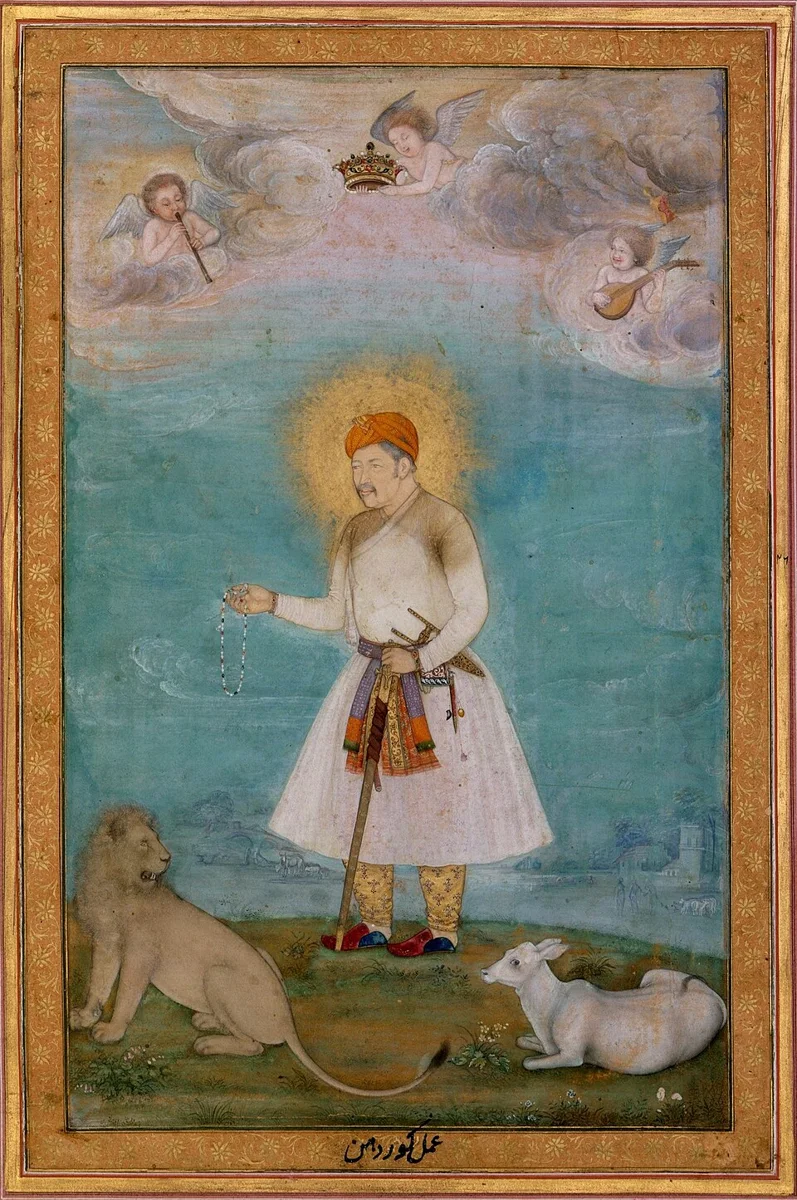
Akbar with Lion and Calf, attributed to Govardhan, circa 1630: an illustrative context for Sulh-i-kul.
Credit: Govardhan / Mir Ali Heravi · Public domain · sourceResized and converted to WebP; uncropped.
Meaning and historical background
Sulh-i-kul expressed the ideal that the ruler should maintain peace among different religious communities and administer justice without allowing attachment to one sect to determine public policy. It did not require subjects to abandon their beliefs or merge their religions. Rather, it treated religious diversity as a condition of imperial society that an effective sovereign should accommodate. Its immediate setting was a monarchy, not a constitutional state founded on equal citizenship.
The idea developed within the culturally diverse environment of the Mughal Empire. Its population included numerous Hindu traditions, Muslims of different affiliations, Jains, Christians, Zoroastrians and others. Political authority also depended on cooperation among groups with different regional, ethnic and religious backgrounds. Akbar’s expanding empire therefore needed a language of legitimacy broader than the interests of a single religious establishment.
Persianate political thought, Sufi traditions and Akbar’s engagement with religious specialists contributed to this outlook. However, sulh-i-kul should not be reduced to a direct borrowing from one saint or school. It emerged through the interaction of intellectual debate, personal religious inquiry and practical state-building. Earlier traditions of accommodation provided precedents, but Akbar gave the principle an unusually systematic imperial expression.
- Core idea: impartial protection and justice across religious divisions.
- Political objective: a stable empire supported by diverse elites and subjects.
- Conceptual caution: religious accommodation was not identical to modern secular democracy.
Timeline
1563
Akbar abolished the pilgrimage tax.
1564
Akbar abolished jizya.
1575
The Ibadat Khana was established at Fatehpur Sikri.
1579
The mahzar strengthened Akbar’s authority in resolving specified disputes over religious interpretation.
1580
The first Jesuit mission from Goa arrived at Akbar’s court.
Around 1582
The development conventionally called Din-i Ilahi became associated with Akbar’s spiritual discipleship.
Akbar’s religious inquiry and its institutional setting
Akbar’s religious policies evolved rather than appearing as a complete programme at the beginning of his reign. The abolition of the pilgrimage tax in 1563 and jizya in 1564 removed prominent fiscal distinctions affecting non-Muslims. These decisions preceded the establishment of the Ibadat Khana and demonstrate that administrative accommodation and intellectual inquiry developed along overlapping paths.
In 1575, Akbar established the Ibadat Khana, or House of Worship, at Fatehpur Sikri. Initially associated with discussions among Muslim religious scholars, it subsequently opened to representatives of other traditions. The disputes among scholars appear to have reinforced Akbar’s dissatisfaction with exclusive claims to religious authority. Jain teachers, Brahmanical scholars, Zoroastrians and Christian missionaries became participants in the wider culture of discussion at court. The first Jesuit mission from Portuguese Goa arrived in 1580.
The mahzar of 1579 strengthened Akbar’s position in relation to the ulama. Under specified conditions, it authorised him to select among conflicting interpretations offered by qualified Muslim jurists when public benefit required a decision. Describing it simply as an “infallibility decree” is misleading: it did not proclaim that every imperial statement was divinely protected from error. Its significance lay in enhancing the sovereign’s authority within contested religious interpretation.
- Ibadat Khana was a place and forum for debate, not another name for sulh-i-kul.
- The mahzar concerned authority in disputed interpretation; sulh-i-kul was a wider ethic of governance.
- The chronology of tax abolition shows that accommodation did not begin only after the religious debates.
Logic of inclusive Mughal sovereignty
- 1. A diverse population and expanding imperial territory
- 2. Need for cooperation across religious and regional divisions
- 3. Religious inquiry and criticism of sectarian exclusiveness
- 4. Articulation of sulh-i-kul as an imperial ideal
- 5. Accommodation through taxation, appointments and cultural patronage
Abu’l Fazl and the practice of inclusive sovereignty
Abu’l Fazl, author of the Akbarnama and its administrative component, the Ain-i Akbari, explained Akbar’s sovereignty through ideals of reason, justice and universal concord. In this formulation, a ruler possessing exceptional insight should rise above sectarian prejudice and protect the whole population. Such arguments also magnified imperial authority: the emperor, rather than a particular body of theologians, became the principal arbiter of public order.
The principle found practical expression in the incorporation of different groups into imperial service. Rajput chiefs entered the mansabdari system and received important military and administrative assignments. Raja Man Singh and Raja Todar Mal illustrate the prominence that Hindu officers could attain. Recruitment nevertheless remained structured by status, patronage and service, and the nobility was not an institution of democratic representation.
Marriage alliances with several Rajput houses supported political accommodation, but they were neither universal nor the sole basis of integration. Mewar resisted Mughal supremacy, and the Battle of Haldighati in 1576 demonstrates that Akbar’s relations with Rajputs cannot be described as uniformly peaceful. Sulh-i-kul meant accommodation within an empire; it did not entail acceptance of the political independence of every kingdom.
Translation projects also encouraged engagement with different intellectual traditions. At Akbar’s court, the Mahabharata was translated into Persian as the Razmnama, while other Sanskrit works were also translated. These enterprises widened access to knowledge, facilitated discussion and expressed the court’s ambition to understand the traditions of its subjects. Their significance went beyond any attempt to establish a new creed.
- Administrative integration: participation of diverse elites in imperial service.
- Fiscal accommodation: abolition of pilgrimage tax and jizya.
- Cultural engagement: translations and interreligious discussion.
- Political qualification: loyalty to Mughal sovereignty remained essential.
| Term | Nature | Main significance |
|---|---|---|
| Sulh-i-kul | Governing principle | Peace and impartial justice across religious differences |
| Ibadat Khana | Discussion forum established in 1575 | Religious debate at Fatehpur Sikri |
| Mahzar | Declaration of 1579 | Enhanced imperial authority in specified interpretive disputes |
| Din-i Ilahi | Limited spiritual discipleship | Personal ethical and spiritual affiliation with Akbar |
| Razmnama | Persian translation of the Mahabharata | Court-sponsored engagement with Sanskrit learning |
Distinguishing sulh-i-kul from Din-i Ilahi
Din-i Ilahi is conventionally associated with initiatives around 1582 and is better approached as a limited circle of spiritual discipleship centred on Akbar than as a mass religion. Tawhid-i Ilahi is another term associated with this development. Its participants followed ethical expectations and practices of loyalty or discipleship, but it did not acquire a large organised community comparable to established religious traditions.
Sulh-i-kul had a much wider political scope. An official or subject did not have to become Akbar’s disciple to receive protection or participate in imperial life. The principle addressed relations among communities and the conduct of rulers and officials, while imperial discipleship concerned a small group close to the sovereign. Confusing the two obscures the difference between public governance and personal spiritual affiliation.
The evidence also requires critical reading. Abu’l Fazl portrayed Akbar’s policies in a celebratory imperial idiom, whereas the historian Abd al-Qadir Badauni was sharply critical of several religious innovations. Their contrasting accounts help historians reconstruct both the ambitions of the court and the resistance those ambitions generated. Neither should be treated as a neutral transcript of events.
- Sulh-i-kul: universal concord and impartial governance.
- Din-i Ilahi: limited imperial spiritual discipleship.
- Abu’l Fazl and Badauni: contrasting contemporary perspectives.
Significance, limitations and legacy
Sulh-i-kul helped formulate a model of sovereignty suited to a large, religiously diverse empire. It widened the basis of political cooperation and made public justice, rather than narrow sectarian preference, a central claim of imperial legitimacy. For historical analysis, its importance lies in connecting religious ideas with recruitment, taxation, cultural patronage and the consolidation of state authority.
Its limits are equally important. Akbar remained an autocratic conqueror, and accommodation did not eliminate coercion or social inequality. The massacre following the capture of Chittor in 1568 cautions against depicting his reign as consistently non-violent. Policies were also uneven and could be reconsidered by successors. Aurangzeb’s reimposition of jizya in 1679 marked a significant departure from Akbar’s fiscal approach, although non-Muslims continued to serve within Mughal institutions.
For UPSC answers, avoid both idealisation and dismissal. Calling sulh-i-kul merely a cynical political device ignores its substantial intellectual and ethical articulation; calling it modern secularism overlooks its monarchical setting. A balanced interpretation presents it as an influential early modern ideal of inclusive kingship, implemented through specific policies but constrained by the requirements and contradictions of empire.
- Prelims focus: terminology, chronology, texts, personalities and distinctions.
- Mains focus: connect religious accommodation with imperial integration and legitimacy.
- Evaluation: distinguish proclaimed ideals from actual political conduct.
Sulh-i-kul and the Ideal of Imperial Concord
The supplied metadata identifies a painting of Akbar with a lion and calf, attributed to Govardhan and dated circa 1630. This subject offers an illustrative connection to Sulh-i-kul: the pairing of potentially antagonistic animals can evoke concord under a just sovereign. That interpretation should remain qualified, however. The title alone cannot establish the artist’s intended message or prove that the work explicitly represents Sulh-i-kul.
Associated especially with Akbar and articulated by Abu’l Fazl, Sulh-i-kul made peace across religious differences a principle of imperial governance. Its significance lay in the ruler’s obligation to administer justice without allowing sectarian allegiance to determine political inclusion. Incorporating diverse elites and reducing discriminatory burdens helped give this ideal practical expression, although particular policies require their own documentary evidence.
The supplied date places the painting after Akbar’s lifetime, making it useful for discussing his remembered royal image rather than treating it as a contemporary record of his decisions. For Indian history, such imagery complements textual and administrative sources; it cannot independently demonstrate how consistently tolerance operated across the empire.
- Sulh-i-kul was a governing ethic, not a separate religion or an exact equivalent of modern constitutional secularism.
- Distinguish the principle from the Ibadat Khana’s debates, the mahzar of 1579 and Din-i Ilahi.
- For Mains, separate imperial ideals, specific administrative measures and lived outcomes; artistic symbolism primarily illuminates representation.
Real-world case studies
The Razmnama translation project
During the 1580s, Sanskrit scholars and Persian literati collaborated on a Persian rendering of the Mahabharata under Akbar’s patronage. The Razmnama illustrates intellectual engagement across traditions without requiring religious conversion. It also shows how cultural patronage supported the court’s claim to govern a diverse society.
Jain engagement with Akbar
The Jain teacher Hiravijaya Suri visited Akbar’s court in the 1580s. Jain representations contributed to restrictions on animal killing on specified occasions. This illustrates accommodation through dialogue, but it should not be interpreted as Akbar’s conversion to Jainism or a permanent empire-wide prohibition of all slaughter.
Previous year questions
No source-linked PYQ is available here yet. Use the practice questions below.
Practice questions
Practice MCQ 1
With reference to sulh-i-kul, consider the following statements: 1. It required imperial officials to join Din-i Ilahi. 2. Abu’l Fazl articulated it as an ideal of imperial governance. 3. It envisaged peace among different religious communities. Which of the statements given above are correct?
- A. 1 and 2 only
- B. 2 and 3 only
- C. 1 and 3 only
- D. 1, 2 and 3
Practice MCQ 2
Which one of the following gives the correct chronological order?
- A. Abolition of jizya → Establishment of Ibadat Khana → Mahzar → First Jesuit mission
- B. Establishment of Ibadat Khana → Abolition of jizya → First Jesuit mission → Mahzar
- C. Mahzar → Abolition of jizya → Establishment of Ibadat Khana → First Jesuit mission
- D. Abolition of jizya → First Jesuit mission → Mahzar → Establishment of Ibadat Khana
Practice MCQ 3
The mahzar of 1579 is best understood as:
- A. A proclamation abolishing all religious taxes
- B. A charter establishing a representative legislature
- C. A declaration enabling Akbar, under specified conditions, to choose among conflicting juristic interpretations
- D. A decree making Din-i Ilahi compulsory throughout the empire
Mains practice · Sulh-i-kul was both an ethical ideal and a strategy of imperial integration. Discuss with reference to Akbar’s reign. Answer in 250 words.
- Define universal peace and situate it within early modern monarchy.
- Explain Abu’l Fazl’s emphasis on impartial justice and supra-sectarian kingship.
- Connect the ideal with tax abolition, Rajput incorporation and translation projects.
- Distinguish it from the Ibadat Khana, mahzar and Din-i Ilahi.
- Assess conquest, coercion and continuing hierarchy as limitations.
- Conclude that ethical articulation and political utility were mutually reinforcing.
Further reading
- NCERT, Themes in Indian History, Part II, Kings and Chronicles: The Mughal Courts, in editions containing this chapter.
- NCERT, Our Pasts II, The Mughal Empire.
- Satish Chandra, Medieval India: From Sultanat to the Mughals, Part Two.
- Abu’l Fazl, Akbarnama and Ain-i Akbari, available in English translations.
- Archaeological Survey of India: official material on Fatehpur Sikri.
- https://commons.wikimedia.org/wiki/File:Govardhan._Akbar_With_Lion_and_Calf_ca._1630,_Metmuseum.jpg
Preparing for UPSC Civil Services? Get classroom teaching, answer-writing evaluation and mentorship at Pragnya IAS Academy, Ashok Nagar — see why aspirants choose us for IAS coaching in Hyderabad.