

United Nations General Assembly Building, New York City
Credit: Jakub Hałun · CC BY 4.0 · source

DRC Kinshasa 29/05/13 International Peacekeeping Day. Photo MONUSCO/ Myriam Asmani
Credit: MONUSCO Photos · CC BY-SA 2.0 · source
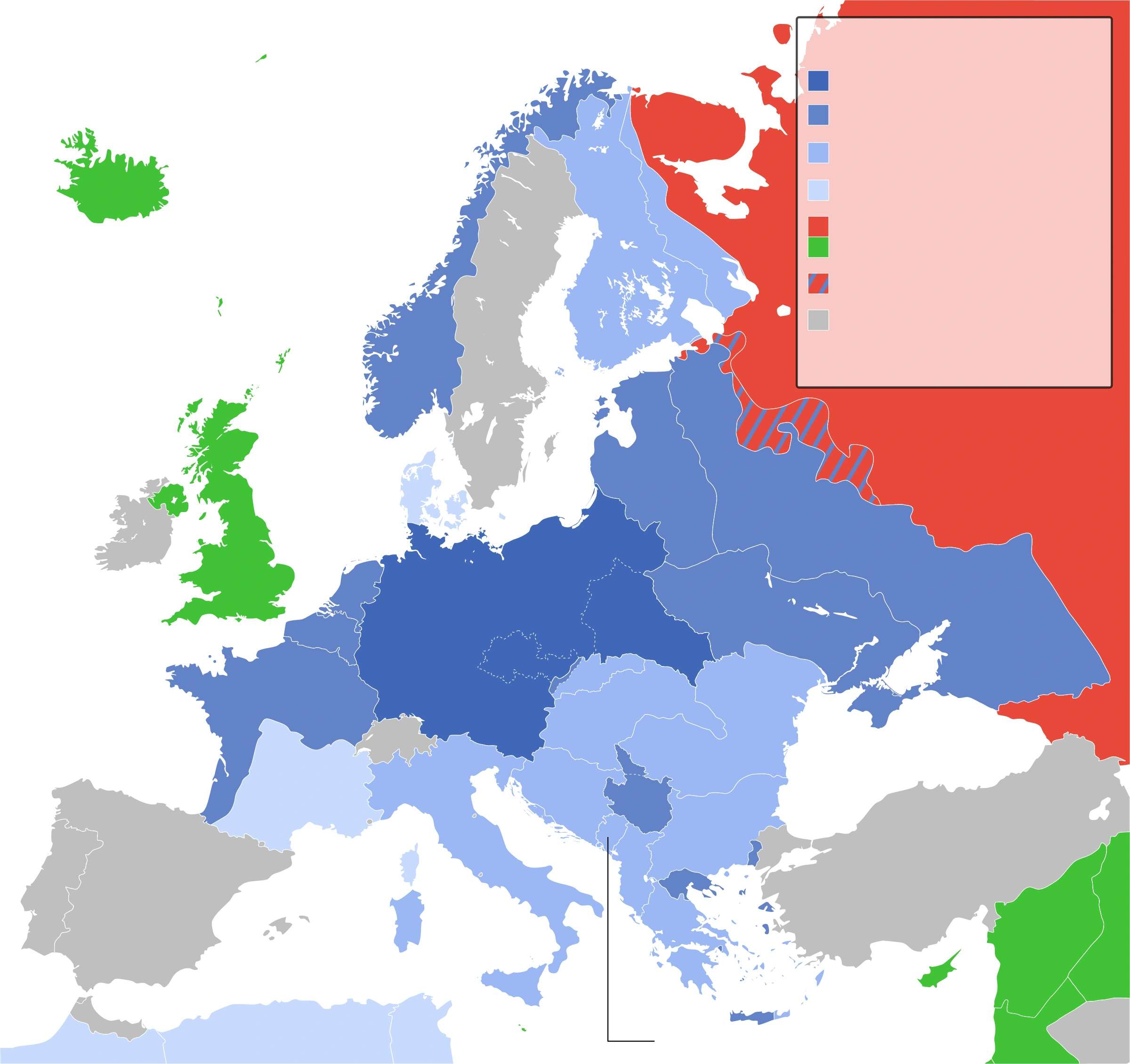
Map study
Europe in 1942 during the Second World War: historical context for the postwar UN order; distinguish occupation, alliance and neutrality through the legend.
- Read the source legend and reference date before interpreting the map.
- Use spatial patterns to support topic revision; verify current official boundaries, designations and warnings separately.
Credit: Goran tek-en · CC BY-SA 4.0 · sourceConverted to WebP on an opaque white background; proportionally resized without cropping. Original cartography and legend retained.
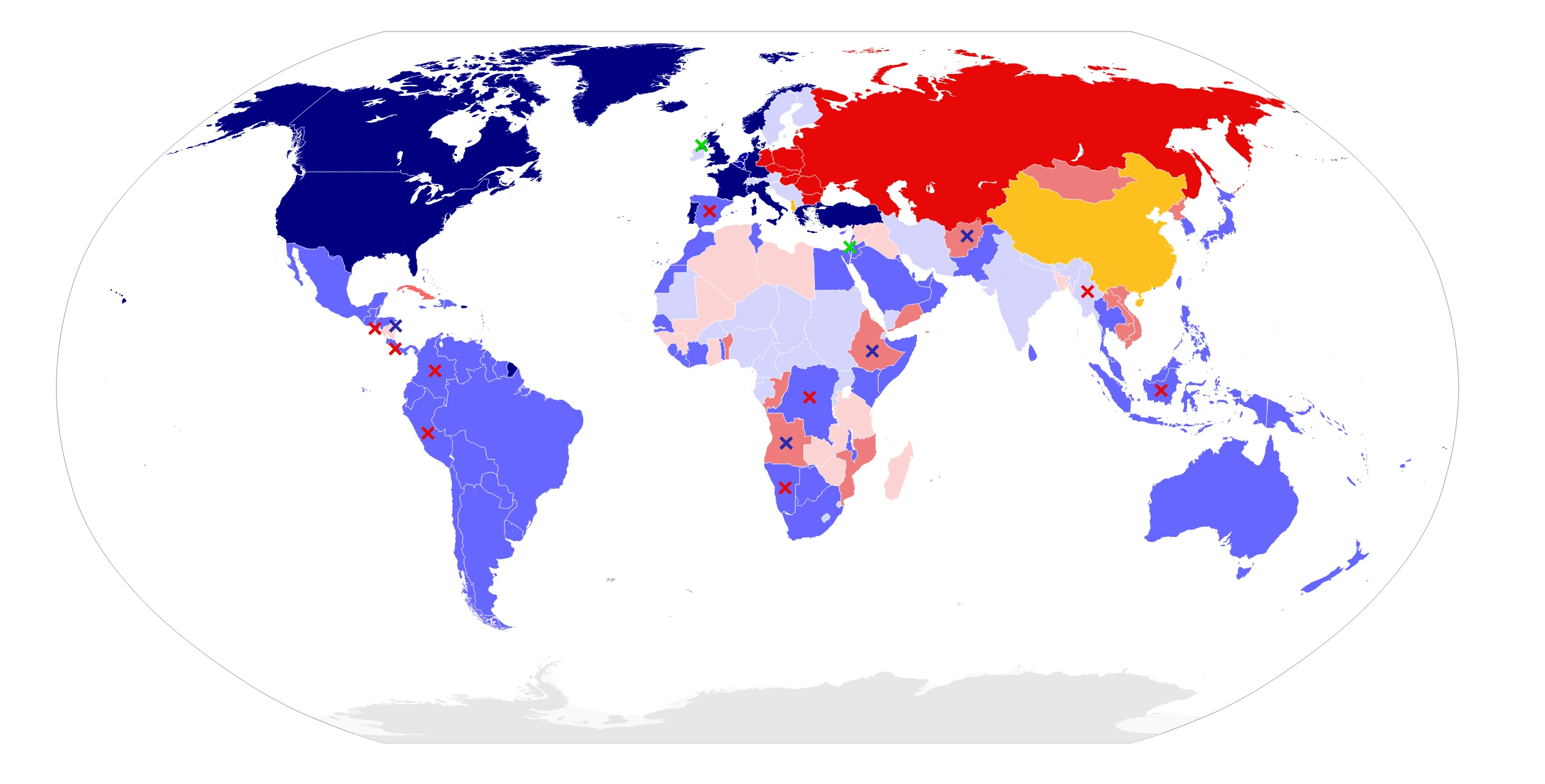
Map study
Cold War alliances in 1980: compare blocs and non-aligned regions. This historical map is not current NATO membership or present geopolitical alignments.
- Read the legend and reference date before interpreting regional patterns.
- Relate the map to the article’s topic; verify current administrative boundaries or data separately.
Credit: Chabacano; Sancebau · CC BY-SA 3.0 · sourceConverted to WebP on an opaque white background; proportionally resized without cropping. Original cartography and legend retained.
1. Origins, purposes and Charter principles
The United Nations emerged from the destruction of the Second World War and the failure of the League of Nations to prevent aggression. Its Charter was signed at San Francisco on 26 June 1945 and entered into force on 24 October after the required ratifications. Its founding bargain combined sovereign equality with special responsibilities and privileges for the major victorious powers.
Article 1 identifies four broad purposes: maintaining international peace and security; developing friendly relations based on equal rights and self-determination; cooperating on economic, social, cultural and humanitarian problems while promoting human rights; and harmonising national action. The UN is not a world government: its effectiveness depends on authority conferred by the Charter, member-state cooperation and political consent.
Article 2 establishes sovereign equality, good-faith fulfilment of obligations, peaceful settlement of disputes and the prohibition of the threat or use of force against states’ territorial integrity or political independence. Domestic jurisdiction is protected under Article 2(7), but this does not prevent enforcement measures under Chapter VII. Article 51 recognises individual and collective self-defence if an armed attack occurs.
- Admission: membership requires a Security Council recommendation followed by a General Assembly decision.
- Legal hierarchy: Article 103 gives Charter obligations priority over conflicting obligations under other international agreements.
- Exam distinction: sovereign equality does not mean equal institutional power; permanent membership and the veto create a structural asymmetry.
Timeline
1945
UN Charter signed on 26 June; enters into force on 24 October.
1948
Universal Declaration of Human Rights adopted; UNTSO becomes the first UN peacekeeping operation.
1965
Security Council enlargement from 11 to 15 members takes effect.
1994
Trusteeship Council suspends operations following Palau’s independence.
2015
General Assembly adopts the 2030 Agenda for Sustainable Development.
2024
Summit of the Future adopts the Pact for the Future.
2. Institutional architecture and decision-making
The General Assembly comprises all member states, each with one vote. Important questions, including admission and budgetary matters, require a two-thirds majority of members present and voting; other questions normally require a simple majority. Most Assembly resolutions are recommendations, but decisions within its institutional competence, such as budgetary assessments, have legal consequences.
The Security Council has primary responsibility for international peace and security. Its permanent members are China, France, Russia, the United Kingdom and the United States. Procedural decisions require nine affirmative votes. Substantive decisions also require nine votes and no negative vote by a permanent member; a permanent member’s abstention does not constitute a veto. Members agree under Article 25 to accept and carry out Council decisions.
The Economic and Social Council has 54 elected members and coordinates economic, social and related work. The Secretariat, headed by the Secretary-General, performs administrative, diplomatic and operational functions. Under Article 99, the Secretary-General may bring threats to international peace and security to the Council’s attention.
The International Court of Justice has 15 judges elected independently by the Assembly and Council. It decides disputes between states on the basis of jurisdiction founded on state consent and gives advisory opinions when requested by authorised bodies. The Trusteeship Council suspended operations in 1994 after Palau’s independence, but remains a principal organ.
- The Human Rights Council is a 47-member subsidiary organ of the General Assembly, not a principal UN organ.
- WHO, ILO and UNESCO are specialised agencies; UNDP, UNICEF and UNEP are programmes or funds.
- The International Criminal Court is a separate treaty-based institution, not a UN organ.
Possible UN response to a threat to peace
- 1. A dispute or crisis is brought to UN attention
- 2. Diplomacy, mediation or peaceful settlement is pursued
- 3. Security Council considers the situation and available mandates
- 4. Council may impose sanctions, establish a mission or authorise enforcement
- 5. Member states and UN bodies implement authorised measures
- 6. Monitoring and review inform mandate renewal or adjustment
3. Peace, security, development and human rights
Chapter VI provides tools for peaceful dispute settlement, including negotiation, mediation, arbitration and judicial settlement. Under Chapter VII, the Security Council may determine threats to peace and adopt sanctions or authorise force. Sanctions range from arms embargoes to travel bans and asset freezes, with targeted measures intended to reduce harm to civilians.
Peacekeeping evolved through practice rather than an explicit Charter chapter. Its central principles are consent of the main parties, impartiality, and non-use of force except in self-defence and defence of the mandate. Modern missions may protect civilians, support elections, monitor ceasefires and assist institutional rebuilding. Robust peacekeeping is not identical to peace enforcement, which need not depend on the parties’ consent.
The UN’s development role spans technical assistance, norm-setting and coordination. The 2030 Agenda, adopted in 2015, contains 17 Sustainable Development Goals and 169 targets. Implementation remains nationally led; the High-level Political Forum reviews progress, including through voluntary national reviews. UN agencies also coordinate humanitarian relief, refugee protection, food assistance and public-health responses.
The Universal Declaration of Human Rights, adopted in 1948, established influential common standards but is not itself a treaty. The 1966 human-rights covenants created treaty obligations for their parties. The Universal Periodic Review examines all UN member states. The Responsibility to Protect, endorsed in 2005, concerns genocide, war crimes, ethnic cleansing and crimes against humanity; it does not provide a general licence for unilateral military intervention.
- Regular and peacekeeping budgets rely on assessed contributions; many humanitarian and development activities depend heavily on voluntary funding.
- SDG goals are political commitments, unlike binding treaty obligations.
- Civilian protection requires clear mandates, adequate resources, accountability and a viable political process.
| Mechanism | Primary role | Key limitation |
|---|---|---|
| General Assembly | Universal deliberation, recommendations and institutional decisions | Most resolutions do not bind states |
| Security Council | Peace and security decisions, sanctions and force authorisation | Permanent-member veto and political divisions |
| International Court of Justice | Interstate adjudication and advisory opinions | Contentious jurisdiction depends on state consent |
| Peacekeeping | Support for peace processes and mandate implementation | Depends on personnel, resources and political cooperation |
| Human Rights Council | Human-rights scrutiny, review and investigations | Not a court; implementation depends heavily on cooperation |
4. India and the United Nations
India treats the UN as central to rules-based multilateral cooperation while arguing that its institutions inadequately reflect contemporary realities. Its historical contributions include advocacy against colonialism and apartheid, participation in peacekeeping, and support for development priorities. Hansa Mehta helped secure the gender-inclusive phrase “all human beings” in Article 1 of the Universal Declaration of Human Rights.
India is a longstanding major troop contributor to UN peacekeeping. Its contributions have extended across missions in Congo, Lebanon, South Sudan and elsewhere. In 2007, India deployed the UN’s first all-female formed police unit to Liberia, linking operational security with women’s participation. India emphasises consultation with troop-contributing countries, peacekeeper safety and realistic mandates.
India seeks permanent membership of an expanded Security Council. Its case rests on population, economic weight, democratic credentials, peacekeeping contributions and the underrepresentation of developing countries. It works with Brazil, Germany and Japan in the G4 and supports greater African representation. However, credentials alone cannot overcome resistance from rival states and divergent reform preferences.
India also advances counterterrorism cooperation, climate equity, sustainable development and the interests of the Global South. It proposed a Comprehensive Convention on International Terrorism in 1996; negotiations remain unresolved, including over definitional questions. India’s positions on conflicts often combine strategic autonomy, dialogue, sovereignty and concern over humanitarian consequences.
- India has served eight terms as an elected Security Council member.
- The International Day of Yoga, proclaimed by the General Assembly in 2014, illustrates India’s agenda-setting through coalition building.
- For answers, distinguish support for international law from automatic endorsement of every UN resolution.
5. Institutional limitations and reform priorities
The UN’s principal weakness is the gap between universal responsibilities and unequal political power. Vetoes and great-power rivalry can block responses to major conflicts. Failures in Rwanda in 1994 and Srebrenica in 1995 exposed weaknesses in mandates, resources and political will. Contemporary crises also demonstrate inconsistent enforcement and allegations of selective application of international norms.
Reform involves both representation and performance. Proposals include expansion of permanent and elected Security Council seats, improved working methods, veto restraint in mass-atrocity situations, predictable financing and stronger coordination across agencies. Africa’s Ezulwini Consensus demands at least two permanent seats with all permanent-member privileges, including the veto while it exists, and five non-permanent seats for Africa.
Charter reform faces a demanding legal threshold. Under Article 108, amendments require adoption by two-thirds of General Assembly members and ratification by two-thirds of UN members, including every permanent Security Council member. Thus, an Assembly majority alone cannot deliver Council reform. The Uniting for Consensus group favours alternatives to adding new national permanent seats.
Practical reforms can proceed without comprehensive Charter amendment. A 2022 Assembly resolution established a standing mandate for an Assembly debate following a Security Council veto, increasing scrutiny without removing the veto. The 2024 Pact for the Future, adopted alongside the Global Digital Compact and Declaration on Future Generations, renewed commitments to institutional adaptation. India’s approach should combine ambitious structural reform with achievable improvements in accountability, representation and delivery.
- Balanced assessment: the UN cannot substitute for political agreement among states, but provides indispensable legitimacy, coordination and negotiating space.
- Way forward: build cross-regional coalitions, strengthen preventive diplomacy, protect humanitarian access and improve peacekeeping accountability.
Real-world case studies
Liberia: Indian women in peacekeeping
India’s all-female formed police unit served in UNMIL from 2007 to 2016. Beyond security duties, its presence provided visible role models for women entering policing. The case demonstrates how mission composition can support community confidence and gender inclusion.
Ukraine: action beyond a deadlocked Council
Following Russia’s full-scale invasion in February 2022, a Russian veto blocked a substantive Security Council draft. The Council nevertheless referred the issue to an emergency special session through a procedural vote. The Assembly adopted resolutions under the Uniting for Peace framework, illustrating its political reach but lack of equivalent enforcement powers.
Previous year questions
UPSC Mains 2015 · GS-II
Discuss the impediments India faces in its pursuit of a permanent seat in the UN Security Council.
- Charter amendment requires ratification by all five permanent members.
- Regional rivalries and competing reform coalitions obstruct consensus.
- Disagreements concern membership categories, representation and veto powers.
- India needs sustained African and cross-regional support alongside G4 coordination.
Practice questions
Practice MCQ 1
Which of the following is a principal organ of the United Nations?
- A. Human Rights Council
- B. International Criminal Court
- C. Trusteeship Council
- D. United Nations Development Programme
Practice MCQ 2
Consider two statements: 1. A permanent member’s abstention necessarily vetoes a substantive Security Council resolution. 2. Nine affirmative votes are required for a Security Council procedural decision. Which is correct?
- A. 1 only
- B. 2 only
- C. Both 1 and 2
- D. Neither 1 nor 2
Practice MCQ 3
Under Article 108, which requirement applies to ratification of a UN Charter amendment?
- A. Ratification by every UN member
- B. Ratification by two-thirds of UN members, including all permanent Security Council members
- C. Ratification only by the Security Council’s current members
- D. Approval by the Secretary-General without national ratification
Mains practice · The United Nations faces a crisis of representation as well as a crisis of effectiveness. Examine this statement and suggest priorities for India’s engagement. Answer in 250 words.
- Introduce the tension between sovereign equality and unequal decision-making power.
- Explain outdated Council representation, especially Africa’s lack of permanent seats.
- Discuss veto paralysis, financing constraints and implementation gaps.
- Balance criticism with humanitarian, developmental and peacekeeping achievements.
- Assess India’s reform claim, G4 engagement and Global South partnerships.
- Recommend structural reform alongside practical improvements in transparency, prevention and delivery.
Further reading
- United Nations Charter, especially Articles 1–2, 24–27, 51, 99, 103 and 108
- NCERT, Contemporary World Politics: International Organisations
- United Nations Peacekeeping: peacekeeping.un.org
- Permanent Mission of India to the United Nations, New York: pminewyork.gov.in
- UN General Assembly Resolution 76/262 on debate following a Security Council veto
- UN General Assembly Resolution 79/1: Pact for the Future
Preparing for UPSC Civil Services? Get classroom teaching, answer-writing evaluation and mentorship at Pragnya IAS Academy, Ashok Nagar — see why aspirants choose us for IAS coaching in Hyderabad.