

Photographs of the constituent assembly taken on Dec.10, showing Jawaharlal Nehru addressing the House. Dr. Sachchidananda Sinha provisional Chairman in the presidential chair. On Jawaharlal Nehru’s l
Credit: Unknown authorUnknown author · Public domain · source

The en:Indian Constitution en:preamble
Credit: Illumination/ornamentation by Beohar Rammanohar Sinha, calligraphy by Prem Behari Narain Raizada. · Public domain · source
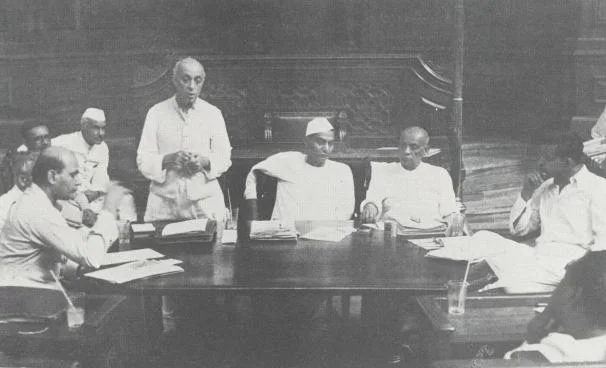
Jawaharlal Nehru addressing a Constituent Assembly committee meeting, New Delhi, 1949, as identified in the supplied metadata.
Credit: Unknown authorUnknown author · Public domain · sourceResized and converted to WebP; uncropped.
1. Origins and constitutional basis
A constituent assembly is a body entrusted with preparing a constitution. In India, its demand expressed the principle that Indians, rather than the British Parliament, should determine their political institutions. M. N. Roy is generally credited with proposing an Indian constituent assembly in 1934. The Indian National Congress officially demanded one in 1935. The August Offer of 1940 accepted, in principle, that framing India’s new constitutional framework should primarily be an Indian responsibility; the Cripps proposals of 1942 envisaged a constitution-making body after the war.
The Cabinet Mission Plan of May 1946 provided the actual scheme for constituting the Assembly. Its establishment therefore preceded both independence and the Constitution it eventually framed. The Assembly was not created under any article of the present Constitution, nor was it directly elected through universal adult franchise.
The Muslim League initially participated in elections to the Assembly but boycotted its first meeting. Following Partition, representatives associated with territories becoming Pakistan ceased to belong to the Indian Assembly. The Indian Independence Act, 1947 removed British parliamentary control over constitution-making and enabled the Assembly to function as a sovereign body. It was not required to secure British approval for the Constitution.
- Distinguish the historical demand for an Assembly from its actual establishment under the Cabinet Mission Plan.
- The Cabinet Mission comprised Pethick-Lawrence, Stafford Cripps and A. V. Alexander.
Timeline
May 1946
Cabinet Mission Plan provides the scheme for the Constituent Assembly.
9–11 December 1946
Assembly first meets; Rajendra Prasad is elected permanent President.
22 January 1947
Objectives Resolution is adopted.
29 August 1947
Drafting Committee is constituted.
4 November 1948
Ambedkar introduces the Draft Constitution in the Assembly.
26 November 1949
Constitution is adopted; specified provisions commence immediately.
24–26 January 1950
Members sign the Constitution on 24 January; general commencement follows on 26 January.
2. Composition, election and representation
The proposed Assembly had 389 members: 292 from Governors’ provinces, four from Chief Commissioners’ provinces and 93 from princely states. Seats were broadly allocated in proportion to population, approximately one seat for every million people. Provincial seats were divided among General, Muslim and Sikh categories according to their respective populations.
Provincial representatives were elected indirectly by members of the provincial legislative assemblies, using proportional representation through the single transferable vote. Members of each community in those legislatures elected their corresponding representatives. The princely states’ representatives were not elected through this provincial procedure; their selection was to be settled through consultation and was generally based on nomination.
After Partition, the Assembly’s strength fell to 299, comprising 229 provincial representatives and 70 representatives of princely states. The Congress held a dominant position, but the Assembly included people with diverse ideological, professional, regional and social backgrounds. Fifteen women served in it, including Hansa Mehta, Durgabai Deshmukh, Dakshayani Velayudhan and Rajkumari Amrit Kaur.
Its representativeness nevertheless had limits. The provincial legislatures that elected members rested on a restricted franchise, and the Assembly was neither directly elected by all adults nor ratified through a referendum. Its legitimacy also arose from the national movement, extensive public debate and its commitment to establishing universal adult suffrage under Article 326.
- Do not confuse the proposed membership of 389, the post-Partition membership of 299 and the 284 members who signed the Constitution.
- Princely-state representation was provided from the beginning, although participation developed gradually.
From constitutional principles to an operative Constitution
- 1. Objectives Resolution establishes guiding principles
- 2. Committees examine institutions, rights and safeguards
- 3. Constitutional Adviser prepares preliminary draft
- 4. Drafting Committee prepares text for public consultation
- 5. Assembly debates clauses and amendments
- 6. Constitution adopted on 26 November 1949
- 7. General commencement on 26 January 1950
3. Leadership and committee organisation
The Assembly first met on 9 December 1946 in New Delhi. Sachchidananda Sinha acted as temporary chairman. Rajendra Prasad was elected permanent President on 11 December. H. C. Mookherjee and V. T. Krishnamachari served as Vice-Presidents. B. N. Rau, the Constitutional Adviser, supplied comparative research and prepared an initial constitutional draft; he was not a member of the Drafting Committee.
Committees enabled specialised examination before the full Assembly debated proposals. Jawaharlal Nehru chaired the Union Powers Committee and Union Constitution Committee. Vallabhbhai Patel chaired the Provincial Constitution Committee and the Advisory Committee on Fundamental Rights, Minorities and Tribal and Excluded Areas. Within the advisory structure, J. B. Kripalani chaired the Fundamental Rights Sub-Committee and H. C. Mookherjee chaired the Minorities Sub-Committee.
The seven-member Drafting Committee was appointed on 29 August 1947 and chaired by B. R. Ambedkar. Its other original members were N. Gopalaswami Ayyangar, Alladi Krishnaswami Ayyar, K. M. Munshi, Mohammad Saadulla, B. L. Mitter and D. P. Khaitan. N. Madhava Rau subsequently replaced Mitter, while T. T. Krishnamachari replaced Khaitan after the latter’s death.
Ambedkar coordinated legal drafting and defended provisions during debates, but the Constitution was a collective achievement. Distinguish the Assembly’s President, the Drafting Committee’s chairman and the Constitutional Adviser: Rajendra Prasad, Ambedkar and B. N. Rau respectively.
| Body or office | Leading figure | Principal function |
|---|---|---|
| Constituent Assembly | Rajendra Prasad | Deliberation and adoption of the Constitution |
| Drafting Committee | B. R. Ambedkar | Preparation and revision of constitutional text |
| Constitutional Adviser | B. N. Rau | Comparative research and preliminary drafting |
| Advisory Committee | Vallabhbhai Patel | Recommendations concerning rights, minorities and specified tribal areas |
| Constituent Assembly functioning as legislature | G. V. Mavalankar | Ordinary legislative business after independence |
4. Deliberation, adoption and commencement
Nehru moved the Objectives Resolution on 13 December 1946; the Assembly adopted it on 22 January 1947. It outlined an independent sovereign republic, authority derived from the people, guarantees of justice and equality, and safeguards for minorities and disadvantaged groups. It supplied the philosophical foundation of the Preamble, but was not identical to the final Preamble.
Committee reports and Rau’s preliminary draft informed the Drafting Committee’s work. A Draft Constitution was published in February 1948 for public discussion. Ambedkar introduced it in the Assembly on 4 November 1948. General discussion was followed by detailed clause-by-clause scrutiny and a final reading. Of approximately 7,635 amendments tabled, 2,473 were moved.
The Assembly adopted the Constitution on 26 November 1949 after two years, eleven months and eighteen days of work. The original Constitution contained 395 articles, 22 parts and eight schedules. Under Article 394, selected provisions commenced immediately, including Articles 5–9 on citizenship, Article 324 concerning the Election Commission and several transitional provisions.
The remaining provisions commenced on 26 January 1950, commemorating the independence pledge associated with 26 January 1930. Thus, adoption and general commencement occurred on different dates. On 24 January 1950, 284 members signed the Constitution; the Assembly also elected Rajendra Prasad as the first President of India.
After independence, the Assembly additionally performed legislative functions. Its legislative sittings were presided over by G. V. Mavalankar, while Rajendra Prasad presided over constitution-making sittings. After the Constitution commenced, the Assembly continued as the Provisional Parliament until the first elected Parliament was constituted in 1952.
5. Constitutional significance and examination traps
The Assembly reconciled competing demands: national unity and federalism, parliamentary government and judicial review, enforceable rights and social transformation. Its decisions shaped Fundamental Rights, Directive Principles, an independent judiciary, affirmative action and a Union with substantial powers. The Constitution drew upon foreign models and the Government of India Act, 1935, but adapted them through Indian political experience rather than merely reproducing them.
Constituent Assembly Debates remain an important aid to understanding constitutional history and purpose. Courts may consult them, but individual speeches do not override the enacted text or bind judicial interpretation. In Kesavananda Bharati v. State of Kerala, 1973, the Supreme Court held that Parliament’s amending power under Article 368 cannot destroy the Constitution’s basic structure. Distinguish the Assembly’s original constitution-making authority from Parliament’s constitutionally limited amending power.
Another common trap concerns the Preamble: socialist, secular and integrity were inserted by the Forty-second Amendment, 1976, not by the Constituent Assembly. Similarly, universal adult franchise governed elections under the new Constitution, not the Assembly’s own selection. These distinctions connect foundational history with constitutional provisions frequently tested in Prelims.
Committee Deliberation in Constitution-Making
The supplied metadata identifies Nehru addressing a committee meeting of the Constituent Assembly, making this photograph directly relevant to its working methods. Constitution-making involved more than speeches in plenary sessions: committees examined institutional design, rights and governance, and their recommendations informed debates in the Assembly. This division of labour enabled detailed scrutiny while leaving constitutional decisions to the Assembly. It also helps explain why the Constitution should be understood as a collective achievement rather than the work of a single leader or committee.
Established under the Cabinet Mission Plan of 1946, the Assembly included representatives indirectly elected by provincial legislative assemblies and representatives of princely states selected through a different process. It was therefore not elected through universal adult franchise, although its deliberations engaged a wide range of political and social concerns. After independence, it exercised sovereign constitution-making authority and also performed legislative functions in a separate capacity. The metadata does not name the committee or identify its agenda, so the photograph cannot establish which provision was being discussed or what decisions followed.
- Distinguish roles: Rajendra Prasad presided over the Assembly; B. R. Ambedkar chaired the Drafting Committee; Nehru moved the Objectives Resolution.
- Committee recommendations were inputs, not automatically constitutional provisions: drafting, debate, amendments and adoption were distinct stages.
- For Mains, distinguish electoral representativeness from deliberative legitimacy; indirect election did not make the Assembly merely an advisory body after independence.
Real-world case studies
Dakshayani Velayudhan and the abolition of untouchability
Dakshayani Velayudhan, the Assembly’s only Dalit woman member, linked constitutional freedom with ending caste oppression. Her participation illustrates how historically excluded voices contributed despite restricted electoral arrangements. Article 17 abolished untouchability and prohibited its practice in any form, making social emancipation a constitutional commitment.
The official-language compromise
The 1949 language debates produced the Munshi–Ayyangar compromise. Article 343 designated Hindi in Devanagari script as the Union’s official language while providing for continued use of English for fifteen years and permitting Parliament to legislate for its further use. The Constitution did not declare Hindi India’s national language.
Previous year questions
No source-linked PYQ is available here yet. Use the practice questions below.
Practice questions
Practice MCQ 1
With reference to the Constituent Assembly’s composition under the Cabinet Mission Plan, consider the following statements: 1. Provincial representatives were directly elected by universal adult franchise. 2. Provincial representatives were elected through proportional representation by the single transferable vote. 3. Princely states were allotted 93 seats. Which statements are correct?
- A. 1 and 2 only
- B. 2 and 3 only
- C. 1 and 3 only
- D. 1, 2 and 3
Practice MCQ 2
Which of the following pairs is incorrectly matched?
- A. Union Powers Committee — Jawaharlal Nehru
- B. Provincial Constitution Committee — Vallabhbhai Patel
- C. Fundamental Rights Sub-Committee — J. B. Kripalani
- D. Constitutional Adviser — K. M. Munshi
Practice MCQ 3
Consider the following statements: 1. Every provision of the Constitution commenced on 26 January 1950. 2. The Constituent Assembly performed legislative functions after independence. 3. The words socialist and secular were present in the Preamble adopted in 1949. How many statements are correct?
- A. Only one
- B. Only two
- C. All three
- D. None
Mains practice · Although not elected through universal adult franchise, the Constituent Assembly developed substantial democratic legitimacy. Discuss with reference to its composition and working methods. Answer in 150 words.
- Identify indirect election, restricted franchise, princely-state nomination and Congress dominance as limitations.
- Explain legitimacy derived from the national movement and diverse political and social participation.
- Discuss specialised committees, public consultation, extensive debate and amendment procedures.
- Highlight commitments to rights, social justice and universal adult suffrage.
- Conclude that deliberative legitimacy was substantial without equating the Assembly with a directly elected body.
Further reading
- Constitution of India, Legislative Department: Preamble and Articles 17, 326, 343 and 394.
- Constituent Assembly Debates, Parliament Digital Library.
- NCERT, Indian Constitution at Work: Constitution: Why and How?
- Granville Austin, The Indian Constitution: Cornerstone of a Nation.
- B. Shiva Rao, The Framing of India’s Constitution: A Study.
- https://commons.wikimedia.org/wiki/File:Jawaharlal_Nehru_addressing_a_meeting_of_a_committee_of_the_Constituent_Assembly_New_Delhi,_1949.jpg
Preparing for UPSC Civil Services? Get classroom teaching, answer-writing evaluation and mentorship at Pragnya IAS Academy, Ashok Nagar — see why aspirants choose us for IAS coaching in Hyderabad.