
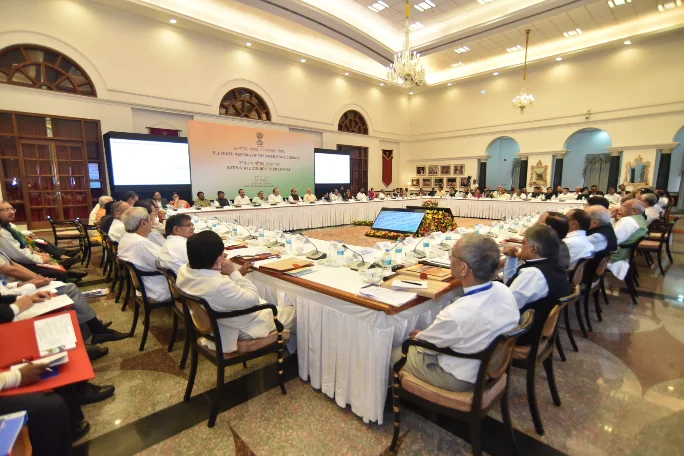
Prime Minister Narendra Modi inaugurating the 11th Inter-State Council meeting in New Delhi, as identified in the metadata.
Credit: Narendra Modi · CC BY-SA 2.0 · sourceResized and converted to WebP; uncropped.
1. Constitutional foundation and rationale
Indian federalism distributes legislative and executive authority between the Union and the States, but many policy problems cross territorial and departmental boundaries. Migration, internal security, environmental protection and welfare delivery require sustained consultation. The Inter-State Council provides an institutional forum where the Union and State governments can discuss common concerns instead of relying entirely on bilateral negotiations or litigation.
Article 263 empowers the President to establish a council if, at any time, it appears that public interests would be served by doing so. The President may define its duties, organisation and procedure. Thus, the Constitution enables establishment but does not itself bring a permanently functioning council into existence. The accurate formulation is that the Council has a constitutional basis and was established through a Presidential Order, not an Act of Parliament.
Article 263 envisages three possible duties: inquiring into and advising upon disputes between States; investigating and discussing subjects in which some or all States, or the Union and one or more States, have a common interest; and making recommendations on such subjects, particularly for better coordination of policy and action. These are enabling possibilities: the actual duties of a council depend on its constituting order.
The Council established in 1990 primarily performs the discussion and coordination functions corresponding to Article 263(b) and (c). Its mandate also covers deliberation on other matters of general interest to the States referred to it by its Chairman. The dispute-inquiry function in Article 263(a) should not automatically be treated as part of the present Council’s assigned mandate.
- Article 263 is in Part XI, which concerns relations between the Union and the States.
- The Council cannot impose a judicial settlement or alter the constitutional distribution of powers.
Timeline
1950
Article 263 comes into force with the Constitution.
1988
The Sarkaria Commission submits its report recommending a permanent Inter-State Council.
28 May 1990
The Inter-State Council is established by Presidential Order.
10 October 1990
The Council holds its first meeting.
1996
The Standing Committee of the Council is established.
16 July 2016
The eleventh Council meeting takes place after a long interval.
2. Establishment, composition and supporting institutions
The Sarkaria Commission, constituted in 1983 to examine Centre–State relations, recommended a permanent Inter-State Council under Article 263. The Commission submitted its report in 1988. The Council was established on 28 May 1990, and its first meeting was held on 10 October 1990. Its creation translated a previously underused constitutional provision into a standing forum for federal consultation.
The Prime Minister chairs the Council. Its membership includes Chief Ministers of all States, Chief Ministers of Union Territories having Legislative Assemblies, Administrators of Union Territories without Legislative Assemblies, and six Union Cabinet Ministers nominated by the Prime Minister. Governors of States under President’s Rule are also included under the Council’s composition arrangements. Membership therefore brings together the political executives responsible for implementing most major public policies.
Other Union ministers may participate as permanent invitees or be invited in connection with subjects under discussion, according to the applicable arrangements. For examinations, distinguish the core membership framework from changes in the individuals nominated or invited. The Council is not an elected second chamber and does not replace the Rajya Sabha’s legislative role.
A Standing Committee was established in 1996 and is chaired by the Union Home Minister. It facilitates continuing consultation, processes matters for the Council and monitors implementation of recommendations. The Inter-State Council Secretariat, functioning under the Ministry of Home Affairs, provides administrative and organisational support. It also provides secretariat support to the Zonal Councils.
- The President establishes the Council; the Prime Minister chairs it.
- The Union Home Minister chairs its Standing Committee, not the full Council.
Indicative consultation and follow-up process
- 1. Union or State governments identify a common-interest issue.
- 2. The Secretariat coordinates background material and agenda preparation.
- 3. The Standing Committee processes relevant matters for consideration.
- 4. The Council deliberates and seeks consensus on recommendations.
- 5. Responsible governments and ministries undertake follow-up, with monitoring.
3. Working and significance for cooperative federalism
The Council is designed as a deliberative and consensus-oriented institution. Governments raise concerns, officials prepare material, and issues may be processed through the Standing Committee before consideration by the full Council. Recommendations then require follow-up by the relevant Union ministries and State governments. A Council recommendation does not by itself become a law, executive rule or enforceable judicial decree.
Its value lies in connecting decision-making with implementation. Union policies frequently depend on State personnel, administrative systems and local knowledge. Consultation can reveal fiscal burdens, differences in institutional capacity and region-specific difficulties before policies are finalised. States also gain an opportunity to learn from one another and place shared concerns before the Union collectively.
The Council has a potentially broader remit than specialised federal institutions. The GST Council concentrates on the goods and services tax framework, while the Finance Commission recommends specified fiscal transfers and related measures. The Inter-State Council can discuss a wide range of common-interest questions, subject to its mandate and agenda. It supports, rather than supersedes, these specialised bodies.
The Supreme Court’s decision in S. R. Bommai v. Union of India, 1994, recognised federalism as a basic feature of the Constitution and strengthened judicial scrutiny of President’s Rule. Although the judgment did not create the Council, its constitutional emphasis helps explain why meaningful consultation between levels of government matters. Cooperative federalism must operate within, not override, constitutional limits.
- Consensus is a method of political coordination; it is not equivalent to legally binding adjudication.
- Discussion in the Council does not require a constitutional amendment, but implementing a particular proposal may require legislation or constitutional change.
| Institution | Legal basis | Chairperson | Primary role |
|---|---|---|---|
| Inter-State Council | Article 263; Presidential Order of 1990 | Prime Minister | Broad common-interest consultation and coordination |
| Zonal Councils | States Reorganisation Act, 1956 | Union Home Minister | Regional consultation and coordination |
| GST Council | Article 279A | Union Finance Minister | Recommendations concerning GST |
| NITI Aayog Governing Council | Executive resolution framework | Prime Minister | Development-policy consultation |
4. Distinguishing related institutions and dispute mechanisms
Zonal Councils are statutory regional forums established under the States Reorganisation Act, 1956. There are five such councils: Northern, Central, Eastern, Western and Southern. The Union Home Minister chairs them. The North Eastern Council is a separate statutory institution under the North Eastern Council Act, 1971; it is not a sixth Zonal Council created by the 1956 Act.
The GST Council is expressly provided for in Article 279A, inserted by the 101st Constitutional Amendment Act, 2016. It has a tax-specific remit and a constitutional voting framework. The Inter-State Council should not be assumed to follow that framework merely because both institutions involve Union and State representatives.
Federal disputes may involve legal routes distinct from consultation. Article 131 gives the Supreme Court original jurisdiction over specified Union–State and inter-State disputes involving legal rights, subject to constitutional conditions. Article 262 permits parliamentary arrangements for adjudication of inter-State river-water disputes and exclusion of court jurisdiction. The Inter-State Council is not a substitute for these adjudicatory mechanisms.
- Remember the distinctions: Article 263 concerns consultation; Article 279A concerns GST; Article 262 concerns inter-State river-water disputes.
- Do not confuse constitutional recognition with binding decision-making authority.
5. Limitations and reform priorities
The Council’s principal weakness has been irregular convening. The eleventh meeting on 16 July 2016 followed the tenth meeting held in December 2006, illustrating how a formal institution can remain underused. Long gaps reduce continuity and encourage governments to depend on ad hoc negotiations. A broad remit also requires careful agenda preparation to prevent discussions from becoming diffuse.
Its recommendations are non-binding, and political differences can obstruct agreement or follow-up. Union leadership of the Council makes trust and meaningful State participation especially important. Nevertheless, advisory status need not imply ineffectiveness: negotiated agreement can improve implementation precisely because participating governments have helped shape it.
The Punchhi Commission’s 2010 report supported strengthening intergovernmental consultation and the Council’s role. Practical reforms include predictable meetings, structured opportunities for States to propose agenda items, stronger research support and time-bound action-taken reports. The objective should be reliable consultation and transparent follow-up, not conversion of the Council into a court or an authority superior to elected governments.
- A useful reform test is whether consultation occurs early enough to influence policy.
- Administrative continuity through the Secretariat and Standing Committee should complement political-level meetings.
Inter-State Council: Consultation within India’s Federal System
The metadata identifies an actual Inter-State Council meeting, making this image directly relevant to institutional dialogue between the Union and States. Article 263 provides the constitutional basis for a council established by the President when public interest requires it. The present Council was established in 1990 following the Sarkaria Commission’s recommendation. Its constitutional foundation should not be confused with automatic creation by the Constitution: establishment required a Presidential Order.
Chaired by the Prime Minister, the Council brings Union and State leadership into a common consultative forum. Its role centres on discussing subjects of common interest and recommending better coordination of policy and action. This can strengthen cooperative federalism by allowing governments to articulate concerns beyond bilateral exchanges. However, consultation does not itself guarantee agreement or implementation. The meeting metadata establishes the occasion, not the agenda, decisions, attendance or effectiveness of the proceedings.
- Article 263 permits functions including inquiry and advice on inter-State disputes. Do not assume every constitutionally permitted function was assigned to the present Council; its assigned mandate emphasises common-interest discussion and coordination.
- The Council is advisory, not a court or tribunal. Distinguish political consultation from the Supreme Court’s original jurisdiction under Article 131 and the separate framework for inter-State river-water disputes under Article 262.
- For Prelims, distinguish the Inter-State Council from statutory Zonal Councils and the GST Council under Article 279A. For Mains, assess regular consultation, agenda-setting and follow-up rather than treating a meeting alone as proof of effective federal cooperation.
Real-world case studies
Eleventh Inter-State Council meeting, 2016
The meeting discussed the Punchhi Commission’s recommendations, use of Aadhaar and direct benefit transfers, educational outcomes and internal security. The agenda illustrates the Council’s broad remit and the need for coordinated implementation rather than judicial adjudication.
Sarkaria Commission recommendations as a continuing agenda
The Standing Committee and the Council examined Sarkaria Commission recommendations over successive meetings. This demonstrates how an expert commission’s proposals can undergo intergovernmental scrutiny. Discussion or acceptance, however, must be distinguished from implementation through the necessary legal or administrative action.
Previous year questions
No source-linked PYQ is available here yet. Use the practice questions below.
Practice questions
Practice MCQ 1
With reference to the Inter-State Council, consider the following statements: 1. Article 263 empowers the President to establish it. 2. The Union Home Minister chairs the full Council. 3. Its recommendations automatically bind State legislatures. Which of the statements given above is/are correct?
- A. 1 only
- B. 1 and 2 only
- C. 2 and 3 only
- D. 1, 2 and 3
Practice MCQ 2
Which of the following pairs is incorrectly matched?
- A. Inter-State Council: Article 263
- B. GST Council: Article 279A
- C. Zonal Councils: States Reorganisation Act, 1956
- D. North Eastern Council: Article 262
Practice MCQ 3
Consider the following statements: 1. Every duty envisaged in Article 263 must necessarily be assigned to every council established under it. 2. The Inter-State Council was established following a recommendation of the Sarkaria Commission. 3. The Council can coordinate policy without itself enacting legislation. Which of the statements given above are correct?
- A. 1 and 2 only
- B. 2 and 3 only
- C. 1 and 3 only
- D. 1, 2 and 3
Mains practice · The effectiveness of the Inter-State Council depends more on institutionalised consultation than on binding powers. Discuss. Answer in 150 words.
- Introduce Article 263 and the Council’s advisory character.
- Explain its broad remit and the significance of State participation.
- Identify irregular meetings, agenda-setting concerns and weak follow-up.
- Distinguish consultation from judicial dispute settlement.
- Recommend predictable meetings, State-proposed agenda items and action-taken reports.
Further reading
- Constitution of India, Legislative Department: Articles 131, 262, 263 and 279A.
- Inter-State Council Secretariat, Ministry of Home Affairs: composition, functions, meetings and Standing Committee.
- Report of the Sarkaria Commission on Centre–State Relations, 1988.
- Report of the Commission on Centre–State Relations chaired by Justice M. M. Punchhi, 2010.
- NCERT, Indian Constitution at Work: Federalism.
- Press Information Bureau: Eleventh Inter-State Council meeting, 16 July 2016.
- https://commons.wikimedia.org/wiki/File:Prime_Minister_Narendra_Modi_at_the_11th_meeting_of_the_Inter_State_Council.png
Preparing for UPSC Civil Services? Get classroom teaching, answer-writing evaluation and mentorship at Pragnya IAS Academy, Ashok Nagar — see why aspirants choose us for IAS coaching in Hyderabad.