
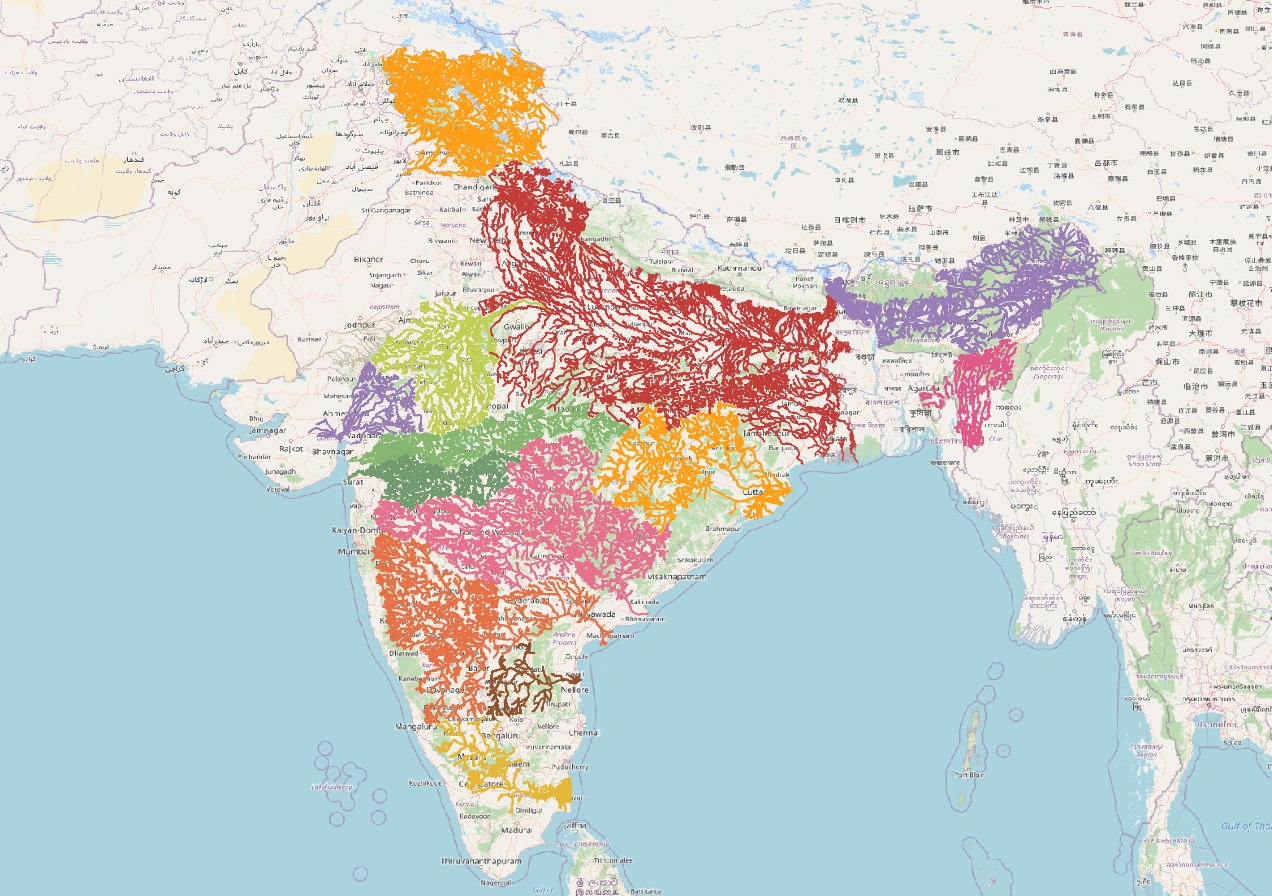
Map study
India river basins: distinguish watershed divides from state boundaries; compare east-flowing and west-flowing drainage.
- Read the source legend, scale and reference period before comparing regions.
- Connect spatial patterns to the processes discussed in this topic; this map is a study reference, not live operational data.
Credit: Heinz OSM · ODbL · sourceConverted to WebP on an opaque white background; proportionally resized without cropping. Original cartography and legend retained.
1. Nature and constitutional setting
Indian federalism divides authority between the Union and the States, but rivers, transport networks, forests and economic activity cross political boundaries. Disputes may concern river-water allocation, territorial claims, access to shared infrastructure, allocation of assets after reorganisation, or the exercise of governmental powers. Political disagreements become judicial disputes only when the relevant jurisdictional requirements, especially an identifiable legal right, are satisfied.
Water disputes involve both resource scarcity and competing development priorities. Upstream storage can affect downstream irrigation, drinking water, ecology and power generation. Boundary disputes may arise from colonial administrative arrangements, linguistic reorganisation or competing interpretations of notifications and maps. Seasonal shortages and identity-based mobilisation can transform technical disagreements into wider law-and-order problems.
The Constitution therefore provides more than one route to settlement. Courts determine legal rights; water tribunals provide specialised adjudication; councils facilitate consultation; and governments negotiate implementation arrangements. These mechanisms are complementary rather than interchangeable. Identifying the subject of the dispute and the legal source of the claim is the first step in determining the appropriate forum.
- Important examples include the Cauvery and Krishna water disputes, the Maharashtra–Karnataka boundary dispute and boundary disagreements among several northeastern States.
- An inter-State dispute is not automatically a Centre–State dispute, although the Union may act as mediator, legislator, administrator or litigant.
2. Supreme Court jurisdiction and territorial disputes
Article 131 confers exclusive original jurisdiction on the Supreme Court in disputes between the Government of India and one or more States; between the Government of India and a State or States on one side and other States on the other; and between two or more States. The dispute must involve a question of law or fact on which the existence or extent of a legal right depends. Original jurisdiction means that the case begins in the Supreme Court rather than reaching it on appeal.
This jurisdiction is subject to constitutional limitations. The proviso to Article 131 excludes specified disputes arising from certain pre-Constitution treaties, agreements and similar instruments. Article 262 also permits a special exclusion concerning inter-State river-water disputes. Private individuals and companies cannot become parties to an Article 131 suit merely because their interests overlap with those of a State; their remedies arise through other legal proceedings.
Territorial disagreements require a distinction between determining an existing boundary and changing a State’s territory. Article 3 empowers Parliament to alter State areas, boundaries or names. Such a Bill requires the President’s recommendation. Where a proposal affects a State’s area, boundary or name, the President must refer it to the State legislature for its views within a specified period. Parliament is not bound by those views. Under Article 4, the relevant reorganisation law is not treated as a constitutional amendment under Article 368.
- In State of West Bengal v. Union of India, 1963, the Supreme Court rejected the claim that States possess sovereignty preventing Parliament from authorising acquisition of State-owned property.
- Prelims distinction: adjudicating a boundary claim under existing law differs from legislatively altering a boundary under Article 3.
Simplified route for a river-water dispute
- 1. A State raises a qualifying water dispute with the Central Government.
- 2. Negotiated settlement is explored.
- 3. If negotiations cannot settle the dispute, the statutory tribunal mechanism is invoked.
- 4. The tribunal examines evidence and gives its decision, with statutory provision for further reference.
- 5. The decision is published in the Official Gazette and becomes binding.
- 6. An implementation scheme and monitoring arrangements support compliance.
3. Inter-State river-water disputes
Water is primarily covered by Entry 17 of the State List, but that entry is expressly subject to Entry 56 of the Union List. Entry 56 concerns regulation and development of inter-State rivers and river valleys to the extent that Parliament declares Union control expedient in the public interest. Article 262 separately authorises parliamentary legislation for adjudicating disputes over the use, distribution or control of waters of an inter-State river or river valley.
The Inter-State River Water Disputes Act, 1956 establishes a complaint-and-tribunal mechanism. A State government may request Union intervention in a qualifying water dispute. When the Central Government concludes that negotiations cannot settle the dispute, the statutory framework requires reference to a tribunal. Tribunals assess competing claims using hydrological information, existing uses, irrigation requirements and other relevant considerations.
Section 11 bars the jurisdiction of the Supreme Court and other courts over water disputes that may be referred to a tribunal under the Act. Section 6 provides for publication of the tribunal’s decision in the Official Gazette; the published decision is final and binding and has the same force as an order or decree of the Supreme Court. Section 6A enables an implementation scheme. These provisions do not mean that every legal question connected with a river is necessarily outside judicial scrutiny.
In its 2018 Cauvery judgment, the Supreme Court entertained appeals against the tribunal’s award under Article 136 and modified allocations. The decision illustrates why an absolute statement that the Supreme Court can never examine a water-related dispute is misleading. The River Boards Act, 1956 is a separate framework for inter-State river regulation and development; it should not be confused with the adjudicatory tribunal legislation.
- Separate three stages: adjudicating entitlement, monitoring compliance and managing releases during shortages.
- Article 262 enables exclusion of judicial jurisdiction; the statutory exclusion is contained in the 1956 disputes Act.
| Mechanism | Legal basis | Primary role | Exam distinction |
|---|---|---|---|
| Supreme Court | Article 131 | Adjudicates qualifying federal legal disputes | Exclusive original jurisdiction, subject to constitutional limits |
| Water dispute tribunal | Article 262 and the 1956 disputes Act | Adjudicates inter-State river-water disputes | Published decision is binding |
| Inter-State Council | Article 263 and Presidential Order, 1990 | Consultation and coordination | Not a judicial body |
| Zonal Councils | States Reorganisation Act, 1956 | Regional consultation | Statutory, not constitutional bodies |
| Parliament | Articles 3 and 4 | Alters State areas, boundaries or names | State views required; consent not mandatory |
4. Negotiation and cooperative institutions
Article 263 permits the President to establish an Inter-State Council when public interests would be served. Its contemplated functions include inquiring into and advising upon disputes between States, discussing subjects of common interest, and recommending better coordination of policy and action. Established by Presidential Order in 1990 following the Sarkaria Commission’s recommendation, the present Council is a consultative institution chaired by the Prime Minister, not a binding adjudicatory forum.
The five Zonal Councils were created under the States Reorganisation Act, 1956. Chaired by the Union Home Minister, they bring together governments to discuss issues such as borders, transport, security and economic cooperation. The North Eastern Council has a separate statutory basis under the North Eastern Council Act, 1971; it is not a sixth Zonal Council created by the 1956 Act.
Negotiated arrangements can be more adaptable than litigation, especially where settlement requires surveys, compensation, coordinated policing or infrastructure sharing. However, a political agreement must still be implemented consistently with applicable constitutional and statutory requirements. Council recommendations do not themselves alter State boundaries or override tribunal decisions.
- The Sarkaria and Punchhi Commissions emphasised stronger consultation and cooperative Centre–State relations.
- Do not confuse constitutional authorisation for a council with constitutional status for every intergovernmental forum.
5. Implementation challenges and reform priorities
Formal decisions do not automatically eliminate conflict. Water disputes face inconsistent data, changing cropping patterns, groundwater dependence, climate variability and disagreements over distress sharing. Boundary settlements may encounter local opposition where administrative control affects identity, land rights and access to public services. Long proceedings can harden political positions and postpone investment.
Effective dispute management requires jointly verified data, transparent operating rules, regular political dialogue and institutions capable of monitoring compliance. River-basin planning should account for surface water, groundwater and ecological needs rather than treating annual allocation as the only question. Boundary negotiations need reliable maps, joint surveys and consultation with affected communities.
For examination purposes, connect each institution with its precise function: Article 131 concerns adjudication of federal legal rights; Article 262 concerns a special water-dispute framework; Article 263 concerns consultation; and Article 3 concerns territorial reorganisation. Cooperative federalism is strongest when negotiated solutions remain anchored in legal obligations and credible implementation.
- Useful reform priorities: shared databases, clearer distress-sharing arrangements, timely proceedings and empowered implementation bodies.
- Avoid assuming that every dispute can be resolved by a court or that a negotiated settlement requires no subsequent legal action.
Real-world case studies
Cauvery: allocation and implementation
The Cauvery Water Disputes Tribunal delivered its final award in 2007, which was notified in 2013. In 2018, the Supreme Court modified allocations, including increasing Karnataka’s allocation by 14.75 thousand million cubic feet relative to the tribunal award. The Union subsequently notified the Cauvery Water Management Scheme, establishing the Cauvery Water Management Authority and the Cauvery Water Regulation Committee. The case demonstrates that allocation, reservoir-operation monitoring and shortage management are separate governance tasks.
Assam–Meghalaya: negotiated boundary settlement
In March 2022, Assam and Meghalaya signed an agreement addressing six of their twelve identified areas of boundary difference. Negotiations considered historical claims, ethnicity, administrative convenience, contiguity and local sentiments. The agreement illustrates the value of executive negotiation while also showing that partial settlement does not resolve every disputed stretch or remove the need for surveys and lawful implementation.
Previous year questions
No source-linked PYQ is available here yet. Use the practice questions below.
Practice questions
Practice MCQ 1
Consider the following statements: 1. Article 262 itself establishes a permanent water disputes tribunal. 2. Parliament may exclude the jurisdiction of the Supreme Court over disputes covered by Article 262. 3. State List Entry 17 is subject to Union List Entry 56. Which statements are correct?
- A. 1 and 2 only
- B. 2 and 3 only
- C. 1 and 3 only
- D. 1, 2 and 3
Practice MCQ 2
Which one of the following correctly describes the Inter-State Council?
- A. A tribunal whose decisions bind all States
- B. A statutory council established under the States Reorganisation Act, 1956
- C. A consultative body established by Presidential Order under Article 263
- D. A parliamentary committee empowered to alter State boundaries
Practice MCQ 3
Regarding a parliamentary proposal to alter a State’s boundary under Article 3, consider the following statements: 1. Introduction of the Bill requires the President’s recommendation. 2. The affected State legislature must be given an opportunity to express its views. 3. Parliament must obtain that legislature’s consent. Which statements are correct?
- A. 1 only
- B. 2 and 3 only
- C. 1 and 2 only
- D. 1, 2 and 3
Mains practice · Adjudication is necessary but insufficient for resolving inter-State disputes in India. Discuss with reference to river-water and boundary disputes. Answer in 250 words.
- Distinguish legal adjudication, political negotiation and administrative implementation.
- Explain Articles 131, 262, 263 and 3.
- Discuss data disagreements, distress sharing, identity politics and compliance problems.
- Use Cauvery and Assam–Meghalaya as examples.
- Recommend transparent data, joint surveys, regular dialogue and credible implementation institutions.
Further reading
- Legislative Department: Constitution of India, Articles 3, 4, 131, 262 and 263; Seventh Schedule.
- India Code: Inter-State River Water Disputes Act, 1956.
- India Code: River Boards Act, 1956 and States Reorganisation Act, 1956.
- Inter-State Council Secretariat: official material on the Inter-State Council, Zonal Councils, Sarkaria Commission and Punchhi Commission.
- Supreme Court of India: judgment dated 16 February 2018 in State of Karnataka v. State of Tamil Nadu.
- NCERT: Indian Constitution at Work, chapter on Federalism.
Preparing for UPSC Civil Services? Get classroom teaching, answer-writing evaluation and mentorship at Pragnya IAS Academy, Ashok Nagar — see why aspirants choose us for IAS coaching in Hyderabad.