
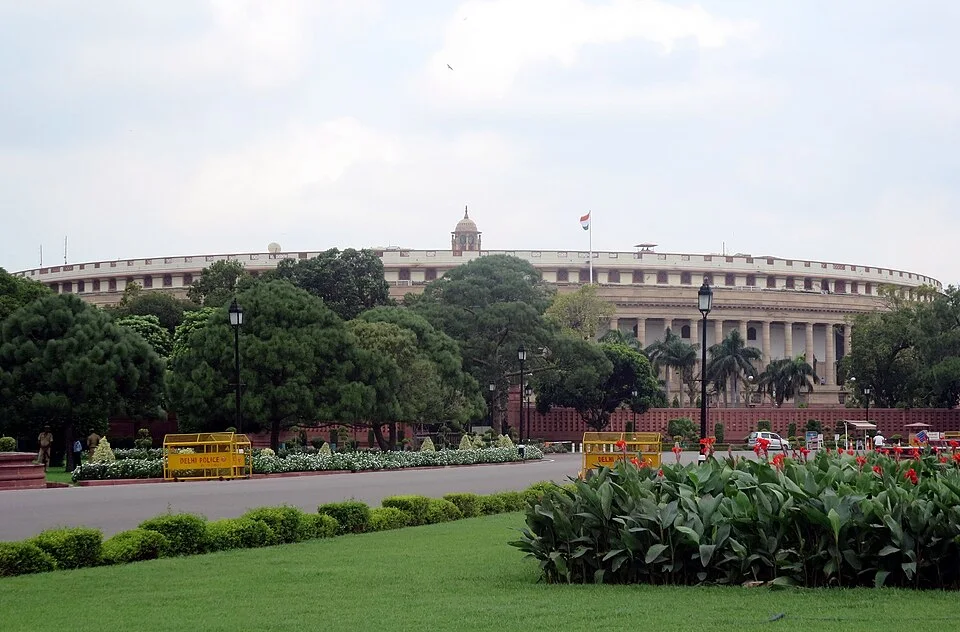
Old Sansad Bhavan, New Delhi: historical institutional context for the Lok Sabha.
Credit: Nikhilb239 · CC BY-SA 4.0 · sourceResized and converted to WebP; uncropped.
1. Constitutional position, composition and representation
Article 79 establishes Parliament as comprising the President, the Rajya Sabha and the Lok Sabha. The Lok Sabha represents the people through territorial constituencies and direct elections. Although commonly called the Lower House, it is politically decisive because the Union government must retain its confidence. In ordinary legislation, however, the two Houses generally possess equal authority; the Lok Sabha is not constitutionally superior in every matter.
Article 81 allows a maximum of 530 representatives of States and 20 representatives of Union territories. The current elected strength is 543. The older textbook figure of 552 included the former provision for up to two nominated Anglo-Indian members. The Constitution (104th Amendment) Act, 2019 extended reservation for Scheduled Castes and Scheduled Tribes in the Lok Sabha and State Assemblies to 2030, but did not extend Anglo-Indian nomination beyond January 2020.
Article 326 establishes adult suffrage for Lok Sabha and State Assembly elections. The Constitution (61st Amendment) Act, 1988 lowered the voting age from 21 to 18. Elections generally follow the first-past-the-post system: the candidate receiving the highest number of valid votes in a constituency wins, without needing an absolute majority. Article 325 prohibits exclusion from electoral rolls solely on grounds of religion, race, caste or sex.
Article 330 provides reservation of seats for Scheduled Castes and Scheduled Tribes; currently, 84 Lok Sabha seats are reserved for SCs and 47 for STs. Article 82 concerns readjustment after each census. The inter-State seat allocation freeze continues until publication of relevant figures from the first census taken after 2026. The 84th and 87th Amendments enabled constituency readjustment without changing State-wise seat allocation, ultimately using the 2001 Census.
- A reserved constituency has the ordinary electorate; reservation restricts candidate eligibility, not voting rights.
- The 106th Amendment, 2023 provides approximately one-third reservation for women, including within SC/ST reserved seats, but implementation requires the census-linked delimitation process under Article 334A. It did not apply to the 2024 election.
Timeline
1952
The first Lok Sabha was constituted following the first general election.
1978
The 44th Amendment restored the normal Lok Sabha term to five years.
1989
The 61st Amendment came into force, lowering the voting age to 18.
2020
Anglo-Indian nomination ceased; SC/ST seat reservation was extended to 2030.
2023
The 106th Amendment provided for women’s reservation with census-linked implementation conditions.
2. Membership, disqualification and duration
Article 84 requires a Lok Sabha member to be an Indian citizen, make the prescribed oath or affirmation, be at least 25 years old and possess additional qualifications prescribed by Parliament. The Representation of the People Act, 1951 supplies statutory qualifications and disqualifications. A candidate ordinarily must be an elector for a parliamentary constituency; residence in the constituency being contested is not generally required.
Article 102 covers disqualification for holding a disqualifying office of profit, being of unsound mind as declared by a competent court, being an undischarged insolvent, specified citizenship-related grounds and disqualification under parliamentary law. For these constitutional grounds, Article 103 makes the President the deciding authority, acting according to the Election Commission’s opinion. Defection is different: disqualification under the Tenth Schedule is decided by the Speaker, subject to judicial review.
In Lily Thomas v. Union of India (2013), the Supreme Court invalidated the statutory protection that allowed sitting legislators to postpone disqualification following specified convictions merely by filing an appeal. In Kihoto Hollohan v. Zachillhu (1992), it upheld the anti-defection framework while recognising judicial review of the presiding officer’s decisions.
Under Article 83(2), the Lok Sabha normally lasts five years from the date appointed for its first meeting, unless sooner dissolved. During a National Emergency, Parliament may extend this period by law for no more than one year at a time, and not beyond six months after the Emergency ceases. The 42nd Amendment increased the normal term to six years; the 44th Amendment restored five years.
- Under Article 101, resignation is addressed to the Speaker, who must be satisfied that it is voluntary and genuine.
- Absence without permission for 60 days can permit the House to declare a seat vacant; specified periods of prorogation or adjournment are excluded from this calculation.
How a Money Bill becomes law
- 1. President’s recommendation is obtained for introduction.
- 2. The Bill is introduced and passed in the Lok Sabha; the Speaker certifies it as a Money Bill.
- 3. The Bill is transmitted to the Rajya Sabha.
- 4. The Rajya Sabha may return recommendations within 14 days.
- 5. The Lok Sabha may accept or reject recommendations; non-return within 14 days results in deemed passage in the Lok Sabha’s form.
- 6. The Bill is presented to the President, who cannot return a Money Bill for reconsideration.
3. Speaker, sessions and conduct of business
Under Article 93, the Lok Sabha elects its Speaker and Deputy Speaker from among its members. The Speaker presides over proceedings, maintains order, interprets procedural rules, certifies Money Bills and decides defection petitions. Under Article 100, the presiding officer does not vote initially but has a casting vote when votes are equal. The Speaker also ordinarily presides over a joint sitting.
Under Article 94, removal of the Speaker requires a resolution passed by a majority of all the then members of the House, commonly called an effective majority, after at least 14 days’ notice. The Speaker cannot preside while that resolution is considered. Under Article 96, the Speaker may speak, participate and vote in the first instance during such proceedings, but cannot exercise a casting vote.
Article 85 empowers the President to summon and prorogue Parliament and dissolve the Lok Sabha, ordinarily on ministerial advice. No more than six months may intervene between the last sitting of one session and the first sitting of the next. Budget, Monsoon and Winter Sessions are conventions rather than constitutionally prescribed names or numbers.
Adjournment suspends a sitting; adjournment sine die closes sittings without fixing a date for reassembly; prorogation terminates a session; dissolution ends the House itself. The Speaker continues in office after dissolution until immediately before the first meeting of the next Lok Sabha. Article 105 protects parliamentary speech and voting, but parliamentary privilege is not blanket immunity from criminal law.
- Article 118 authorises each House to make procedural rules.
- Article 122 protects proceedings from challenge merely for procedural irregularity, not from all constitutional judicial review.
| Feature | Lok Sabha | Rajya Sabha |
|---|---|---|
| Duration | Normally five years; subject to dissolution | Permanent House; approximately one-third retire every two years |
| Minimum membership age | 25 years | 30 years |
| Executive responsibility | Can remove the ministry through loss of confidence | Cannot remove the ministry through a no-confidence motion |
| Money Bills | Introduces and determines final text | May recommend changes within 14 days |
| Demands for grants | Votes on demands | May discuss the Budget but cannot vote on demands |
| Constitutional amendments | Must separately pass the Bill | Must separately pass the Bill; no joint sitting |
4. Legislative, financial and executive-control powers
Ordinary Bills may originate in either House and normally require passage by both. Article 108 permits a joint sitting to resolve specified legislative deadlocks; the Lok Sabha’s larger membership gives it a numerical advantage. Joint sittings are unavailable for Money Bills and constitutional amendment Bills. Under Article 368, each House must separately pass a constitutional amendment with the prescribed special majority.
Money Bills under Article 110 may be introduced only in the Lok Sabha and require the President’s recommendation. The Speaker certifies whether a Bill is a Money Bill. The Rajya Sabha has 14 days to return it with recommendations, which the Lok Sabha may accept or reject. Not every Bill involving expenditure or taxation is a Money Bill; Article 117 distinguishes other financial legislation.
Article 113 reserves voting on demands for grants to the Lok Sabha. Expenditure charged on the Consolidated Fund of India may be discussed but is not submitted to vote. Appropriation legislation authorises withdrawal from the Fund, while financial legislation gives effect to taxation proposals. Cut motions and examination of departmental demands help scrutinise executive expenditure.
Collective responsibility under Article 75(3) makes the Lok Sabha the confidence chamber. A no-confidence motion requires support from at least 50 members for leave to introduce it under the House’s rules; passage depends on the voting majority, not merely those 50 members. Question Hour, debates, motions and parliamentary committees supplement this decisive power. A minister may belong to either House, but the ministry remains collectively accountable to the Lok Sabha.
- Under Article 88, ministers and the Attorney General may participate in either House, but that provision does not itself confer voting rights.
- Zero Hour is a parliamentary practice, not a constitutional provision.
5. Dissolution, accountability and examination traps
On dissolution, Bills pending in the Lok Sabha lapse. Bills passed by the Lok Sabha but pending in the Rajya Sabha also lapse. A Bill pending in the Rajya Sabha that has not been passed by the Lok Sabha does not lapse. A Bill awaiting presidential assent does not lapse merely because the House is dissolved. Article 108 also protects a joint-sitting process where the President notified the intention to summon it before dissolution.
The Lok Sabha combines representation, law-making and executive accountability, but these functions depend on meaningful deliberation. Disruptions, limited scrutiny time and delays in deciding defection petitions can weaken oversight. Department-related standing committees allow detailed, often cross-party examination of Bills, demands for grants and ministry performance. Their reports are generally advisory, not legally binding.
For Prelims, distinguish constitutional rules from conventions and House rules. The Prime Minister need not be a Lok Sabha member; the President is part of Parliament but not a member of either House; and dissolution does not abolish the continuing constitutional offices of government. In Sita Soren v. Union of India (2024), the Supreme Court clarified that legislative privilege does not immunise bribery connected with a speech or vote.
- The Speaker’s Money Bill certification is not safely described as wholly beyond judicial review.
- A constitutional amendment cannot be passed through a joint sitting, even if the Lok Sabha supports it overwhelmingly.
Lok Sabha: Representation and Executive Accountability
The metadata identifies this photograph as the old Sansad Bhavan in New Delhi, which historically housed both Houses of Parliament. It therefore provides institutional context for the Lok Sabha, rather than an image specific to its chamber. Parliament now conducts its sittings in the new Parliament building. The constitutional institution must be distinguished from its premises: under Article 79, Parliament consists of the President, the Rajya Sabha and the Lok Sabha.
The Lok Sabha represents the people through direct elections from territorial constituencies. Its normal term is five years from the date appointed for its first meeting, unless sooner dissolved; the Constitution permits a limited extension during an Emergency. Its central political role follows from Article 75(3): the Council of Ministers is collectively responsible to the Lok Sabha. Thus, parliamentary accountability involves more than debating legislation—it includes sustaining or withdrawing confidence in the Union government. A building photograph cannot establish these powers or illustrate parliamentary proceedings; constitutional provisions and procedural rules supply that evidence.
- Confidence: a no-confidence motion operates in the Lok Sabha; the Rajya Sabha cannot remove the ministry through such a motion.
- Finance: Money Bills originate only in the Lok Sabha; the Rajya Sabha may recommend changes within fourteen days.
- Legislation: Lok Sabha primacy is not universal. Constitutional amendment bills require separate passage by each House, with no joint sitting.
Real-world case studies
1999 confidence vote: a one-vote defeat
On 17 April 1999, the Atal Bihari Vajpayee government lost a confidence motion by 269 votes to 270. The episode demonstrates that executive survival rests on support in the Lok Sabha. Defeat does not constitutionally require immediate dissolution in every case: the possibility of an alternative government must also be considered.
2008 delimitation and the 2009 election
The delimitation exercise based on the 2001 Census redrew constituency boundaries and readjusted reserved constituencies while leaving State-wise Lok Sabha seat allocation unchanged. The 2009 general election used the revised boundaries in most States. This illustrates the distinction between constituency delimitation and redistribution of seats among States.
Previous year questions
No source-linked PYQ is available here yet. Use the practice questions below.
Practice questions
Practice MCQ 1
Consider the following statements: 1. The Council of Ministers is collectively responsible to both Houses of Parliament. 2. Only the Lok Sabha votes on demands for grants. 3. A constitutional amendment deadlock may be resolved through a joint sitting. Which of the statements given above is/are correct?
- A. 1 and 2 only
- B. 2 only
- C. 2 and 3 only
- D. 1 and 3 only
Practice MCQ 2
Which of the following Bills ordinarily lapses upon dissolution of the Lok Sabha?
- A. A Bill pending in the Rajya Sabha that has not been passed by the Lok Sabha
- B. A Bill passed by both Houses and awaiting presidential assent
- C. A Bill passed by the Lok Sabha and pending in the Rajya Sabha, with no prior notification of a joint sitting
- D. A Bill for which the President notified the intention to summon a joint sitting before dissolution
Practice MCQ 3
With reference to the Speaker of the Lok Sabha, consider the following statements: 1. The Speaker continues in office after dissolution until immediately before the first meeting of the next Lok Sabha. 2. Removal requires a majority of all the then members of the House. 3. The Speaker has a casting vote while a resolution for their removal is under consideration. Which of the statements given above are correct?
- A. 1 and 2 only
- B. 2 and 3 only
- C. 1 and 3 only
- D. 1, 2 and 3
Mains practice · The Lok Sabha enjoys political and financial primacy, but not unrestricted legislative supremacy within Parliament. Explain. Suggest measures to strengthen its accountability functions. (250 words)
- Introduce direct election and the constitutional structure under Article 79.
- Explain collective responsibility under Article 75(3), confidence motions and executive scrutiny.
- Discuss Money Bills, demands for grants and financial control.
- Contrast ordinary legislation with constitutional amendments; explain joint-sitting limits.
- Recognise constitutional constraints, judicial review and the Rajya Sabha’s distinct role.
- Suggest adequate sitting time, stronger committee scrutiny, timely defection decisions and effective opportunities for opposition scrutiny.
Further reading
- Legislative Department, Constitution of India: Articles 79–122, 325–330, 334A and the Tenth Schedule.
- Lok Sabha Secretariat, Rules of Procedure and Conduct of Business in Lok Sabha.
- Election Commission of India, election statistical reports and Delimitation of Parliamentary and Assembly Constituencies Order, 2008.
- NCERT, Indian Constitution at Work: Legislature.
- PRS Legislative Research, Parliament functioning reports and legislative briefs.
- Subhash C. Kashyap, Our Parliament.
- https://commons.wikimedia.org/wiki/File:Sansad_Bhavan,_Delhi,_BNK.jpg
Preparing for UPSC Civil Services? Get classroom teaching, answer-writing evaluation and mentorship at Pragnya IAS Academy, Ashok Nagar — see why aspirants choose us for IAS coaching in Hyderabad.