

Gram Panchayat Office of Nyalkal village in Sangareddy district, Telangana, India.
Credit: NyalkalEditor · CC BY-SA 4.0 · source

The Union Minister for Urban Development, Housing and Urban Poverty Alleviation and Parliamentary Affairs, Shri M. Venkaiah Naidu in a public meeting in connection with the “Panchayat Raj Diwas – the
Credit: Ministry of Housing and Urban Affairs · GODL-India · source
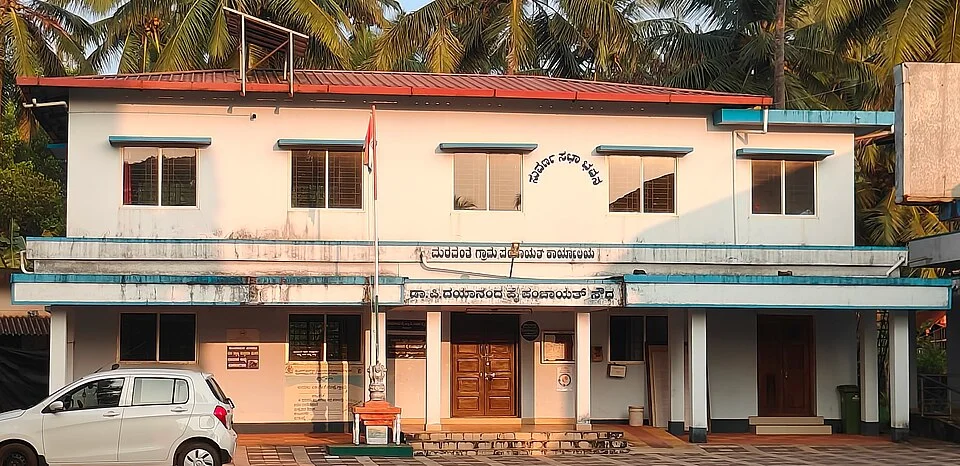
Maravanthe Gram Panchayat office, Udupi district, Karnataka: an illustrative setting for rural local government.
Credit: Rohan Pinto · CC BY-SA 4.0 · sourceResized and converted to WebP; uncropped.
1. Meaning and evolution of democratic decentralisation
Decentralisation means distributing authority away from higher levels of government. Deconcentration relocates administrative work within a department; delegation assigns tasks to another body; devolution gives elected local institutions powers, resources and responsibility. Panchayati Raj seeks democratic devolution, allowing rural residents to influence public decisions and hold local representatives accountable.
Article 40 originally provided a non-justiciable constitutional direction to organise village Panchayats. The Balwantrai Mehta Committee, appointed in 1957, recommended democratic decentralisation through a three-tier structure. Rajasthan inaugurated the system at Nagaur in 1959. The Ashok Mehta Committee, constituted in 1977, later favoured a two-tier arrangement with the district as the principal decentralisation unit.
The G.V.K. Rao Committee of 1985 emphasised the role of Panchayati Raj institutions in rural development, while the L.M. Singhvi Committee of 1986 recommended constitutional recognition and highlighted the Gram Sabha. Irregular elections, supersession and weak finances eventually prompted the 73rd Amendment. Its significance lies in protecting elected institutions without making their powers identical across states.
- Political decentralisation concerns representation and elections.
- Administrative decentralisation concerns authority over services and personnel.
- Fiscal decentralisation concerns revenue powers, transfers and expenditure autonomy.
Timeline
1957
Balwantrai Mehta Committee recommends democratic decentralisation through a three-tier system.
1959
Rajasthan inaugurates Panchayati Raj at Nagaur.
1993
The 73rd Amendment comes into force on 24 April.
1996
PESA extends Part IX to Fifth Schedule areas with modifications.
2. Constitutional architecture: Gram Sabha and three tiers
Article 243A recognises the Gram Sabha, comprising persons registered in the electoral rolls relating to a village within the village-level Panchayat area. It is a body of voters, not merely elected representatives. Its powers depend on state legislation. It can support participatory planning, beneficiary scrutiny and public accountability, but should not be confused with the Gram Panchayat, the elected local institution.
Article 243B provides Panchayats at village, intermediate and district levels. States with populations not exceeding 20 lakh may omit the intermediate level. Names vary: Gram Panchayat, Panchayat Samiti or Mandal Parishad, and Zila Parishad are common forms. A Panchayat may cover more than one village.
Under Article 243C, seats in Panchayats are filled by direct election from territorial constituencies. State law may additionally provide specified representation, including that of legislators. The chairpersons at intermediate and district levels are elected by and from among elected members; the method of choosing a village-level chairperson is determined by state law.
Article 243G enables state legislatures to endow Panchayats with powers for self-government, economic development and social justice. The Eleventh Schedule covers 29 subjects, including agriculture, minor irrigation, drinking water, roads, primary and secondary education, health and sanitation. Listing a subject does not itself confer exclusive jurisdiction or ensure its transfer.
Illustrative participatory village planning cycle
- 1. Identify needs through habitation-level consultations and Gram Sabha discussions.
- 2. Map available funds, devolved responsibilities and technical capacity.
- 3. Prepare and prioritise the Gram Panchayat Development Plan.
- 4. Secure approvals and coordinate with relevant departments and higher tiers.
- 5. Implement projects with transparent procurement and accounting.
- 6. Review outcomes through Gram Sabha scrutiny, audits and public disclosure.
3. Representation, tenure and electoral safeguards
Article 243D reserves directly elected seats for Scheduled Castes and Scheduled Tribes broadly in proportion to their population in the Panchayat area. At least one-third of these reserved seats must be reserved for women of the respective categories. At least one-third of all directly elected seats, including SC/ST women's seats, must be reserved for women. At least one-third of chairperson offices at each level must also be reserved for women.
States may provide reservation for backward classes, but the Constitution does not mandate a uniform OBC quota. Many states have increased women's reservation to 50 per cent through state laws. In K. Krishna Murthy v. Union of India (2010), the Supreme Court distinguished local-body political reservation from employment and education reservation. Vikas Kishanrao Gawali v. State of Maharashtra (2021) reiterated the triple-test requirements for OBC local-body reservation.
Article 243E fixes a five-year tenure from the first meeting. Elections must occur before expiry or within six months of dissolution; an election is unnecessary if the unexpired period is less than six months. A reconstituted Panchayat after premature dissolution serves only the remaining term. Under Article 243F, attaining 21 years prevents disqualification merely for being below 25.
Article 243K entrusts electoral rolls and Panchayat elections to the State Election Commission, not the Election Commission of India. The Governor appoints the State Election Commissioner, whose removal requires the same manner and grounds as a High Court judge. Article 243O protects delimitation and seat-allotment laws from court challenge and channels election challenges through election petitions under state law.
- OBC triple test: dedicated commission inquiry, local-body-specific reservation determination, and compliance with the aggregate 50 per cent ceiling for SC/ST/OBC reservations.
- Women's reservation is distinct from the aggregate ceiling applicable to vertical caste-based reservations.
| Issue | Constitutional position | Prelims distinction |
|---|---|---|
| Women's representation | Minimum one-third reservation | A 50 per cent quota comes from state law, not the constitutional minimum. |
| Intermediate tier | Ordinarily required | May be omitted where state population does not exceed 20 lakh. |
| Village chairperson | Selection method prescribed by state law | Direct election is not constitutionally compulsory. |
| Backward-class reservation | States are empowered to provide it | Not a uniform mandatory constitutional quota. |
| Eleventh Schedule | Lists 29 subjects | Actual devolution depends on state legislation. |
4. Finances, planning and the three Fs
Effective self-government requires functions, funds and functionaries together. Assigning a water-supply responsibility without revenue or technical staff creates nominal rather than substantive decentralisation. Activity mapping should clarify which tier plans, finances, implements and monitors each service, reducing overlapping mandates.
Article 243H permits state legislatures to authorise Panchayat taxes, duties, tolls and fees, assign state revenues, provide grants and establish Panchayat funds. Panchayats therefore have no uniform, independent constitutional taxing domain comparable to that of states. Their finances generally combine own-source revenue, assigned revenues and intergovernmental transfers.
Under Article 243I, the Governor constitutes a State Finance Commission every five years. It recommends principles for sharing state tax proceeds, assigning revenues and providing grants, alongside measures to improve Panchayat finances. Its recommendations and an explanatory memorandum on action taken must be laid before the state legislature. Article 280(3)(bb) separately requires the Union Finance Commission to recommend measures to augment state consolidated funds to supplement Panchayat resources.
Article 243J leaves accounts and audit provisions to state law. Gram Panchayat Development Plans can connect local priorities with available schemes and resources. The District Planning Committee under Article 243ZD consolidates Panchayat and municipal plans; importantly, this provision lies in Part IXA, not Part IX. The Fifteenth Finance Commission recommended Rs 2,36,805 crore for rural local bodies for 2021–26.
5. Territorial exceptions and PESA
Part IX does not automatically apply everywhere. Article 243M excludes Scheduled Areas and tribal areas referred to in Article 244, and the states of Nagaland, Meghalaya and Mizoram. It also contains specific exceptions for Manipur's hill areas with district councils and for district-level Panchayats in the specified Darjeeling hill areas. Article 243D's SC reservation provision does not apply to Arunachal Pradesh.
Parliament enacted the Panchayats (Extension to the Scheduled Areas) Act, 1996, or PESA, to extend Part IX to Fifth Schedule areas with modifications. PESA does not generally extend Panchayati Raj to Sixth Schedule tribal areas. Its approach protects customary institutions, community resources and tribal participation rather than mechanically imposing ordinary administrative arrangements.
Under PESA, the Gram Sabha safeguards traditions, cultural identity and community resources, approves development plans before village-level implementation, and identifies beneficiaries. Consultation is required before land acquisition and rehabilitation in Scheduled Areas. Recommendations are mandatory before granting concessions for minor minerals. State law must endow the Gram Sabha or appropriate Panchayat with specified powers, including ownership of minor forest produce. These provisions should not be reduced to a blanket claim that Gram Sabha consent is required for every activity.
6. Performance, accountability and reform priorities
Panchayats have widened political participation, especially for women and historically excluded communities. However, proxy representation, elite capture, inadequate staffing, delayed elections and dependence on tied grants can weaken substantive autonomy. Weak State Finance Commission follow-up further separates constitutional design from everyday capacity.
Reform requires predictable transfers, realistic own-revenue powers, trained staff and transparent activity mapping. Regular Gram Sabha meetings, accessible budgets, social audits and inclusive planning improve downward accountability. Digital systems such as eGramSwaraj support planning and accounting, but cannot replace public deliberation. The central test is whether Panchayats can make meaningful choices and answer to residents, rather than merely execute departmental schemes.
Gram Panchayat: Institution, Participation and Devolution
The metadata identifies this building as the Maravanthe Gram Panchayat office in Karnataka, making it directly relevant to Panchayati Raj. A Gram Panchayat is the elected village-level institution within the constitutional framework established by the 73rd Amendment through Part IX. Its office provides an institutional setting for local administration, but the existence of a building does not establish how effectively powers, resources or staff have been devolved. The metadata cannot demonstrate service quality, public participation or administrative autonomy.
Distinguish the Gram Panchayat from the Gram Sabha: the former is a representative body, while the latter comprises persons registered in the electoral rolls relating to a village within the village-level Panchayat area. State law determines the Gram Sabha’s powers and assigns Panchayats responsibilities for economic development and social justice. The Eleventh Schedule lists 29 subjects, but does not automatically transfer exclusive control over them. For Mains, meaningful decentralisation should therefore be assessed through functions, funds and functionaries, alongside accountability and inclusive participation.
- Constitutional structure: village, intermediate and district tiers are envisaged; states with populations not exceeding 20 lakh may omit the intermediate tier.
- Institutional distinction: the State Election Commission supervises Panchayat elections; the State Finance Commission reviews local bodies’ financial position and recommends fiscal arrangements.
- Analytical caution: an office illustrates institutional presence, not effective self-government. Examine state legislation, fiscal discretion, staffing control and Gram Sabha oversight before judging actual devolution.
Real-world case studies
Kerala's People's Plan Campaign
Launched in 1996, the campaign placed a substantial share of state plan resources under local-government planning. Gram Sabha participation, working groups and technical support demonstrated that decentralisation requires resources and planning capacity together. It covered both rural and urban local governments.
Karnataka's increased representation of women
Karnataka provides 50 per cent reservation for women in Panchayati Raj institutions through state legislation. It illustrates how states may exceed the constitutional floor of one-third. Representation nevertheless needs training, administrative support and protection against proxy control to become effective decision-making power.
Previous year questions
UPSC Prelims 2015
The fundamental object of Panchayati Raj is to ensure which of the following? 1. People's participation in development 2. Political accountability 3. Democratic decentralisation 4. Financial mobilisation
- A. 1, 2 and 3 only
- B. 2 and 4 only
- C. 1 and 3 only
- D. 1, 2, 3 and 4
Practice questions
Practice MCQ 1
Consider the following statements: 1. The Gram Sabha comprises all adult residents of a village, irrespective of electoral registration. 2. State law determines the method of choosing the village-level Panchayat chairperson. 3. An intermediate Panchayat may be omitted in a state with a population not exceeding 20 lakh. Which statements are correct?
- A. 1 and 2 only
- B. 2 and 3 only
- C. 1 and 3 only
- D. 1, 2 and 3
Practice MCQ 2
Which statement correctly describes Panchayat finances?
- A. The Eleventh Schedule automatically grants Panchayats exclusive taxing powers.
- B. The Union Finance Commission replaces the State Finance Commission.
- C. State law may authorise Panchayats to levy and collect specified taxes, duties, tolls and fees.
- D. The State Election Commission allocates Panchayat grants.
Practice MCQ 3
With reference to PESA, consider the following statements: 1. It extends Part IX to Fifth Schedule areas with modifications. 2. It automatically replaces Sixth Schedule autonomous district councils with Zila Parishads. 3. It recognises the Gram Sabha's role in safeguarding community resources. Which statements are correct?
- A. 1 only
- B. 2 and 3 only
- C. 1 and 3 only
- D. 1, 2 and 3
Mains practice · Constitutional recognition has secured Panchayats as elected institutions, but not necessarily as institutions of self-government. Discuss. Answer in 250 words.
- Introduce the distinction between electoral decentralisation and substantive devolution.
- Explain constitutional safeguards: tenure, reservation, State Election Commissions and State Finance Commissions.
- Identify state discretion under Articles 243G and 243H.
- Discuss incomplete transfer of functions, funds and functionaries.
- Use Kerala's participatory planning as an illustration, while recognising capacity constraints.
- Recommend activity mapping, predictable finance, empowered Gram Sabhas, staffing and transparent audits.
Further reading
- Constitution of India: Article 40, Part IX, Article 243ZD, Article 280 and the Eleventh Schedule.
- Ministry of Panchayati Raj: PESA Act, 1996 and official Panchayati Raj resources.
- NCERT, Indian Constitution at Work: Local Governments.
- Second Administrative Reforms Commission, Sixth Report: Local Governance.
- Fifteenth Finance Commission Report for 2021–26: Local Government recommendations.
- https://commons.wikimedia.org/wiki/File:Maravanthe_Gram_Panchayat_Office.jpg
Preparing for UPSC Civil Services? Get classroom teaching, answer-writing evaluation and mentorship at Pragnya IAS Academy, Ashok Nagar — see why aspirants choose us for IAS coaching in Hyderabad.