

The Constitution made by 130 Public of India and adopted and followed by 130 Crores Citizens of Republic of India. In 15 August-1947 India got freedom from long British Rule. The Constitution of India
Credit: http://legislative.gov.in/constitution-of-india Government of India · CC BY-SA 4.0 · source

Jawaharlal Nehru addressing a meeting of a committee of the Constituent Assembly New Delhi, 1949. Rajendra Prasad and Vallabhbhai Patel are seated at right
Credit: Unknown authorUnknown author · Public domain · source
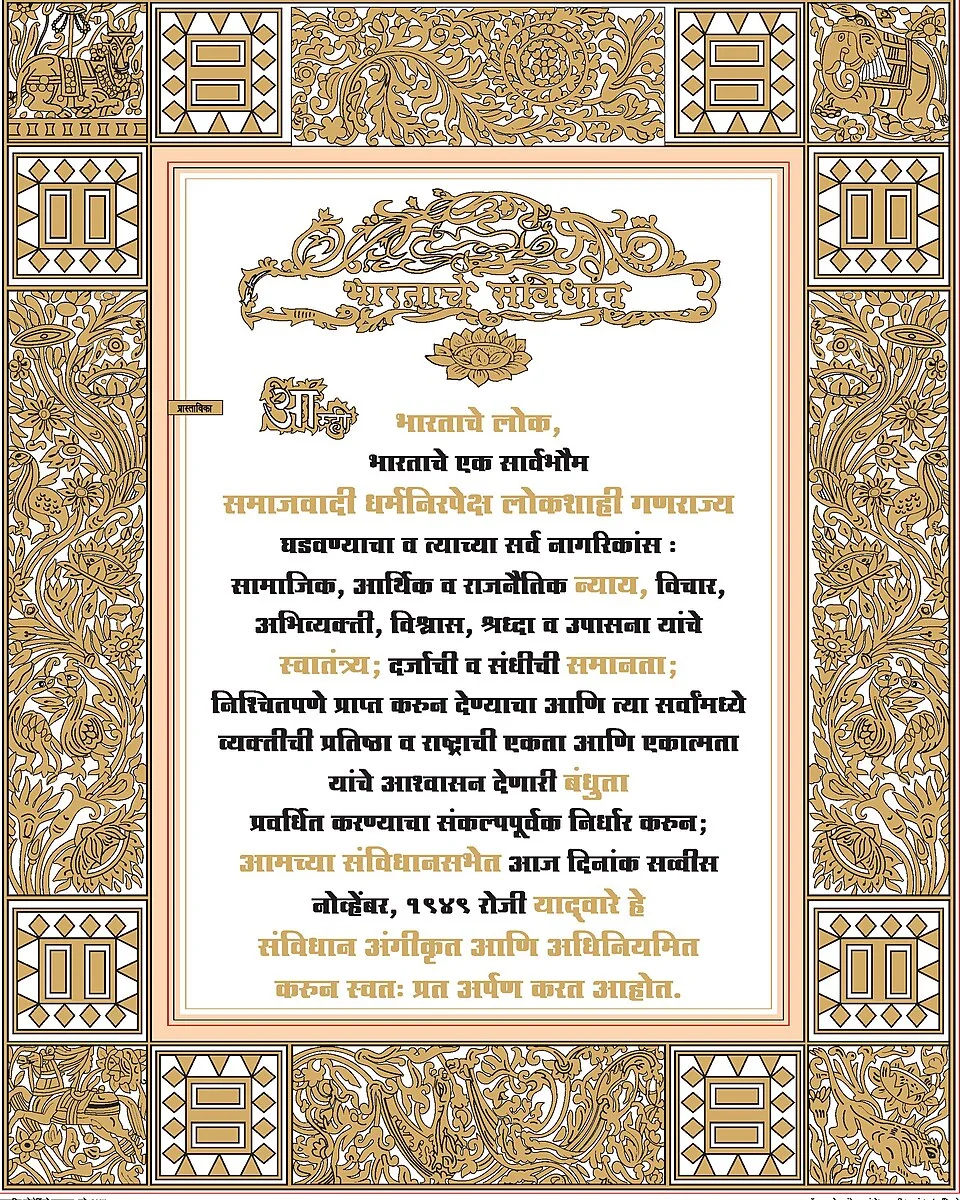
Marathi rendering of the Preamble to the Constitution of India.
Credit: Unknown author · Public domain · sourceResized and converted to WebP; uncropped.
1. Origin, text and constitutional significance
The Preamble is the Constitution’s introductory declaration of political authority and public purpose. Its opening phrase, “We, the People of India”, locates ultimate constitutional authority in the people rather than in a monarch, an external power or an ordinary legislature. The concluding words, “adopt, enact and give to ourselves this Constitution”, express collective constitutional self-government. Although the Constituent Assembly was largely indirectly elected through provincial legislatures and included representatives of princely states, the Constitution claimed its legitimacy in the name of the entire people.
Its substantive objectives developed from Jawaharlal Nehru’s Objectives Resolution. The Preamble was settled after the Assembly had considered the main constitutional provisions, allowing it to reflect their overall design. It records 26 November 1949 as the date of adoption. This must be distinguished from 26 January 1950, when the Constitution generally came into force and India became a republic.
For examination purposes, read the Preamble through four questions: Who gives the Constitution? What kind of State does it establish? What objectives must that State pursue? When was the Constitution adopted? The answers connect popular sovereignty, the five descriptions of the Republic, the four constitutional ideals and the adoption date.
Timeline
13 December 1946
Jawaharlal Nehru moved the Objectives Resolution in the Constituent Assembly.
22 January 1947
The Constituent Assembly adopted the Objectives Resolution.
26 November 1949
The Constitution was adopted; this date appears in the Preamble.
1973
Kesavananda Bharati recognised the Preamble as part of the Constitution and established the basic structure limitation.
1976–1977
The Forty-second Amendment Act, 1976 amended the Preamble; the relevant provision took effect on 3 January 1977.
2. Sovereign, socialist, secular, democratic republic
Sovereignty denotes India’s independent authority over internal affairs and external relations, exercised through the Constitution. Membership of the United Nations or Commonwealth does not by itself negate sovereignty. Treaty commitments represent exercises of sovereign choice, though their domestic implementation must follow constitutional requirements. Sovereignty must not be confused with unlimited parliamentary power: Parliament operates within a supreme Constitution.
Socialism expresses a commitment to reducing inequalities and advancing social and economic justice. Indian constitutional socialism does not mandate total State ownership or prohibit private enterprise. It accommodates a mixed economy and welfare-oriented public policy. Articles 38 and 39 provide important connections through their emphasis on welfare, distributive justice and prevention of harmful concentration of wealth.
Secularism requires the State to respect freedom of conscience and equal citizenship without establishing a State religion. Articles 14–16 and 25–28 give this principle concrete expression. Indian secularism does not demand complete State withdrawal from religious affairs: regulation of secular activities associated with religion and constitutionally permitted social reform remain possible.
Democracy combines representative government with political freedoms, accountability and constitutional restraints; Article 326 provides adult suffrage for elections to the Lok Sabha and State Legislative Assemblies. Republic signifies a non-hereditary head of State. India’s President is indirectly elected under Articles 54 and 55. Democracy and republicanism are therefore related but distinct ideas.
Using the Preamble in constitutional interpretation
- 1. Identify the disputed constitutional provision.
- 2. Examine its text and constitutional context.
- 3. Use relevant Preamble ideals to clarify its purpose.
- 4. Apply the operative provision and judicial doctrine.
- 5. Do not treat the Preamble as an independent source of power or remedy.
3. Justice, liberty, equality and fraternity
Justice is expressly social, economic and political. Social justice seeks to dismantle exclusion and inherited disadvantage; economic justice addresses deprivation and unequal access to resources; political justice concerns meaningful participation in public affairs. Fundamental Rights and Directive Principles together advance these purposes. Examples include abolition of untouchability under Article 17, welfare obligations under Article 38 and equal justice and free legal aid under Article 39A.
Liberty covers thought, expression, belief, faith and worship. These aspirations find operative protection in provisions such as Articles 19, 21 and 25. The Preamble does not make liberty absolute: particular rights carry constitutionally specified limits. For example, restrictions on speech must satisfy Article 19(2), while religious freedom is subject to public order, morality, health and other provisions of Part III.
Equality is of status and opportunity. Articles 14–18 translate this ideal into enforceable guarantees. Equality does not invariably require identical treatment; constitutionally authorised affirmative action can promote substantive equality by addressing disadvantage. Fraternity means a sense of common belonging among citizens, assuring individual dignity and national unity and integrity. It connects constitutional citizenship with rejection of caste humiliation, communal hostility and social exclusion. Article 51A(e), requiring promotion of harmony and common brotherhood, provides a related Fundamental Duty.
| Expression | Correct understanding | Common error |
|---|---|---|
| We, the People | Popular source of constitutional authority | Parliament possesses unlimited sovereignty |
| Republic | Non-hereditary head of State | President must be directly elected |
| Secular | Equal citizenship and religious freedom under the Constitution | All State regulation connected with religion is prohibited |
| Economic justice | Expressly included | Economic liberty is expressly included |
| Part of the Constitution | Interpretively significant and amendable within constitutional limits | Every promise is independently enforceable |
4. Legal status, interpretation and Supreme Court doctrine
In the Berubari Union advisory opinion (1960), concerning territorial arrangements with Pakistan, the Supreme Court described the Preamble as a key to the framers’ intentions but held that it was not part of the Constitution. It also stressed that the Preamble was not a source of substantive governmental power. These propositions must be separated because later jurisprudence changed the first without turning the Preamble into an independent grant of power.
In Kesavananda Bharati v. State of Kerala (1973), the Court held that the Preamble forms part of the Constitution. It also established that Parliament’s constituent power under Article 368 cannot destroy the Constitution’s basic structure. The Preamble helps identify fundamental constitutional commitments, but it is not an exhaustive catalogue of every basic feature.
The Preamble is therefore legally significant without being independently enforceable. A litigant cannot obtain a remedy merely by invoking its promise of justice without an applicable constitutional or legal basis. Courts use it to illuminate constitutional purpose and interpret provisions; it cannot override clear constitutional language. In S. R. Bommai v. Union of India (1994), secularism was recognised as a basic feature. Minerva Mills v. Union of India (1980) emphasised the constitutional balance between Fundamental Rights and Directive Principles, linking individual freedom with social transformation.
5. Amendment and examination distinctions
The Forty-second Amendment Act, 1976 changed “Sovereign Democratic Republic” to “Sovereign Socialist Secular Democratic Republic” and “unity of the Nation” to “unity and integrity of the Nation”. It did not insert justice, liberty, equality, fraternity or republic: these were already present. The addition of socialist and secular made commitments explicit that already had substantial expression in constitutional provisions.
The Preamble can be amended under Article 368, subject to the basic structure limitation. Both extreme claims are incorrect: that it can never be amended, and that Parliament may rewrite its essential constitutional identity without restraint. The amending power operates within the Constitution rather than above it.
For Prelims, distinguish textual presence from constitutional implication. Federalism, judicial review, universal adult suffrage and parliamentary government are not expressly named in the Preamble, although they are important features of India’s constitutional system. Likewise, “liberty of expression” appears, while the term “economic liberty” does not. Finally, distinguish a constitutional aspiration from its operative machinery: the Preamble states equality as an objective, Articles 14–18 provide enforceable guarantees, and legislation and institutions help implement them. Its best description is a constitutional statement of identity and purpose with interpretive value, not a decorative introduction or a self-contained bill of rights.
Reading the Preamble: Authority, Ideals and Interpretation
A Marathi rendering of the Preamble provides a language-accessible entry point into India’s constitutional foundations. “We, the People of India” expresses popular sovereignty: the Constitution derives its authority from the people, rather than a monarch or an external power. Its description of India as a sovereign, socialist, secular, democratic republic combines distinct ideas about independence, social orientation, religious neutrality, representative government and a non-hereditary head of state. These terms should be understood within the wider constitutional scheme, not as isolated slogans.
The Preamble links justice, liberty and equality with fraternity, which connects individual dignity to national unity and integrity. It guides constitutional interpretation but does not independently confer governmental powers or make every stated ideal directly enforceable. In Kesavananda Bharati, the Supreme Court recognised the Preamble as part of the Constitution; constitutional amendments remain subject to the basic structure limitation. The metadata identifies this image as a Marathi Preamble, but does not establish its translation authority, exact wording or whether it reproduces the original or amended text.
- The Forty-second Amendment added “socialist” and “secular” and changed “unity of the Nation” to “unity and integrity of the Nation”.
- Distinguish adoption from commencement: the Preamble records adoption on 26 November 1949; the Constitution generally commenced on 26 January 1950.
- For Mains, connect Preamble ideals to Fundamental Rights and Directive Principles; for Prelims, remember that interpretive importance does not mean independent enforceability.
Real-world case studies
Berubari: constitutional purpose does not confer territorial power
The proposed transfer of part of Berubari to Pakistan raised the question whether Article 3 was sufficient. In 1960, the Supreme Court advised that cession required amendment under Article 368; the Ninth Amendment followed. The case illustrates why the Preamble cannot substitute for the constitutional provision authorising State action.
Bommai: secularism and constitutional government
S. R. Bommai v. Union of India (1994) examined presidential proclamations under Article 356. The Court recognised secularism as a basic feature and held that proclamations were judicially reviewable. The decision shows how a Preamble commitment informs enforceable constitutional standards rather than operating merely as a political slogan.
Previous year questions
UPSC Prelims 2017
Which one of the following objectives is not embodied in the Preamble to the Constitution of India?
- A. Liberty of thought
- B. Economic liberty
- C. Liberty of expression
- D. Liberty of belief
Practice questions
Practice MCQ 1
Consider the following statements: 1. The Preamble is part of the Constitution. 2. It independently grants legislative power to Parliament. 3. Its amendment is subject to the basic structure doctrine. Which statements are correct?
- A. 1 and 2 only
- B. 2 and 3 only
- C. 1 and 3 only
- D. 1, 2 and 3
Practice MCQ 2
Which set consists entirely of words added to the Preamble by the Forty-second Amendment?
- A. Socialist, secular, integrity
- B. Sovereign, socialist, republic
- C. Secular, fraternity, unity
- D. Democratic, integrity, justice
Practice MCQ 3
With reference to the Preamble, consider the following pairs: 1. Justice: social, economic and political. 2. Equality: status and opportunity. 3. Fraternity: dignity of the individual and unity and integrity of the Nation. How many pairs are correctly matched?
- A. Only one
- B. Only two
- C. All three
- D. None
Mains practice · “The Preamble is neither a mere ornament nor an independent source of enforceable rights.” Explain with reference to constitutional provisions and Supreme Court decisions. Answer in 150 words.
- Introduce the Preamble as a declaration of popular authority, constitutional identity and objectives.
- Contrast Berubari with Kesavananda Bharati on its status as part of the Constitution.
- Explain interpretive relevance without independent grants of power or remedies.
- Link equality and liberty to Articles 14–19, 21 and 25.
- Use Bommai to illustrate secularism and basic structure.
- Conclude with amendability under Article 368 subject to basic structure limits.
Further reading
- Legislative Department: Constitution of India, Preamble and Articles 14–19, 25–28, 38–39 and 368.
- Legislative Department: Constitution (Forty-second Amendment) Act, 1976, Section 2.
- NCERT: Indian Constitution at Work, Class XI, chapter on The Philosophy of the Constitution.
- Constituent Assembly Debates: Objectives Resolution and debate on the Preamble.
- Supreme Court judgments: Kesavananda Bharati (1973), Minerva Mills (1980) and S. R. Bommai (1994).
- https://commons.wikimedia.org/wiki/File:Marathi_Preamble_to_the_Constitution_of_India.jpg
Preparing for UPSC Civil Services? Get classroom teaching, answer-writing evaluation and mentorship at Pragnya IAS Academy, Ashok Nagar — see why aspirants choose us for IAS coaching in Hyderabad.