
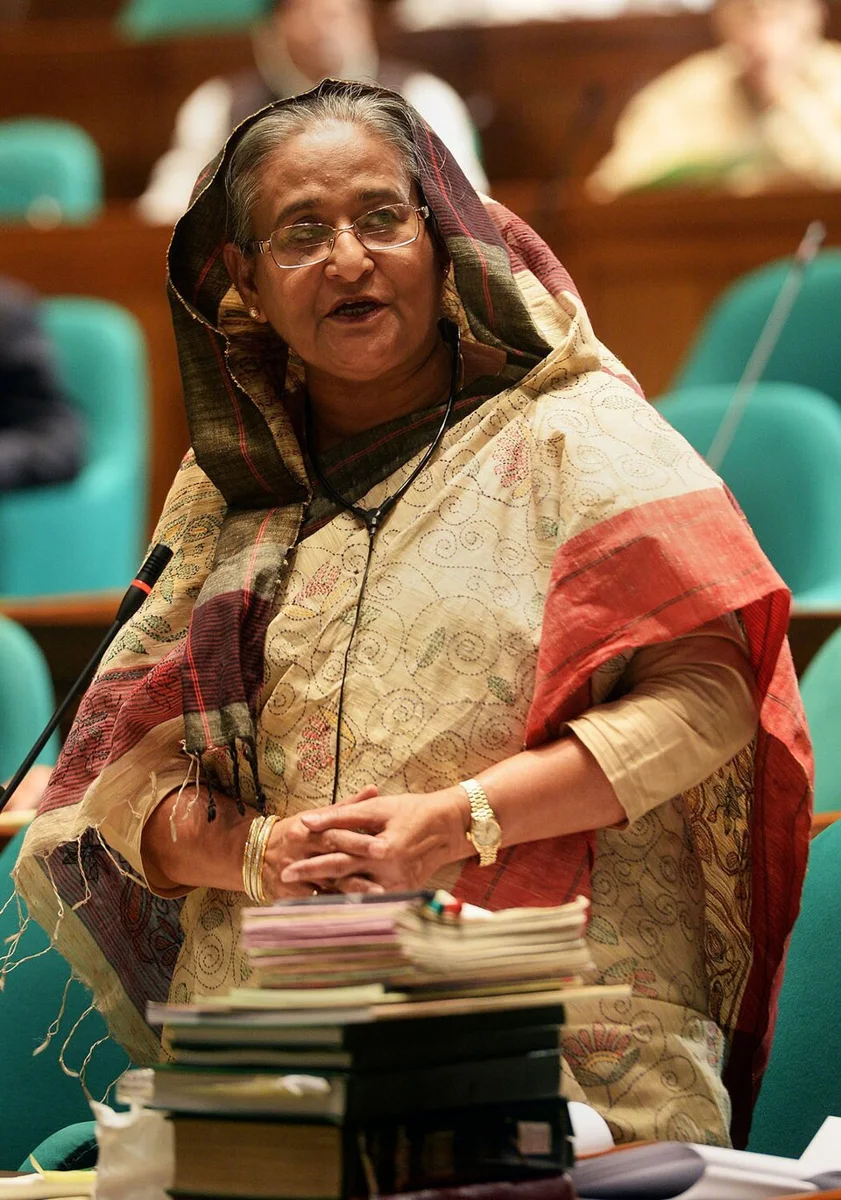
Sheikh Hasina answering parliamentary questions in Bangladesh, 2016: a comparative illustration of Question Hour.
Credit: Press Information Department · Public domain · sourceResized and converted to WebP; uncropped.
1. Meaning and constitutional foundations
Question Hour is the period ordinarily earmarked during a parliamentary sitting for members to ask questions and obtain answers. Most questions are addressed to ministers about matters within their official responsibility. The device allows a legislator to move from a general political allegation to a specific demand for information: how much money was released, why a project was delayed, whether vacancies remain unfilled, or what corrective action the government proposes.
The Constitution does not expressly establish a period called Question Hour. Its detailed framework is supplied by the Rules of Procedure and Conduct of Business of each House, made under Article 118, together with directions and parliamentary practice. The relevant chapters are titled Questions in Lok Sabha and Questions to Members in Rajya Sabha. Question Hour is therefore a rule-based parliamentary institution, not merely an informal convention.
Its constitutional significance is linked to responsible government. Article 75(3) makes the Union Council of Ministers collectively responsible to Lok Sabha. Nevertheless, ministers also answer questions in Rajya Sabha: scrutiny of the executive is not confined to the House that determines its survival. Article 105 protects parliamentary freedom of speech, subject to the Constitution and parliamentary rules, while Article 88 enables ministers to speak and participate in either House, without conferring a vote merely through that provision.
- Question Hour provides continuing scrutiny between major debates, budget proceedings and confidence votes.
- Responsibility to answer questions in Rajya Sabha should not be confused with collective responsibility to that House.
2. Types of questions and their practical differences
A starred question is marked with an asterisk and is intended for an oral answer on the floor of the House. After the minister’s answer, the presiding officer may allow supplementary questions to clarify or probe the reply. These follow-up questions are its principal accountability advantage: a minister may have to explain an omission or inconsistency immediately. Supplementaries must remain connected to the original question and cannot become an unrestricted debate.
An unstarred question receives a written answer, and no supplementary questions arise from it. This does not make it unimportant. Written replies can supply extensive district-wise statistics, expenditure statements, implementation details and annexures. Researchers, journalists, parliamentary committees and citizens frequently use these replies as official evidence. Listing a question as starred also does not guarantee that it will be reached for an oral answer within the available time.
A short-notice question addresses a matter of urgent public importance with less than ten clear days’ notice. The member must explain the urgency. The presiding officer assesses the request, and the minister’s ability to answer at short notice is relevant under the rules. It ordinarily receives an oral answer with opportunities for supplementary questions. Questions may also be addressed to private members, but only concerning a bill, resolution or other House business for which that member is responsible; private members are not substitutes for ministers in answering about government administration.
- The subject’s urgency alone does not make a short-notice question automatically admissible.
- The distinction between starred and unstarred questions concerns the mode of answer, not the importance of the subject.
From an MP’s notice to executive scrutiny
- 1. MP submits a question notice identifying the subject and addressee.
- 2. Secretariat scrutinises the notice under the House rules.
- 3. Speaker or Chairman determines admissibility.
- 4. Admitted questions undergo prescribed selection and listing procedures.
- 5. Minister provides an oral or written answer; eligible oral answers may attract supplementaries.
- 6. Members may pursue unresolved issues through further parliamentary devices.
3. Notice, selection and admissibility
An MP submits a notice identifying the question and the minister or member to whom it is addressed. Ordinary questions generally require at least ten clear days’ notice. Ministries are allotted answering days, while prescribed selection and listing procedures, including balloting where applicable, operate within limits on the number of questions. The Secretariat examines notices, but the authority to decide admissibility rests with the Speaker or Chairman under the respective House rules.
Questions must be precise, intelligible and directed towards obtaining information on a matter of public importance. They should not contain arguments, defamatory statements, imputations, unnecessary names or expressions, or demands for an abstract legal opinion. A question cannot be used simply to deliver a political speech in interrogative form. Ordinarily, it should concern a subject for which the Union government has responsibility; a matter belonging exclusively to a state is not automatically a proper subject for questioning a Union minister.
Restrictions also protect judicial proceedings, parliamentary functions and other recognised institutional interests. Questions concerning matters under adjudication are restricted under the rules, and requests for information may encounter public-interest or security limitations. These safeguards require careful application: the purpose is orderly scrutiny, not a blanket exclusion of difficult subjects. Members can seek accountability through other parliamentary devices when a question is inadmissible or when a reply requires wider examination.
- Distinguish submission, admission, listing and actual oral answering: these are separate stages.
- Admissibility rules regulate the form and permissible subject of a question; they do not establish the truth of its premise.
| Category | Answer | Supplementaries | Distinctive feature |
|---|---|---|---|
| Starred | Oral | Permitted by the presiding officer | Marked with an asterisk |
| Unstarred | Written | Not permitted | Useful for detailed information and annexures |
| Short-notice | Oral | Permitted | Urgent public importance; less than ten clear days’ notice |
| Question to a private member | According to applicable question procedure | Depends on the applicable procedure | Restricted to House business for which that member is responsible |
4. Question Hour, Zero Hour and related devices
Question Hour ordinarily runs from 11 a.m. to noon in Lok Sabha. In Rajya Sabha, it ordinarily runs from noon to 1 p.m., following a scheduling change introduced in 2014. These timings are subject to the House’s arrangements. Consequently, the proposition that Question Hour is invariably the first hour of every sitting in both Houses is incorrect.
Zero Hour is different. It is a practice-based opportunity for members to raise matters of urgent public importance, regulated through directions and established procedures rather than the formal question-and-answer framework. It does not mean that members can speak without permission or that a minister must provide an immediate answer. Its timing should not be mechanically inferred from its name, especially in Rajya Sabha.
A half-an-hour discussion may examine a matter of sufficient public importance arising from a recent parliamentary answer that needs further elucidation on a question of fact. It is distinct from an ordinary supplementary question. Calling Attention, short-duration discussions and adjournment motions are also separate devices, each with its own conditions. Question Hour ordinarily seeks information rather than a House decision: there is no automatic vote, censure or consequence for the government’s tenure.
- For Prelims, classify each device by notice, purpose, reply, debate and voting requirements.
- Question Hour can produce material for a later debate, committee inquiry or political campaign without itself becoming any of those proceedings.
5. Democratic value, limitations and improvement
Question Hour reduces the information imbalance between the executive and legislature. Preparing answers requires ministries to gather records, coordinate with implementing agencies and explain administrative choices. The possibility of public questioning can encourage officials to monitor programmes more closely even before a question is answered. Opposition and government-party MPs alike can use the device to represent constituency grievances and highlight neglected groups.
Its effectiveness depends on regular sittings, usable parliamentary time, sound questions and accurate replies. Disruptions can eliminate oral scrutiny; vague answers can obscure responsibility; and limited time means that only a portion of listed questions receive oral treatment. Written answers preserve a substantial information channel, but they cannot fully reproduce the immediacy of supplementary questioning. A reply reporting that data are unavailable may itself expose a weakness in governance.
Improvements include stronger research support for MPs, precise notices, timely and disaggregated government data, searchable answer archives and systematic follow-up through committees or other proceedings. Evaluation should not rely solely on how many questions an MP asks: relevance, evidence, persistence and policy consequences matter. Protecting Question Hour therefore means protecting both parliamentary time and the quality of the exchange.
- Accountability chain: information enables scrutiny; scrutiny can generate explanation, correction and political responsibility.
- A parliamentary answer is an important official source, but its definitions, reporting period and data limitations must still be examined.
Question Hour as a Tool of Executive Accountability
The supplied metadata identifies Bangladesh’s Prime Minister Sheikh Hasina answering questions during Parliament’s Prime Minister’s Question Hour. This is a comparative illustration of legislative scrutiny, not evidence of Indian parliamentary procedure. The shared principle is that representatives seek explanations from the executive in a public institutional setting. However, a dedicated Prime Minister’s Question Hour abroad should not be confused with India’s arrangements for questions addressed to ministers.
In India, Question Hour operationalises ministerial accountability through the rules and procedures of each House. Questions can elicit information about administrative decisions, spending and programme implementation, creating a parliamentary record against which government claims may be assessed. Oral answers also permit supplementary questioning, allowing members to probe omissions or ambiguities. Its effectiveness depends on admissibility decisions, the quality of replies and opportunities for follow-up; asking a question does not itself establish wrongdoing or compel a policy reversal. The photograph’s metadata cannot establish whether replies were complete or scrutiny was effective.
- Starred questions seek oral answers and allow supplementary questions; unstarred questions receive written answers without supplementaries.
- Short-notice questions concern urgent public matters and seek oral answers with less than the ordinary notice period, subject to procedural conditions.
- Question Hour is governed by parliamentary rules, not expressly prescribed by the Constitution. Zero Hour is a distinct convention for raising matters of public importance.
Real-world case studies
The Mundhra affair, 1957–1958
Parliamentary questions and subsequent debate, prominently associated with Feroze Gandhi, brought scrutiny to the Life Insurance Corporation’s investment in companies controlled by Haridas Mundhra. The government appointed a commission headed by Justice M. C. Chagla, and Finance Minister T. T. Krishnamachari resigned in 1958. The episode illustrates how parliamentary information-seeking can develop into wider investigation and ministerial accountability; the outcome did not arise from Question Hour alone.
Question Hour during the 2020 Monsoon Session
During Parliament’s pandemic-constrained Monsoon Session in September 2020, Question Hour was not held, although arrangements were made for written replies to unstarred questions. The decision prompted debate over executive accountability. It demonstrated the distinction between retaining an information channel and preserving the live scrutiny enabled by oral answers and supplementary questions.
Previous year questions
No source-linked PYQ is available here yet. Use the practice questions below.
Practice questions
Practice MCQ 1
With reference to parliamentary questions, consider the following statements: 1. An unstarred question receives a written answer. 2. Supplementary questions are permitted after every written answer. 3. A short-notice question must concern a matter of urgent public importance. Which of the statements given above are correct?
- A. 1 and 2 only
- B. 1 and 3 only
- C. 2 and 3 only
- D. 1, 2 and 3
Practice MCQ 2
Which of the following most directly provides the constitutional authority for each House to frame the rules governing Question Hour?
- A. Article 75(3)
- B. Article 88
- C. Article 105
- D. Article 118
Practice MCQ 3
Consider the following statements: 1. Question Hour must always be the first hour of a sitting in both Houses. 2. A question can be addressed to a private member concerning a bill for which that member is responsible. 3. Ministers answer questions in Rajya Sabha even though the Council of Ministers is collectively responsible to Lok Sabha. Which of the statements given above are correct?
- A. 1 and 2 only
- B. 2 and 3 only
- C. 1 and 3 only
- D. 1, 2 and 3
Mains practice · Question Hour is more than a means of obtaining information; it is an instrument of responsible government. Discuss its significance and the constraints on its effectiveness. Answer in 250 words.
- Distinguish the rule-making basis under Article 118 from collective responsibility under Article 75(3).
- Explain oral scrutiny through starred questions and supplementary questions.
- Highlight written replies as sources of administrative data and evidence.
- Discuss constituency representation, policy correction and scrutiny by both Houses.
- Identify disruptions, inadequate replies, limited time and weak follow-up.
- Use the Mundhra affair or the 2020 suspension of Question Hour as an illustration.
- Recommend protected parliamentary time, research assistance, better data and systematic follow-up.
Further reading
- Constitution of India: Articles 75, 88, 105 and 118, Legislative Department.
- Lok Sabha Rules of Procedure and Conduct of Business: chapter on Questions.
- Rajya Sabha Rules of Procedure and Conduct of Business: chapter on Questions to Members.
- Lok Sabha Secretariat: parliamentary procedure material on questions and Question Hour.
- Rajya Sabha Secretariat: Rajya Sabha at Work, discussion of questions.
- NCERT, Indian Constitution at Work: Legislature.
- https://commons.wikimedia.org/wiki/File:Prime_Minister_Sheikh_Hasina_Answers_Questions_During_Parliament%27s_Question_Hour_2016-02-24_(PID-0055677).jpg
Preparing for UPSC Civil Services? Get classroom teaching, answer-writing evaluation and mentorship at Pragnya IAS Academy, Ashok Nagar — see why aspirants choose us for IAS coaching in Hyderabad.