

Inside the Supreme Court of India, Bhagwandas Road, New Delhi
Credit: Pinakpani · CC BY-SA 4.0 · source

Library of congress image
Credit: Wikimedia Commons · Public domain · source
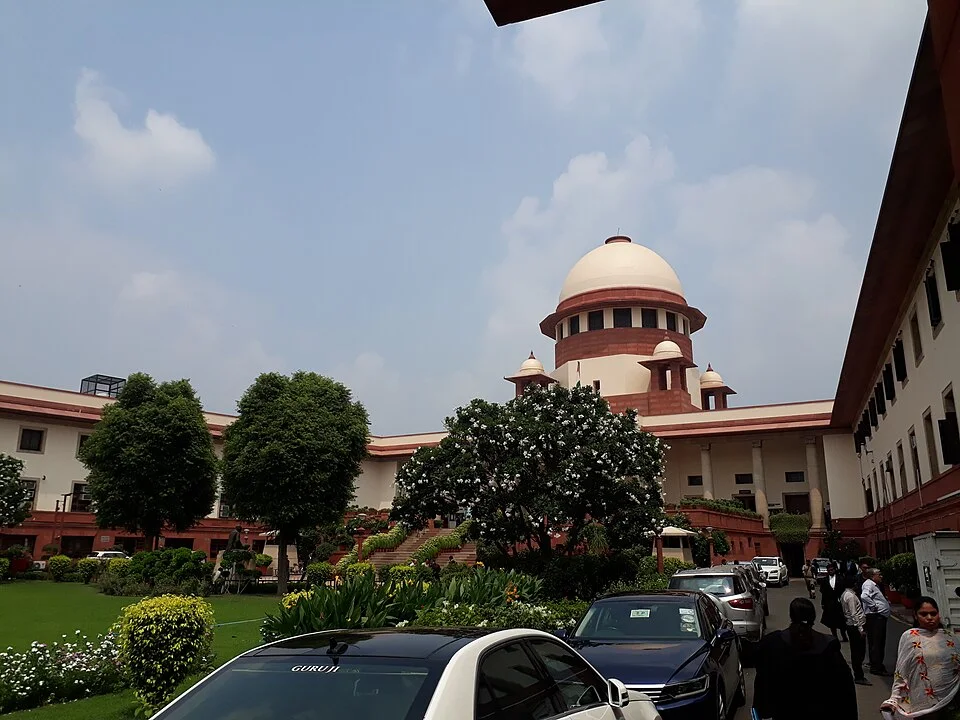
Supreme Court of India premises, New Delhi, as identified in the image metadata.
Credit: Pinakpani · CC BY-SA 4.0 · sourceResized and converted to WebP; uncropped.
1. Constitutional position and composition
India has an integrated judicial system with the Supreme Court at its apex. Unlike the United States, India does not maintain entirely separate federal and State court hierarchies. The Supreme Court hears constitutional disputes as well as civil and criminal appeals. However, High Courts derive their authority directly from the Constitution and are not merely administrative branches of the Supreme Court.
Article 124 establishes the Court. The Constitution originally provided for the Chief Justice of India and, until Parliament prescribed a larger number, not more than seven other judges. Parliament regulates the number through legislation. The Supreme Court (Number of Judges) Amendment Act, 2019 increased the sanctioned strength from 31 to 34, including the Chief Justice.
Under Article 130, the Court sits in Delhi or at another place appointed by the Chief Justice with the President’s approval. Article 129 makes it a court of record, whose records possess authoritative evidentiary value, and expressly includes the power to punish for contempt of itself. Article 146 addresses its officers, servants and administrative expenses.
- Article 126: appointment of an acting Chief Justice.
- Article 127: attendance of qualified High Court judges as ad hoc judges under specified conditions.
- Article 128: attendance of retired judges, subject to constitutional conditions and their consent.
Timeline
1950
The Supreme Court was inaugurated on 28 January.
1973
Kesavananda Bharati established the basic structure limitation on constitutional amendments.
1993–1998
The Second and Third Judges Cases established and clarified the collegium system.
2015
The Court invalidated the Ninety-ninth Amendment and NJAC framework.
2019
Legislation increased sanctioned strength to 34 judges, including the Chief Justice.
2. Appointment, qualifications and the collegium
The President appoints Supreme Court judges by warrant under the President’s hand and seal. A candidate must be an Indian citizen and must have served as a High Court judge for at least five years, practised as a High Court advocate for at least ten years, or be, in the President’s opinion, a distinguished jurist. Service or practice in two or more High Courts in succession can count. The Constitution prescribes neither a minimum appointment age nor a competitive examination.
The collegium is a judicially developed arrangement, not a body expressly named in the Constitution. The First Judges Case, S. P. Gupta v. Union of India (1981), favoured executive primacy. The Second Judges Case (1993) established judicial primacy. The Third Judges Case, a Presidential reference decided in 1998, clarified collective consultation: recommendations for Supreme Court appointments ordinarily involve the Chief Justice and four senior-most Supreme Court judges.
The Ninety-ninth Constitutional Amendment and the National Judicial Appointments Commission Act, 2014 sought to replace the collegium. In 2015, the Supreme Court invalidated this framework for violating judicial independence, a component of the basic structure. The collegium consequently continued. Appointment of the senior-most Supreme Court judge considered fit as Chief Justice is a convention reflected in the appointment procedure, not an express constitutional command.
- The executive processes recommendations and may seek reconsideration; the collegium does not itself issue appointment warrants.
- Transparency, diversity, accountability and protection against executive domination remain central reform concerns.
Removal of a Supreme Court judge
- 1. Notice signed by at least 100 Lok Sabha members or 50 Rajya Sabha members.
- 2. Speaker or Chairman decides whether to admit the motion.
- 3. If admitted, a statutory three-member committee investigates the charges.
- 4. A finding of proved misbehaviour or incapacity permits further parliamentary consideration.
- 5. Each House adopts an address with the constitutionally required special majority in the same session.
- 6. President issues the removal order.
3. Tenure, removal and judicial independence
A judge holds office until age 65 and may resign by writing to the President. Removal is permitted only for proved misbehaviour or incapacity. Under Article 124(4), each House of Parliament must adopt an address in the same session, supported by both a majority of its total membership and at least two-thirds of members present and voting. The President then issues the removal order.
Under the Judges (Inquiry) Act, 1968, initiation requires a notice signed by at least 100 Lok Sabha members or 50 Rajya Sabha members. The Speaker or Chairman may admit or refuse it. If admitted, a three-member committee investigates. An adverse finding enables parliamentary consideration; it does not automatically remove the judge. Although commonly called impeachment, the Constitution uses the language of removal.
Independence is supported by security of tenure, protected service conditions and expenditure charged on the Consolidated Fund of India. Charged expenditure may be discussed but is not voted upon. Article 121 restricts parliamentary discussion of judges’ conduct except upon a removal motion. Article 124(7) prohibits a former Supreme Court judge from pleading or acting before any court or authority within India.
- Article 125 protects privileges, allowances and rights concerning leave and pension against disadvantageous variation after appointment.
- Article 360 permits directions reducing judges’ salaries and allowances during a Financial Emergency.
- Article 50, a Directive Principle, calls for separation of the judiciary from the executive in the State’s public services.
| Feature | Supreme Court | High Courts |
|---|---|---|
| Principal constitutional provisions | Articles 124–147 | Articles 214–231 |
| Retirement age | 65 years | 62 years |
| Writ jurisdiction | Article 32: enforcement of fundamental rights | Article 226: fundamental rights and other legal rights |
| Court of record | Article 129 | Article 215 |
| Superintendence | No general Article 227-type power | Article 227: superintendence over courts and tribunals within territorial jurisdiction, subject to exceptions |
4. Original, writ, appellate and advisory jurisdiction
Article 131 gives the Supreme Court exclusive original jurisdiction over specified disputes between the Union and States or among States, provided the dispute concerns the existence or extent of a legal right. It does not cover every political disagreement or ordinary dispute involving a private person. Constitutional exclusions also matter: Article 262 permits Parliament to exclude court jurisdiction over specified inter-State water disputes.
Article 32 guarantees access to the Supreme Court for enforcement of fundamental rights. It can issue habeas corpus, mandamus, prohibition, certiorari and quo warranto. High Courts’ Article 226 jurisdiction is wider in subject matter because it extends to fundamental rights and other legal rights. Article 32 is itself a fundamental right; Article 226 is not.
Articles 132–134 provide appellate routes in constitutional, civil and criminal matters; Article 134A concerns certificates for appeal. Article 136 permits discretionary special leave to appeal from decisions of courts or tribunals, except those constituted under laws relating to the Armed Forces. Special leave is not an automatic right of appeal.
Under Article 143(1), the President may refer a question of public importance involving law or fact; the Court may decline to answer. Article 143(2) separately covers certain treaty-related disputes excluded from Article 131. An advisory opinion is not an ordinary executable decree and does not bind the President.
5. Judicial review, precedent and corrective powers
Judicial review enables scrutiny of legislation and executive action for constitutional validity. Its foundations include Articles 13, 32 and the wider constitutional scheme. In Kesavananda Bharati v. State of Kerala (1973), a thirteen-judge Bench held that Parliament’s Article 368 amending power cannot destroy the Constitution’s basic structure. Minerva Mills v. Union of India (1980) reaffirmed limited amending power and judicial review.
Article 141 makes the law declared by the Court binding, rather than converting every factual observation into a universal rule. Smaller Benches must follow larger-Bench rulings; disagreement requires reference through the appropriate procedure. Article 142 permits orders necessary for complete justice in a pending cause or matter, but is not an unrestricted licence to disregard substantive law. Article 144 requires all civil and judicial authorities to act in aid of the Court.
Article 137 authorises review of the Court’s judgments, subject to applicable law and rules. Review is not a routine rehearing. Rupa Ashok Hurra v. Ashok Hurra (2002) recognised the exceptional curative petition after dismissal of review to prevent abuse of process and gross miscarriage of justice. Public interest litigation relaxed standing requirements, particularly where disadvantaged groups could not effectively approach courts themselves.
6. Institutional challenges and examination approach
The Supreme Court must balance constitutional adjudication with a heavy appellate workload. Delay, litigation costs, uneven access, vacancies and the volume of special leave petitions affect this balance. The Law Commission’s 229th Report (2009) proposed a Constitution Bench at Delhi and cassation benches in regional locations. This remains a reform proposal, not the existing institutional arrangement.
E-filing, virtual hearings, publication of judgments and legal-aid mechanisms can improve access, but digital exclusion and language barriers require attention. For Prelims, separate constitutional text from statutes, judicial interpretation and convention. Distinguish sanctioned strength from vacancies, review from appeal, and judicial independence from immunity against accountability.
Supreme Court: Constitutional Role and Jurisdiction
The metadata identifies this image as depicting premises within the Supreme Court of India in New Delhi, making it directly relevant to the institution. The photograph provides institutional context, not evidence of courtroom proceedings or judicial practice. Established under Article 124, the Supreme Court stands at the apex of India’s integrated judicial system. Its constitutional authority encompasses federal dispute resolution, appeals, protection of fundamental rights and judicial review; it is not merely the highest criminal or civil appellate court.
Different jurisdictions serve distinct constitutional purposes. Article 131 provides exclusive original jurisdiction over specified disputes involving the Union and states where a legal right is at issue. Article 32 guarantees the right to approach the Court for enforcement of fundamental rights. Article 136 permits discretionary special leave to appeal, rather than creating an automatic right of appeal. Under Article 143, the President may seek the Court’s advisory opinion. For Mains, these powers illustrate how an independent judiciary supports constitutional supremacy while operating within a framework of separated institutional responsibilities.
- Article 32 concerns fundamental rights; High Courts’ writ jurisdiction under Article 226 also extends to other legal rights and is therefore broader in subject matter.
- Article 141 makes law declared by the Supreme Court binding on all courts in India; Article 142 concerns orders necessary for complete justice in a pending matter.
- Judicial review tests government action against the Constitution; it differs from the Supreme Court reviewing its own judgments under Article 137.
Real-world case studies
Justice V. Ramaswami removal proceedings, 1993
An inquiry committee found Justice V. Ramaswami guilty on several charges, but the Lok Sabha removal motion failed to secure the required majority of the total membership. The episode demonstrates that an adverse inquiry report is not equivalent to removal and that abstentions matter under this special-majority requirement.
Privacy as a fundamental right, 2017
In K. S. Puttaswamy v. Union of India, a unanimous nine-judge Bench recognised privacy as a constitutionally protected fundamental right. The judgment illustrates the Supreme Court’s constitutional-interpretation role and the use of larger Benches to resolve questions arising from earlier precedents.
Previous year questions
UPSC Prelims 2014
The power to increase the number of judges in the Supreme Court of India is vested in which authority?
- A. The President of India
- B. Parliament
- C. The Ministry of Law
- D. The Law Commission
Practice questions
Practice MCQ 1
Consider the following statements: 1. The Constitution prescribes a minimum age for appointment as a Supreme Court judge. 2. A distinguished jurist may qualify for appointment as a Supreme Court judge. 3. Every Supreme Court judge must previously have served as a High Court judge. Which of the statements is/are correct?
- A. 1 and 2 only
- B. 2 only
- C. 2 and 3 only
- D. 1, 2 and 3
Practice MCQ 2
Which of the following correctly distinguishes Articles 32 and 226?
- A. Only the Supreme Court can issue habeas corpus.
- B. Article 226 is confined to fundamental rights.
- C. Article 32 is itself a fundamental right, while Article 226 also allows enforcement of other legal rights.
- D. High Courts require Supreme Court permission before issuing constitutional writs.
Practice MCQ 3
With reference to the Supreme Court, consider the following statements: 1. Article 141 makes the law declared by it binding on all courts within India. 2. Article 136 guarantees an appeal against every tribunal decision. 3. Article 137 empowers it to review its judgments. Which statements are correct?
- A. 1 and 2 only
- B. 2 and 3 only
- C. 1 and 3 only
- D. 1, 2 and 3
Mains practice · The Supreme Court is simultaneously a constitutional court and a final court of appeal. Explain how these roles create institutional challenges and suggest reforms. Answer in 250 words.
- Introduce the integrated judiciary and the Court’s constitutional and appellate jurisdictions.
- Explain rights protection, federal adjudication and basic structure review.
- Discuss appellate workload, special leave petitions, delay, cost and geographical access.
- Examine regular Constitution Benches, better case management and reasoned prioritisation of special leave.
- Assess regional-bench proposals, legal aid, multilingual access and digital infrastructure.
- Conclude with reforms that preserve judicial independence and consistent constitutional interpretation.
Further reading
- Constitution of India, Legislative Department: Articles 32, 50, 121, 124–147, 226 and 360.
- Supreme Court of India official website: History, jurisdiction and judgments.
- Department of Justice: Memorandum of Procedure for appointment of Supreme Court judges.
- India Code: Judges (Inquiry) Act, 1968 and Supreme Court (Number of Judges) Act, 1956, as amended.
- Law Commission of India: Report No. 229, 2009.
- NCERT, Indian Constitution at Work: chapter on the Judiciary.
- https://commons.wikimedia.org/wiki/File:Supreme_Court_of_India,_inside_buildings_03.jpg
Preparing for UPSC Civil Services? Get classroom teaching, answer-writing evaluation and mentorship at Pragnya IAS Academy, Ashok Nagar — see why aspirants choose us for IAS coaching in Hyderabad.