
Draft BS-VII Rules: On-Road Testing, Brake Dust and Tyre Pollution Controls
Revise the static topic: UPSC Environment notes
In short: The Ministry of Road Transport and Highways has proposed draft BS-VII vehicle emission standards, with a phased rollout beginning with passenger cars in April 2029. The proposal extends attention beyond exhaust emissions to brake particles, tyre abrasion, battery durability and real-world performance, while retaining the principal tailpipe limits for passenger cars.
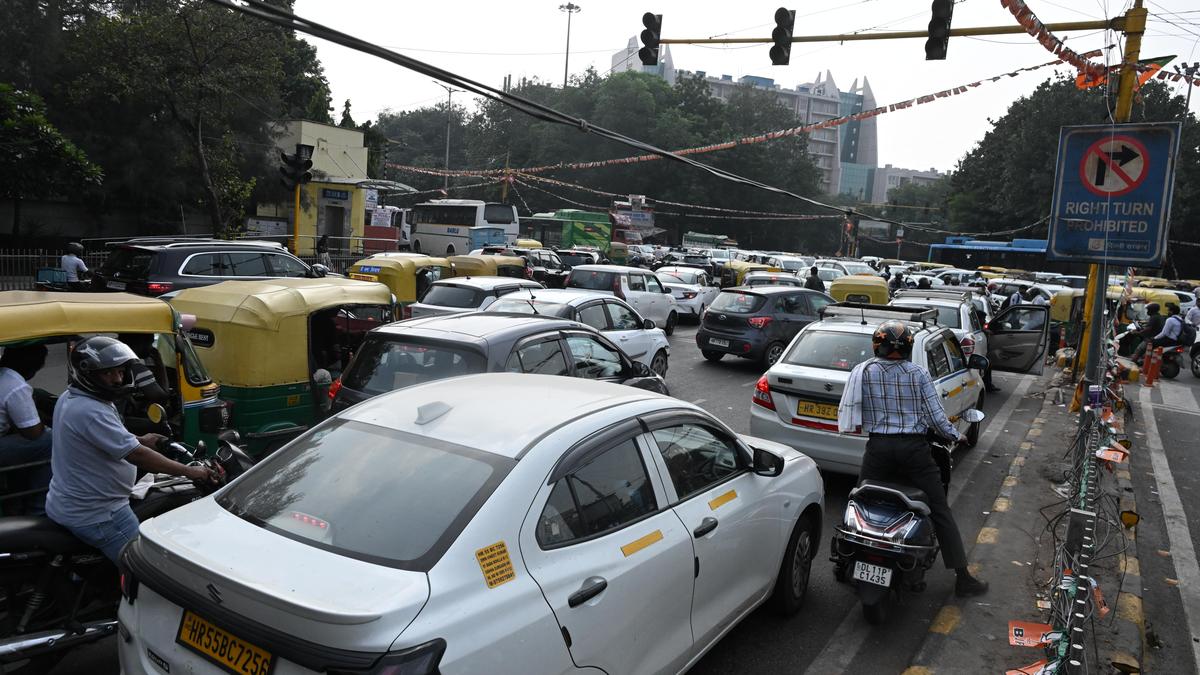
India’s proposed BS-VII framework extends vehicle pollution controls beyond exhaust emissions to brake particles and tyre abrasion, alongside on-road testing and battery durability requirements.
Image: The Hindu
Why in news
Draft notifications published in October 2026 propose category-wise introduction of BS-VII standards and invite public comments for 30 days from their public availability. These are proposals, not finalised requirements, and some numerical limits remain to be notified separately.
April 1, 2029
Proposed passenger-car rollout
23 nm to 10 nm
Particle-number measurement threshold
3 mg/km
Pure electric car brake-particle limit from April 2031
7 mg/km
Other specified car types: brake limit from April 2031
April 2035
Common passenger-car brake-particle limit
875,000 km or 15 years
Longest proposed heavy-vehicle emissions-durability period
Background
Bharat Stage standards regulate emissions from motor vehicles within India's motor-vehicle regulatory framework. India introduced BS-VI nationwide in April 2020, tightening controls on pollutants including nitrogen oxides and particulate matter; the BS-VI framework also includes real-driving emissions testing for applicable vehicles. Laboratory testing provides controlled, repeatable measurements, whereas on-road testing examines performance under actual driving conditions. Vehicle pollution also includes non-exhaust emissions from friction and wear, so eliminating tailpipe emissions does not eliminate every form of vehicle-related pollution.
What changes under the proposed BS-VII framework?
For passenger cars, the draft retains the principal exhaust limits for carbon monoxide, nitrogen oxides and particulate matter. Its central shift is towards broader pollutant coverage, more realistic testing and monitoring of emissions-control performance over time, rather than a uniform tightening of all headline tailpipe limits.
The particle-number measurement threshold would fall from 23 nanometres to 10 nanometres. This brings smaller particles within the measurement regime; it should not be confused with a reduction in the particulate-mass limit. The proposal also covers fuel-vapour emissions and battery-performance benchmarks for electric vehicles and plug-in hybrids.
- Petrol cars would retain proposed limits of 1,000 mg/km for carbon monoxide and 60 mg/km for nitrogen oxides.
- Diesel cars would retain proposed limits of 500 mg/km for carbon monoxide and 80 mg/km for nitrogen oxides.
- The proposed exhaust particulate-matter limit for both petrol and diesel cars is 4.5 mg/km.
- The draft specifies performance requirements rather than prescribing a particular engine design.
Infographic
Real-world testing
Portable on-road measurement strengthens assessment beyond laboratory conditions.
Smaller particles
Particle-number measurement threshold proposed to fall from 23 nm to 10 nm.
Non-exhaust controls
Brake particles and tyre abrasion enter the proposed regulatory framework.
Durability and monitoring
Greater attention to emissions-control performance and EV battery retention over time.
Phased implementation
Cars first from April 2029; later deadlines vary by category and requirement.
AI-assisted infographic by Pragnya IAS Academy, based on the cited sources.
On-road testing: closing the laboratory–road gap
The draft proposes on-road testing using portable equipment as part of type approval from April 2030 for passenger cars. Since real-driving emissions testing already exists for applicable vehicles under BS-VI, BS-VII should be understood as strengthening real-world assessment, not introducing the concept for the first time.
Laboratory tests cannot fully reproduce variations in traffic, driving behaviour, load and ambient conditions. On-road measurements can therefore help establish whether emissions-control systems perform effectively outside controlled test cycles. Monitoring emissions and fuel or electric-energy consumption would add information on performance during vehicle use.
For cars, onboard monitoring would detect specified emissions exceedances, including levels at least 2.5 times the relevant limit. The draft requires monitoring data to be accessible through the diagnostic port for vehicles manufactured from April 1, 2032. Such monitoring supports compliance assessment but is not, by itself, evidence of an automatic penalty or recall mechanism.
- Portable testing requires calibrated equipment, trained personnel and reproducible protocols.
- Monitoring can help identify deterioration, but data must translate into effective diagnosis and corrective action.
- Manufacturers may need changes to sensors, software, engine controls or exhaust-treatment systems, depending on existing technology.
Brake and tyre pollution: why electric vehicles are also covered
Braking releases particles as friction surfaces wear down, while tyres shed material through contact with the road. These are non-exhaust emissions and remain relevant even when a vehicle has no tailpipe emissions.
For passenger cars, the draft proposes brake-particle limits from April 2031 of 3 mg/km for pure electric cars and 7 mg/km for other specified vehicle types. A common limit of 3 mg/km across powertrains is proposed from April 2035. Passenger-car tyre-abrasion requirements would begin in April 2031, but their numerical limits are to be notified separately.
Regenerative braking can reduce reliance on friction brakes in electric vehicles, but it does not eliminate tyre wear. Proposed battery-performance benchmarks address a separate issue: whether electric-vehicle and plug-in-hybrid batteries retain adequate performance over time.
- Zero tailpipe emissions should not be equated with zero vehicle-related pollution.
- Brake-particle mass limits and tyre-abrasion requirements regulate different wear processes.
- The air-quality effect of tyre controls cannot be quantified from the supplied material, particularly while numerical limits remain unspecified.
Phased rollout: benefits, regulatory gaps and implementation demands
The proposed sequence begins with passenger cars in April 2029, followed by light commercial vehicles in April 2030 and buses and heavy trucks in April 2031. Individual obligations have separate commencement dates: the initial category rollout does not mean every testing, monitoring and non-exhaust requirement starts simultaneously.
Light-commercial-vehicle requirements vary by weight, with brake-particle requirements proposed from April 2032 and a common limit across powertrains from 2035; numerical brake limits remain to be notified separately. For buses and heavy trucks, exhaust limits are expressed against engine energy output rather than distance travelled. Their draft also covers ammonia, methane and nitrous oxide.
Phasing can provide time for product development and testing infrastructure, but multiple deadlines complicate compliance planning. Since the proposal applies to vehicles manufactured from specified dates, improvements in fleet-wide air quality would also depend on fleet turnover, vehicle use and maintenance. The source does not support a quantified estimate of pollution reduction or compliance costs.
- Heavy-vehicle exhaust limits, on-road testing and onboard monitoring are proposed from April 2031.
- Additional heavy-vehicle monitoring and brake-particle requirements are proposed from April 2033.
- Heavy-vehicle tyre-abrasion requirements are proposed from April 2035.
- Numerical heavy-vehicle limits for brake particles, tyre wear and battery performance remain to be notified separately.
| Requirement | Draft provision | Proposed commencement |
|---|---|---|
| Passenger-car BS-VII rollout | Initial category rollout; individual obligations have separate dates | April 1, 2029 |
| On-road type-approval testing | Testing with portable equipment | April 2030 |
| Brake particles | 3 mg/km for pure electric cars; 7 mg/km for other specified types | April 2031 |
| Tyre abrasion | Requirements proposed; numerical limits to be notified separately | April 2031 |
| Monitoring-data access | Data available through the vehicle's diagnostic port | Vehicles manufactured from April 1, 2032 |
| Common brake-particle limit | 3 mg/km across powertrains | April 2035 |
- 1. Specify category-wise emission limits and testing conditions.
- 2. Assess vehicle compliance through laboratory and applicable on-road testing.
- 3. Monitor emissions-control performance during vehicle use.
- 4. Use diagnostic information to identify exceedances and deterioration.
- 5. Support corrective action so that certified performance is better sustained on the road.
April 2020
India introduces BS-VI emission standards nationwide.
October 2026
Draft BS-VII notifications are published for public consultation.
April 2029
Proposed passenger-car BS-VII rollout begins.
April 2030
Proposed light-commercial-vehicle rollout and passenger-car on-road type-approval testing begin.
April 2031
Proposed heavy-vehicle rollout begins; passenger-car brake-particle and tyre-abrasion requirements also commence.
April 2032
Proposed passenger-car monitoring-data access and light-commercial-vehicle brake-particle requirements begin.
April 2033
Proposed additional monitoring and brake-particle requirements begin for heavy vehicles.
April 2035
Proposed common passenger-car brake-particle limit and heavy-vehicle tyre-abrasion requirements begin.
Significance, challenges & way forward
Significance
- The proposal broadens regulation from exhaust emissions to include brake and tyre wear.
- Measuring smaller particles expands the scope of particle-number assessment without changing the retained principal passenger-car particulate-mass limit.
- Real-world testing and monitoring can make certification more representative of actual vehicle performance.
- Non-exhaust controls recognise that electric mobility alone cannot eliminate all transport-related particulate pollution.
- Durability requirements can strengthen attention to emissions performance over a vehicle's operating life.
Challenges
- Portable testing equipment, calibration facilities and skilled personnel must be available at adequate scale.
- Real-world variability must be addressed without making test results inconsistent or compliance requirements unpredictable.
- Unspecified tyre-abrasion and other numerical limits create uncertainty for product design and investment.
- Manufacturers and suppliers may face technology and validation costs, although the supplied material does not establish their magnitude.
- Monitoring will deliver limited benefits unless reliable data are linked to maintenance and enforceable compliance procedures.
- New-vehicle standards cannot immediately address pollution from the entire existing fleet or other urban sources.
Way forward
- Finalise pending numerical limits and test methods early enough to provide credible development lead times.
- Publish a consolidated category-wise compliance calendar distinguishing initial rollout from later obligations.
- Expand accredited testing capacity and harmonise equipment calibration, test protocols and staff training.
- Define clear responsibilities for accessing monitoring data, diagnosing failures and securing corrective action.
- Assess brake and tyre solutions alongside road safety, durability and affordability requirements.
- Combine vehicle standards with effective in-use compliance, public transport, walking and cycling infrastructure, and road-dust management.
Key terms
- Type approval
- Certification that a vehicle type meets applicable regulatory requirements before being placed on the market.
- Real-driving emissions testing
- Measurement of vehicle emissions during on-road operation rather than solely under laboratory conditions.
- Portable emissions measurement equipment
- Equipment carried on a vehicle to measure emissions during road testing.
- Non-exhaust emissions
- Vehicle-related pollution arising outside the exhaust, including brake wear and tyre abrasion.
- Particle number
- A count-based measure of emitted particles above a specified size threshold, distinct from their total mass.
- Onboard monitoring
- Vehicle-based monitoring designed to identify specified emissions exceedances or performance issues.
- Regenerative braking
- A braking process that recovers kinetic energy as electrical energy and can reduce reliance on friction brakes.
- Emissions durability
- The ability of a vehicle's emissions-control system to maintain required performance over a specified period or distance.
Link with static syllabus
Prelims practice MCQs
Q1. With reference to the proposed BS-VII standards for passenger cars, consider the following statements: 1. The principal tailpipe limits for carbon monoxide, nitrogen oxides and particulate matter are retained. 2. The particle-number measurement threshold is proposed to be lowered from 23 nanometres to 10 nanometres. 3. Lowering the particle-number threshold necessarily means lowering the particulate-mass limit. Which of the statements given above are correct?
Q2. Which one of the following correctly describes non-exhaust vehicle pollution?
Q3. Consider the following statements about the proposed BS-VII rollout: 1. Passenger cars are proposed to enter the framework before buses and heavy trucks. 2. Every passenger-car requirement would begin on April 1, 2029. 3. Numerical limits for passenger-car tyre abrasion are to be notified separately. Which of the statements given above are correct?
Q4. With reference to vehicle emissions testing, consider the following statements: 1. Real-driving emissions testing already exists for applicable vehicles under the BS-VI framework. 2. On-road testing assesses emissions under actual driving conditions using portable equipment. 3. Proposed heavy-vehicle exhaust limits are expressed against distance travelled rather than engine energy output. Which of the statements given above are correct?
Mains practice questions
GS 3 · 15 marks · 250 words
India's proposed BS-VII standards seek to move beyond tailpipe-centred vehicle pollution regulation. Examine their potential air-quality benefits and the challenges of implementing the phased rollout.
Frequently asked questions
Are BS-VII standards already final and applicable?
No. The October 2026 notifications are drafts under consultation, with a proposed phased rollout beginning in April 2029; provisions may change before finalisation.
Does BS-VII reduce all passenger-car tailpipe limits?
No. The draft retains the principal limits for carbon monoxide, nitrogen oxides and exhaust particulate matter, while expanding testing, monitoring and non-exhaust controls.
Why do electric vehicles need brake and tyre pollution controls?
Pure electric vehicles have no tailpipe emissions, but their tyres and friction brakes can still release wear particles. Regenerative braking reduces reliance on friction braking without eliminating all non-exhaust pollution.
Will all BS-VII requirements start in April 2029?
No. Passenger cars enter first, while other categories and individual requirements follow separate schedules; some obligations extend to April 2035.
Sources
Analysis prepared by the Pragnya IAS Academy current-affairs desk with AI assistance from the cited reports. Verify figures with the original sources.
Turn current affairs into marks
Join Pragnya IAS Academy's mentorship for daily answer-writing evaluation on stories like this — classroom programmes from a trusted name in IAS coaching in Hyderabad.