
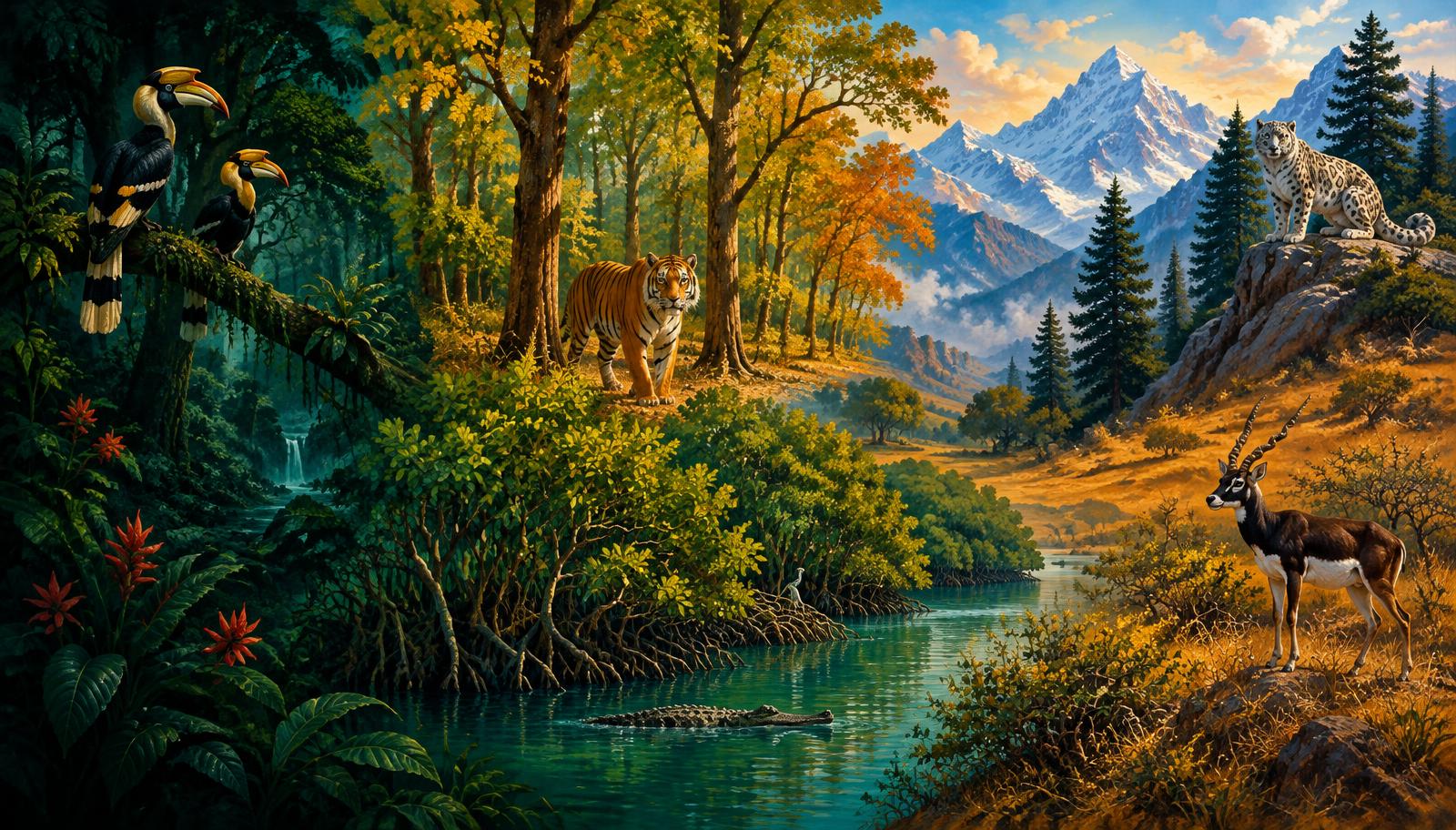
InfoGraphix by Pragnya · Geography · Chapter 18
Natural Vegetation and Wildlife
Read India’s vegetation through moisture, altitude and tides. Connect forest evidence to species conservation, community rights and restoration.
- 18 visual topics
- 54 practice MCQs
- 54 flip cards
From ecological patterns to public action
Topics 1–6
Explain vegetation
Trace moisture, seasonality and altitude through forest structure.
Topics 7–12
Read habitats and evidence
Study coasts, canopy data and overlapping conservation designations.
Topics 13–18
Evaluate governance
Combine wetland recovery, laws, rights and community restoration.
Conservation institutions in context
Scroll the ribbon and tap any milestone to open its infographic.
1927
Forest administration
The Indian Forest Act codifies forest categories.
Open topic →1972
Wildlife law
A national statutory framework protects species and habitats.
Open topic →1973
Tiger and community action
Project Tiger begins; Chipko emerges in the Himalaya.
Open topic →1980
Diversion control
Prior Central approval becomes central to forest diversion.
Open topic →1986
Nilgiri biosphere reserve
India designates its first biosphere reserve.
Open topic →1988
Forest policy
Ecological stability and cover goals anchor policy.
Open topic →1992
Project Elephant
Landscape conservation extends to elephant habitats.
Open topic →2006
Forest rights
Individual and community rights receive statutory recognition.
Open topic →2023
New policy links
MISHTI begins; the forest-conservation law is amended.
Open topic →
Topic index
Follow the numbers in order, or jump to what you need.
0 of 18 revised on this device
- 1Climate controls
Rainfall, Seasonality and Vegetation
Rainfall, Seasonality and Vegetation
Rainfall supplies water, but the length of the dry season determines how long trees must conserve it. Temperature, soil, slope and disturbance modify every broad rainfall–forest association.
Open infographic - 2Tropical forests
Evergreen and Semi-evergreen Forests
Evergreen and Semi-evergreen Forests
Evergreen forests combine year-round warmth with abundant moisture and asynchronous leaf replacement. Semi-evergreen forests mix evergreen and deciduous trees where moisture availability is more seasonal.
Open infographic - 3Tropical forests
Tropical Moist Deciduous Forests
Tropical Moist Deciduous Forests
Moist deciduous forests occupy monsoonal landscapes with substantial rain and a marked dry season. Seasonal leaf fall limits transpiration and creates a pronounced annual cycle of light and litter.
Open infographic - 4Tropical forests
Tropical Dry Deciduous Forests
Tropical Dry Deciduous Forests
Dry deciduous woodland grades between moister monsoon forests and thorn vegetation. A longer dry season produces a more open canopy, seasonal grasses and strong competition for soil moisture.
Open infographic - 5Drylands
Thorn Forests and Scrub
Thorn Forests and Scrub
Thorn vegetation survives long moisture deficits through reduced leaf area, deep roots and other water-saving traits. Natural scrub is a functioning ecosystem rather than empty land awaiting plantations.
Open infographic - 6Highlands
Montane Zonation and Sholas
Montane Zonation and Sholas
Temperature generally falls with altitude, producing successive vegetation belts on Himalayan slopes. Rainfall, aspect and latitude shift their elevations, while southern highlands contain distinct shola–grassland mosaics.
Open infographic - 7Coastal ecosystems
Mangroves, Littoral and Swamp Forests
Mangroves, Littoral and Swamp Forests
Mangroves occupy suitable tropical intertidal settings where salt exposure and oxygen-poor sediments constrain plants. Littoral and swamp vegetation is broader than mangroves and includes other coastal and freshwater communities.
Open infographic - 8Evidence
Reading ISFR 2023 Correctly
Reading ISFR 2023 Correctly
The India State of Forest Report 2023 distinguishes canopy-based forest cover from tree cover and legally recorded forest land. Its release in December 2024 does not change the report’s reference year.
Open infographic - 9Biogeography
Biodiversity Hotspots and Endemism
Biodiversity Hotspots and Endemism
India intersects four global biodiversity hotspots, defined by both exceptional plant endemism and extensive historical habitat loss. A hotspot is a prioritisation concept, not a protected-area notification.
Open infographic - 10Protection
National Parks and Wildlife Sanctuaries
National Parks and Wildlife Sanctuaries
India’s statutory protected-area categories differ in objectives and permitted uses. National parks and sanctuaries protect habitats under the Wild Life (Protection) Act, while biosphere and international designations can overlap them.
Open infographic - 11Protection
Biosphere Reserves and UNESCO MAB
Biosphere Reserves and UNESCO MAB
Biosphere reserves integrate biodiversity conservation, sustainable development and research across larger landscapes. Indian designation and admission to UNESCO’s Man and the Biosphere network are separate decisions.
Open infographic - 12Species programmes
Project Tiger and Project Elephant
Project Tiger and Project Elephant
Flagship-species programmes can protect landscapes far larger than an animal’s immediate home range. Project Tiger and Project Elephant require habitat connectivity, monitoring and coexistence measures beyond reserve boundaries.
Open infographic - 13Conservation tools
Ramsar Wetlands and Species Recovery
Ramsar Wetlands and Species Recovery
Wetland conservation and species-recovery programmes address habitats beyond terrestrial forests. Ramsar recognition promotes wise use, while domestic legal instruments determine enforceable site protection.
Open infographic - 14Governance
Forest and Wildlife Law: 1927–2023
Forest and Wildlife Law: 1927–2023
Forest governance combines laws on land administration, wildlife and diversion for non-forest uses. The 2023 forest-conservation amendment requires precise reading and cannot be reduced to a blanket border-area exemption.
Open infographic - 15Governance
Forest Rights, Policy and CAMPA
Forest Rights, Policy and CAMPA
Conservation legitimacy depends on secure rights and accountable institutions as well as funding. The Forest Rights Act, forest policy and compensatory-afforestation system perform different functions and must be read together.
Open infographic - 16Restoration
Green India Mission and Restoration Quality
Green India Mission and Restoration Quality
The Green India Mission treats forests as providers of ecosystem services and climate resilience. Restoration should recover native ecological function, not merely maximise the number of planted stems.
Open infographic - 17People and forests
Chipko, Appiko and Coexistence
Chipko, Appiko and Coexistence
Community movements showed that forests supply water, fodder, soil protection and cultural security beyond timber revenue. Coexistence policy must also address the unequal costs borne by people living near wildlife.
Open infographic - 18Revision
Chapter Quick Revision
Chapter Quick Revision
Connect climate and landform to vegetation, then distinguish habitat evidence from conservation labels. Revise a small set of dated numbers alongside the legal and ecological qualifications that prevent common errors.
Open infographic