
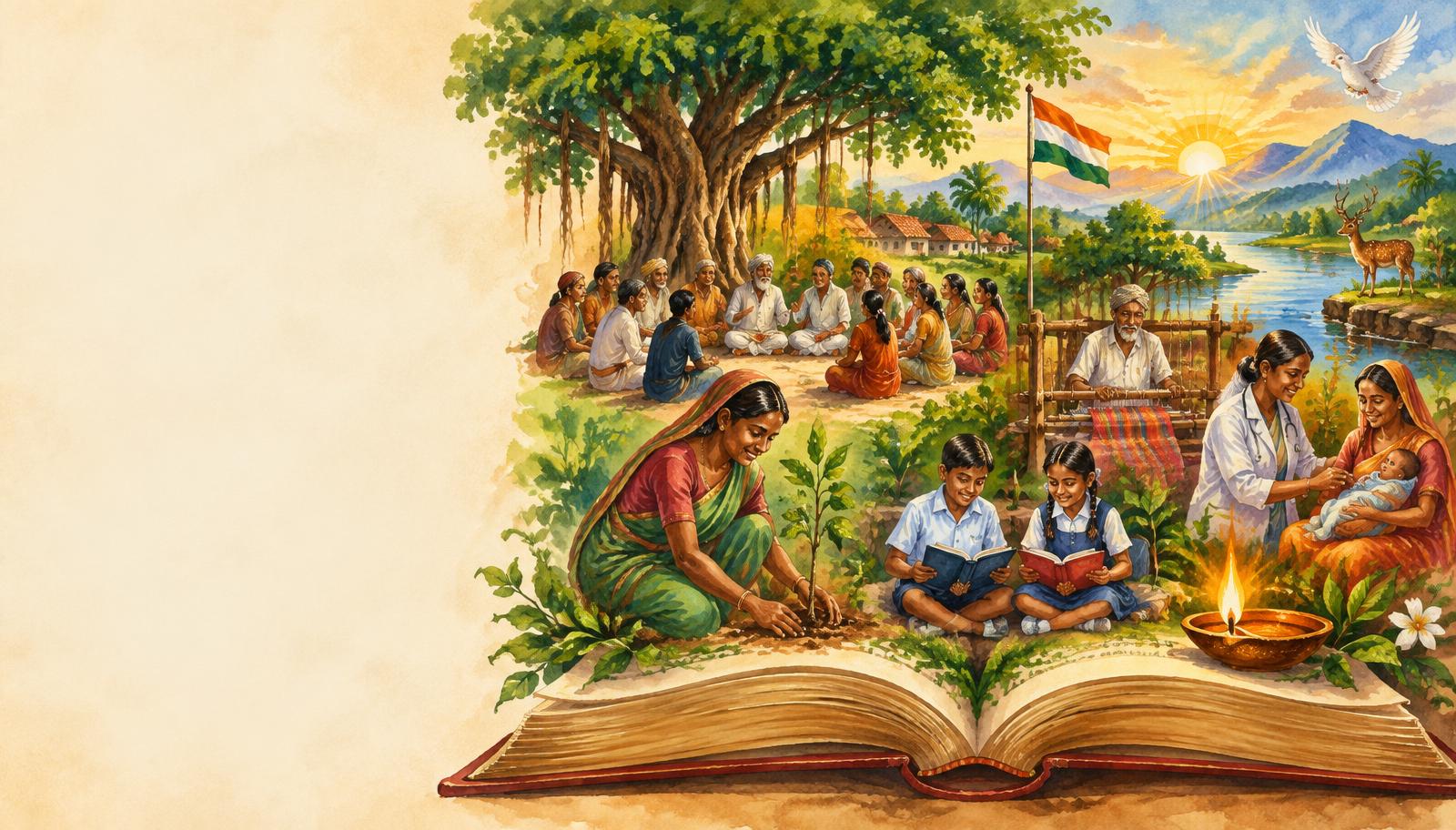
InfoGraphix by Pragnya · Indian Polity · Chapter 4
Directive Principles & Fundamental Duties
The Directive Principles of State Policy (Articles 36–51) and the Fundamental Duties (Article 51A) — the three families of directives, how they became laws and schemes, the long FR–DPSP balance in the courts, the Uniform Civil Code debate and all eleven duties of a citizen.
- 18 visual topics
- 54 practice MCQs
- 54 flip cards
Three pillars of the chapter
Articles 36–51
Directive Principles
Non-justiciable goals for a welfare State — Socialist, Gandhian and Liberal-intellectual.
1951–2024
The balance
How courts and Parliament reconciled directives with Fundamental Rights.
Article 51A
Fundamental Duties
Eleven responsibilities of every citizen, added in 1976 and 2002.
Chapter mind-map: 1935 → 2025
Scroll the ribbon and tap any milestone to open its infographic.
1935
Instrument of Instructions
Ambedkar's model for Part IV.
Open topic →1937
Irish Constitution
Source of the idea.
Open topic →1950
Part IV in force
Fundamental in governance (Art 37).
Open topic →1951
Champakam Dorairajan
Rights prevail over directives.
Open topic →1971
25th Amendment
Article 31C for 39(b), (c).
Open topic →1973
Kesavananda Bharati
Basic structure.
Open topic →1976
42nd Amendment
Four new directives; Part IVA.
Open topic →1978
44th Amendment
Article 38(2).
Open topic →1980
Minerva Mills
Balance is basic structure.
Open topic →1992
73rd Amendment
Article 40 realised.
Open topic →1999
Verma Committee
Laws that enforce duties.
Open topic →2002
86th Amendment
Art 45 rewritten; duty 51A(k).
Open topic →2011
97th Amendment
Article 43B — cooperatives.
Open topic →2024
Property Owners Association
39(b) read narrowly.
Open topic →2025
Uttarakhand UCC
State civil code in force.
Open topic →
Topic index
Follow the numbers in order, or jump to what you need.
0 of 18 revised on this device
- 1Part IV
Directive Principles: An Introduction
Part IV, its Irish roots and a 'novel feature'
What the Directive Principles of State Policy are, where Part IV came from, and why the framers called them a 'novel feature' — instructions to every government to build a welfare State.
Open infographic - 2Arts 36–37
Articles 36–37: Fundamental yet Non-justiciable
Why courts cannot enforce them — and why they matter
Article 36 borrows the meaning of 'State' from Article 12; Article 37 makes the directives unenforceable in court yet fundamental in governance — the reasons, the criticism and the real value of that bargain.
Open infographic - 3Classification
Three Families of Directive Principles
Socialist, Gandhian and Liberal-intellectual
The Constitution does not group the directives, but textbooks sort them into three families — Socialist, Gandhian and Liberal-intellectual — with a few Articles straddling two families.
Open infographic - 4Arts 38–43A, 47
Socialist Principles
Welfare, livelihood, legal aid and fair work
The Socialist directives — Articles 38, 39, 39A, 41, 42, 43, 43A and 47 — commit the State to social and economic justice: livelihood, equal pay, free legal aid, work, humane conditions, living wages, worker participation and public health.
Open infographic - 5Art 39
Article 39, Article 31C & Material Resources
From Sanjeev Coke to the 2024 nine-judge ruling
Article 39's six clauses, and the long contest over clauses (b) and (c) — Article 31C, Kesavananda, Minerva Mills, Sanjeev Coke and the 2024 nine-judge ruling on 'material resources of the community'.
Open infographic - 6Arts 40–48
Gandhian Principles
Panchayats, cottage industry, cooperatives, weaker sections
The Gandhian directives — Articles 40, 43, 43B, 46, 47 and 48 — carry Gandhi's programme of village self-rule, cottage industry, cooperatives, uplift of weaker sections, prohibition and care of cattle.
Open infographic - 7Arts 44–51
Liberal-Intellectual Principles
Civil code, child care, environment, heritage, peace
The Liberal-intellectual directives — Articles 44, 45, 48, 48A, 49, 50 and 51 — aim at a modern State: one civil code, early childhood care, scientific farming, a clean environment, protected heritage, an independent judiciary and world peace.
Open infographic - 8Art 44
Article 44: Uniform Civil Code
Debates, Goa, Uttarakhand and the courts
Article 44 asks the State to work towards one civil code for marriage, divorce, succession and adoption. Its debates, the Goa and Uttarakhand examples, Supreme Court observations and the arguments on both sides.
Open infographic - 9Amendments
New Directives & Directives outside Part IV
42nd, 44th, 86th, 97th Amendments; Arts 335, 350A, 351
How four amendments added or rewrote directives — the 42nd (1976), 44th (1978), 86th (2002) and 97th (2011) — and the three directives that sit outside Part IV: Articles 335, 350A and 351.
Open infographic - 10Implementation
Directives in Action: Laws & Schemes
From land reform to food security
How governments have turned Part IV into law and policy — land reform, panchayats, legal aid, labour codes, rural employment, food security, child care, environment, heritage and an independent judiciary.
Open infographic - 111951–1980
FR vs DPSP: From Conflict to Balance
Champakam to Minerva Mills in five phases
How the courts and Parliament settled the conflict between Fundamental Rights and Directive Principles — from FR supremacy in 1951, through Golak Nath and Article 31C, to the balance and harmony of Kesavananda and Minerva Mills.
Open infographic - 12Case law
Landmark Judgments on Directive Principles
Ten cases that shaped Part IV
Ten Supreme Court judgments that shaped how the Directive Principles are used — prohibition, cattle protection, equal pay, livelihood, education, environment, cooperatives and material resources.
Open infographic - 13Part IVA
Fundamental Duties: Origin & Evolution
Swaran Singh Committee, 42nd and 86th Amendments
Why the Constitution, silent on duties in 1950, gained Part IVA in 1976: the Swaran Singh Committee, the 42nd Amendment's ten duties, the eleventh added in 2002, and the Soviet inspiration.
Open infographic - 14Art 51A
The Eleven Fundamental Duties
Article 51A(a)–(k), clause by clause
All eleven Fundamental Duties of Article 51A, clause by clause — from respecting the Constitution, Flag and Anthem to a parent's duty to educate a child aged six to fourteen.
Open infographic - 15Enforcement
Features & Enforcement of Duties
Citizens only, Verma Committee laws, court use
The features of Fundamental Duties — citizens only, moral and civic, non-justiciable — and how they are still enforced through existing laws identified by the Verma Committee and through the courts.
Open infographic - 16Evaluation
Fundamental Duties: Criticism & Significance
Gaps, critiques and why duties still matter
The case against Part IVA — incomplete, vague, unenforceable, poorly placed — and the case for it: a civic reminder, a guide for courts and legislatures, and a check on anti-national and anti-social conduct.
Open infographic - 17Parts III–IVA
Rights, Principles & Duties Compared
Parts III, IV and IVA side by side
Fundamental Rights, Directive Principles and Fundamental Duties side by side — Parts, Articles, sources, addressees, justiciability, amendments — the comparison grid every aspirant should know.
Open infographic - 18Revision
Chapter Quick Revision
Articles 36–51A, amendments, cases and traps
The whole chapter on one sheet — Articles 36–51 and 51A, the three families, amendments, landmark cases, critics' phrases and the traps examiners love.
Open infographic
Full reading notes in the Study Library
- Socialistic principles →
- Gandhian principles →
- Liberal-intellectual principles →
- Implementation of DPSP →
- FR-DPSP relationship →
- Panchayati Raj →
- 73rd Amendment →
- Important amendments →
- Basic structure →
- Fundamental Duties →
Previous year questions