
InfoGraphix by Pragnya · Indian Polity · Chapter 1
Historical Background & Making of the Constitution
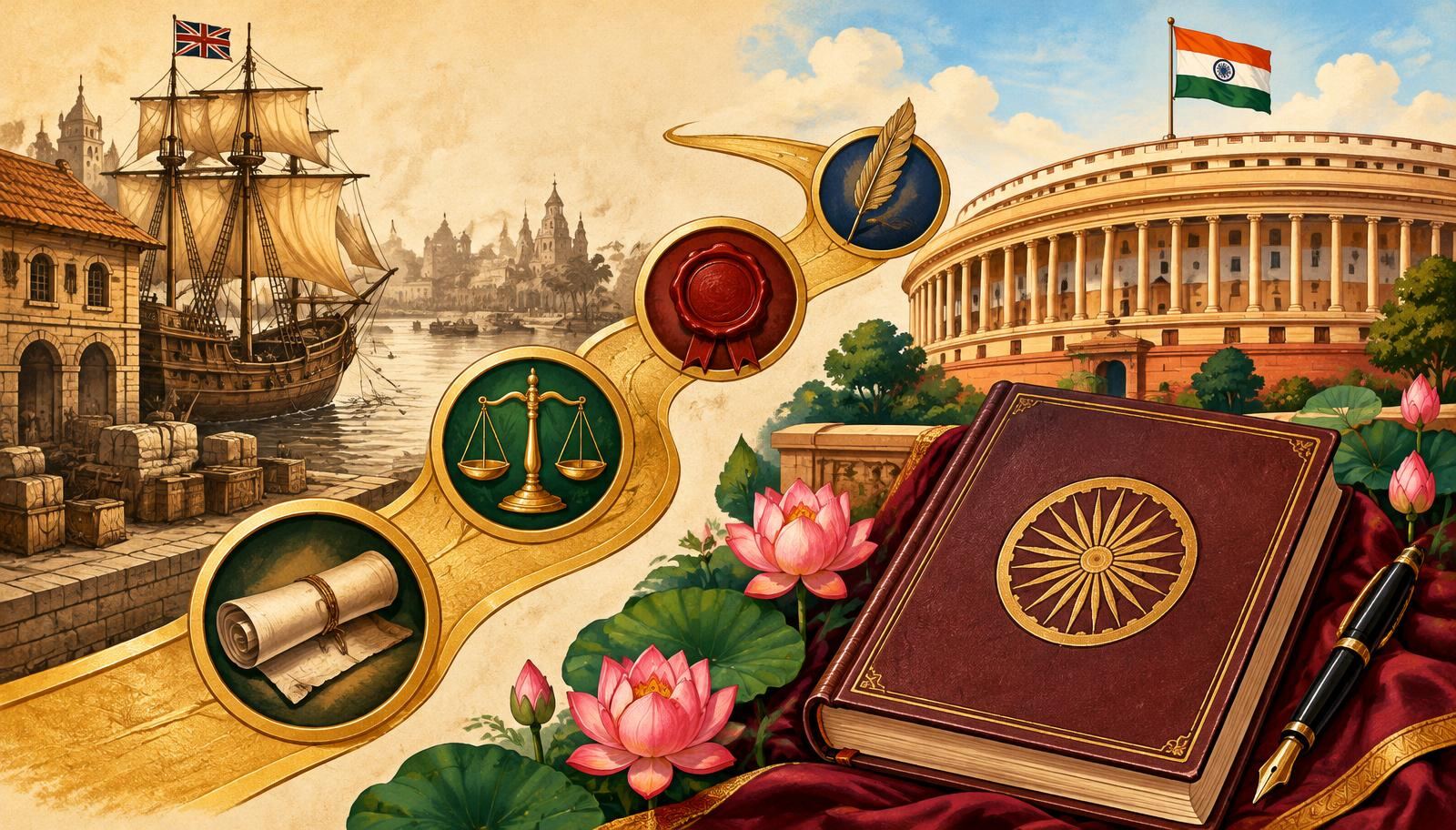
How 350 years of charters, Acts and assemblies shaped the Constitution of India — the Company era, Crown rule, the march of representation and the Constituent Assembly that wrote our Republic's rulebook.
- 15 visual topics
- 45 practice MCQs
- 47 flip cards
Three phases, one journey
1600–1858
Company rule
A trading company becomes a ruling power; Parliament regulates it through the Regulating Act, Pitt's India Act and the Charter Acts.
1858–1947
Crown rule
The Crown governs directly; councils, elections and provincial autonomy expand Indian participation step by step.
1946–1950
Constitution-making
An Indian Constituent Assembly drafts, debates and adopts the Constitution of the Republic.
Chapter mind-map: 1600 → 1950
Scroll the ribbon and tap any milestone to open its infographic.
1600
Company chartered
Exclusive trading rights in the East.
Open topic →1773
Regulating Act
Governor-General of Bengal; Supreme Court.
Open topic →1784
Pitt's India Act
Board of Control; double government.
Open topic →1813
Charter Act
Trade monopoly ends (mostly).
Open topic →1833
Charter Act
Governor-General of India.
Open topic →1853
Charter Act
Legislative Council; open competition.
Open topic →1858
GoI Act
Crown rule; Secretary of State.
Open topic →1861
Councils Act
Indians nominated to councils.
Open topic →1892
Councils Act
Budget discussion; indirect election.
Open topic →1909
Morley–Minto
Separate electorate for Muslims.
Open topic →1919
Montagu–Chelmsford
Provincial dyarchy; bicameral Centre.
Open topic →1935
GoI Act
Federation plan; provincial autonomy.
Open topic →1946
Constituent Assembly
First meeting, 9 December.
Open topic →1947
Independence Act
Two dominions; sovereign Assembly.
Open topic →1949
Adopted
26 November — Constitution Day.
Open topic →1950
Republic
26 January — Constitution in force.
Open topic →
Topic index
Follow the numbers in order, or jump to what you need.
0 of 15 revised on this device
- 11600–1773
From Traders to Rulers: Company Rule
Charter, Plassey, Buxar and the road to regulation
How a London trading company with a royal charter became the political master of Bengal in 173 years — and why the British Parliament had to step in by 1773.
Open infographic - 21773
Regulating Act, 1773
Parliament's first grip on the Company
The Regulating Act of 1773 was the British Parliament's first step to control the East India Company: it created the Governor-General of Bengal, a Supreme Court at Calcutta and the foundation of central administration.
Open infographic - 31784
Pitt's India Act, 1784
Double government: commerce vs politics
Pitt's India Act of 1784 separated the Company's commercial and political functions, creating the Board of Control and a system of double government that lasted until 1858.
Open infographic - 41813–1853
Charter Acts of 1813, 1833 and 1853
Monopoly ends, centralisation peaks, legislature emerges
The Charter Acts of 1813, 1833 and 1853 ended the Company's trade monopoly, centralised power in a Governor-General of India and began a separate legislature and open civil-service competition.
Open infographic - 51858
Government of India Act, 1858
Company out, Crown in
After the Revolt of 1857, the Government of India Act, 1858 ended Company rule, transferred power to the British Crown, abolished double government and created the Secretary of State for India.
Open infographic - 61861–1909
Indian Councils Acts: 1861, 1892, 1909
The ladder of Indian representation
The Indian Councils Acts of 1861, 1892 and 1909 gradually brought Indians into law-making: nomination in 1861, indirect election in 1892 and enlarged councils with separate Muslim electorates in 1909.
Open infographic - 71919
Government of India Act, 1919
Dyarchy, bicameralism and the road to 1935
The Government of India Act, 1919 (Montagu–Chelmsford Reforms) introduced dyarchy in the provinces, a bicameral central legislature with direct elections and extended separate electorates.
Open infographic - 81935
Government of India Act, 1935
Federation, provincial autonomy and the blueprint
The Government of India Act, 1935 — 321 sections and 10 schedules — proposed an All-India Federation, introduced provincial autonomy, set up the Federal Court and became the largest single source of the Constitution.
Open infographic - 91947
Indian Independence Act, 1947
Two dominions and the end of British rule
The Indian Independence Act, 1947 ended British rule from 15 August 1947, created the dominions of India and Pakistan, made the Constituent Assemblies sovereign and ended British paramountcy over princely states.
Open infographic - 101934–1946
Constituent Assembly: Demand & Composition
From an idea in 1934 to 389 seats in 1946
How the demand for a Constituent Assembly grew from M.N. Roy's idea in 1934 to the Cabinet Mission Plan of 1946, and how the 389-member Assembly was composed and elected.
Open infographic - 111946–1950
Constituent Assembly at Work
Objectives Resolution, sovereignty and criticism
The Constituent Assembly met first on 9 December 1946, adopted Nehru's Objectives Resolution, became fully sovereign under the Independence Act, served also as a legislature, and faced criticism as unrepresentative and Congress-dominated.
Open infographic - 121946–1949
Committees & the Drafting Committee
Who drafted what — and how the draft was read
The Constituent Assembly worked through specialised committees — the most important being the seven-member Drafting Committee chaired by Dr B.R. Ambedkar — and read the Draft Constitution three times before adoption.
Open infographic - 131949–1950
Enactment & Enforcement of the Constitution
26 November 1949 → 26 January 1950
The Constitution was adopted on 26 November 1949 with a Preamble, 395 Articles, 22 Parts and 8 Schedules; some provisions began at once, and the rest came into force on 26 January 1950.
Open infographic - 14Borrowed features
Sources of the Constitution
What India borrowed — and how it adapted
The Constitution borrowed features from the Government of India Act, 1935 and from the constitutions of Britain, the USA, Ireland, Canada, Australia, Germany (Weimar), the USSR, France, South Africa and Japan — and adapted them to Indian needs.
Open infographic - 15Revision
Chapter Quick Revision
Every Act, every 'first', one sheet
One-page revision of Chapter 1: every Act from 1773 to 1947 with its headline feature, the key 'firsts', the Constituent Assembly dates and a memory aid for the sequence.
Open infographic
Full reading notes in the Study Library
All Polity notes →Previous year questions