

Rice field in Tehsil Chunian, Punjab, Pakistan
Credit: Kamran sardar · CC BY 3.0 · source
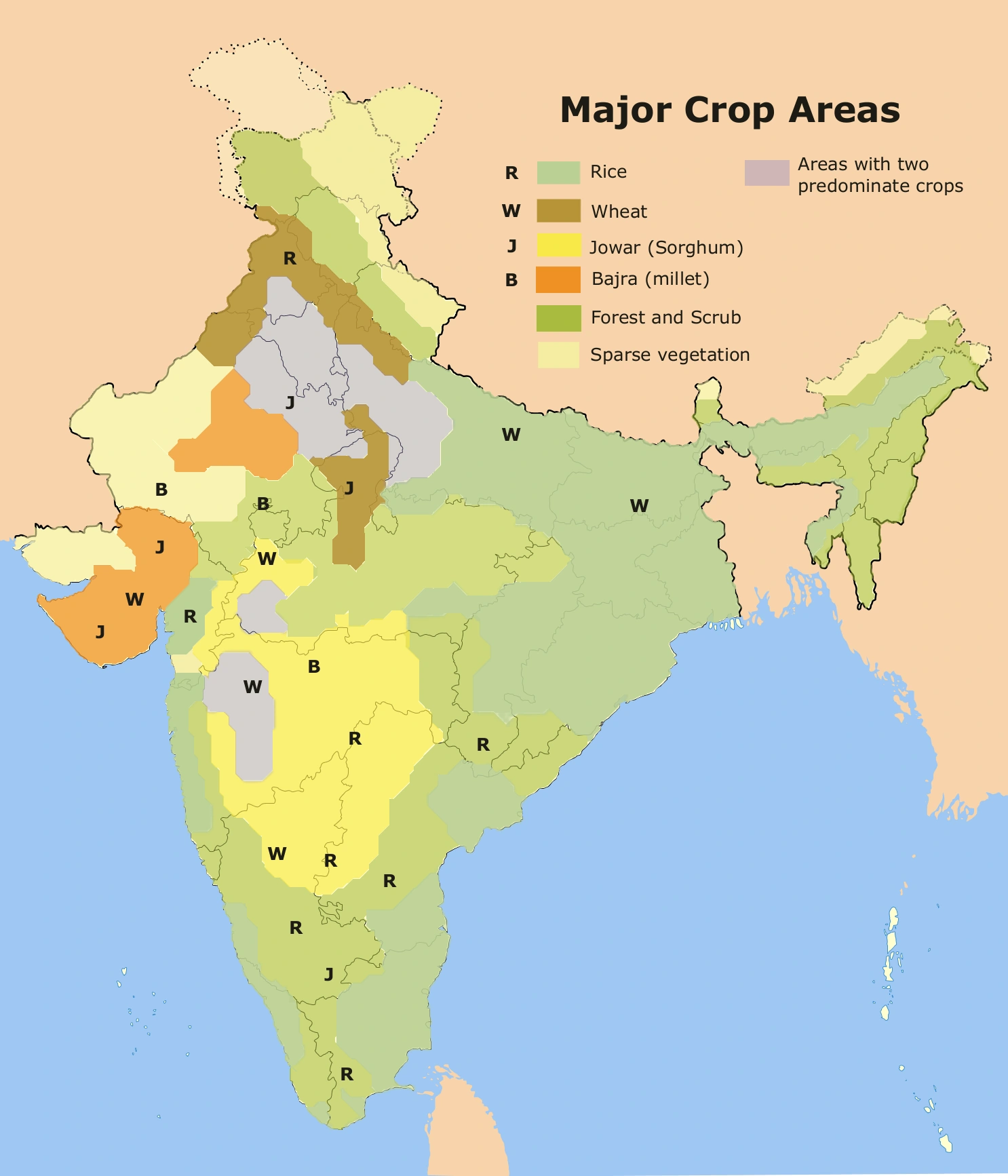
Map study
Major crop regions of India: relate crop belts to rainfall, soils, temperature and irrigation. Schematic historical reference, not current production rankings.
- Read the source legend, scale and reference period before comparing regions.
- Connect spatial patterns to the processes discussed in this topic; this map is a study reference, not live operational data.
Credit: Amog · CC BY-SA 2.5 · sourceConverted to WebP on an opaque white background; proportionally resized without cropping. Original cartography and legend retained.
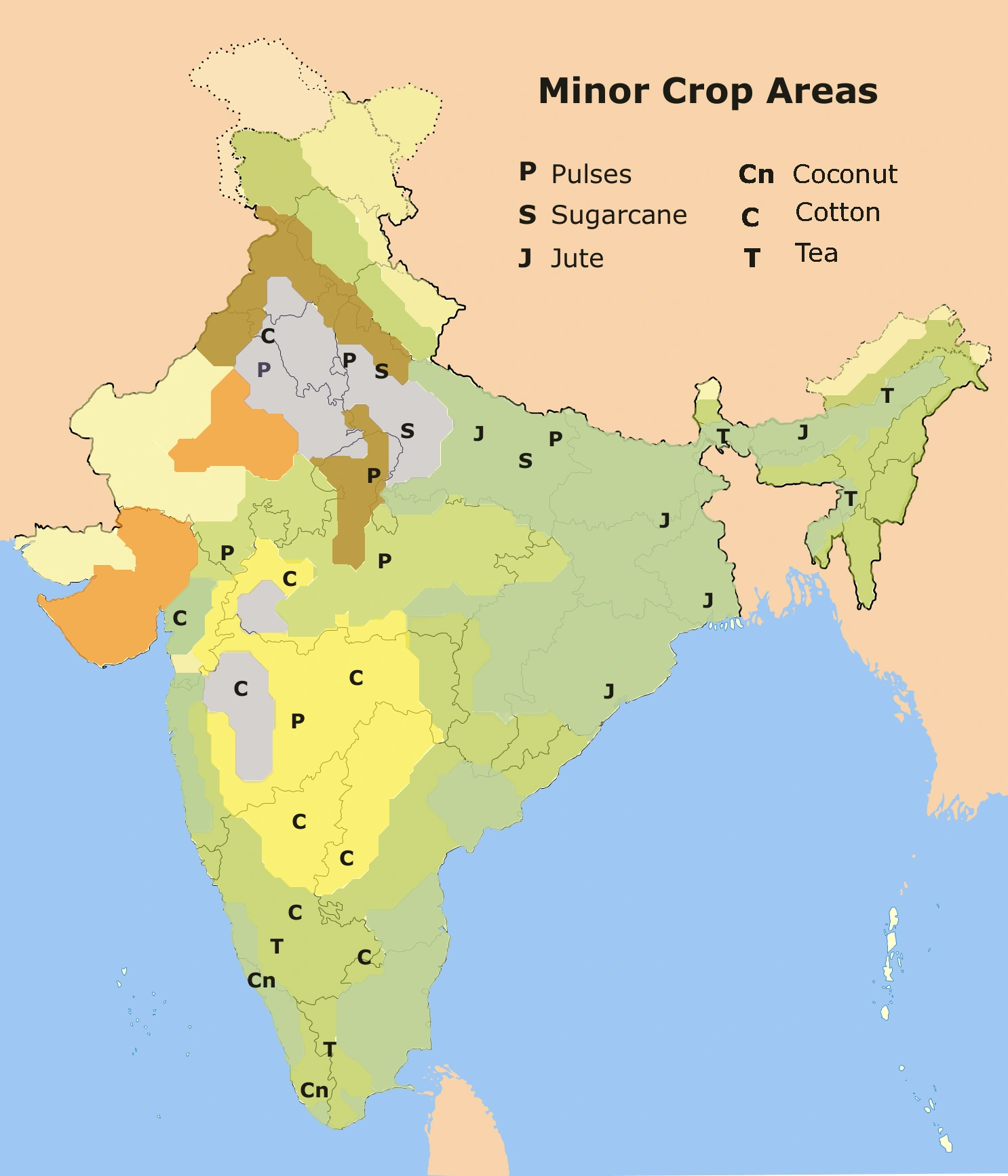
Map study
Selected crop regions of India: identify the legend symbols before comparing patterns. Symbols do not imply exclusive growing areas or current production totals.
- Read the source legend, scale and reference period before comparing regions.
- Connect spatial patterns to the processes discussed in this topic; this map is a study reference, not live operational data.
Credit: Amog · CC BY-SA 2.5 · sourceConverted to WebP on an opaque white background; proportionally resized without cropping. Original cartography and legend retained.
1. Meaning, forms and measurement
Crop diversification means moving away from excessive dependence on a narrow crop base towards a more varied and economically appropriate crop portfolio. It can occur within a holding, across seasons or across a region. A farmer may replace part of the paddy area with maize or pulses, introduce vegetables into a cereal rotation, or cultivate fruit alongside annual crops. Diversification need not imply abandoning staple cereals; the objective is a better balance between income, food requirements, environmental suitability and risk.
Horizontal diversification involves cultivating different crops through substitution, rotations, intercropping or mixed cropping. Vertical diversification refers to value addition, such as converting tomatoes into puree or producing packaged millet foods. Integrating crops with livestock, fisheries or agroforestry is broader agricultural diversification. These distinctions matter because adding a dairy enterprise improves farm resilience without necessarily changing the crop portfolio.
Diversification differs from cropping intensity, which measures gross cropped area relative to net sown area. Growing rice repeatedly may increase cropping intensity without improving diversity. Researchers use crop shares and indices such as the Simpson Index of Diversification: one minus the sum of squared area shares of individual crops. A higher value indicates a more diversified distribution of cropped area, not necessarily higher profitability or sustainability.
2. Why diversification matters for Indian agriculture
The Green Revolution strengthened cereal availability through improved varieties, irrigation, fertilisers, procurement and public investment. However, persistent rice–wheat specialisation in parts of north-western India has contributed to groundwater stress, nutrient imbalances and difficulties in crop-residue management. Moving suitable acreage towards less water-demanding crops can reduce pressure, provided farmers do not use the saved water to expand other water-intensive cultivation.
Diversification spreads production and price risks when different crops respond differently to weather, pests and market conditions. Pulses in rotations can contribute biologically fixed nitrogen and interrupt some pest cycles. Millets often suit rainfed and relatively dry environments, although performance depends on species, soils and management. Crop diversity can therefore improve resilience, but cannot eliminate losses from widespread droughts or floods.
Income and demand provide another rationale. Vegetables, fruits, spices and seed production can generate higher returns per hectare and additional employment in harvesting, grading and processing. Pulses, vegetables and fruits also support dietary diversity, while suitable oilseed expansion can contribute to reducing edible-oil import dependence. Yet high-value crops commonly entail higher working capital, perishability and price volatility. Policy should compare risk-adjusted net returns, labour requirements and resource costs rather than assuming that a high output price means a superior livelihood.
Planning a sustainable crop transition
- 1. Assess agro-climatic suitability, water budgets and household constraints
- 2. Identify demand and compare risk-adjusted net returns
- 3. Arrange seeds, extension, credit and risk protection
- 4. Pilot alternatives with farmer participation
- 5. Build aggregation, procurement or buyer links and post-harvest capacity
- 6. Monitor income and ecological outcomes before scaling
3. Regional pathways and crop choices
In Punjab, Haryana and parts of western Uttar Pradesh, the main issue is reducing dependence on groundwater-intensive paddy where conditions justify a switch. Maize, pulses, oilseeds, fodder and horticultural crops are possible alternatives, but their suitability varies with soils, rainfall, processing demand and market access. A replacement crop must offer a credible income pathway relative to paddy's established procurement, mechanisation and marketing arrangements.
Eastern India offers a different opportunity: some rice fallows can support short-duration pulses or oilseeds using residual soil moisture. Timely sowing, suitable varieties, drainage, limited supplementary irrigation and protection from grazing are essential. In dryland central and peninsular India, millet–pulse systems, oilseeds and locally adapted intercrops can spread climatic risk. Horticulture should expand only where water budgets and market logistics support it.
Peri-urban areas can benefit from demand for vegetables and flowers, while hill regions may develop suitable temperate fruits, spices and off-season vegetables. Such choices must respect slope stability, biodiversity and transport constraints. Diversification should also retain local food needs and women's access to land, inputs and income. A nationally prescribed replacement crop would risk recreating monoculture under a different name; agro-climatic planning must guide decisions.
| Existing situation | Possible pathway | Critical enabling condition |
|---|---|---|
| Groundwater-stressed paddy cultivation | Suitable maize, pulses, oilseeds or horticulture | Competitive returns, dependable buyers and water-sensitive incentives |
| Seasonally uncultivated rice fallows | Short-duration pulses or oilseeds | Residual moisture management, timely sowing and suitable seeds |
| Risk-prone dryland monocropping | Locally adapted millet–pulse rotations or intercrops | Extension, seed availability and risk protection |
| Low-value cropping near cities | Vegetables, flowers or specialised crops | Reliable market information, logistics and quality management |
| Sale of unprocessed farm output | Grading, milling, packaging or processing | Aggregation, working capital and food-safety compliance |
4. Structural barriers and the policy framework
Farmers often remain with established crops because the surrounding institutions reduce uncertainty. Relatively dependable rice and wheat procurement in major producing regions, subsidised electricity, existing machinery and familiar practices can outweigh the prospective returns from alternatives. Although MSPs cover several pulses, oilseeds and coarse cereals, announcement alone does not ensure that every farmer can sell at that price. Crop switching consequently involves both production risk and marketing risk.
Other constraints include fragmented holdings, insecure tenancy, limited access to quality seeds, weak extension for unfamiliar crops and inadequate grading or processing capacity. Perishable produce requires appropriate packhouses, transport, storage and buyers. Credit and insurance may not match the needs of new crops or intercropping systems. Agricultural marketing regulation and its implementation also differ across states, affecting trading options and transaction costs.
Relevant interventions include the Crop Diversification Programme under the Rashtriya Krishi Vikas Yojana framework, introduced in 2013–14 in the original Green Revolution states of Punjab, Haryana and western Uttar Pradesh. The Mission for Integrated Development of Horticulture supports horticultural development; PM-AASHA provides mechanisms for price support for specified crops, subject to operational conditions. Farmer Producer Organisations, e-NAM, the Agriculture Infrastructure Fund and micro-irrigation support can strengthen enabling conditions. None substitutes for actual demand or sound crop economics.
5. A reform strategy centred on viable transitions
Reform should begin with district-level assessments of water availability, soils, climate risks, household needs and market demand. Farmers need demonstrations and transparent comparisons of full cultivation costs, expected yields and price variability. Transitional incentives can compensate for learning costs, but should be predictable, time-bound and linked to verifiable outcomes. Abrupt withdrawal of existing support without alternatives can undermine livelihoods and political trust.
Market development must precede or accompany acreage expansion. FPOs can aggregate produce, negotiate sales and organise primary processing, provided they have professional management and working capital. Warehousing and negotiable warehouse receipts can help suitable storable crops; perishable commodities require faster logistics and commodity-appropriate temperature management. Transparent contracts need clear quality standards, payment timelines and accessible dispute resolution. Nutrition programmes can create demand for suitable millets and pulses where dietary preferences, supply reliability and programme rules permit.
Emerging technologies offer decision support rather than automatic solutions. Weather advisories, remote sensing, soil testing, short-duration varieties and small-scale processing can improve crop choice and reduce losses. Digital marketplaces work best when backed by physical assaying, logistics and enforceable transactions. Outcomes should be assessed through net income, income variability, groundwater trends, soil health, nutritional access and participation of smallholders and women. The governing principle is to diversify opportunities and manage transition risks, not merely diversify acreage.
Real-world case studies
Odisha Millets Mission: connecting production with demand
Launched in 2017, the Odisha Millets Mission combined support for millet cultivation with community institutions, processing, consumption promotion and procurement. Ragi inclusion in public distribution in participating areas helped connect production incentives with institutional demand. Its central lesson is that reviving a crop requires seed systems, labour-saving processing and consumer acceptance alongside cultivation support.
Haryana's Mera Pani Meri Virasat
Haryana launched Mera Pani Meri Virasat in 2020 to encourage movement away from paddy towards alternative crops through financial incentives and associated support. It illustrates an attempt to align farm decisions with groundwater conservation. Evaluation must examine sustained crop switching, net farmer returns and actual water savings rather than treating registered acreage as proof of environmental success.
Previous year questions
UPSC Mains 2021 · GS-III
What are the present challenges before crop diversification? How do emerging technologies provide an opportunity for crop diversification?
- Explain procurement asymmetry, market uncertainty, fragmented holdings and infrastructure gaps.
- Discuss agro-climatic suitability and the production risks associated with unfamiliar crops.
- Evaluate remote sensing, weather advisories, improved varieties, digital markets and processing technologies.
- Emphasise complementary institutions, affordability and physical infrastructure.
Practice questions
Practice MCQ 1
With reference to crop diversification, consider the following statements: 1. Higher cropping intensity necessarily implies greater crop diversification. 2. Introducing pulses into a cereal rotation may improve nutrient management. 3. Integrating dairy with crop cultivation is broader agricultural diversification. Which statements are correct?
- A. 1 and 2 only
- B. 2 and 3 only
- C. 1 and 3 only
- D. 1, 2 and 3
Practice MCQ 2
Which intervention most directly addresses the marketing risk faced by farmers switching from procured paddy to a perishable vegetable crop?
- A. Announcing a production target without buyer assessment
- B. Increasing irrigation supply irrespective of groundwater conditions
- C. Establishing buyer linkages, grading facilities and appropriate logistics
- D. Providing cereal-specific harvesting machinery
Practice MCQ 3
The Simpson Index of Diversification, calculated using crop area shares, primarily measures:
- A. The distribution of cultivated area across crops
- B. Groundwater extracted per hectare
- C. Net farm income after depreciation
- D. Yield growth caused by improved seeds
Mains practice · Crop diversification is as much a reform of agricultural markets and incentives as a change in cropping patterns. Discuss with reference to India's regional agricultural challenges. Suggest a farmer-centred transition strategy. (250 words)
- Define diversification and distinguish it from cropping intensity.
- Contrast north-western groundwater stress, eastern rice fallows and dryland risks.
- Explain procurement, input incentives, infrastructure and demand constraints.
- Propose region-specific pilots, transitional support, FPO aggregation and buyer linkages.
- Include extension, suitable technologies, credit and insurance.
- Measure success through risk-adjusted income and ecological outcomes, not acreage alone.
Further reading
- NCERT, India: People and Economy, Class XII, chapter on Land Resources and Agriculture.
- Department of Agriculture and Farmers Welfare: RKVY and Crop Diversification Programme guidelines.
- Department of Agriculture and Farmers Welfare: Agricultural Statistics at a Glance.
- Commission for Agricultural Costs and Prices: Price Policy Reports for Kharif and Rabi Crops.
- ICAR–Indian Institute of Farming Systems Research: publications on cropping systems and integrated farming.
- Government of Odisha: Odisha Millets Mission programme documents.
Preparing for UPSC Civil Services? Get classroom teaching, answer-writing evaluation and mentorship at Pragnya IAS Academy, Ashok Nagar — see why aspirants choose us for IAS coaching in Hyderabad.