

This image is taken from a bridge on Indira Gandhi Canal at Lohgarh village (in Mandi Dabwali tehsil, Sirsa district, Haryana). It is the place where waters of Indira Gandhi Canal flow from Punjab int
Credit: Shemaroo at English Wikipedia (Sivendersingh, email:-Sivendersingh@gmail.Com) · CC BY-SA 3.0 · source

Drip irrigation tubes for the use in banana farm at Chinawal village, India
Credit: ABHIJEET · CC BY-SA 3.0 · source
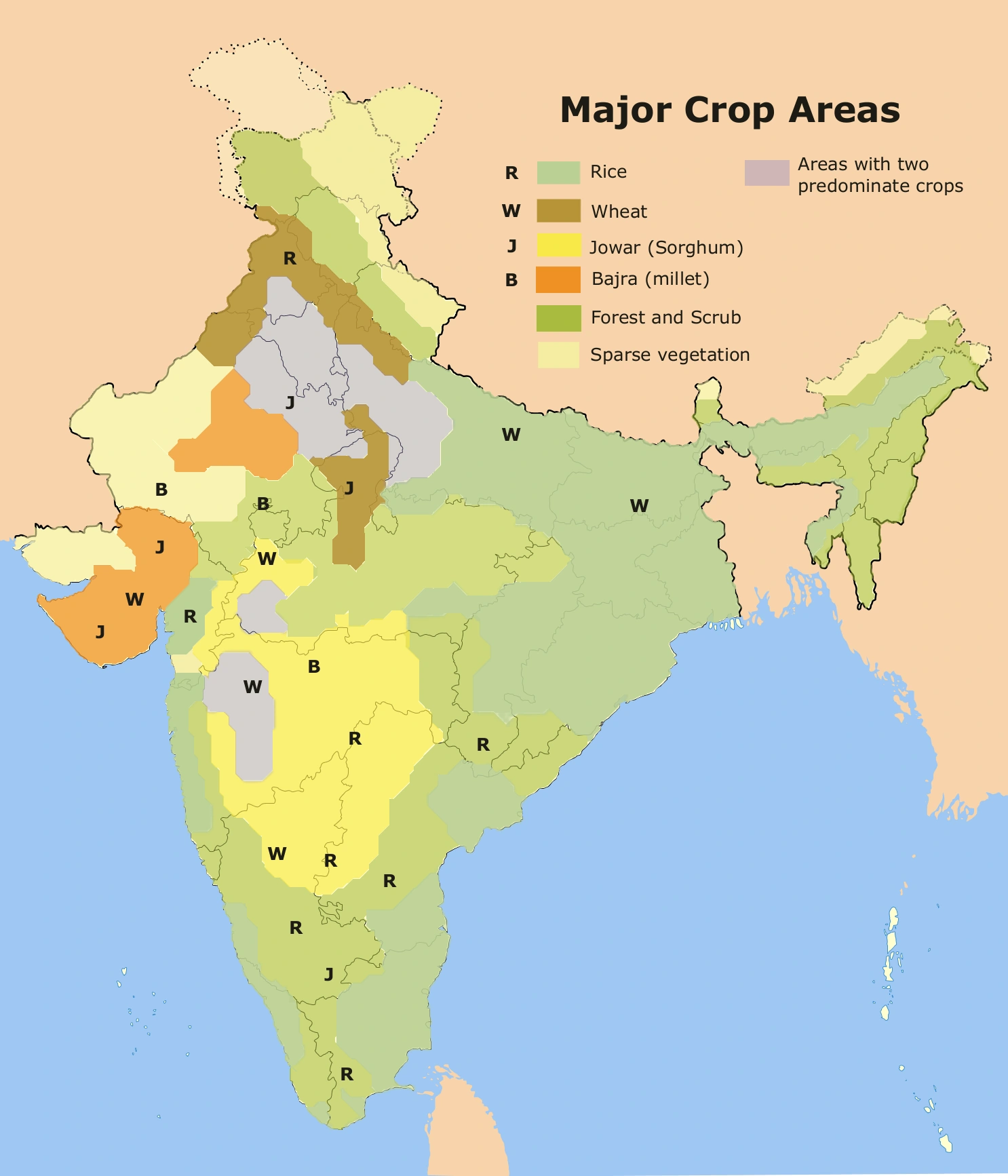
Map study
Major crop regions of India: relate crop belts to rainfall, soils, temperature and irrigation. Schematic historical reference, not current production rankings.
- Read the source legend, scale and reference period before comparing regions.
- Connect spatial patterns to the processes discussed in this topic; this map is a study reference, not live operational data.
Credit: Amog · CC BY-SA 2.5 · sourceConverted to WebP on an opaque white background; proportionally resized without cropping. Original cartography and legend retained.
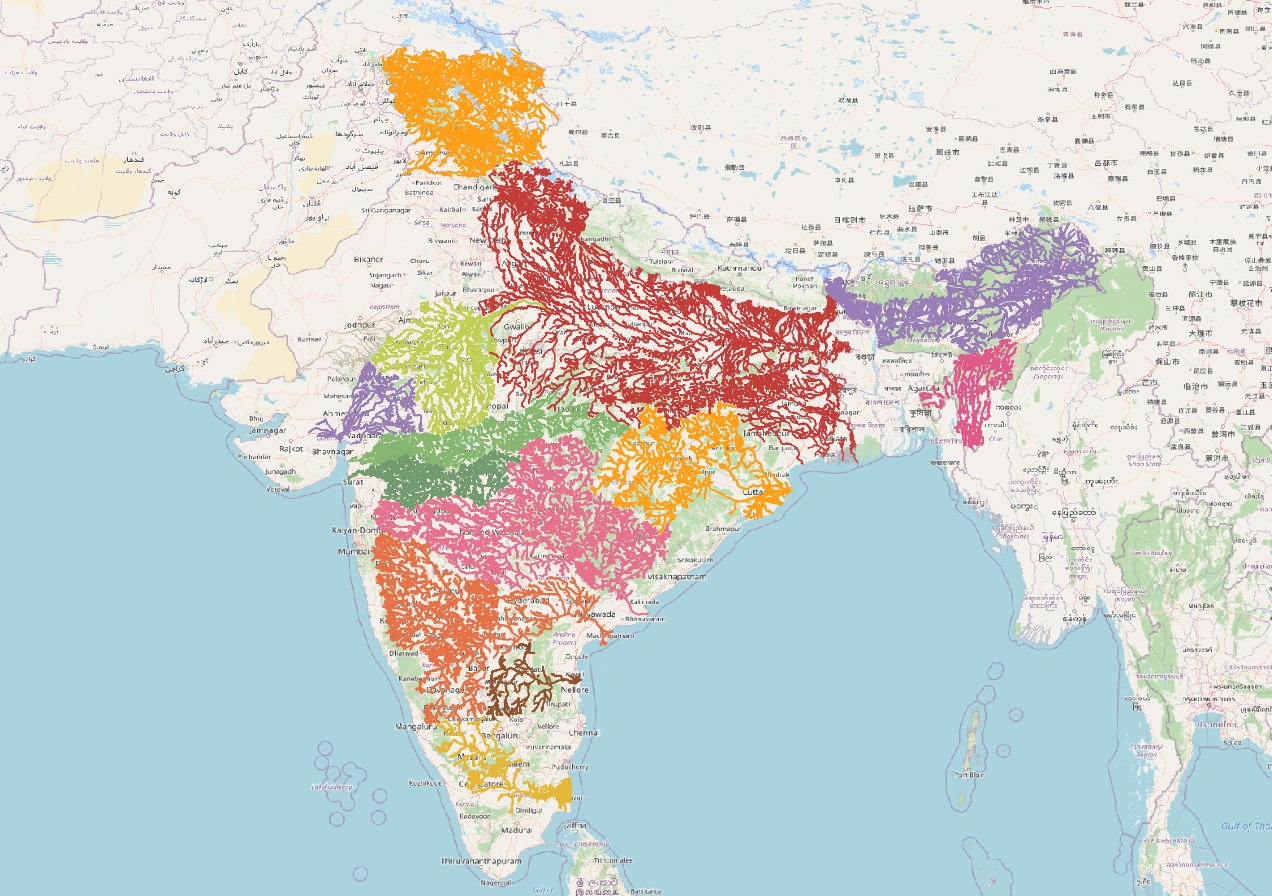
Map study
India river basins: distinguish watershed divides from state boundaries; compare east-flowing and west-flowing drainage.
- Read the source legend, scale and reference period before comparing regions.
- Connect spatial patterns to the processes discussed in this topic; this map is a study reference, not live operational data.
Credit: Heinz OSM · ODbL · sourceConverted to WebP on an opaque white background; proportionally resized without cropping. Original cartography and legend retained.
1. Irrigation and agricultural transformation
Irrigation reduces dependence on the timing, distribution and intensity of monsoon rainfall. Even where annual rainfall appears adequate, a dry spell during flowering or grain formation can sharply reduce yields. Protective irrigation supplies limited water at critical growth stages to prevent crop failure; intensive irrigation supports higher yields, multiple cropping and input-intensive cultivation. Its benefits therefore extend beyond expanding cultivated area to stabilising farm output and reducing production risk.
Reliable irrigation encourages investment in improved seeds, fertilisers, machinery and higher-value crops. It can increase cropping intensity, generate agricultural employment and support horticulture, dairying and agro-processing. However, irrigation alone does not guarantee higher incomes: market access, extension, drainage, credit and suitable agronomy are complementary requirements. Capital-intensive schemes that encourage unsuitable crops may raise output temporarily while creating long-term ecological and fiscal costs.
Coverage statistics require careful interpretation. Net irrigated area measures physical land receiving irrigation, whereas gross irrigated area includes repeated irrigation of successive crops on the same land. Irrigation potential created represents the area that completed infrastructure can serve; potential utilised reflects actual use. A gap between them may indicate incomplete field channels, unreliable supply, inadequate maintenance or constraints faced by farmers.
Timeline
1974–75
The Command Area Development Programme was launched to improve utilisation of irrigation potential.
1996–97
The Accelerated Irrigation Benefits Programme began to support completion of irrigation projects.
2015
Pradhan Mantri Krishi Sinchayee Yojana was launched.
2019
Atal Bhujal Yojana was launched for community-led groundwater management in selected areas.
2022–23
Per Drop More Crop began implementation under the Rashtriya Krishi Vikas Yojana framework.
2. Sources, technologies and regional suitability
Canal irrigation diverts river or reservoir water through distribution networks. It can serve large command areas and provide water where local groundwater is inadequate. However, high construction costs, land acquisition, displacement and slow completion can weaken its economic performance. Distribution is often unequal: head-reach farmers may receive excessive water while tail-end farmers face shortages. Without drainage, seepage and over-irrigation can raise the water table and produce waterlogging and secondary salinisation.
Wells and tube wells provide flexible, on-demand irrigation and have supported agricultural growth across the alluvial plains. Their decentralised character allows farmers to match irrigation with crop requirements. Nevertheless, access depends on landownership, capital, electricity and aquifer conditions. In hard-rock regions of peninsular India, groundwater storage is limited and spatially variable; deeper drilling does not necessarily produce a dependable supply. Falling water levels also increase pumping costs and disadvantage farmers with shallow wells.
Tanks, ponds, check dams and harvested rainwater are particularly important for decentralised irrigation and supplementary watering. Their performance depends on catchment protection, desilting where justified, functioning channels and community management. Encroachment and disrupted drainage can render a restored tank ineffective. Conjunctive use coordinates surface water and groundwater to improve reliability and, where hydrogeologically suitable, manage both waterlogging and excessive pumping.
Surface methods include basin, border and furrow irrigation. Drip systems deliver water near the root zone, while sprinklers apply it as controlled spray. Drip is especially useful for orchards, vegetables and widely spaced crops; sprinklers suit several field crops and undulating terrain. Suitability depends on soil texture, water quality, crop spacing, wind, energy requirements and farmers' capacity to operate the equipment.
Planning sustainable irrigation at command or watershed scale
- 1. Map rainfall, soils, aquifers, existing infrastructure and user groups.
- 2. Prepare a seasonal water budget, accounting for domestic and ecological needs.
- 3. Select crops and irrigation methods compatible with available water.
- 4. Improve storage, distribution, drainage and critical maintenance.
- 5. Agree on delivery schedules, abstraction safeguards and user responsibilities.
- 6. Monitor water levels, consumptive use, equity and farm income; revise the plan.
3. Water-use efficiency and the limits of technology
Irrigation efficiency has several dimensions. Conveyance efficiency concerns water reaching the farm from its source; application efficiency concerns water retained in the crop root zone relative to water delivered to the field. Crop water productivity measures output or economic value per unit of water used. These indicators should not be treated as interchangeable: a technically efficient irrigation system can still support a crop that consumes substantial water.
Micro-irrigation can reduce non-beneficial evaporation, improve application uniformity and facilitate fertigation, which delivers soluble nutrients with irrigation water. Proper scheduling using crop stage, soil moisture and weather information is equally important. Land levelling, mulching, suitable furrow design and deficit irrigation where agronomically appropriate can improve performance without relying solely on expensive equipment. Paddy practices such as alternate wetting and drying require controlled water delivery and careful management.
Field-level savings do not automatically become basin-level savings. Water previously lost through seepage may have recharged an aquifer or supplied downstream users. Moreover, farmers may use saved water to expand irrigated acreage or shift to water-intensive crops, creating a rebound effect. Assessments must therefore distinguish reduced withdrawals from reduced consumptive use. Micro-irrigation should be combined with water budgeting, limits on unsustainable abstraction and crop planning rather than presented as a universal solution.
| Option | Principal advantage | Key constraint | Reform priority |
|---|---|---|---|
| Canals | Large-area surface-water distribution | Unreliable delivery and head-tail inequality | Maintenance, drainage and accountable scheduling |
| Wells and tube wells | Flexible, on-demand supply | Depletion and unequal access | Aquifer-based budgeting and energy reform |
| Tanks and ponds | Decentralised supplementary irrigation | Siltation, encroachment and catchment degradation | Catchment restoration and collective management |
| Drip systems | Precise root-zone delivery and fertigation | Clogging, initial cost and maintenance | Filtration, servicing and suitable crop selection |
| Sprinkler systems | Controlled application across varied terrain | Wind drift and pressure requirements | Correct design and weather-sensitive scheduling |
4. Institutions, schemes and the water-energy-crop nexus
Pradhan Mantri Krishi Sinchayee Yojana seeks to expand access to irrigation and improve water management. Its architecture has included the Accelerated Irrigation Benefits Programme, Har Khet Ko Pani and watershed development. The Accelerated Irrigation Benefits Programme, originally launched in 1996–97, supports completion of eligible irrigation projects. Command Area Development and Water Management addresses the last-mile gap through measures such as field channels and improved distribution within commands.
Per Drop More Crop promotes micro-irrigation and moved from PMKSY to the Rashtriya Krishi Vikas Yojana framework from 2022–23. Atal Bhujal Yojana was designed as a community-led groundwater management programme in selected areas of seven States, emphasising water budgeting, local plans and demand management. Watershed development and suitable MGNREGS works can support soil-moisture conservation, water harvesting and recharge, but their effectiveness depends on catchment and aquifer conditions.
Subsidised electricity, unreliable canal supply and assured procurement for particular crops interact to influence irrigation demand. Flat-rate or free power can reduce the marginal cost of pumping, encouraging over-extraction where controls are weak. Solar pumps lower diesel dependence but can similarly increase abstraction unless linked to appropriate safeguards. Power-purchase arrangements that reward farmers for exporting surplus solar electricity may create an incentive to conserve pumping energy.
Participatory Irrigation Management involves Water Users' Associations in distribution, maintenance and sometimes fee collection. Warabandi allocates canal water through rotational turns. These arrangements require clear entitlements, transparent records and effective dispute resolution. Representation of women, tenants and tail-end users is essential; transferring responsibility without technical support or financial resources merely shifts the burden of an underperforming system.
5. A reform agenda for sustainable irrigation
Reform should prioritise dependable water services rather than construction targets alone. Completing viable projects, rehabilitating distribution systems, maintaining gates and providing drainage can deliver better returns than continually launching new works. Canal lining should be selective: while it can prevent undesirable seepage, blanket lining may reduce useful groundwater recharge. Project appraisal must incorporate ecological flows, displacement, downstream impacts and climate-related changes in water availability.
Demand management requires aligning crops with agro-climatic conditions and realistic water budgets. Diversification towards millets, pulses, oilseeds or suitable horticulture will succeed only when farmers have credible markets, processing facilities and income protection. Groundwater governance should operate at aquifer scale, supported by monitoring and community participation. Success should be assessed through reliable delivery, tail-end access, sustainable groundwater levels, crop water productivity and net farm income—not merely hectares covered or equipment installed.
- Combine micro-irrigation subsidies with installation standards, extension, spare parts and after-sales support.
- Use transparent water accounts and publicly accessible delivery schedules to strengthen accountability.
- Build drought plans around critical-stage irrigation, local storage and protection of drinking-water sources.
Real-world case studies
Andhra Pradesh Farmer Managed Groundwater Systems
This programme used participatory hydrological monitoring, farmer training and crop-water budgeting in hard-rock areas of the then undivided Andhra Pradesh. Farmers measured rainfall and groundwater levels and discussed crop choices against estimated water availability. It illustrates how information and collective learning can support demand management, while also showing that voluntary measures cannot guarantee aquifer recovery where abstraction pressures remain high.
Dhundi solar irrigation cooperative, Gujarat
The Dhundi Solar Pump Irrigators' Cooperative Enterprise in Anand district demonstrated a model allowing participating farmers to sell surplus solar electricity to the grid. Unlike stand-alone solar pumping, electricity sales provide an opportunity cost for additional pumping. The case highlights the potential of linking clean energy with water conservation, subject to appropriate tariffs, metering and groundwater safeguards.
Previous year questions
UPSC Mains 2021 · GS-III
How and to what extent would micro-irrigation help in solving India's water crisis?
- Explain drip and sprinkler irrigation and their role in precise application.
- Discuss crop water productivity, fertigation and reduced non-beneficial losses.
- Examine cost, maintenance, water quality and crop-specific constraints.
- Distinguish field savings from basin savings and explain rebound effects.
- Conclude with groundwater governance, crop diversification and energy-policy reform.
Practice questions
Practice MCQ 1
Consider the following statements: 1. Gross irrigated area counts successive irrigated crops on the same land separately. 2. Net irrigated area necessarily exceeds gross irrigated area. 3. Irrigation potential created may exceed irrigation potential utilised. Which statements are correct?
- A. 1 and 2 only
- B. 1 and 3 only
- C. 2 and 3 only
- D. 1, 2 and 3
Practice MCQ 2
Why might adoption of drip irrigation fail to reduce total groundwater abstraction in a region?
- A. Drip irrigation necessarily raises evaporation from open water surfaces.
- B. Farmers may expand irrigated acreage using the water saved per hectare.
- C. Drip systems cannot be connected to groundwater sources.
- D. Drip irrigation eliminates crop transpiration.
Practice MCQ 3
Consider the following statements: 1. Conjunctive use involves coordinated use of surface water and groundwater. 2. Canal lining always increases groundwater recharge. 3. Inadequate drainage in canal commands can contribute to secondary salinisation. Which statements are correct?
- A. 1 only
- B. 2 and 3 only
- C. 1 and 3 only
- D. 1, 2 and 3
Mains practice · India's irrigation challenge is as much about institutions and incentives as about infrastructure. Discuss with reference to groundwater sustainability, water-use efficiency and equitable access. Suggest a reform strategy. (250 words)
- Introduce the shift from infrastructure creation to reliable irrigation services.
- Explain maintenance deficits, incomplete last-mile works and head-tail inequity.
- Analyse the electricity-procurement-cropping nexus and groundwater depletion.
- Assess micro-irrigation benefits alongside rebound and basin-accounting concerns.
- Recommend aquifer budgeting, inclusive user associations, appropriate pricing and solar-pump safeguards.
- Link diversification to markets and evaluate outcomes through sustainability, equity and income.
Further reading
- NCERT, India: People and Economy, Class XII: Water Resources.
- Department of Agriculture and Farmers Welfare, Agricultural Statistics at a Glance.
- Ministry of Jal Shakti, PMKSY and Command Area Development and Water Management guidelines.
- Department of Agriculture and Farmers Welfare, Per Drop More Crop operational guidelines.
- Central Ground Water Board, National Compilation on Dynamic Ground Water Resources of India.
- Atal Bhujal Yojana official website and programme documents.
- Central Water Commission, Water and Related Statistics.
Preparing for UPSC Civil Services? Get classroom teaching, answer-writing evaluation and mentorship at Pragnya IAS Academy, Ashok Nagar — see why aspirants choose us for IAS coaching in Hyderabad.