

Hogg market Calcutta Kolkata India
Credit: Jorge Royan · CC BY-SA 3.0 · source

This is a photo of ASI monument number
Credit: Dr Murali Mohan Gurram · CC BY-SA 3.0 · source
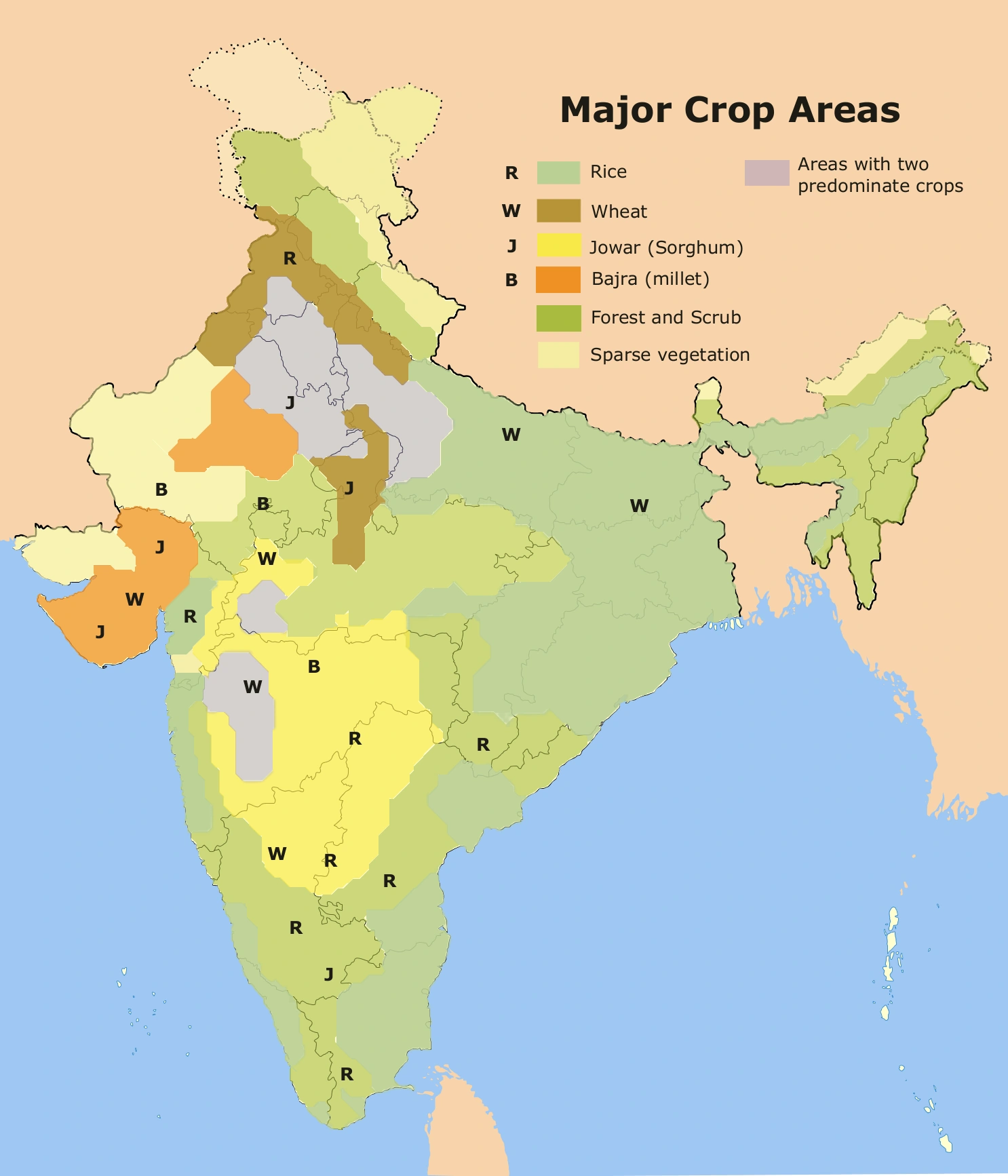
Map study
Major crop regions of India: relate crop belts to rainfall, soils, temperature and irrigation. Schematic historical reference, not current production rankings.
- Read the source legend, scale and reference period before comparing regions.
- Connect spatial patterns to the processes discussed in this topic; this map is a study reference, not live operational data.
Credit: Amog · CC BY-SA 2.5 · sourceConverted to WebP on an opaque white background; proportionally resized without cropping. Original cartography and legend retained.
1. Meaning, objectives and institutional design
e-NAM is a pan-India electronic trading portal that networks participating Agricultural Produce Market Committee markets to create a more integrated market for agricultural commodities. It is best understood as digital infrastructure for agricultural marketing rather than a replacement for physical mandis. Farmers still require aggregation, weighing, quality testing, storage and transport; the platform digitises and standardises important parts of the transaction.
The Ministry of Agriculture and Farmers Welfare oversees the scheme, while SFAC acts as the lead implementing agency. State governments, state agricultural marketing boards and individual APMCs provide the regulatory and operational framework. Farmers, traders, commission agents and Farmer Producer Organisations can participate subject to applicable registration and licensing requirements.
Its principal objectives are transparent price discovery, wider access to buyers, reduced information asymmetry and timely electronic payments. Linking previously separated markets can enable inter-mandi and interstate trade. However, integration means more than displaying prices online: buyers must be able to bid, trust quality descriptions, arrange delivery and enforce contracts across locations.
- Policy rationale: convert fragmented local markets into a more competitive and accessible trading network.
- Exam distinction: electronic auctioning is one function; integrated agricultural marketing is the broader objective.
2. How e-NAM transactions work
In a typical mandi transaction, a registered farmer brings produce to the market, where the consignment is recorded and assigned a lot identifier. The produce may undergo assaying against commodity-specific quality parameters. Publishing reliable information about the lot allows buyers to compare consignments and bid electronically rather than depend only on physical inspection or negotiations with local intermediaries.
Electronic bidding generates a price through competition among participating buyers. Following acceptance of the transaction under applicable market procedures, produce is weighed, a sale agreement or bill is generated, payment is processed and delivery is authorised. Exact sequencing can vary with the commodity and mandi workflow. Payment directly into the seller’s bank account improves traceability, but platform availability alone does not guarantee that every transaction is settled immediately.
Quality-based trade is central to remote participation. Parameters such as moisture content, size, foreign matter and damaged grains affect commercial value. If assaying is unreliable or certificates are not trusted, distant buyers demand discounts or avoid bidding. Consequently, standard operating procedures, representative sampling, calibrated equipment and mechanisms for quality-related disputes are as important as the software.
An FPO can aggregate members’ produce, create commercially viable lots and negotiate logistics. The FPO trading module introduced in 2020 facilitates trading from collection centres without necessarily bringing produce to a mandi. The warehouse-based module supports trade linked to electronic negotiable warehouse receipts from eligible WDRA-registered warehouses, subject to applicable arrangements.
- Digital records can improve transaction traceability and reduce scope for discretionary manipulation.
- Remote trade requires dependable delivery, payment security and dispute resolution alongside bidding.
Illustrative mandi-based e-NAM transaction
- 1. Register participants and record produce arrival
- 2. Create a lot and record quality information through assaying
- 3. Invite electronic bids from eligible buyers
- 4. Accept the trade under applicable market procedures
- 5. Complete weighing, billing and electronic settlement
- 6. Authorise delivery and provide grievance redressal where needed
3. Legal reforms and cooperative federalism
Agriculture and markets and fairs are primarily state subjects under the Seventh Schedule of the Constitution. State APMC laws therefore shape where trade can occur, who may trade and how market charges are collected. e-NAM operates through this existing institutional structure; participation does not automatically remove state-level restrictions or create unrestricted nationwide trading rights.
Three important enabling reforms are provision for electronic trading, a unified trading licence valid across the state and single-point levy of market fees. These seek to reduce repeated licensing and transaction costs within a state. Interstate trade nevertheless requires compatibility between regulatory systems, workable trader access, reliable settlement and clarity regarding charges and delivery obligations.
The Model Agricultural Produce and Livestock Marketing (Promotion and Facilitation) Act, 2017 provided a reform template for states, including a more unified and competitive marketing environment. A model law is advisory and does not amend state legislation by itself. Likewise, e-NAM should not be confused with the three central farm laws enacted in 2020 and repealed in 2021: the platform predates them and continues independently.
- The APMC framework can coexist with electronic auctions and wider buyer participation.
- Legal permission is necessary but insufficient: administrative practices and trader behaviour determine actual contestability.
| Instrument | Primary function | Important distinction |
|---|---|---|
| e-NAM | Electronic trading and market integration | Does not guarantee a minimum selling price |
| APMC | Regulation and administration of notified agricultural markets under state law | Participating APMC mandis remain part of e-NAM |
| MSP and public procurement | Announced price support and purchase under specified arrangements | A price-support intervention rather than an electronic trading platform |
| FPO | Collective organisation and aggregation of producers | Can participate as a seller and facilitate member access to e-NAM |
| Electronic negotiable warehouse receipt | Electronic record representing produce deposited in an eligible registered warehouse | Supports financing and transfer of stored produce; distinct from an auction portal |
4. Potential gains and complementary institutions
For farmers, a wider bidding pool can weaken dependence on a small set of local purchasers and improve bargaining power. Electronic price information allows comparison across markets, while transparent auctions can reduce opaque deductions and collusive practices. These benefits are conditional: a higher quoted price in a distant market is useful only when additional transport, handling, commissions and quality-related deductions do not erase the gain.
For buyers, the platform offers access to a broader supply base and standardised transaction information. For governments, digital records can support market intelligence and monitoring. Better spatial integration may reduce unjustified price differences between producing and consuming regions, although seasonal supply shocks, perishability and infrastructure constraints continue to influence prices.
Complementary initiatives include the Central Sector Scheme for Formation and Promotion of 10,000 FPOs and the Agriculture Infrastructure Fund, both launched in 2020. Aggregation strengthens smallholder participation, while investment in warehouses, grading, packhouses and other eligible infrastructure supports market access. Warehouse receipts can facilitate credit against stored produce, potentially reducing distress sales. The e-NAM Platform of Platforms initiative, launched in 2022, seeks to connect trading with services such as logistics and warehousing.
- Judge benefits through net farmer realisation, payment timeliness and transaction reliability, not gross auction prices alone.
- e-NAM complements storage, credit and producer organisation; it cannot substitute for them.
5. Constraints and reform priorities
A major implementation risk is digitising an existing local auction without widening competition. If the same buyers dominate bidding, or transactions are negotiated offline and entered later, recorded electronic turnover may overstate genuine market integration. The number of connected mandis and registered users indicates coverage, not necessarily active use or additional farmer income.
Small and marginal farmers face limited marketable surplus, uneven digital literacy, connectivity gaps and immediate cash requirements. Existing trader relationships may bundle credit, transport and assured purchase; replacing these arrangements requires credible alternatives. Women farmers and tenant cultivators can encounter additional barriers involving documentation, bank access and recognition as sellers.
Priorities include independent and accessible assaying, effective enforcement against collusion, interoperable state systems and transparent grievance redressal. Assisted access through FPOs and mandi facilitation centres can reduce exclusion. Affordable first-mile transport, aggregation and storage are especially important for smaller lots and perishables.
Evaluation should track unique active sellers, repeat participation, bidders per lot, quality-tested trade, inter-mandi and interstate trade shares, settlement delays and disputes. Comparing net realisations with suitable non-participating markets can provide stronger evidence of impact. The central lesson is that e-NAM succeeds when digital connectivity is matched by competitive institutions and physical infrastructure.
- Reform sequence: legal compatibility, trustworthy quality information, competitive bidding, secure settlement and reliable delivery.
- Avoid treating all intermediaries as redundant; distinguish useful services from restrictive or non-transparent practices.
Real-world case studies
Karnataka: institutional foundations for electronic agricultural markets
Karnataka’s Unified Market Platform, developed through Rashtriya e Market Services, preceded e-NAM and offers a relevant reform experience. It combined electronic trading with changes in market access and supporting arrangements for assaying and settlement. It is a distinct state initiative, not another name for e-NAM. Its lesson is that a common portal requires changes in market rules and operational processes to generate meaningful competition.
India: FPO and warehouse modules introduced in 2020
In April 2020, during the COVID-19 disruption, e-NAM introduced FPO trading and warehouse-based trading modules. These expanded the possibilities for selling from collection centres and eligible warehouses, reducing dependence on physical arrivals at crowded mandis. The experience illustrates the potential of decentralised trade while highlighting the continuing need for trusted quality certification, buyer participation and transport.
Previous year questions
UPSC Mains 2023 · GS-III
How does e-Technology help farmers in production and marketing of agricultural produce? Explain.
- Production applications include weather advisories, precision farming, pest surveillance and access to extension.
- Marketing applications include price information, electronic auctions, buyer discovery and digital payments.
- Use e-NAM to illustrate transparent trading and FPO participation.
- Discuss digital exclusion, weak assaying, logistics constraints and the need for institutional reforms.
Practice questions
Practice MCQ 1
With reference to e-NAM, consider the following statements: 1. SFAC is its lead implementing agency. 2. Participating APMC markets are automatically abolished. 3. It aims to promote transparent price discovery through electronic trading. Which of the statements given above are correct?
- A. 1 and 2 only
- B. 1 and 3 only
- C. 2 and 3 only
- D. 1, 2 and 3
Practice MCQ 2
Which of the following best explains the importance of assaying for remote agricultural trade?
- A. It guarantees procurement at MSP.
- B. It eliminates transport costs.
- C. It provides quality information that buyers can use without inspecting every lot personally.
- D. It replaces the need for settlement and dispute-resolution arrangements.
Practice MCQ 3
Which set of measures most directly supports the enabling regulatory framework for e-NAM?
- A. Electronic trading, unified state trading licence and single-point market fee
- B. Mandatory public procurement, universal MSP and export subsidies
- C. Abolition of warehouses, compulsory contract farming and free transport
- D. Central ownership of all mandis and prohibition of private traders
Mains practice · “Connecting mandis digitally is necessary but insufficient for creating an integrated agricultural market.” Examine with reference to e-NAM. Suggest indicators for evaluating its success. Answer in 250 words.
- Introduce e-NAM as an electronic trading network operating through participating markets.
- Explain price discovery, buyer access, traceability and electronic settlement.
- Discuss state-level regulatory differences, concentrated buyer power, quality uncertainty and logistics costs.
- Highlight FPO aggregation, reliable assaying, warehouse linkages and assisted digital access.
- Evaluate active participation, bidders per lot, interstate trade, payment delays and net farmer realisation.
- Conclude that legal, physical and institutional integration must accompany digitisation.
Further reading
- National Agriculture Market official portal: enam.gov.in, including FAQs and operational guidelines.
- Small Farmers’ Agribusiness Consortium: official e-NAM resources.
- Department of Agriculture and Farmers Welfare: annual reports and agricultural marketing scheme documents.
- Model Agricultural Produce and Livestock Marketing (Promotion and Facilitation) Act, 2017.
- Warehousing Development and Regulatory Authority: guidance on electronic negotiable warehouse receipts.
- NCERT, Indian Economic Development: Rural Development.
Preparing for UPSC Civil Services? Get classroom teaching, answer-writing evaluation and mentorship at Pragnya IAS Academy, Ashok Nagar — see why aspirants choose us for IAS coaching in Hyderabad.