
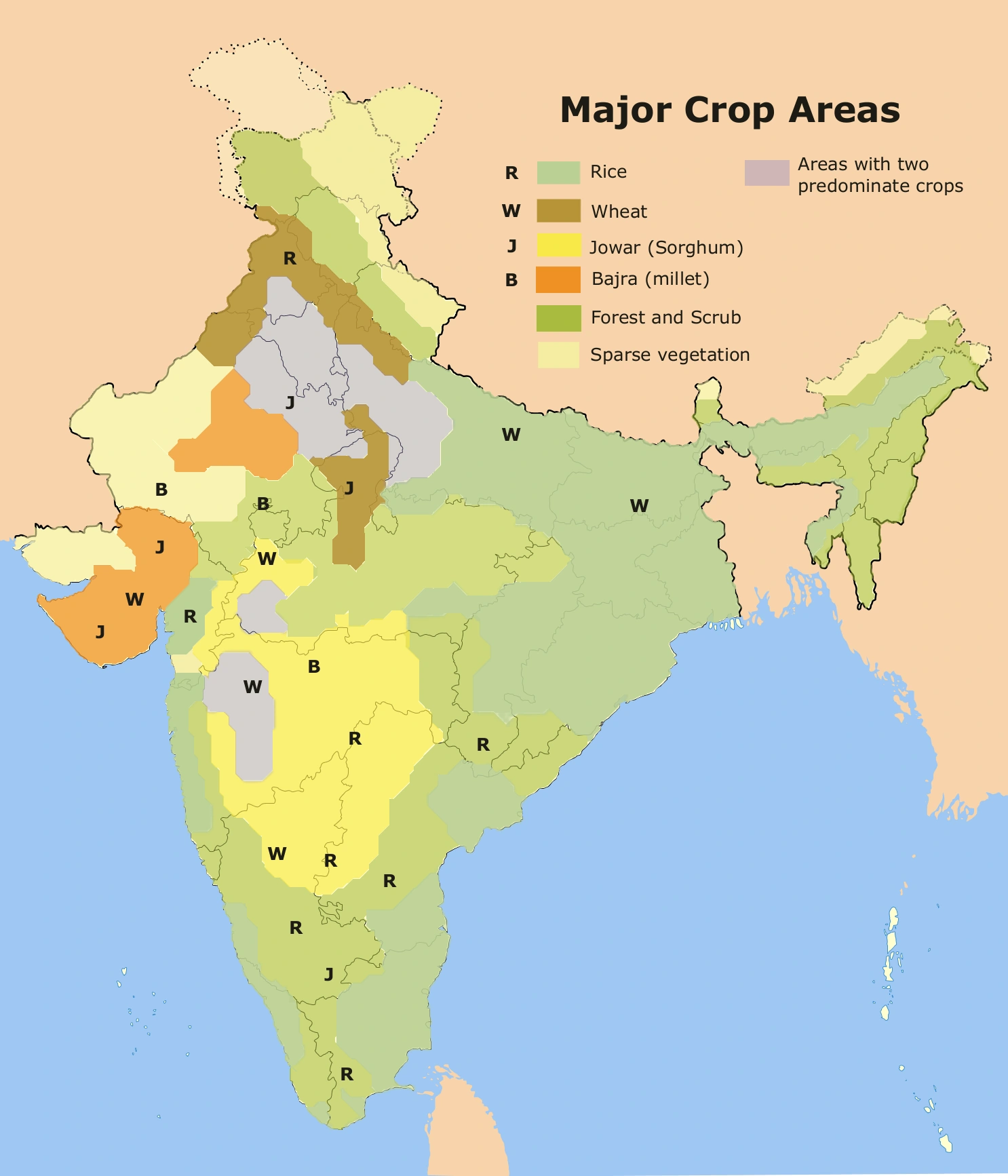
Map study
Major crop regions of India: relate crop belts to rainfall, soils, temperature and irrigation. Schematic historical reference, not current production rankings.
- Read the source legend, scale and reference period before comparing regions.
- Connect spatial patterns to the processes discussed in this topic; this map is a study reference, not live operational data.
Credit: Amog · CC BY-SA 2.5 · sourceConverted to WebP on an opaque white background; proportionally resized without cropping. Original cartography and legend retained.
1. Meaning, institutional structure and constitutional position
An Agricultural Produce Market Committee is a statutory institution constituted under a state's agricultural produce marketing legislation. Its jurisdiction typically covers a notified market area containing a principal market yard and, where provided, sub-yards. State laws determine the commodities covered, permitted trading channels, licensing requirements, fees and governance arrangements. Consequently, rules applicable to a grain mandi in Punjab need not match those governing a horticultural market in Maharashtra.
Regulated markets expanded after Independence to address distress sales, manipulated weights, arbitrary deductions and dependence on village moneylenders and traders. Their intended functions include organising auctions, supervising weighing, ensuring payment, settling disputes and developing common infrastructure. Committees may include farmer, trader and government representatives, but their composition and electoral arrangements differ across states.
Agriculture and markets are primarily state subjects: Entries 14 and 28 of the State List concern agriculture and markets and fairs respectively. However, agricultural commerce also intersects with inter-state trade and Concurrent List Entry 33, covering trade, supply and distribution of specified products, including foodstuffs. Agricultural marketing reform therefore involves cooperative federalism. It should not be treated as either an exclusively Union responsibility or an area in which all central intervention is constitutionally excluded.
- APMC: the regulatory and administrative institution.
- Mandi: the physical market where agricultural produce is assembled and traded.
- MSP: a government-announced support price; its announcement does not itself create universal procurement or a general statutory price floor.
Timeline
2003
Union government circulates the Model APMC Act to encourage state-level agricultural marketing reforms.
2006
Bihar repeals its agricultural produce market legislation.
14 April 2016
e-NAM is launched to connect participating agricultural markets electronically.
2017
Model Agricultural Produce and Livestock Marketing (Promotion and Facilitation) Act is circulated.
2020
Parliament enacts three central farm laws, including legislation facilitating trade outside specified APMC market premises.
2021
The Farm Laws Repeal Act repeals all three central farm laws.
2. How regulated markets work and why they matter
In a conventional mandi transaction, farmers bring produce for arrival registration and sale through auction or negotiation, depending on local rules and practice. Licensed traders bid, while commission agents may arrange handling, sale, credit and payment. Produce is weighed and applicable charges are assessed. A market fee collected under state law is distinct from a commission agent's service charge; the legally liable payer and permissible deductions vary across jurisdictions.
Well-functioning mandis concentrate buyers and sellers, reduce search costs and provide reference prices for surrounding villages. Public weighing, price display and supervised auctions can improve price discovery. Market infrastructure is particularly valuable to smallholders who cannot independently identify distant buyers, arrange bulk transport or assess a purchaser's creditworthiness. Commission agents also perform real services, although opaque charges and tied credit can turn useful intermediation into dependence.
APMC networks can support public procurement by providing established arrival points, labour, storage links and transaction records. However, the procurement agency purchases produce, not the APMC simply by virtue of its regulatory role. Procurement availability differs sharply across crops and regions. For perishables, speedy handling, cold chains and access to multiple buyers may matter more than conventional grain-market arrangements. Reform must therefore distinguish commodities rather than prescribe an identical marketing model for every crop.
Quality-based, electronically enabled mandi transaction
- 1. Farmer or FPO brings produce and registers the lot
- 2. Assaying establishes quality parameters
- 3. Lot and quality information are displayed to eligible buyers
- 4. Competitive bidding establishes the sale price
- 5. Weighing and transparent assessment of applicable charges follow
- 6. Payment, delivery and transaction records complete settlement
3. Major constraints and their economic consequences
Some state frameworks historically required notified produce to pass through regulated market channels or imposed licensing conditions that restricted alternative buyers. Scarce trading licences, high entry costs and entrenched relationships can encourage buyer concentration and collusive bidding. Fragmented market permissions may deter processors, organised retailers and other purchasers from sourcing across several locations. Political influence over committee appointments and expenditure can weaken accountability.
Multiple charges, repeated handling and inconsistent rules can increase transaction costs, especially when produce moves through several markets. Nevertheless, the farmer–consumer price spread cannot be attributed entirely to APMC fees or intermediaries. Transport, sorting, spoilage, storage, finance and retail services also contribute. Analysis should distinguish avoidable rents from legitimate service costs and recognise that market failures occur outside regulated mandis as well.
Physical limitations are equally important. Many farmers face long distances to suitable markets, inadequate assaying, poor drying facilities and insufficient storage. Perishable output must often be sold immediately, weakening bargaining power. Small lots make transport and quality certification expensive. Without working capital, farmers cannot postpone sale even when warehouse space exists. Thus, merely permitting additional trading channels does not guarantee effective choice.
Weak price information and delayed payment further reduce market efficiency. Digital platforms may display attractive prices elsewhere, but those prices are not automatically accessible after accounting for quality differences, freight and settlement risks. Removing an APMC monopoly without creating competing buyers and enforceable trading standards can replace a public regulatory bottleneck with private buyer dominance.
| Institution or mechanism | Principal role | Important limitation |
|---|---|---|
| APMC | Regulates agricultural markets under state law | Powers and coverage differ across states |
| e-NAM | Enables electronic trading across participating markets | Does not itself provide all logistics or guarantee better prices |
| MSP procurement | Government agencies purchase eligible produce under applicable operations | MSP announcement does not ensure procurement of every farmer's output |
| Farmer Producer Organisation | Aggregates farmers' produce and strengthens collective market access | Requires capital, management and viable business relationships |
| Negotiable warehouse receipt | Represents stored produce and can support trading or pledge finance | Storage and borrowing costs remain relevant |
4. Reform trajectory: model laws, e-NAM and the farm laws
The Model APMC Act, 2003 proposed changes such as direct marketing, private markets and provisions for contract farming. The Model Agricultural Produce and Livestock Marketing (Promotion and Facilitation) Act, 2017 advanced ideas including a unified state market, wider trading channels and rationalised market regulation. These were advisory models, not automatically applicable national laws; implementation depended on states amending their own legislation.
Launched in 2016 and implemented by the Small Farmers' Agribusiness Consortium, e-NAM links participating markets through an electronic trading platform. Its objectives include transparent bidding, quality-based price discovery and better payment systems. Meaningful integration requires compatible state rules, reliable assaying, interoperable market processes, logistics and trusted settlement. Registering a mandi or farmer on a portal is not equivalent to sustained competitive online trade.
The Farmers' Produce Trade and Commerce (Promotion and Facilitation) Act, 2020 sought to facilitate trade in specified areas outside the physical premises of markets notified under state APMC laws and prohibited state APMC fees on such trade. It did not abolish APMCs. Supporters emphasised buyer choice; critics highlighted an uneven regulatory playing field, possible weakening of mandi finances and dispute-resolution concerns. This Act, the contract-farming legislation and the Essential Commodities amendment enacted in 2020 were repealed in 2021.
5. Reform priorities for inclusive and competitive marketing
The appropriate objective is to make mandis contestable and efficient while enabling credible alternatives. States can simplify trader registration, facilitate direct purchases and private markets, rationalise charges and publish transparent fee schedules. Regulatory functions should be clearly distinguished from market operation to reduce conflicts of interest. Committee finances, infrastructure expenditure and auction practices require regular disclosure and independent oversight.
Farmer Producer Organisations can aggregate small lots, negotiate freight, arrange grading and bargain with processors or retailers. Their effectiveness nevertheless depends on professional management, adequate working capital and reliable buyers. Warehousing linked to negotiable warehouse receipts can reduce compulsory post-harvest sales, provided storage quality, finance costs and price risks are addressed. Rural aggregation centres and cold chains are especially important for horticulture.
Reform should retain safeguards: verified buyer identities, enforceable payment timelines, accessible dispute resolution, standard weights and measures, and competition oversight. Digital bidding must be combined with physical assaying, delivery and settlement systems. Success should be measured through farmers' net realisation after marketing costs, payment reliability, buyer participation and reduced losses—not merely portal registrations or the number of markets deregulated.
- Combine freedom of market choice with protection against fraud, collusion and delayed payment.
- Coordinate state reforms with inter-state logistics, quality standards and interoperable digital systems.
- Consult farmers, traders, state governments and procurement agencies before major institutional changes.
Real-world case studies
Karnataka: integrating markets through ReMS
Karnataka established Rashtriya e Market Services, a joint venture of the state government and NCDEX e Markets, in 2014. Its Unified Market Platform sought to connect regulated markets through electronic auctions and common market processes. The case illustrates that digital reform is most useful when accompanied by licensing reform, assaying and dependable transaction systems.
Bihar: deregulation is not sufficient
Bihar repealed its APMC legislation in 2006. The experience demonstrates why legal freedom to trade should not be equated with the automatic creation of competitive market infrastructure. Continuing concerns about aggregation, storage and farmers' access to buyers underline the need for complementary investment. Outcomes cannot be attributed to repeal alone, given differences in procurement, infrastructure and crop composition.
Previous year questions
UPSC Mains 2014 · GS-III
There is also a point of view that Agricultural Produce Market Committees set up under the State Acts have not only impeded the development of agriculture but also have been the cause of food inflation in India. Critically examine.
- Explain the original protective rationale of regulated agricultural markets.
- Examine entry restrictions, collusion, multiple charges and impediments to alternative marketing.
- Distinguish regulatory rents from transport, storage, spoilage and other genuine costs.
- Recognise supply shocks and other causes of food inflation beyond APMC regulation.
- Recommend competitive channels, accountable mandis, farmer aggregation and infrastructure investment.
Practice questions
Practice MCQ 1
With reference to APMCs, consider the following statements: 1. They are constituted under state legislation. 2. They are legally identical to agencies undertaking MSP procurement. 3. Their notified commodities and fee structures may differ across states. Which statements are correct?
- A. 1 and 2 only
- B. 1 and 3 only
- C. 2 and 3 only
- D. 1, 2 and 3
Practice MCQ 2
Which statement best describes e-NAM?
- A. It replaces all state APMC laws with a central marketing law.
- B. It guarantees procurement at MSP for every registered farmer.
- C. It electronically connects participating agricultural markets to facilitate trade.
- D. It removes the need for assaying and physical delivery.
Practice MCQ 3
Which measure most directly enables a small farmer to obtain finance against stored produce and avoid an immediate distress sale?
- A. Increasing restrictions on buyer licences
- B. Pledge finance against a negotiable warehouse receipt
- C. Publishing retail prices without providing credit
- D. Requiring repeated physical movement between mandis
Mains practice · Agricultural marketing reform requires more than choosing between APMC mandis and unregulated trade. Discuss with reference to competition, farmer protection and cooperative federalism. (250 words)
- Introduce APMCs as institutions intended to correct agricultural market failures.
- Examine restrictive entry, weak governance and infrastructure deficiencies.
- Explain why deregulation alone may leave smallholders dependent on concentrated buyers.
- Propose competing marketing channels, FPO aggregation, assaying, logistics and warehouse finance.
- Include payment security, dispute resolution and transparent market charges.
- Conclude with state-led, consultative reform assessed through farmers' net returns.
Further reading
- Department of Agriculture and Farmers Welfare: Model APMC Act, 2003, and Model Agricultural Produce and Livestock Marketing Act, 2017.
- e-NAM official portal: enam.gov.in, operational guidelines and market integration resources.
- India Code: Constitution of India, Seventh Schedule, and Farm Laws Repeal Act, 2021.
- Committee on Doubling Farmers' Income reports: agricultural marketing, post-production management and market infrastructure.
- Warehousing Development and Regulatory Authority: negotiable warehouse receipt and electronic warehouse receipt resources.
Preparing for UPSC Civil Services? Get classroom teaching, answer-writing evaluation and mentorship at Pragnya IAS Academy, Ashok Nagar — see why aspirants choose us for IAS coaching in Hyderabad.