

The Minister of State (Independent Charge) for Information & Broadcasting, Shri Manish Tewari interacting with farmers, who has comes to Grain Market to sold their paddy, during his visit to Mullanpur
Credit: Ministry of Information and Broadcasting · GODL-India · source

Central Warehousing Corporation Godowns in Bamanheri, Muzaffarnagar (India). This is operated by Food Corporation of India
Credit: Prabhat1729 · CC BY-SA 4.0 · source
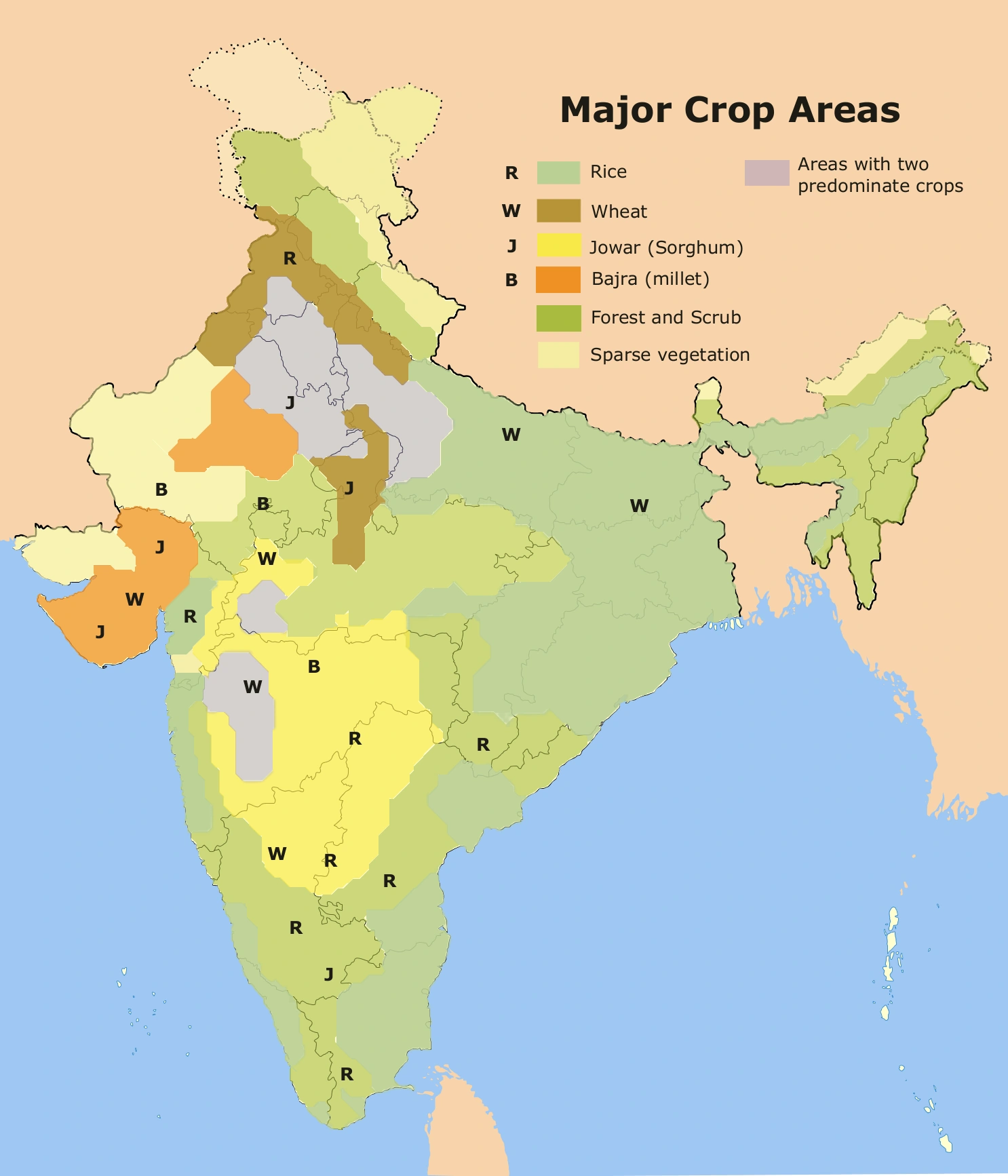
Map study
Major crop regions of India: relate crop belts to rainfall, soils, temperature and irrigation. Schematic historical reference, not current production rankings.
- Read the source legend, scale and reference period before comparing regions.
- Connect spatial patterns to the processes discussed in this topic; this map is a study reference, not live operational data.
Credit: Amog · CC BY-SA 2.5 · sourceConverted to WebP on an opaque white background; proportionally resized without cropping. Original cartography and legend retained.
1. Meaning, coverage and institutional framework
MSP is a pre-announced support price intended to reduce farmers’ exposure to price crashes, particularly during the post-harvest period when arrivals are high and indebted cultivators need immediate cash. It acts as a credible price floor only where procurement or another effective support mechanism operates. MSP must therefore be distinguished from the actual market price, which varies by location, quality, season and buyer competition.
The CACP, an attached office of the Ministry of Agriculture and Farmers Welfare, recommends MSPs after examining production costs, demand and supply, domestic and international prices, inter-crop price parity, terms of trade between agriculture and non-agriculture, and likely effects on consumers and the economy. It consults states and stakeholders, but its recommendations are advisory. The Union government takes the final decision.
The 22 crops comprise 14 kharif crops, six rabi crops and two commercial crops. Coverage includes cereals, pulses, oilseeds, cotton, copra and raw jute. Sugarcane is governed separately through FRP under the Sugarcane (Control) Order, 1966; some states prescribe State Advised Prices. Unlike a general MSP announcement, sugarcane pricing creates a statutory payment obligation for mills.
- Kharif coverage includes paddy, jowar, bajra, maize, ragi, tur, moong, urad, groundnut, sunflower seed, soybean, sesamum, nigerseed and cotton.
- Rabi coverage includes wheat, barley, gram, masur, rapeseed-mustard and safflower; copra and raw jute complete the list.
Timeline
1965
The Agricultural Prices Commission and Food Corporation of India were established, strengthening agricultural price policy and procurement.
1985
The Agricultural Prices Commission was renamed the Commission for Agricultural Costs and Prices.
2013
The National Food Security Act created statutory foodgrain entitlements, reinforcing procurement’s food-security role.
2018
The government adopted the stated minimum 50% margin over A2+FL benchmark for mandated crop MSPs; PM-AASHA was also launched.
2. Production costs and the debate over remunerative prices
Cost concepts are central to the MSP debate. A2 includes paid-out expenses such as hired labour, seed, fertiliser, irrigation, machinery charges and rent for leased-in land. A2+FL adds the imputed value of unpaid family labour. C2 is broader: it adds rental value of owned land and interest on owned fixed capital assets to A2+FL. These measures answer different questions about cash expenditure, household labour and the opportunity cost of farming.
Since 2018-19, the government has used at least 1.5 times the all-India weighted average A2+FL cost as the stated minimum benchmark for MSP. CACP also considers C2 as a benchmark reference cost. Thus, the official claim of a 50% margin should not be interpreted as a guaranteed 50% return over C2 or over every individual farmer’s costs.
The National Commission on Farmers, chaired by M. S. Swaminathan, recommended that MSP should be at least 50% above the weighted average cost of production. The demand commonly expressed as C2+50% seeks to recognise the fuller economic cost of cultivation. However, national averages conceal substantial differences in yields, irrigation access, wages and input expenditure. A higher announced price alone cannot ensure an adequate annual household income when marketed surplus is small.
- Exam distinction: profitability per unit of output is different from annual farm household income.
- A cost-plus formula must be considered alongside demand, productivity and environmental costs; otherwise, it can encourage surplus production.
From MSP recommendation to farmer realisation
- 1. CACP examines costs, markets and stakeholder inputs
- 2. Union government approves and announces MSP
- 3. Agencies organise crop-specific support operations
- 4. Farmers access centres and meet eligibility and quality requirements
- 5. Procurement and payment deliver realised support
3. Procurement, food security and operational limitations
For wheat and paddy, the Food Corporation of India and state agencies procure produce meeting prescribed quality standards during notified operations. Under decentralised procurement, participating states undertake procurement and related functions for foodgrain distribution. Procurement supplies the Central Pool, supports buffer stocks and helps implement the National Food Security Act, 2013. The food subsidy also covers handling, storage, transport and distribution costs, not merely the purchase price paid to farmers.
Support for other crops is less uniform. Under the Price Support Scheme within PM-AASHA, agencies such as NAFED and NCCF undertake procurement of notified pulses, oilseeds and copra subject to operational conditions and approvals. The Cotton Corporation of India and Jute Corporation of India undertake MSP operations for their respective commodities. Price-deficiency approaches instead compensate eligible farmers for a defined gap between support and market prices without necessarily purchasing the crop.
Access depends on procurement centres, registration, quality testing, transport, timely payments and awareness. Smallholders may sell to local traders below MSP because their lots are small or they need immediate liquidity. Tenants and sharecroppers can face difficulties where eligibility relies on land records. Procurement has historically been concentrated in particular crops and states, although paddy procurement has expanded beyond the traditional northwestern centres.
- Announcement, procurement and income realisation are three separate stages.
- Village-level purchase centres, transparent assaying and prompt payment can matter as much as the announced price.
| Instrument | Mechanism | Main limitation |
|---|---|---|
| MSP announcement | Signals a government-supported crop price | Does not itself ensure purchase or payment |
| Physical procurement | Public agencies purchase eligible produce | Requires finance, storage and disposal capacity |
| Price-deficiency payment | Compensates an eligible price gap | Needs trustworthy reference prices and transaction records |
| Sugarcane FRP | Statutory minimum price payable by mills | Payment arrears can weaken effective protection |
| Direct income support | Transfers money to eligible households | May exclude tenants and does not directly stabilise crop prices |
4. Benefits, distortions and the legal guarantee debate
MSP reduces downside price risk, supports investment and can strengthen farmers’ bargaining position. Historically, assured wheat and rice procurement complemented irrigation, improved seeds and fertilisers during the Green Revolution. Public stocks also provide insurance against supply shocks. However, predictable procurement of a narrow crop basket can favour rice-wheat systems over pulses, oilseeds and millets.
In water-stressed regions, procurement incentives interact with subsidised electricity and irrigation to encourage water-intensive cultivation. Other concerns include excessive stocks, storage losses, fiscal costs and unequal distribution of benefits. Larger marketed surpluses generally generate larger absolute benefits. These outcomes cannot be attributed to MSP alone: technology, infrastructure, consumer preferences and state policies also shape cropping choices.
A legal guarantee could mean mandatory government procurement, a prohibition on private purchases below MSP, or an enforceable entitlement to deficiency payments. These designs have different costs and consequences. Universal procurement requires substantial finance, storage and disposal capacity. A private-trade price floor may reduce purchases or encourage informal transactions when demand is weak. Deficiency payments avoid physical stocking but require reliable price discovery and safeguards against collusion. WTO scrutiny concerns support under the Agreement on Agriculture, not simply the existence of an MSP announcement.
- A strong answer should evaluate the design of a legal guarantee rather than treating all proposals as identical.
- Fiscal estimates must distinguish gross procurement expenditure from net costs after stock disposal or distribution.
5. Reform priorities: from price support to income resilience
Reform should improve the reach and credibility of support while aligning production with nutrition, water availability and market demand. Decentralised procurement of pulses and millets can support diversification where appropriate, particularly when linked to local food programmes. Such procurement requires matching consumer demand, processing capacity and storage arrangements rather than simply adding commodities to purchase lists.
Farmer Producer Organisations can aggregate output and improve bargaining power. Better rural roads, warehouses, assaying, negotiable warehouse receipt finance and competitive markets can reduce distress sales. e-NAM can assist price discovery, but digital trading needs physical quality assurance, logistics and payment enforcement. Deficiency-payment pilots should use transparent reference prices, independent audits and clearly specified eligibility.
MSP should remain part of a wider income strategy encompassing productivity, agricultural research, irrigation efficiency, crop insurance, affordable credit and non-farm employment. PM-KISAN provides income support to eligible landholding farmer families but does not replace tenant-inclusive risk protection. A balanced reform pathway preserves food-security capacity, improves access for disadvantaged cultivators and gradually rewards resource-efficient farming rather than unlimited output of selected crops.
- Assess reforms through five tests: farmer coverage, income stability, consumer affordability, fiscal feasibility and ecological sustainability.
Real-world case studies
Punjab: income security with ecological trade-offs
Assured wheat and paddy procurement helped Punjab become a major supplier to the Central Pool. Combined with irrigation and subsidised power, it also reinforced rice-wheat cultivation. Groundwater stress illustrates why diversification requires credible alternative markets and income protection, not merely appeals to change crops.
Madhya Pradesh: Bhavantar Bhugtan Yojana
Launched in 2017 for selected crops, the scheme used a price-deficiency approach linked to recorded sales and a reference price. It illustrated an alternative to physical procurement while highlighting the importance of registration, transparent market prices and protection against strategic trader behaviour.
Previous year questions
UPSC Mains 2018 · GS-III
What do you mean by Minimum Support Price (MSP)? How will MSP rescue the farmers from the low income trap?
- Define MSP and explain its downside price-protection function.
- Connect predictable returns with investment, bargaining power and reduced distress sales.
- Explain why limited procurement, small marketed surplus and high costs constrain benefits.
- Recommend complementary productivity, market-access and risk-management reforms.
Practice questions
Practice MCQ 1
Which production-cost concept includes the imputed rental value of owned land and interest on owned fixed capital assets in addition to A2+FL?
- A. A2
- B. A2+FL
- C. C2
- D. Paid-out cost alone
Practice MCQ 2
Consider the following statements: 1. CACP recommendations are advisory. 2. Announcement of MSP automatically obliges the government to purchase every quantity offered. 3. Sugarcane FRP operates under a separate statutory framework. Which statements are correct?
- A. 1 and 2 only
- B. 1 and 3 only
- C. 2 and 3 only
- D. 1, 2 and 3
Practice MCQ 3
Compared with physical procurement, a price-deficiency payment mechanism most directly reduces the need for which of the following?
- A. Reliable market-price information
- B. Farmer eligibility verification
- C. Public purchase and storage of the supported produce
- D. Safeguards against manipulation
Mains practice · MSP reform must reconcile remunerative farm incomes with nutritional security and ecological sustainability. Discuss the limitations of the present system and evaluate alternatives to universal physical procurement. Answer in 250 words.
- Introduce MSP as a price-risk instrument, distinguishing announcement from effective support.
- Discuss uneven crop and regional coverage, access barriers and rice-wheat incentives.
- Evaluate deficiency payments, targeted procurement and direct income support.
- Link diversification to food programmes, processing and assured alternative markets.
- Conclude with tenant inclusion, transparent operations and fiscally credible implementation.
Further reading
- CACP: Price Policy Reports for Kharif and Rabi Crops, cacp.gov.in.
- Department of Agriculture and Farmers Welfare: Agricultural Statistics at a Glance and PM-AASHA guidelines, agriwelfare.gov.in.
- Department of Food and Public Distribution: Annual Report and procurement policy, dfpd.gov.in.
- National Commission on Farmers: Reports, especially the Fifth Report.
- Economic Survey: Agriculture and Food Management chapter, indiabudget.gov.in.
Preparing for UPSC Civil Services? Get classroom teaching, answer-writing evaluation and mentorship at Pragnya IAS Academy, Ashok Nagar — see why aspirants choose us for IAS coaching in Hyderabad.