

Hogg market Calcutta Kolkata India
Credit: Jorge Royan · CC BY-SA 3.0 · source

The logo of Indian cooperative dairy company, *Anand Milk Union Limited* (known as Amul, copied from their twitter avatar.
Credit: Unknown authorUnknown author · Public domain · source
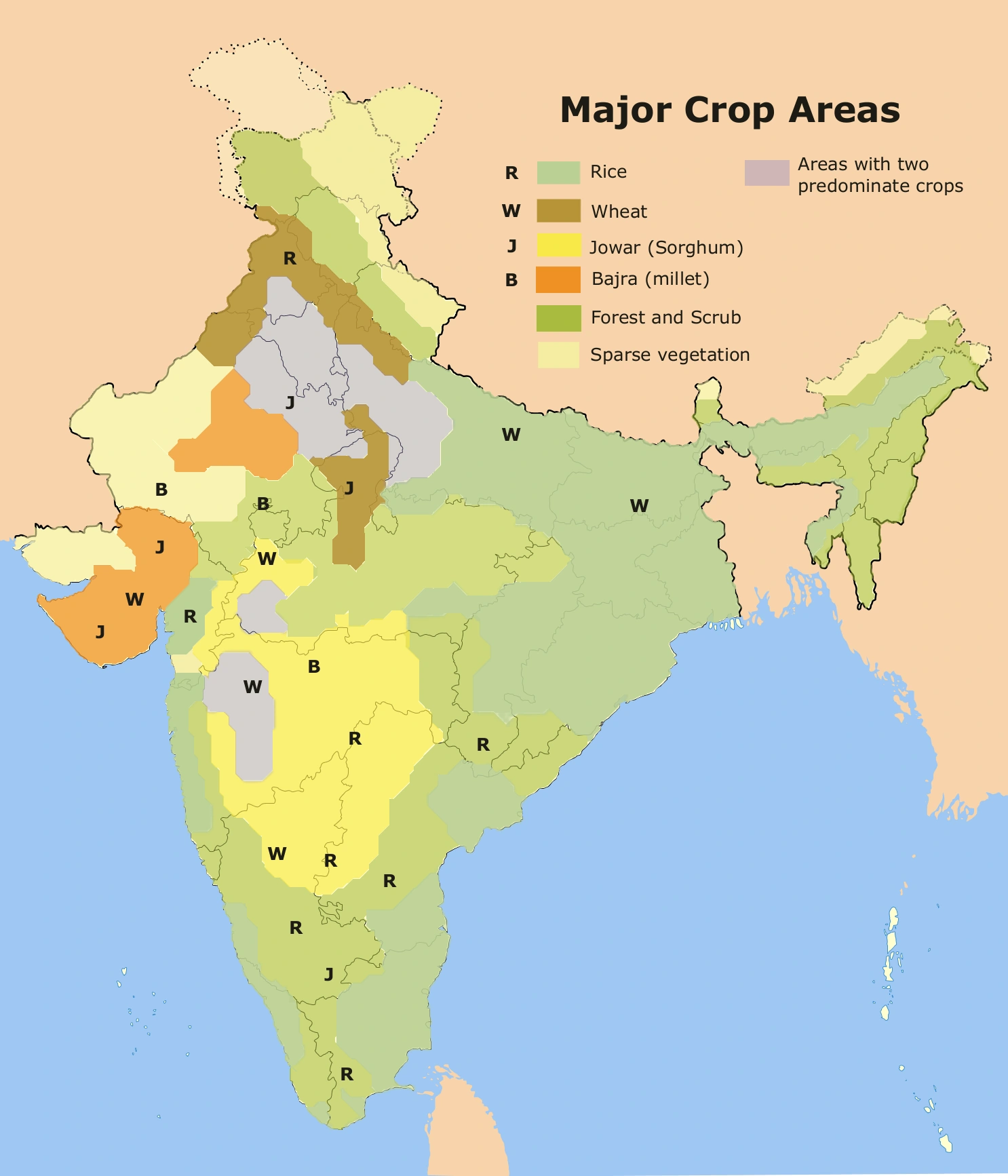
Map study
Major crop regions of India: relate crop belts to rainfall, soils, temperature and irrigation. Schematic historical reference, not current production rankings.
- Read the source legend, scale and reference period before comparing regions.
- Connect spatial patterns to the processes discussed in this topic; this map is a study reference, not live operational data.
Credit: Amog · CC BY-SA 2.5 · sourceConverted to WebP on an opaque white background; proportionally resized without cropping. Original cartography and legend retained.
1. Meaning, functions and economic significance
Agricultural marketing connects farm production with consumption through physical movement, ownership transfer and information exchange. Its functions begin with assembling produce and extend to cleaning, grading, packaging, storage, transport, processing, wholesaling and retailing. Marketing efficiency must therefore be assessed through price discovery, transaction costs, losses, payment reliability and the farmer’s share in the consumer rupee, rather than by market arrivals alone.
Agriculture presents distinctive marketing problems. Production is seasonal and geographically dispersed, while consumption continues throughout the year. Many products are perishable; quality varies across lots; and supply cannot adjust immediately to price signals. Small marketable surpluses and urgent cash needs weaken farmers’ ability to negotiate or postpone sales. Consequently, a bumper harvest may depress farm-gate prices without proportionately reducing retail prices.
An efficient system coordinates supply with demand and rewards quality, creating incentives for diversification into horticulture, livestock and higher-value crops. However, a large farm-to-retail price spread does not necessarily prove exploitation: transport, spoilage, processing and retail services also incur costs. Reform should distinguish necessary marketing services from excessive margins arising from collusion or barriers to entry.
- Marketed surplus is the quantity actually sold; marketable surplus is the quantity available after meeting farm and household requirements.
- Price discovery determines a transaction price; price realisation is the net return after marketing costs and deductions.
- Spatial integration links producing and consuming regions, while storage enables integration across seasons.
Timeline
2003
The Union government circulated a Model APMC Act to encourage state-level marketing reforms.
2016
e-NAM was launched on 14 April.
2017
The Model Agricultural Produce and Livestock Marketing Act proposed a broader framework for market competition.
2020
Three central farm laws were enacted; the Agriculture Infrastructure Fund and the 10,000 FPO scheme were also launched.
2021
The Farm Laws Repeal Act repealed the three central farm laws.
2. Institutions, regulation and marketing channels
State Agricultural Produce Market Committee laws historically established regulated markets to curb malpractices such as manipulated weighing, opaque deductions and delayed payments. APMCs organise market yards, license participants and collect prescribed fees. Their jurisdiction and rules vary by state. Where entry is restricted and auctions are weakly supervised, trader concentration and dependence on commission agents can undermine the original protective purpose.
Commission agents and traders also provide aggregation, transport, credit and information. Eliminating intermediaries without replacing these services may increase farmers’ difficulties. The policy objective should therefore be contestability, transparent charges and accountable intermediation, alongside viable alternatives such as private markets, direct procurement, farmer-consumer markets, cooperatives and Farmer Producer Organisations.
Agricultural marketing operates within a wider legal framework. State laws govern much market regulation; the Essential Commodities Act, 1955 enables specified supply and stock-control interventions; and the Warehousing (Development and Regulation) Act, 2007 supports regulated warehousing and negotiable warehouse receipts. The Agricultural Produce (Grading and Marking) Act, 1937 provides the basis for AGMARK. Export-import measures and food-safety standards also influence market access.
MSP and public procurement affect marketing incentives but are not substitutes for market reform. Procurement is uneven across commodities and regions, with a particularly strong role in rice and wheat. Assured procurement can stabilise incomes, yet geographically concentrated support may discourage diversification and reinforce resource-intensive cropping patterns.
- States retain a central role in implementing reforms; Union initiatives frequently operate through model laws, financing and digital platforms.
- The Model APMC Act, 2003 and Model Agricultural Produce and Livestock Marketing Act, 2017 proposed alternatives such as private markets and direct marketing; adoption has varied.
From fragmented sales to quality-linked marketing
- 1. Aggregate produce through a farmer group or collection centre
- 2. Clean, grade and independently assay the lot
- 3. Compare immediate sale with storage and financing options
- 4. Invite competitive bids through suitable market channels
- 5. Complete delivery, verified weighing and prompt payment
- 6. Record costs and net returns for future decisions
3. Structural constraints and their consequences
Fragmented holdings create small consignments with high per-unit transport and handling costs. Farmers may borrow from the same trader to whom they sell, creating tied transactions that reduce bargaining freedom. Inadequate access to working capital, warehouses and reliable price information encourages sales immediately after harvest, when market arrivals are highest.
Infrastructure weaknesses include poor rural roads, insufficient drying platforms, limited scientific storage and disconnected cold chains. Refrigeration alone is insufficient: perishables require coordinated harvesting, pre-cooling, packing, transport and dependable buyers. Investments that ignore local crop volumes or electricity reliability can produce underused assets rather than lower losses.
Information asymmetry concerns quality as well as prices. Buyers discount produce when moisture content, variety, residues or grading cannot be verified. Farmers may distrust unfamiliar assaying systems if sampling procedures and appeals are unclear. Frequent restrictions on exports or stocks may protect consumers temporarily, but unpredictable interventions can weaken contracts, investment and India’s reputation as a reliable supplier.
- Women cultivators and tenant farmers may face additional barriers through weak asset ownership, limited mobility and exclusion from producer institutions.
- Distress sales can coexist with high retail prices when storage, aggregation and transport networks are inefficient.
- Concentration among buyers can emerge in either public market yards or private procurement networks.
| Channel | Potential advantage | Necessary safeguard |
|---|---|---|
| APMC mandi | Organised auctions and established services | Open entry, transparent fees and auction oversight |
| Direct procurement | Fewer handling stages and buyer-specific demand | Competitive alternatives and timely payment |
| FPO or cooperative | Aggregation and stronger bargaining | Professional management and member accountability |
| Electronic trading | Wider bidding and transaction records | Trusted assaying, delivery and settlement |
| Warehouse-receipt channel | Storage-backed finance and flexible sale timing | Accredited storage, insurance and affordable credit |
4. Reform instruments and their limitations
e-NAM, implemented by the Small Farmers’ Agribusiness Consortium under the agriculture ministry, connects participating mandis through electronic trading infrastructure. It seeks transparent bidding, quality-linked prices and easier payment. However, placing a mandi online does not automatically create a national market: remote buyers need trusted assaying, interoperable rules, economical logistics, delivery assurance and dispute resolution.
FPOs aggregate produce and demand for inputs, enabling larger lots, collective negotiation, primary processing and access to institutional buyers. The Central Sector Scheme for Formation and Promotion of 10,000 FPOs, launched in 2020, supports this approach. Nevertheless, registration alone is inadequate. Professional management, member participation, working capital and a viable commodity-specific business plan determine commercial sustainability.
Warehouses registered with the Warehousing Development and Regulatory Authority can issue electronic negotiable warehouse receipts within the applicable framework. These receipts facilitate pledge finance and trading without immediate physical movement. They can reduce harvest-time distress sales, but storage charges, interest, quality deterioration and subsequent price movements remain important risks.
The Agriculture Infrastructure Fund, launched in 2020, supports eligible post-harvest infrastructure and community farming assets through financing incentives. PM Kisan SAMPADA Yojana supports food-processing infrastructure and value-chain development. Such schemes should be linked to actual market demand, rather than treated as construction programmes. Contract farming can offer assured offtake and technical assistance, but requires understandable contracts, fair grading and accessible remedies.
- Digital trading complements rather than replaces physical infrastructure and market oversight.
- Direct procurement can reduce handling costs, but farmers need alternative buyers to avoid dependence on a single purchaser.
5. A balanced reform agenda
The 2020 central farm laws sought changes in trading outside APMC premises, farming agreements and essential-commodity regulation. Their repeal in 2021 underlined the importance of consultation, federal coordination and credible safeguards. The episode does not eliminate the need for reform; it demonstrates that institutional legitimacy and distributional consequences must accompany efficiency arguments.
A practical agenda should modernise APMCs while allowing competing channels, simplify licensing, publish charges and strengthen auction supervision. Investment priorities include village-level aggregation, assaying laboratories, packhouses, scientific storage and last-mile connectivity. FPOs need business-development support and access to credit, while small sellers require prompt payments and inexpensive grievance redress.
Trade and stock policies should be transparent and as predictable as possible, with emergency interventions justified by clearly communicated conditions. Market intelligence should combine prices with arrivals, quality, transport costs and demand forecasts. Success should be measured through net farmer returns, payment delays, competitive participation and reduced losses—not merely platform registrations or infrastructure expenditure.
- Balance farmer incentives, consumer affordability and fiscal sustainability.
- Promote interoperable digital systems while retaining assisted access for digitally excluded farmers.
- Use local crop patterns and agro-climatic conditions to design market infrastructure and value chains.
Real-world case studies
Karnataka’s Unified Market Platform
Rashtriya e Market Services, established in 2014 as a joint venture of the Karnataka government and NCDEX e Markets, developed a unified trading platform for regulated markets. It illustrates how electronic auctions can be combined with institutional reform. Wider competition still depends on credible assaying, trader participation and reliable settlement.
Amul and cooperative milk marketing
The Anand dairy cooperative model links village-level collection with processing and organised marketing. Regular procurement and quality-based payment help connect small producers to large consumer markets. Its lesson is that aggregation works best when backed by infrastructure, professional management and farmer ownership; the model must be adapted to each commodity’s characteristics.
Previous year questions
UPSC Mains 2022 · GS-III
What are the main upstream and downstream bottlenecks in the marketing of agricultural products in India?
- Upstream: fragmented supply, inadequate aggregation, weak grading, credit constraints and insufficient storage.
- Downstream: inefficient logistics, processing gaps, concentrated buying and weak retail or export linkages.
- Connect reforms through FPOs, competitive markets, assaying, warehouse finance and predictable policy.
Practice questions
Practice MCQ 1
Which statement best describes the relationship between e-NAM and physical agricultural markets?
- A. e-NAM automatically abolishes state APMC legislation.
- B. e-NAM eliminates the need for storage and transport.
- C. e-NAM supports electronic trading, but effective integration also requires assaying, logistics and settlement.
- D. e-NAM guarantees MSP procurement for every listed commodity.
Practice MCQ 2
Consider the following statements about electronic negotiable warehouse receipts: 1. They can facilitate pledge finance against stored produce. 2. They eliminate the risk of a subsequent fall in commodity prices. Which is correct?
- A. 1 only
- B. 2 only
- C. Both 1 and 2
- D. Neither 1 nor 2
Practice MCQ 3
Which intervention most directly improves the credibility of quality-linked agricultural trading?
- A. Restricting entry of new buyers
- B. Standardised assaying with transparent sampling and an appeal mechanism
- C. Publishing only the highest price recorded in a market
- D. Requiring every farmer to sell immediately after harvest
Mains practice · Agricultural marketing reform requires competitive institutions as much as digital platforms. Discuss and suggest a farmer-centred reform strategy. Answer in 250 words.
- Define marketing reform through net realisation, competition and reliable transactions.
- Explain fragmented supply, tied credit, weak infrastructure and quality uncertainty.
- Assess e-NAM’s contribution and dependence on physical and institutional support.
- Combine APMC modernisation with direct procurement, FPOs and warehouse finance.
- Include prompt payment, dispute resolution, federal consultation and predictable trade policy.
- Conclude with measurable outcomes and safeguards for smallholders.
Further reading
- NCERT, Indian Economic Development, chapter on Rural Development.
- Ministry of Agriculture and Farmers Welfare, Report of the Committee on Doubling Farmers’ Income, volumes on agricultural marketing and post-production management.
- e-NAM official portal: enam.gov.in.
- Warehousing Development and Regulatory Authority: wdra.gov.in.
- Commission for Agricultural Costs and Prices, Price Policy Reports.
- India Code: Essential Commodities Act, 1955; Warehousing (Development and Regulation) Act, 2007; Farm Laws Repeal Act, 2021.
Preparing for UPSC Civil Services? Get classroom teaching, answer-writing evaluation and mentorship at Pragnya IAS Academy, Ashok Nagar — see why aspirants choose us for IAS coaching in Hyderabad.