
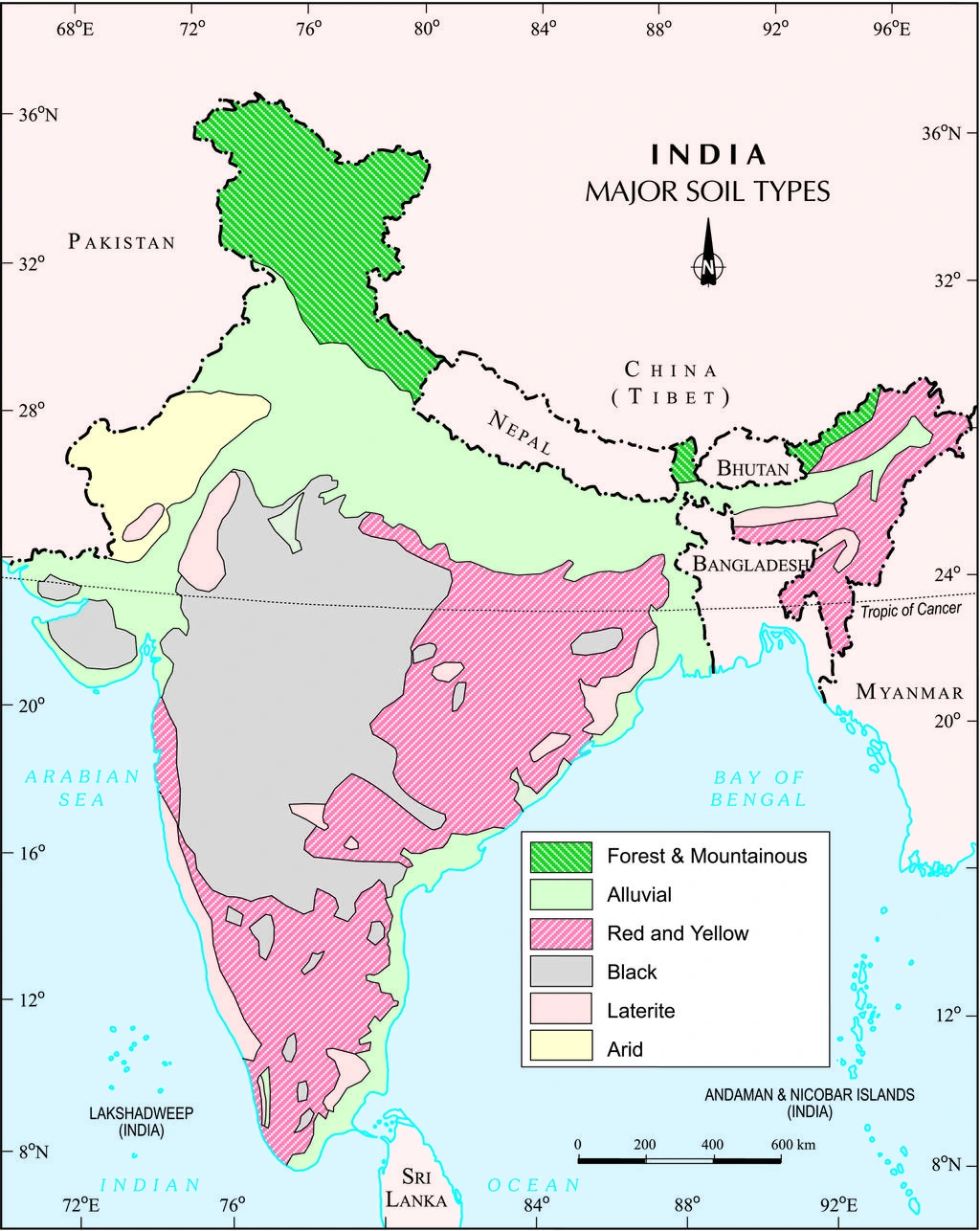
Map study
Major soil groups of India: NCERT reference map via NROER. Compare alluvial, black, red, lateritic and desert soils through the legend; local variation is finer than this national map.
- Read the legend and reference date before interpreting regional patterns.
- Relate the map to the article’s topic; verify current administrative boundaries or data separately.
Credit: NCERT via NROER · CC BY-SA 3.0 · sourceConverted to WebP on an opaque white background; proportionally resized without cropping. Original cartography and legend retained.
1. Concept, principles and distinctions
Organic farming combines agronomic, biological and mechanical methods to maintain production while protecting natural resources. Its internationally recognised principles are health, ecology, fairness and care. Crop rotations, legumes, compost, green manures, livestock integration and biological pest regulation are central practices. Genetically modified organisms and most synthetic fertilisers and pesticides are prohibited under organic standards; however, specified substances may be permitted under defined conditions.
Organic farming differs from traditional farming because it applies explicit production standards, record-keeping and verification. A farmer who uses no synthetic inputs is not automatically eligible to market produce as certified organic. Certification also examines conversion history, input use, contamination safeguards and traceability. Organic farming is therefore both an ecological production approach and a standards-based market category.
Natural farming overlaps with organic farming but generally emphasises on-farm biological inputs, soil cover, crop diversity and minimal dependence on purchased inputs. Organic systems may use purchased certified compost and other permitted inputs. Integrated nutrient management and integrated pest management, by contrast, can combine biological methods with judicious synthetic inputs; they are not necessarily organic.
- Core objective: build a resilient agroecosystem rather than treat each nutrient deficiency or pest outbreak in isolation.
- Important distinction: certified organic production, uncertified low-input cultivation and residue-tested produce are not interchangeable categories.
Timeline
2001
National Programme for Organic Production launched.
2015–16
PKVY and MOVCDNER initiated to support organic farming and value-chain development.
2016
Sikkim recognised as India's first fully organic state.
2017
FSSAI notified the Food Safety and Standards (Organic Foods) Regulations.
2. Farm practices and ecological functioning
Soil fertility management begins with nutrient budgeting. Legumes can introduce nitrogen through biological fixation, while compost, farmyard manure, crop residues and green manures supply nutrients and support soil organisms. Biofertilisers contain beneficial microorganisms; they are not substitutes for the entire nutrient requirement of a crop. Nutrient release from organic materials depends on temperature, moisture, decomposition and the carbon-to-nitrogen ratio, so synchronising supply with crop demand is essential.
Rotations and intercropping interrupt pest cycles and spread production risks. Mulching reduces evaporation and suppresses weeds, while cover crops protect soil against erosion. Mechanical weeding, stale seedbeds and suitable planting arrangements reduce reliance on herbicides. Pest management follows prevention, field monitoring and ecological regulation through resistant varieties, pheromone traps, natural enemies and permitted biopesticides. Biological inputs must meet quality standards and cannot be assumed harmless merely because they are natural.
Mixed farming can close nutrient loops by linking crops, livestock and fodder production. However, recycling does not create nutrients: harvested produce removes phosphorus, potassium and other elements that must eventually be replenished. Buffer zones, clean irrigation water, proper composting and separate storage reduce contamination risks. Records of inputs, field operations and sales make these practices verifiable.
- A practical rotation might combine a cereal, pulse and green-manure crop, adapted to rainfall, irrigation and local markets.
- Organic standards commonly require a conversion period; its duration depends on the crop, production history and applicable certification rules.
Planning a credible organic transition
- 1. Assess soil, water, existing inputs, biomass availability and market demand
- 2. Organise farmers and select an appropriate certification route
- 3. Prepare rotations, nutrient budgets and preventive pest-management plans
- 4. Undertake conversion with training, records and contamination safeguards
- 5. Complete verification and maintain segregation and traceability
- 6. Aggregate, process and market produce while monitoring returns and ecological outcomes
3. Benefits and limits: an evidence-based assessment
Organic management can improve soil structure, biological activity and water infiltration, particularly where it adds organic matter and maintains ground cover. Avoiding prohibited pesticides reduces specific exposure pathways for farm workers and non-target organisms. Diverse rotations and habitat management can support pollinators and natural enemies. These benefits depend on actual practices and the conventional system used for comparison; an organic label alone does not establish every environmental outcome.
Economic gains arise when lower expenditure on synthetic inputs, product premiums and diversified output outweigh additional labour, certification and marketing costs. Low-input rainfed regions may face fewer transition difficulties than intensive irrigated monocultures. High-value spices, tea, coffee, horticultural products and region-specific crops can offer differentiated markets. Yet premiums are neither universal nor guaranteed, and higher retail prices do not necessarily translate into higher farm-gate returns.
Yield outcomes vary substantially by crop, soil fertility and management. Organic yields are often lower than conventional yields, especially during transition or where nutrient supply and weed control are inadequate. Improved rotations and diversification can narrow gaps but cannot guarantee parity everywhere. Climate performance must be assessed both per hectare and per unit of output: soil carbon gains and avoided fertiliser-manufacturing emissions may be offset partly by lower yields, manure-related emissions or additional land requirements.
- Do not equate organic with residue-free: spray drift, contaminated water and persistent pollutants can introduce residues.
- Organic food is not consistently proven to be nutritionally superior across all products; food safety also requires hygiene and microbiological controls.
- For food security, assess total system output, nutritional diversity, affordability and land use alongside individual crop yields.
| Approach | Input strategy | Verification or policy implication |
|---|---|---|
| Certified organic farming | Ecological practices and permitted inputs; most synthetic agrochemicals excluded | Compliance with recognised organic standards and certification requirements |
| Natural farming | Emphasis on on-farm biological inputs and reduced purchased-input dependence | The practice alone does not establish eligibility for a certified organic claim |
| Integrated farming and input management | Combines enterprises and biological, organic and judicious synthetic inputs | Can improve sustainability without qualifying as organic |
| Residue-tested produce | Input use may include pesticides | Testing establishes specified residue results, not compliance with organic production standards |
4. Indian policy, certification and value chains
The National Programme for Organic Production provides standards, accreditation arrangements and third-party certification for organic production and handling. APEDA supports its implementation, including export-oriented traceability through TraceNet. NPOP certification is important for access to relevant export markets, but acceptance depends on the importing country's rules and applicable recognition arrangements; it does not automatically provide unrestricted global access.
PGS-India relies on organised producer groups, peer appraisal, shared responsibility and documentation. It can reduce certification costs for small farmers serving domestic markets, but requires functioning local institutions and credible oversight. FSSAI's Organic Foods Regulations, 2017 establish the food-regulatory framework around recognised organic systems. Jaivik Bharat provides a unified identity for organic foods; prescribed certification, labelling and exemption provisions must still be observed.
Paramparagat Krishi Vikas Yojana, launched in 2015, promotes cluster-based organic farming through support for adoption, capacity building, certification and marketing. Mission Organic Value Chain Development for North Eastern Region, launched in 2015–16, emphasises end-to-end value chains, farmer organisations, collection, processing and market linkages. These approaches recognise that production support without aggregation and assured demand may leave farmers selling organic produce at conventional prices.
Area statistics require careful interpretation. Cultivated organic area, area under conversion and certified wild-harvest collection area represent different categories and should not be added indiscriminately to describe organic cropland. Similarly, export growth is evidence of a market opportunity, not proof that every participating farmer earns a premium.
- FPOs can aggregate output, coordinate certification, share storage and negotiate directly with processors and retailers.
- Traceability must continue through transport, processing and retail to prevent mixing and fraudulent claims.
5. Reform priorities and a balanced way forward
The appropriate reform is a phased, region-specific transition rather than an abrupt nationwide ban on synthetic inputs. Agroecological mapping should identify places where baseline chemical use is low, biomass is available and crops have credible markets. Conversion plans should include nutrient budgets, soil testing, pest surveillance and contingency arrangements. Extension must teach farm-system management rather than promote a fixed package of commercial organic products.
Public support should address transition risks through training, demonstration farms, accessible credit and suitable risk-management instruments. Labour-saving weeders, quality composting infrastructure and reliable biological inputs are particularly important. Strengthening manure quality testing and preventing exaggerated claims by input suppliers would protect farmers. Women contribute substantially to livestock care, compost preparation and weeding; reforms must avoid increasing their unpaid workload.
Demand-side measures should strengthen local markets, transparent contracts, farmer-owned processing and credible consumer information. Certification assistance should be accompanied by independent oversight and risk-based testing. Research must compare organic, natural and integrated systems over multiple seasons, measuring net income, labour requirements, nutrient balances, yield stability and environmental outcomes. The policy goal is sustainable farmer prosperity and resource conservation, with organic farming as one important pathway rather than the sole model for all Indian agriculture.
- Success indicators: net returns, stable yields, soil health, reduced hazardous exposure, reliable premiums and inclusion of smallholders.
- GS-III linkage: agricultural productivity, food security, subsidies, marketing reform, value addition, environmental sustainability and climate resilience.
Real-world case studies
Sikkim: sustained policy commitment
Sikkim began its organised transition in 2003 and achieved fully organic state status in 2016, covering approximately 75,000 hectares of agricultural land. The transition combined withdrawal of chemical-input support, farmer training and certification. It illustrates the value of sustained institutional commitment and place-based branding. Its experience also shows that organic status must be followed by investment in aggregation, logistics and dependable markets; certification alone cannot guarantee higher farm incomes.
Sri Lanka: risks of abrupt input withdrawal
Sri Lanka's April 2021 restriction on imports of chemical fertilisers and agrochemicals disrupted agriculture before farmers had adequate substitutes, training or transition time. The policy was subsequently reversed amid production difficulties. Wider foreign-exchange and macroeconomic problems also contributed to the crisis, so it cannot be attributed solely to agricultural policy. The relevant lesson is that abrupt input bans are not equivalent to a scientifically planned organic transition.
Previous year questions
No source-linked PYQ is available here yet. Use the practice questions below.
Practice questions
Practice MCQ 1
With reference to organic certification in India, consider the following statements: 1. APEDA serves as the secretariat for NPOP. 2. PGS-India uses participatory appraisal and shared responsibility. 3. Certification under either system automatically ensures acceptance in every export market. Which statements are correct?
- A. 1 and 2 only
- B. 2 and 3 only
- C. 1 and 3 only
- D. 1, 2 and 3
Practice MCQ 2
Which statement best describes nutrient management in organic farming?
- A. Recycling crop residues eliminates the need to replace nutrients removed through harvests.
- B. Biofertilisers invariably supply the entire nutrient requirement of cereal crops.
- C. Legumes can add biologically fixed nitrogen, but other nutrient removals still require replenishment.
- D. Nutrient release from compost is independent of soil moisture and temperature.
Practice MCQ 3
Consider the following statements: 1. Certified organic produce may contain residues arising from environmental contamination. 2. Lower greenhouse-gas emissions per hectare necessarily imply lower emissions per kilogram of produce. Which statements are correct?
- A. 1 only
- B. 2 only
- C. Both 1 and 2
- D. Neither 1 nor 2
Mains practice · Organic farming offers ecological and market opportunities, but its expansion requires more than replacing chemical inputs. Discuss the constraints and suggest a region-specific reform strategy for India. Answer in 250 words.
- Define organic farming as an ecological and standards-based production system.
- Explain potential benefits for soil health, biodiversity, input dependence and differentiated markets.
- Discuss transition yields, nutrient availability, labour, certification costs and uncertain premiums.
- Differentiate NPOP, PGS-India and the FSSAI regulatory framework.
- Recommend phased adoption, nutrient budgeting, research, extension and transition support.
- Link FPO-led aggregation, processing and traceability with reliable demand.
- Use Sikkim and Sri Lanka to contrast sustained transition planning with abrupt input withdrawal.
- Conclude with context-specific adoption and evaluation through net incomes, productivity and environmental outcomes.
Further reading
- APEDA: National Programme for Organic Production standards and organic export statistics.
- Ministry of Agriculture and Farmers Welfare: PGS-India operational manual and PKVY guidelines.
- Ministry of Agriculture and Farmers Welfare: MOVCDNER operational guidelines.
- FSSAI: Food Safety and Standards (Organic Foods) Regulations, 2017, subsequent amendments and Jaivik Bharat portal.
- ICAR–Indian Institute of Farming Systems Research: research publications on organic farming and integrated farming systems.
- NCERT Biology, Class XII: Microbes in Human Welfare.
Preparing for UPSC Civil Services? Get classroom teaching, answer-writing evaluation and mentorship at Pragnya IAS Academy, Ashok Nagar — see why aspirants choose us for IAS coaching in Hyderabad.