

Mulch Farming in Kerala.
Credit: Ganesh Mohan T · CC BY-SA 4.0 · source

Intercropping coconut and Tagetes erecta flowers in Kerala, India.
Credit: Ezhuttukari · CC BY-SA 3.0 · source
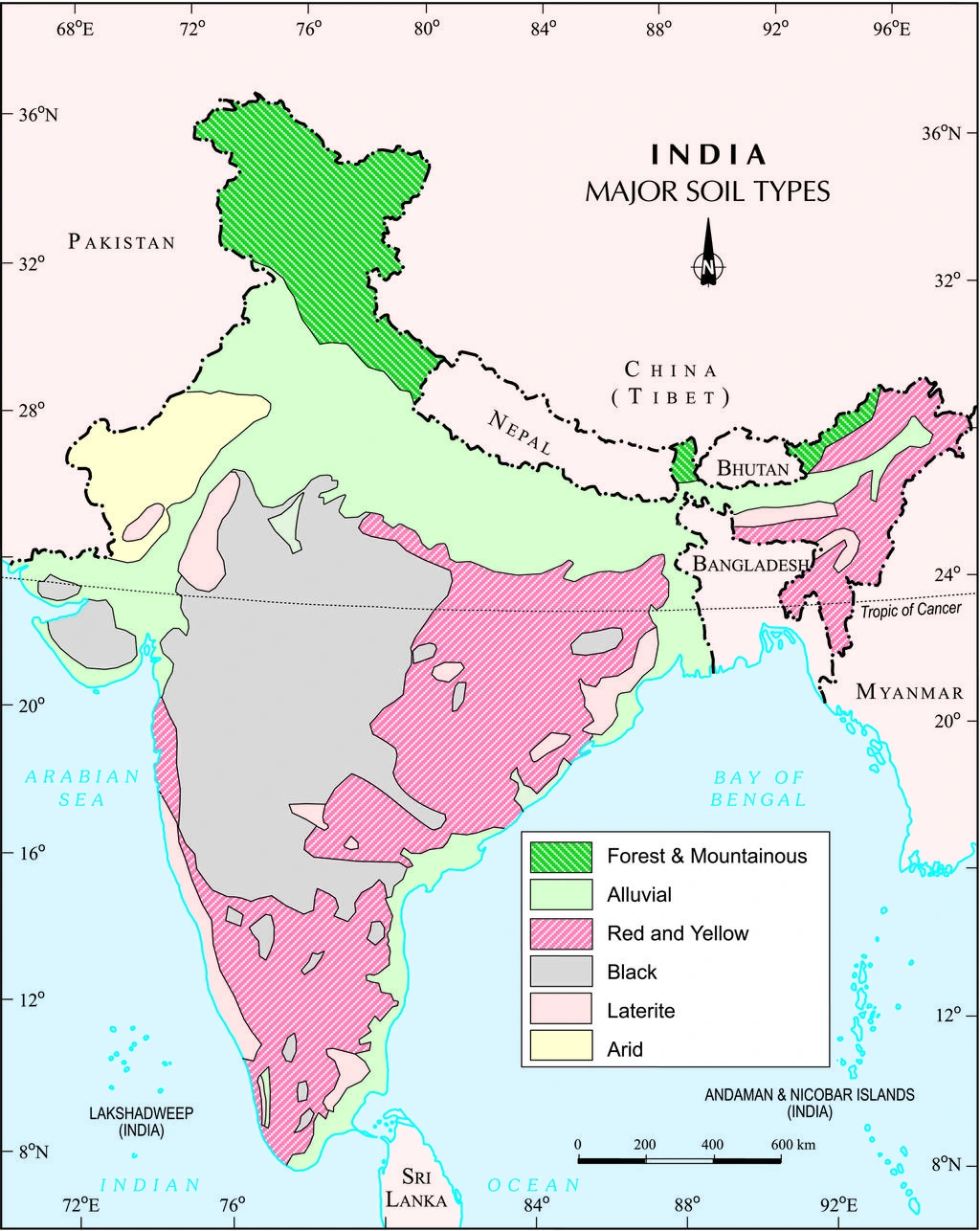
Map study
Major soil groups of India: NCERT reference map via NROER. Compare alluvial, black, red, lateritic and desert soils through the legend; local variation is finer than this national map.
- Read the legend and reference date before interpreting regional patterns.
- Relate the map to the article’s topic; verify current administrative boundaries or data separately.
Credit: NCERT via NROER · CC BY-SA 3.0 · sourceConverted to WebP on an opaque white background; proportionally resized without cropping. Original cartography and legend retained.
1. Meaning, origins and core principles
Natural farming is a family of farming approaches that emphasise ecological processes, recycling of farm resources and reduced reliance on external inputs. Indian programmes generally describe it as chemical-free farming based on locally available resources, livestock integration and diversified cropping. It shares features with agroecology and organic agriculture but is not a single universally standardised package. Masanobu Fukuoka’s work in Japan is an important international reference, while Subhash Palekar popularised Zero Budget Natural Farming in India.
The term zero budget originally highlighted minimising purchased inputs and meeting cultivation expenses through arrangements such as intercrops. It should not be interpreted as an accounting claim that farming has no cost. Family labour, preparation and application of biological formulations, biomass collection, irrigation and livestock maintenance all have economic costs. Consequently, natural farming must be evaluated through net returns and resource productivity, not merely expenditure on fertilisers and pesticides.
Palekar-associated formulations commonly identify four pillars: Beejamrit, a seed or planting-material treatment; Jeevamrit, a dung- and urine-based preparation intended to stimulate biological activity; Acchadana, or soil cover and mulching; and Waaphasa, the maintenance of a favourable balance of air and moisture in soil. Intercropping, crop rotation and botanical pest-management preparations complement these practices. Not every natural-farming tradition prescribes identical ingredients or livestock requirements.
- The central ecological objective is to build a functioning farm ecosystem rather than substitute every synthetic input with a purchased biological product.
- Claims about particular breeds, formulations or universal yield gains require independent, context-specific verification.
Timeline
2016
Andhra Pradesh began its state-supported natural-farming programme, subsequently known as Andhra Pradesh Community Managed Natural Farming.
2019–20
Bharatiya Prakritik Krishi Paddhati was introduced under Paramparagat Krishi Vikas Yojana to support natural farming.
25 November 2024
The Union Cabinet approved the National Mission on Natural Farming as a standalone Centrally Sponsored Scheme.
2. Agronomic mechanisms and environmental relevance
Mulching protects soil from raindrop impact, moderates temperature, suppresses some weeds and reduces direct evaporation. Crop residues and root biomass provide food for soil organisms and can improve aggregation and infiltration. Rotations and intercrops spread production risks and create varied habitats, potentially supporting pollinators and natural enemies of pests. Legumes can add biologically fixed nitrogen when suitable rhizobia and growing conditions are present.
These mechanisms do not eliminate nutrient constraints. Harvested grain, fodder and other produce remove nutrients from the field. Microorganisms can fix atmospheric nitrogen or mobilise some nutrients already present in soil, but they cannot create phosphorus or potassium. Sustained production therefore requires a realistic nutrient budget covering biological fixation, biomass recycling and other inputs permitted under the applicable system. Small quantities of microbial preparations should not automatically be treated as complete replacements for all nutrients removed by high-yielding crops.
Avoiding synthetic pesticides can reduce exposure risks when hazardous chemicals are displaced, while avoiding manufactured nitrogen fertilisers can reduce associated upstream emissions. Better soil cover may improve resilience to dry spells. However, water savings, carbon sequestration and greenhouse-gas outcomes must be measured rather than assumed. Irrigation methods, rice-field water regimes, livestock emissions and any yield changes influence the overall environmental balance.
- Natural preparations are not automatically harmless; hygienic preparation, appropriate handling and food-safety precautions remain necessary.
- Natural farming can support SDG 2, SDG 12, SDG 13 and SDG 15, but contributions depend on actual farm-level outcomes.
Risk-managed transition to natural farming
- 1. Establish baseline soil condition, yields, input costs and family labour.
- 2. Assess local biomass, water, livestock resources and market opportunities.
- 3. Train farmers and begin with a limited demonstration area.
- 4. Introduce locally suitable diversification, soil cover and biological practices.
- 5. Monitor pest pressure, nutrient balance, yields and full economic returns.
- 6. Expand only after satisfactory multi-season results and reliable market planning.
3. Indian policy framework and institutional support
Before the standalone mission, the Union government supported natural farming through Bharatiya Prakritik Krishi Paddhati under the Paramparagat Krishi Vikas Yojana. The National Mission on Natural Farming, approved in November 2024, expanded the policy focus to farmer training, locally adapted practices, demonstration farms and community institutions. Its approved expenditure covered the period up to 2025–26; targets should be distinguished from verified achievements.
The mission envisaged 15,000 clusters in willing gram panchayats, reaching one crore farmers and initiating natural farming on 7.5 lakh hectares. It also proposed 10,000 Bio-input Resource Centres to improve access to locally prepared inputs. Around 2,000 model demonstration farms at institutions including Krishi Vigyan Kendras, agricultural universities and farmers’ fields were envisaged, alongside a community resource-person network.
Implementation requires coordination among agriculture departments, research institutions, panchayats, self-help groups and farmer producer organisations. Demonstrations are most useful when farmers can compare practices under similar conditions and record costs, yields and labour requirements. Certification and common branding are intended to improve market recognition, but credible traceability, affordable verification and consumer awareness are essential. Natural-farming produce does not automatically qualify for every domestic organic label or export certification.
- Public support should finance learning, local extension and transition-risk management rather than reward adoption figures alone.
- Bio-input enterprises can support rural livelihoods, provided quality control prevents ineffective products and exaggerated claims.
| Approach | Defining emphasis | Relationship with synthetic inputs |
|---|---|---|
| Natural farming | Local resource recycling, biological processes and low external-input dependence | Synthetic fertilisers and pesticides excluded under Indian natural-farming programmes |
| Organic farming | Production according to specified organic standards | Most synthetic inputs prohibited; approved purchased organic inputs may be used |
| Conservation agriculture | Minimum soil disturbance, permanent soil cover and crop diversification | Synthetic fertilisers and herbicides may be used |
| Integrated nutrient management | Balanced use of mineral, organic and biological nutrient sources | Synthetic fertilisers used alongside organic sources where appropriate |
| Agroecology | Ecological and social principles applied to farming and food systems | Broader framework rather than one uniform input prohibition or certification standard |
4. Economic opportunities, constraints and evidence
The main economic attraction is lower expenditure on purchased fertilisers and pesticides. This can reduce working-capital needs and exposure to input-price volatility. Diversified production may improve household food availability and spread income across seasons. However, profitability depends on whether input savings compensate for changes in yield, labour use and marketing costs. A price premium is possible in differentiated markets but cannot be assumed for all farmers.
Important constraints include competing demands for crop residues as fodder or fuel, uneven access to dung and urine, preparation time, weed management and the availability of skilled labour. Livestock ownership can facilitate resource recycling but also entails feed, veterinary and maintenance costs. Additional unpaid work may fall on women unless labour-saving tools and fair remuneration are incorporated. Contamination from neighbouring fields can complicate market assurance.
Evidence should be read carefully. Farmer surveys and programme reports can reveal promising outcomes, but participant selection, rainfall variation, differing baseline practices and incomplete labour accounting may distort comparisons. India needs multi-location, multi-season trials combined with participatory farm research. Comparisons should include natural farming, recommended conventional practice and integrated nutrient management, measuring yield stability, full economic costs, nutrition, soil properties and environmental effects.
- A financially viable transition on one crop or marginal plot does not establish suitability for every irrigated commercial crop.
- Food-security assessment must consider aggregate production and land requirements alongside individual-farm profitability.
5. A balanced reform strategy
Natural farming should be promoted as an evidence-based, farmer-led option rather than a compulsory replacement for all existing systems. Phased adoption on part of a holding allows farmers to learn while protecting household income. Local crop plans should account for rainfall, irrigation, soil tests, biomass availability, livestock resources and market demand. Extension must explain both ecological benefits and possible transition difficulties.
Reform priorities include independent evaluation, village-level advisory support, reliable bio-input quality, appropriate machinery for mulching and weed control, and market aggregation through producer organisations. Procurement or premium-market pilots can be useful where demand is credible, but permanent profitability should not depend solely on subsidies. The appropriate policy objective is durable farm income and ecological sustainability, with transparent reporting of successes, failures and trade-offs.
- Track net returns including family labour, not just reductions in cash expenditure.
- Use voluntary, phased implementation with locally validated protocols.
- Integrate natural-farming research with wider work on agroecology, water management and climate-resilient agriculture.
Real-world case studies
Andhra Pradesh Community Managed Natural Farming
Implemented through Rythu Sadhikara Samstha, Andhra Pradesh’s programme uses community institutions, women’s self-help-group networks and farmer-to-farmer learning. Its significance lies in treating adoption as a sustained extension process rather than merely distributing inputs. Reported benefits include reduced purchased-input costs and diversification, but their magnitude varies. Independent evaluation must separate management improvements, selection effects and weather influences from the effects of individual formulations.
Sri Lanka’s 2021 fertiliser-policy reversal
Sri Lanka abruptly restricted imports of chemical fertilisers and agrochemicals in 2021 while pursuing an organic transition. Inadequate preparation and input availability contributed to agricultural disruption, amid a wider economic crisis. This was not a controlled test of Indian natural-farming methods. Its relevant lesson is that compulsory, economy-wide input withdrawal without transition support can threaten production and livelihoods.
Previous year questions
UPSC Mains 2021 · GS-III
How does micro-irrigation contribute to India’s water crisis?
- An adjacent water-management question, not a direct question on natural farming.
- Explain improved application efficiency, reduced conveyance losses and fertigation.
- Distinguish plot-level water savings from basin-level savings and possible expansion of irrigated area.
- Connect soil cover and appropriate irrigation scheduling with wider agricultural water conservation.
Practice questions
Practice MCQ 1
Consider the following statements about natural farming: 1. Microbial preparations can create phosphorus and potassium required by crops. 2. Mulching can reduce direct evaporation from the soil. 3. Lower purchased-input expenditure necessarily guarantees higher net income. Which of the statements given above is/are correct?
- A. 1 and 2 only
- B. 2 only
- C. 2 and 3 only
- D. 1, 2 and 3
Practice MCQ 2
Which of the following best distinguishes conservation agriculture from natural farming as promoted under Indian government programmes?
- A. Conservation agriculture necessarily prohibits synthetic fertilisers.
- B. Natural farming necessarily requires annual deep ploughing.
- C. Conservation agriculture centres on minimum soil disturbance, soil cover and diversification without necessarily prohibiting synthetic inputs.
- D. Natural farming excludes all forms of crop diversification.
Practice MCQ 3
Regarding the National Mission on Natural Farming approved in November 2024, consider the following statements: 1. It was approved as a standalone Centrally Sponsored Scheme. 2. It envisaged Bio-input Resource Centres. 3. Its adoption targets constituted proof of achieved coverage on the approval date. Which of the statements given above are correct?
- A. 1 and 2 only
- B. 2 and 3 only
- C. 1 and 3 only
- D. 1, 2 and 3
Mains practice · Natural farming offers opportunities for ecological restoration and reduced cultivation costs, but its expansion requires careful management of agronomic and economic risks. Discuss. Suggest a suitable policy framework for India. Answer in 250 words.
- Define natural farming and distinguish it from organic certification and conservation agriculture.
- Explain input savings, soil cover, biodiversity and potential resilience benefits.
- Discuss nutrient budgets, yield uncertainty, biomass constraints and unpaid labour.
- Refer to the National Mission on Natural Farming and Andhra Pradesh’s community-based extension model.
- Recommend voluntary phased adoption, transition support, independent trials and credible market assurance.
- Conclude with farmer income, food security and measured environmental outcomes as joint criteria.
Further reading
- Press Information Bureau: Cabinet approval of the National Mission on Natural Farming, 25 November 2024.
- Department of Agriculture and Farmers Welfare: National Mission on Natural Farming guidelines and official programme resources.
- NITI Aayog: Natural Farming portal and publications.
- ICAR: Publications on organic and natural farming, soil fertility and integrated nutrient management.
- Rythu Sadhikara Samstha: Andhra Pradesh Community Managed Natural Farming programme resources.
- FAO: The 10 Elements of Agroecology.
Preparing for UPSC Civil Services? Get classroom teaching, answer-writing evaluation and mentorship at Pragnya IAS Academy, Ashok Nagar — see why aspirants choose us for IAS coaching in Hyderabad.