
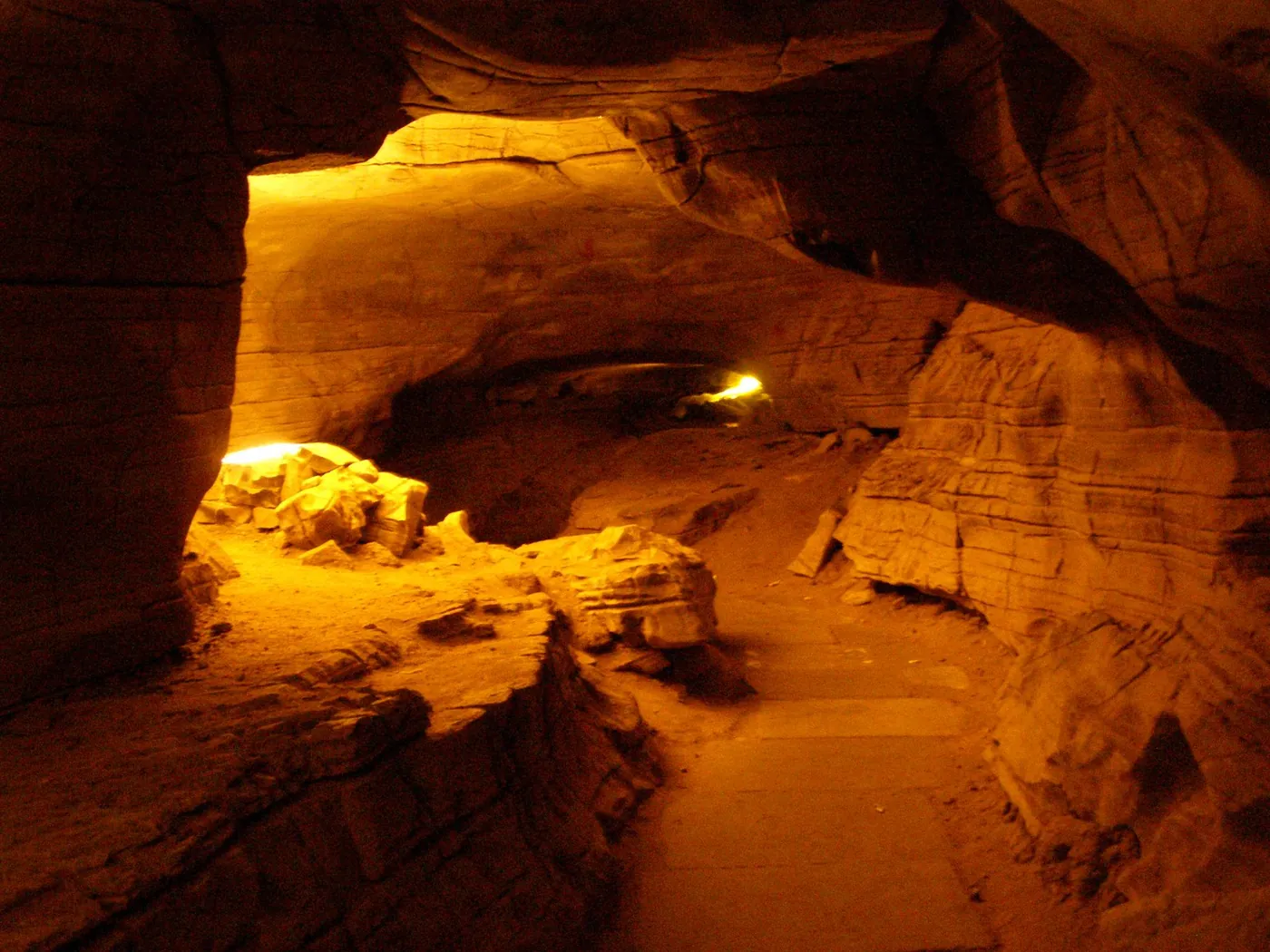
Belum: limestone cave landscape in present-day Nandyal district.
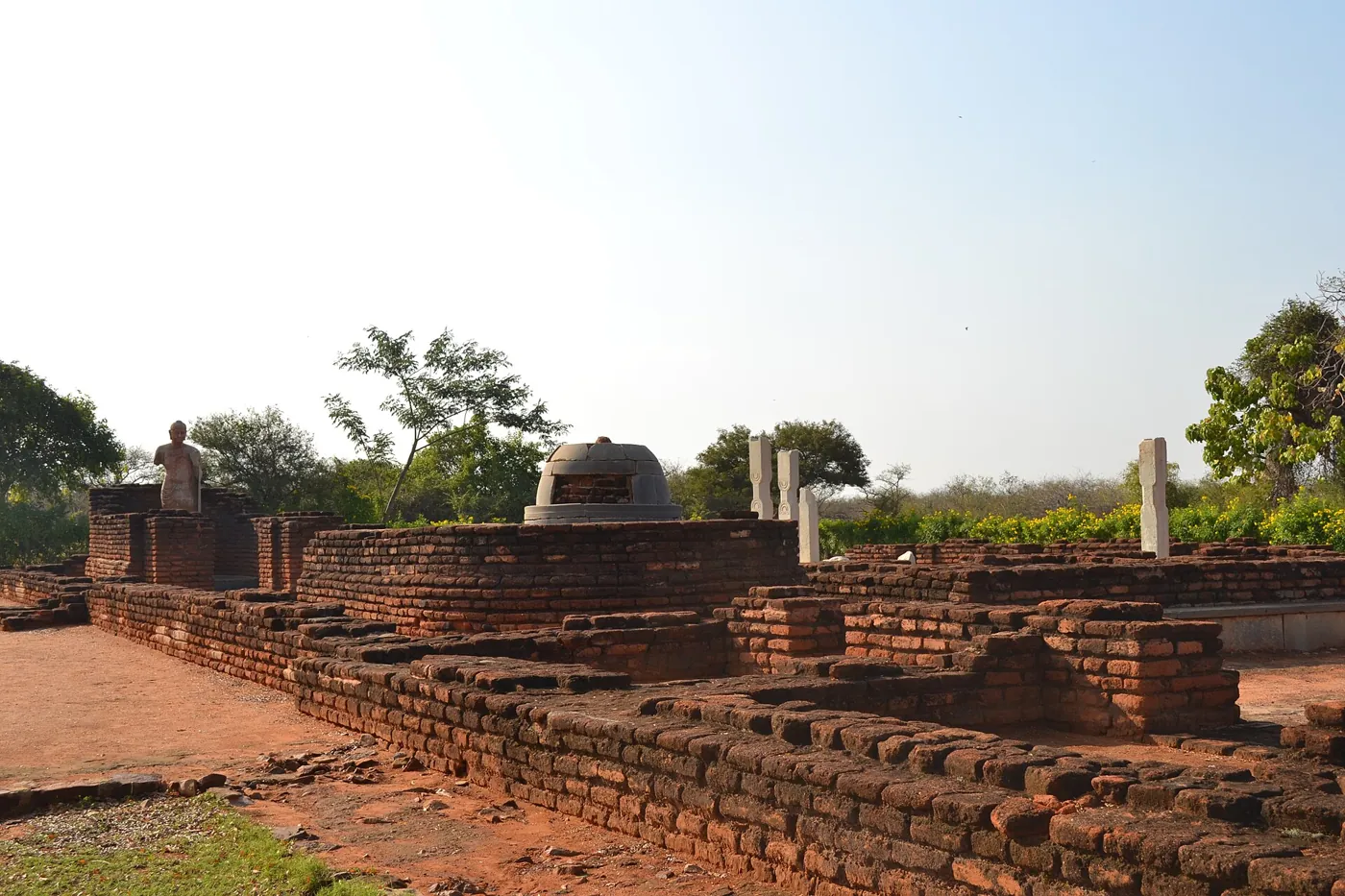
Nagarjunakonda: a valley with prehistoric as well as later Buddhist evidence; the visible ruins are early historic.
Credit: Sabyk2001 · CC BY-SA 3.0 · source
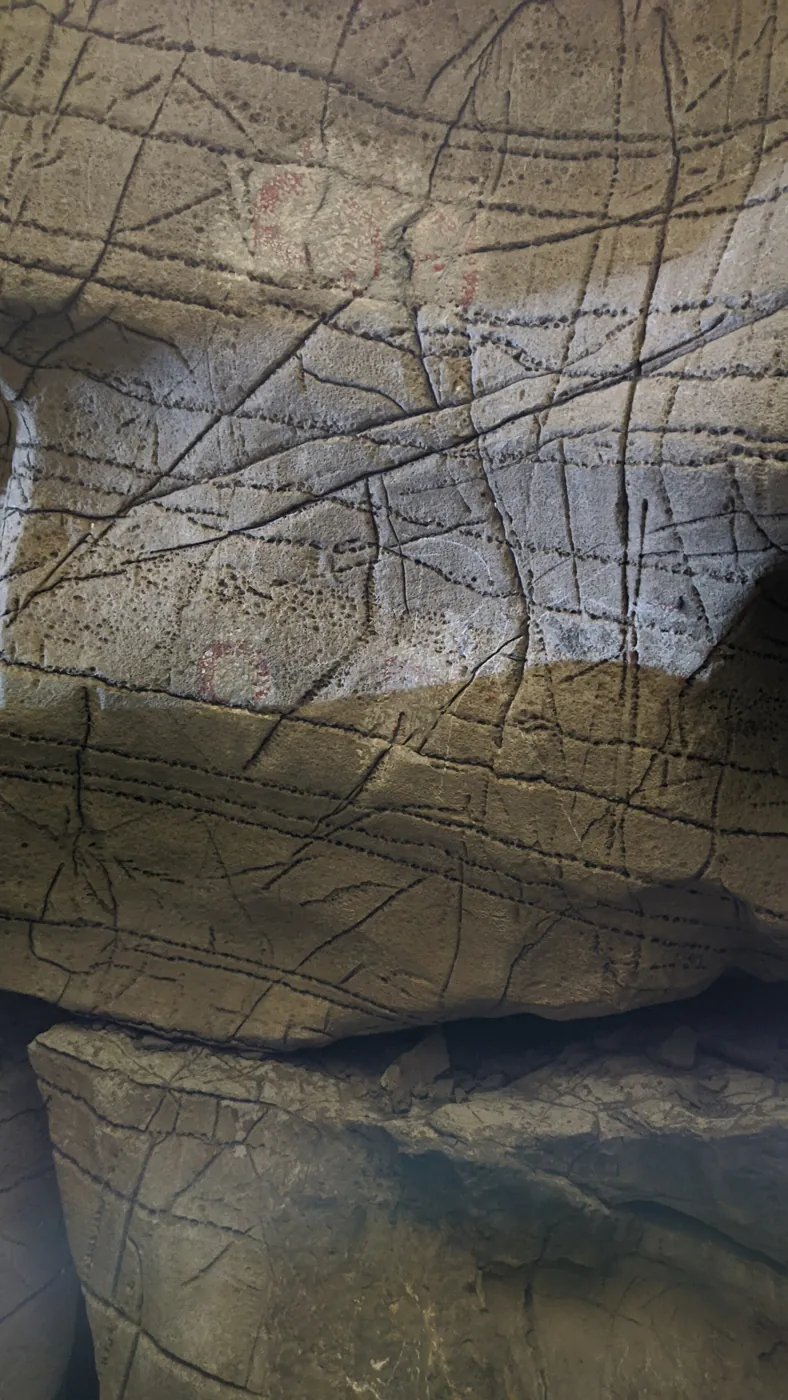
Limestone formations of the cave system where prehistoric tools have been reported.
Credit: Shyamal · CC BY-SA 4.0 · source
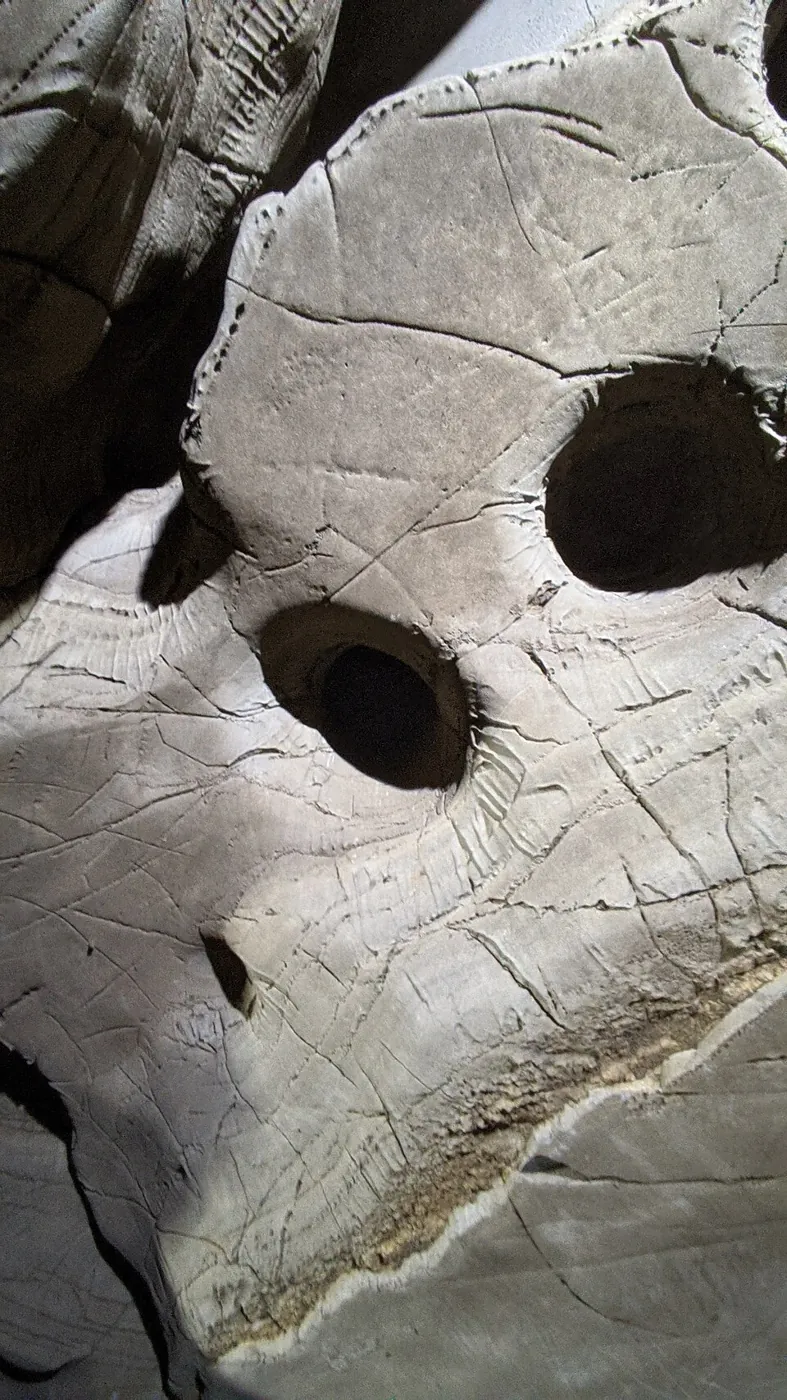
A second view of the limestone cave system.
Credit: Shyamal · CC BY-SA 4.0 · source
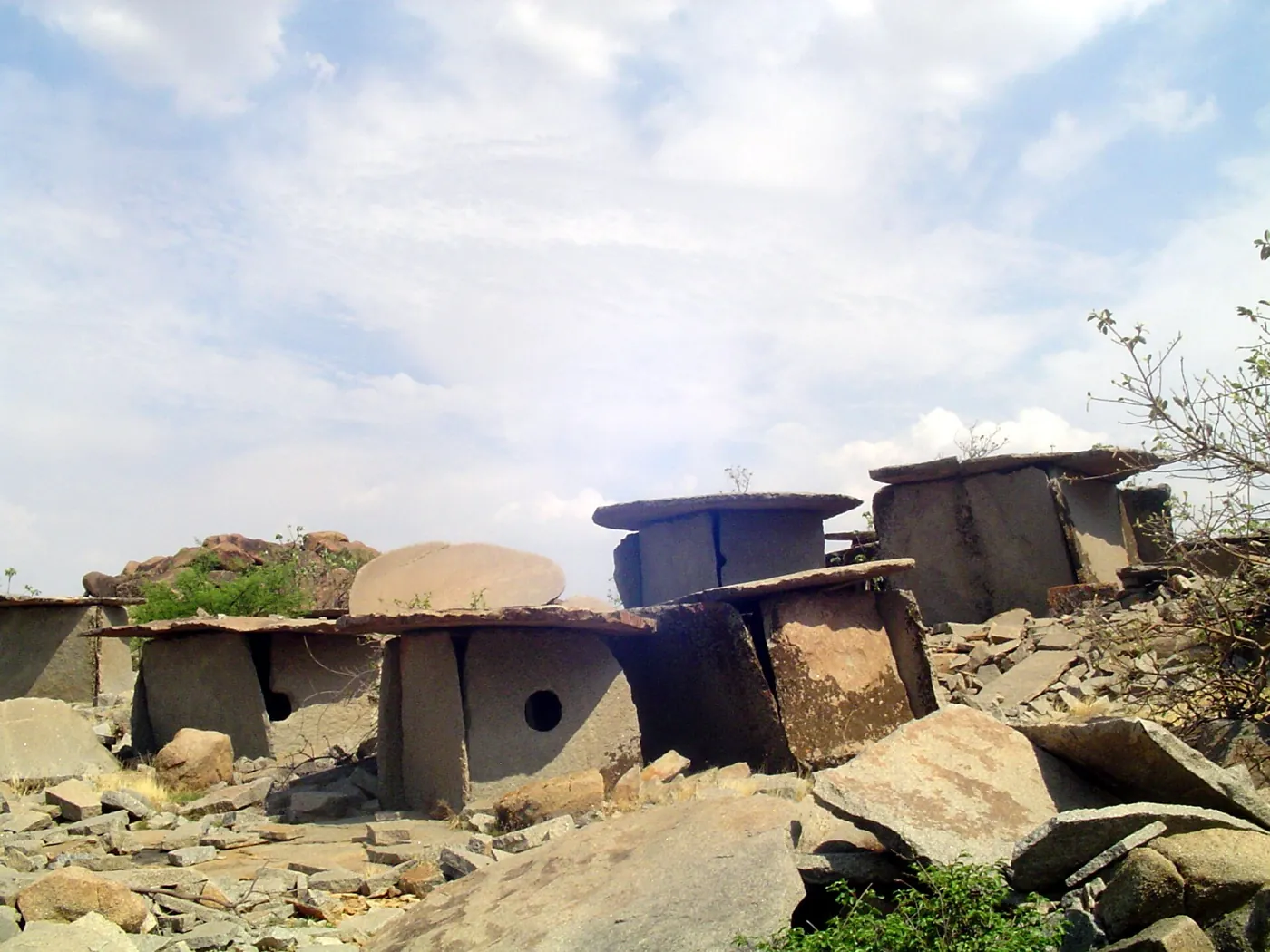
Hire Benakal: megalithic burial monuments in Karnataka, used here as a regional comparison.
Credit: Sudeep m · CC BY-SA 3.0 · source
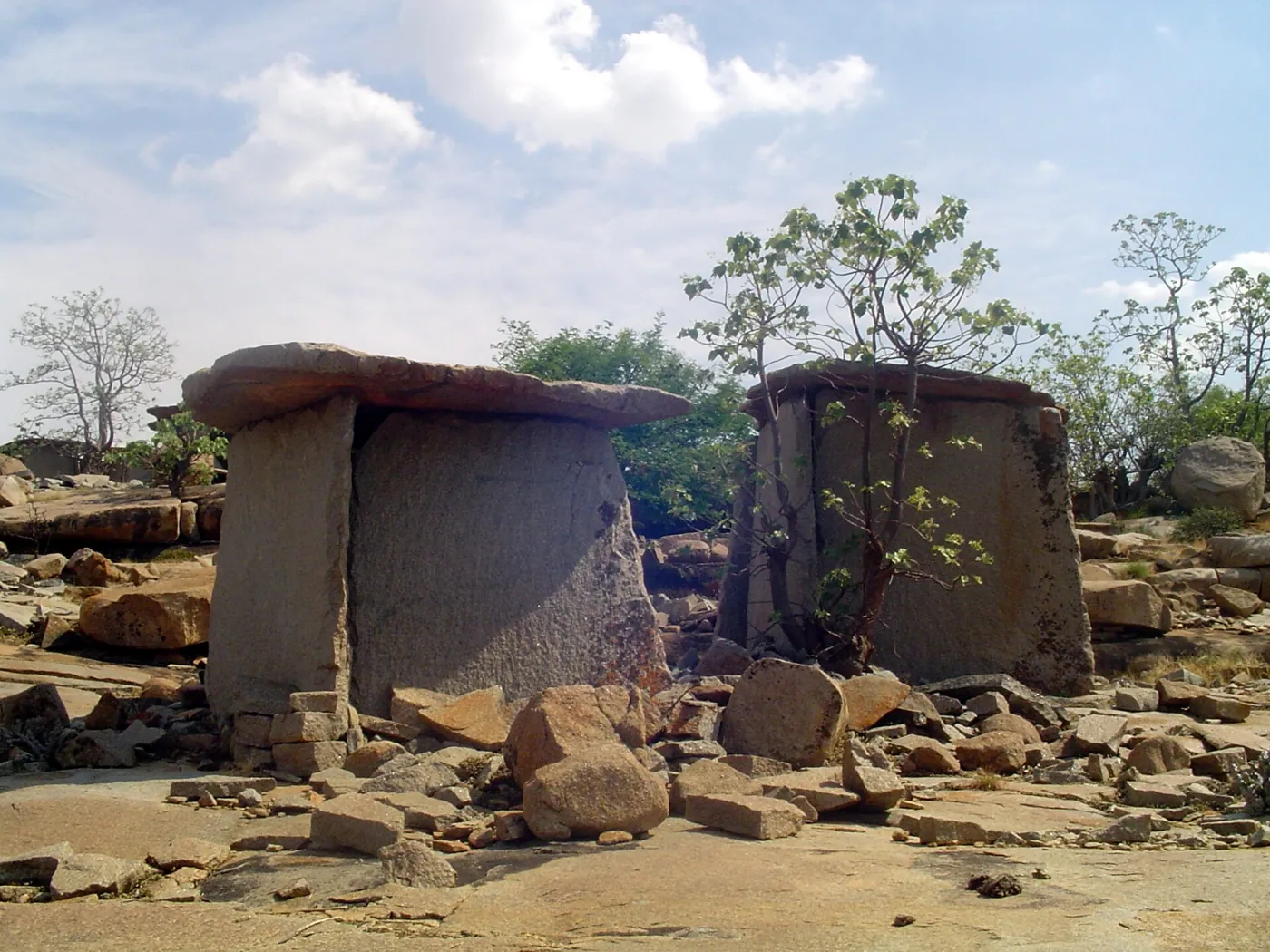
A distinct view of stone-built funerary structures for comparing burial architecture across the southern Deccan.
Credit: Sudeep m · CC BY-SA 3.0 · source
1. Reading the archaeological landscape
Andhra’s prehistoric past is not the biography of a single people moving through a fixed ladder of progress. It consists of locally dated assemblages distributed across limestone country, river terraces and settlement zones. The Krishna, Godavari and Pennar systems help organise this evidence geographically, but their tributaries and adjacent uplands are equally important. Archaeologists first establish how an object entered its deposit, then compare technology, associated remains and suitable scientific dates. Surface discoveries can identify promising areas without necessarily furnishing a secure occupation sequence.
The wider Kurnool region illustrates both the richness and the difficulty of this record. Billa Surgam cave research must be distinguished from the separate Belum system in present-day Nandyal district. Jwalapuram supplies open-air sequences associated with the Toba ash horizon, whose eruption occurred about 74,000 years ago. An eruption date is not automatically the age of every nearby tool. Nor does a tool industry alone identify its maker’s biological species. Nagarjunakonda adds a further warning: its famous Buddhist remains should not conceal the valley’s much earlier archaeological history.
- Separate geological formation from human occupation.
- Use stratigraphy before assigning cultural stages.
- Retain the prehistoric component of the Nagarjunakonda valley.
Timeline
About 74,000 years ago
Toba eruption supplies the ash marker studied in the Jwalapuram sequence.
Third–second millennia BCE
Many southern Neolithic sequences reflect food-producing communities.
First millennium BCE
Iron Age and megalithic mortuary traditions develop in varied regional settings.
Third century BCE
Ashoka’s edicts attest the Andhra people-name.
Last centuries BCE; debated
Satavahana authority emerges under the early royal sequence.
Late centuries BCE; dating debated
Naganika’s Naneghat record advertises early dynastic ritual.
First or early second century CE; disputed
Gautamiputra’s restoration displaces Nahapana’s power.
After Gautamiputra, chronology-dependent
Pulumavi’s records provide an important later dynastic anchor.
About 150 CE
Rudradaman’s Junagadh inscription records conflict with a Satakarni.
Later second century CE, broadly
Yajna Sri represents an important later phase of Satavahana power.
Early third century CE
Regional successor polities gain prominence as Satavahana authority fragments.
Third century CE and later
Amaravati’s religious and artistic life continues across dynastic change.
2. Food production, iron and the commemoration of the dead
Southern Neolithic communities invested in livestock, cultivation, ground stone tools and domestic equipment, yet they could continue exploiting wild foods. Many regional sequences belong broadly to the third and second millennia BCE, but this range cannot replace local dating. Ash mounds in the wider southern zone are commonly connected with cattle dung and repeated burning. Utnur is a useful comparison in present-day Telangana, not an Andhra Pradesh site. Such evidence encourages an explanation of pastoral organisation and repeated gatherings rather than an automatic identification of every mound as a destroyed village.
Iron Age graves make a different aspect of community life visible. Slab-built cists, dolmens and stone circles could contain pottery, ornaments and iron implements, but neither their contents nor their dates were uniform. Black-and-red ware is a recurrent association rather than an infallible ethnic label. Differences between graves may reflect social status, ritual choices, age or preservation. A strong answer therefore compares burials with habitation evidence. It does not reconstruct an entire economy from funerary goods or identify a modern linguistic community solely from a monument’s form.
- Food production and foraging could overlap.
- Megalithic is a mortuary designation, not a dynasty.
- Burial differentiation supports questions about hierarchy, not automatic conclusions.
Construct an evidence-led mains answer
- 1. Identify the question’s period and region.
- 2. Classify the evidence: archaeological, epigraphic, numismatic or literary.
- 3. State what the strongest source directly establishes.
- 4. Connect polity, production, patronage and culture with specific examples.
- 5. Conclude with significance while marking disputed dates and traditions.
3. Early Andhras and the problem of Satavahana origins
The name Andhra enters history through sources that were produced for very different purposes. The Aitareya Brahmana places the Andhras within a literary narrative associated with Vishvamitra; it is not a dated foundation charter. Classical reports associated with Megasthenes survive through later writers, so their numerical descriptions require attribution and caution. Ashoka’s Rock Edict XIII provides a firmer third-century BCE epigraphic reference to the people-name. It does not name Simuka, establish a Satavahana accession year or prove that modern Andhra Pradesh boundaries already existed.
Satavahana origins must consequently be reconstructed independently through coins, inscriptions and Puranic dynastic lists. Simuka occupies the conventional founding position, followed in the formative sequence by Krishna and an early Satakarni. The starting date remains disputed: long chronologies reach into the third century BCE, whereas shorter reconstructions place formation later in the last centuries BCE. Naganika’s Naneghat inscription is central because it connects royal relationships with major sacrifices. Paithan, identified with Pratishthana in Maharashtra, and the Amaravati–Dharanikota area in Andhra Pradesh reveal a polity with changing regional centres rather than one timeless capital.
- Distinguish an early people-name from a later royal house.
- Identify the chosen chronology when precise dates are needed.
- Use Naneghat for royal genealogy, ritual and women’s political representation.
| Source or context | Best use | Main limitation |
|---|---|---|
| Jwalapuram strata | Occupation and technological sequence | Tools do not independently identify species |
| Megalithic graves | Funerary practice and material associations | Selected deposits are not a complete social census |
| Ashokan edicts | Early Andhra name in a political context | No Satavahana founder or regnal list |
| Naneghat record | Genealogy and sacrificial kingship | Does not settle every chronological problem |
| Nashik praise | Royal self-representation and named relationships | Eulogistic conquest claims need corroboration |
| Nahapana overstrikes | Displacement and revalidation of coinage | Do not map every stage of a campaign |
| Guild donation records | Endowment and institutional relationships | Individual arrangements cannot represent all economic life |
| Gathasaptasati tradition | Literary language and poetic social settings | Layered transmission prevents a single-date reading |
4. Restoration, western rivalry and regional fragmentation
Gautamiputra Satakarni’s importance lies in restoring Satavahana authority against the Kshaharata power represented by Nahapana. His overstrikes on Nahapana’s silver issues provide evidence independent of literary genealogy. Gautami Balashri’s Nashik praise adds a royal account of conquest and virtue, but its purpose was commemoration. It was recorded during Pulumavi’s reign and should not be treated as an impartial territorial survey. Chronologies place Gautamiputra in different parts of the first or early second century CE; a textbook date must not be mistaken for settled scholarly consensus.
Vasishthiputra Pulumavi and later Yajna Sri Satakarni show that substantial royal activity continued after the revival. Western relations nevertheless remained competitive. Rudradaman’s Junagadh inscription, dated about 150 CE, claims two victories over a Satakarni spared because of close kinship; identification of the opponent needs caution. Yajna Sri’s ship designs suggest maritime associations without measuring a navy. By the early third century, authority fragmented along regional lines. Ikshvaku power in the Krishna region and Abhira activity in parts of the west demonstrate different successor trajectories, not a simultaneous disappearance of society or commerce.
- Gautami Balashri was Gautamiputra’s mother.
- Nahapana and Rudradaman belong to different ruling contexts.
- Explain decline as uneven redistribution of power rather than a single unsupported event.
5. Government, social claims and economic networks
Satavahana power combined kingship with territorial officers and locally influential elites. Aharas were territorial divisions; amatyas appear as officers, while mahasenapati is a high military title that could carry wider political significance. Maharathis and mahabhojas reveal established regional interests within changing networks of allegiance. These terms do not amount to a complete bureaucratic handbook. Grants expose particular fiscal rights, privileges and protective clauses, whose extent must be read record by record. Administrative reconstruction is strongest when it acknowledges variation instead of translating every ancient title into a modern department.
Agrarian resources supported crafts, markets and exchange linking inland centres with western passes and coastal outlets. Srenis organised occupational groups, and some inscriptions show deposits whose proceeds maintained religious establishments. Ushavadata’s Nashik endowment is particularly instructive, but he belonged to Nahapana’s circle and should not be converted into a Satavahana royal donor. Lead and copper issues, other alloys and western silver overstrikes indicate varied monetary circuits. Roman coins in the Andhra region demonstrate wider contacts, not Roman sovereignty. Their contexts must be examined before claiming a particular port, direct voyage or trade balance.
- Matronymics alone do not establish matrilineal succession.
- Guild finance should not be equated mechanically with modern banking.
- Connect agricultural production with crafts, routes and institutional patronage.
6. Religious patronage and the Amaravati achievement
Royal Vedic performance and Buddhist support were compatible within the same political world. Naganika’s record advertises sacrifices that enhanced rank and legitimacy, while cave and stupa inscriptions identify gifts from royalty, merchants, artisans, monks, nuns and laywomen. These transactions placed resources in enduring religious institutions and created public memories of generosity. They reveal intersecting social networks rather than a simple conversion from one official religion to another. At the same time, varied patronage should not be inflated into proof that all groups enjoyed equal status or that conflicts were absent.
Amaravati gives this social history a material form. The Mahachaitya in the lower Krishna landscape acquired successive architectural and sculptural embellishments over centuries, extending beyond Satavahana political predominance. Its pale limestone reliefs combine movement, intricate composition, sacred symbols, Buddha images and narrative episodes. Circumambulation connected the monument’s physical arrangement with devotional viewing. Comparison with Bhattiprolu, Jaggayyapeta and later Nagarjunakonda helps locate a regional artistic tradition without making all its works contemporary. Museum collections preserve important evidence, but the dispersal of slabs requires renewed attention to original location, donor records and changing archaeological interpretations.
- Use limestone rather than assuming literal marble.
- Do not assign the entire stupa to one named king.
- Treat religious monuments as collective institutions and artistic programmes.
7. Languages, literary traditions and historical judgement
Prakrit inscriptions written in Brahmi and literary works in Maharashtri Prakrit make language central to Satavahana cultural history. Hala is traditionally associated with the Gathasaptasati, a collection of short verses concerned with emotional relationships and varied social settings. Its transmitted form contains layers of compilation and revision. The royal association is therefore not a warrant for assigning every verse to one author or date. Poetry can illuminate conventions and imagined social worlds, but it must be compared with other evidence before it supports a specific claim about economic or household life.
Gunadhya’s lost Brihatkatha, traditionally composed in Paisachi, is known through later adaptations rather than an intact original. The connection between Sarvavarman’s Katantra grammar and a Satavahana court likewise belongs to a tradition requiring qualification. These associations reveal the dynasty’s place in later cultural memory, not securely dated biographies of court personnel. For an APPSC mains conclusion, distinguish achievements from certainty: the Satavahana world fostered extensive political, commercial and religious connections, yet its languages, institutions and cultural products cannot be reduced to the boundaries or identities of a modern state.
- Brahmi is a script; Prakrit names language forms.
- Separate surviving texts from reconstructed originals.
- End a cultural answer with evidence-based significance and explicit limits.
Real-world case studies
Victory tested through two kinds of evidence
Gautami Balashri’s Nashik praise presents an idealised ruler, whereas Gautamiputra’s overstrikes physically appropriate Nahapana’s money. Reading them together strengthens the argument for political restoration without accepting every conquest claim literally. The comparison demonstrates why a royal inscription is more useful when tested against another source category.
A guild endowment without a dynastic shortcut
Ushavadata’s Nashik deposit with weavers illustrates how continuing revenue could support a religious establishment. His connection with Nahapana prevents the example from being mislabelled a Satavahana king’s personal initiative. It belongs in the shared economic landscape of competing early Deccan powers.
Amaravati beyond a royal label
The stupa’s successive embellishments, diverse gifts and continuing sculptural activity show an institution outliving particular political patrons. A cultural answer gains depth by explaining this accumulated process rather than seeking one founder for every surviving slab. The British Museum’s limestone drum slab dated 200–240 CE offers a concrete example of later production.
Previous year questions
No source-linked PYQ is available here yet. Use the practice questions below.
Practice questions
Practice MCQ 1 · Easy
Which evidence most securely links Gautamiputra with Nahapana’s displacement?
- Overstruck silver coins
- A modern statue
- A medieval temple tower
- A printed genealogy alone
Practice MCQ 2 · Easy
Which pairing is correct?
- Naneghat—Odisha
- Pratishthana—Paithan
- Belum—Telangana
- Nashik—Andhra Pradesh
Practice MCQ 3 · Moderate
Consider two statements: megalithic denotes a single royal dynasty; burial goods alone establish a spoken language. Which is correct?
- Only the first
- Only the second
- Neither statement
- Both statements
Practice MCQ 4 · Difficult
The weavers’ endowment associated with Ushavadata should be placed in whose political circle?
- Hala
- Ashoka
- The Ikshvakus
- Nahapana
Practice MCQ 5 · Moderate
Which description of Amaravati is the most accurate?
- A multi-phase Buddhist monument with limestone reliefs
- A single granite temple built by Hala
- A Roman administrative headquarters
- A monument without donor activity
Practice MCQ 6 · Moderate
Which statement about literary evidence is defensible?
- Brahmi is the spoken language of Hala
- The Brihatkatha survives chiefly through later adaptations
- Every Gathasaptasati verse has a secure royal date
- Katantra is an Andhra coin type
Mains practice · Examine the methodological problems in reconstructing prehistoric cultures of the Andhra region.
- Distinguish surface finds from stratified contexts.
- Use Jwalapuram and separate cave systems as examples.
- Discuss regional overlap between subsistence strategies.
- Explain limitations of ethnic inference from burials.
- Conclude with the value of multidisciplinary dating.
Mains practice · How do inscriptions and coins modify a purely dynastic account of the Satavahanas?
- Introduce the disputed chronological framework.
- Use Naneghat for ritual and royal women.
- Compare Nashik praise with Nahapana overstrikes.
- Discuss aharas, officers and local elites.
- Include guilds and non-royal donors.
Mains practice · Assess the relationship between religious patronage, trade and artistic production in the Satavahana world.
- Avoid equating one royal ritual with exclusive affiliation.
- Explain collective donations and guild endowments.
- Relate religious sites to commercial landscapes without claiming a universal cause.
- Use Amaravati’s phased development and limestone narratives.
- Recognise continuities into successor periods.
Further reading
- https://ebooks.inflibnet.ac.in/icp02/chapter/87/
- http://hdl.handle.net/11858/00-001M-0000-002B-1BA7-E
- https://en.wikipedia.org/wiki/Satavahana_dynasty
- https://en.wikipedia.org/wiki/Gautamiputra_Satakarni
- https://www.britishmuseum.org/collection/object/A_1880-0709-80
- https://en.wikipedia.org/wiki/Naneghat
- https://en.wikipedia.org/wiki/Gaha_Sattasai
- https://en.wikipedia.org/wiki/Brihatkatha
Preparing for APPSC Group 1 or Group 2? See the APPSC Groups coaching course at Pragnya IAS Academy for fees, batches and registration.
Long study hours taking a toll? Try the free breathing exercise and self check-in in Pragnya’s student wellness programme for UPSC aspirants.