
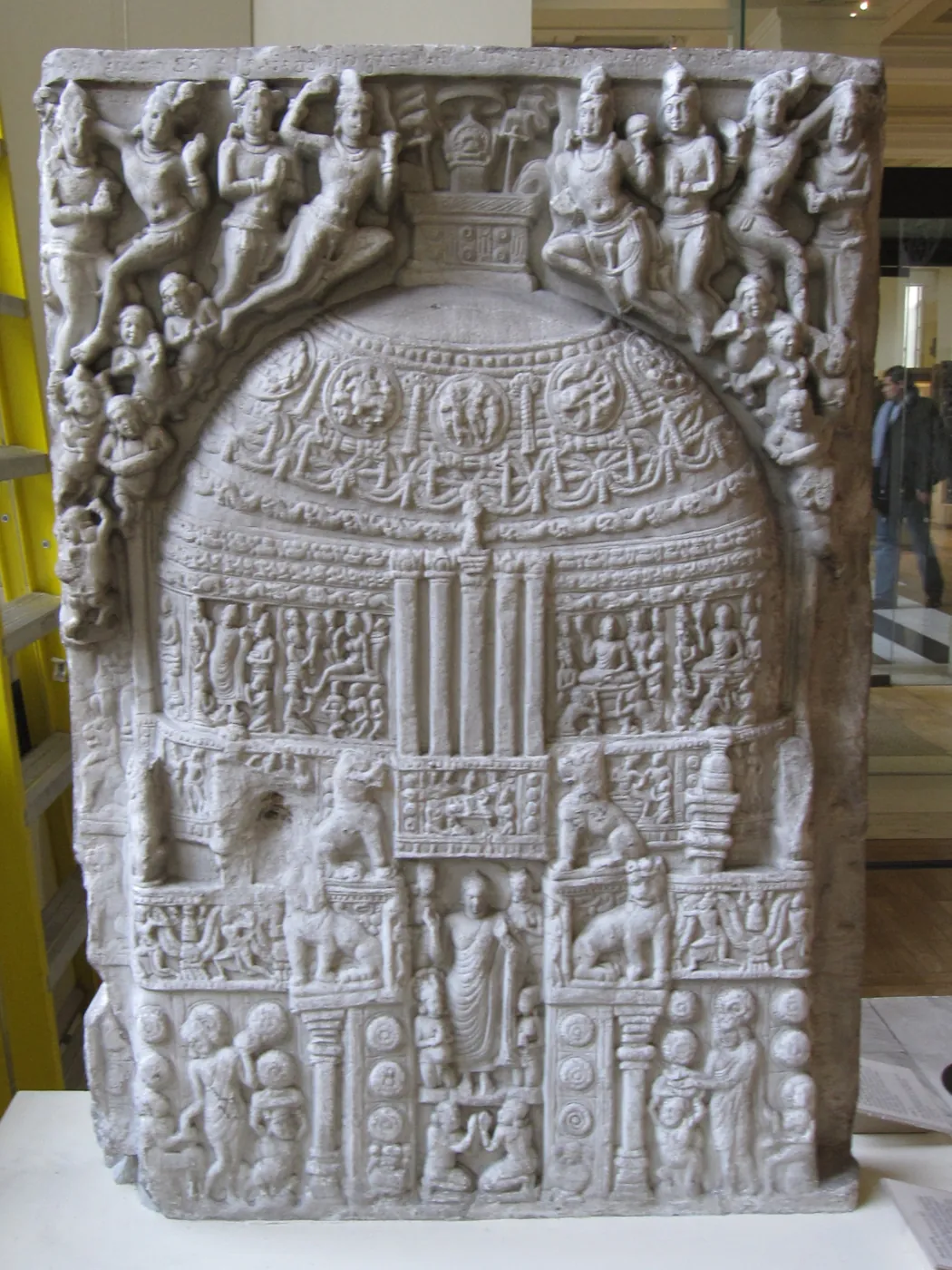
Amaravati: Buddhist institutions formed part of the landscape inherited by Andhra’s successor kingdoms.
Credit: Gryffindor · CC BY-SA 3.0 · source
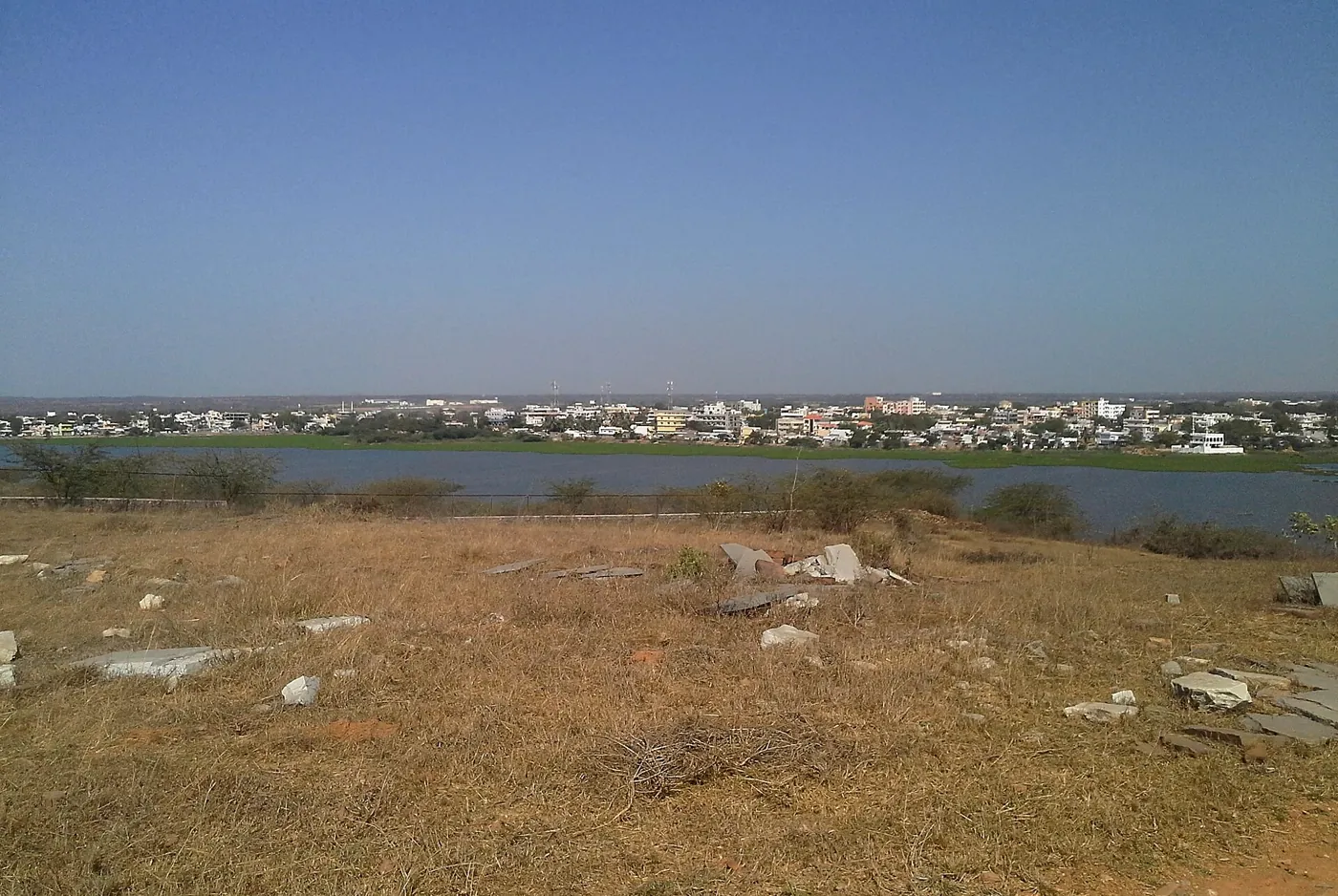
Jaggayyapeta: the lower Krishna setting of regional Buddhist and epigraphic networks.
Credit: Adityamadhav83 · CC BY-SA 4.0 · source
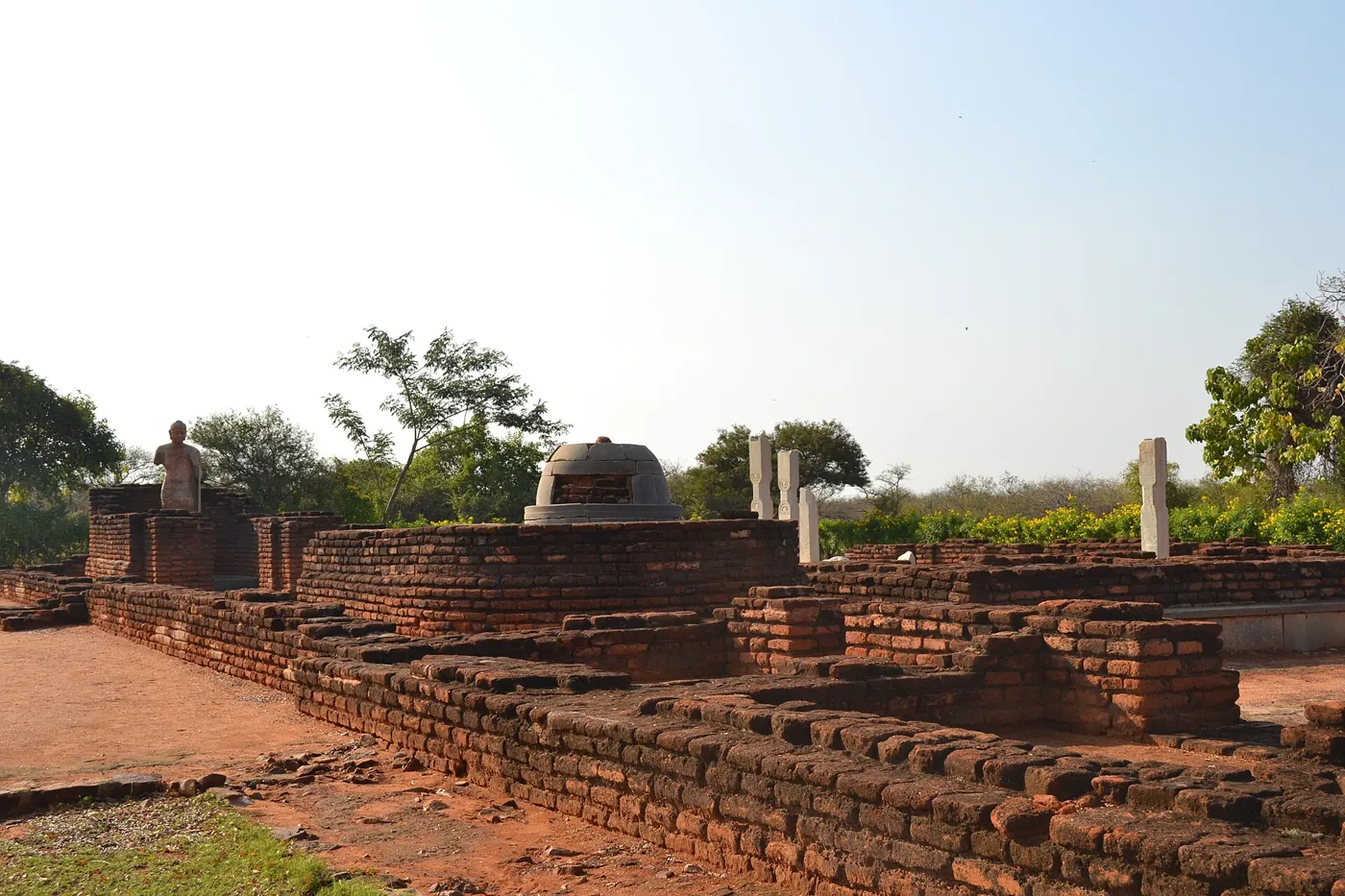
Vijayapuri: surviving remains at the Ikshvaku capital’s archaeological site.
Credit: Sabyk2001 · CC BY-SA 3.0 · source
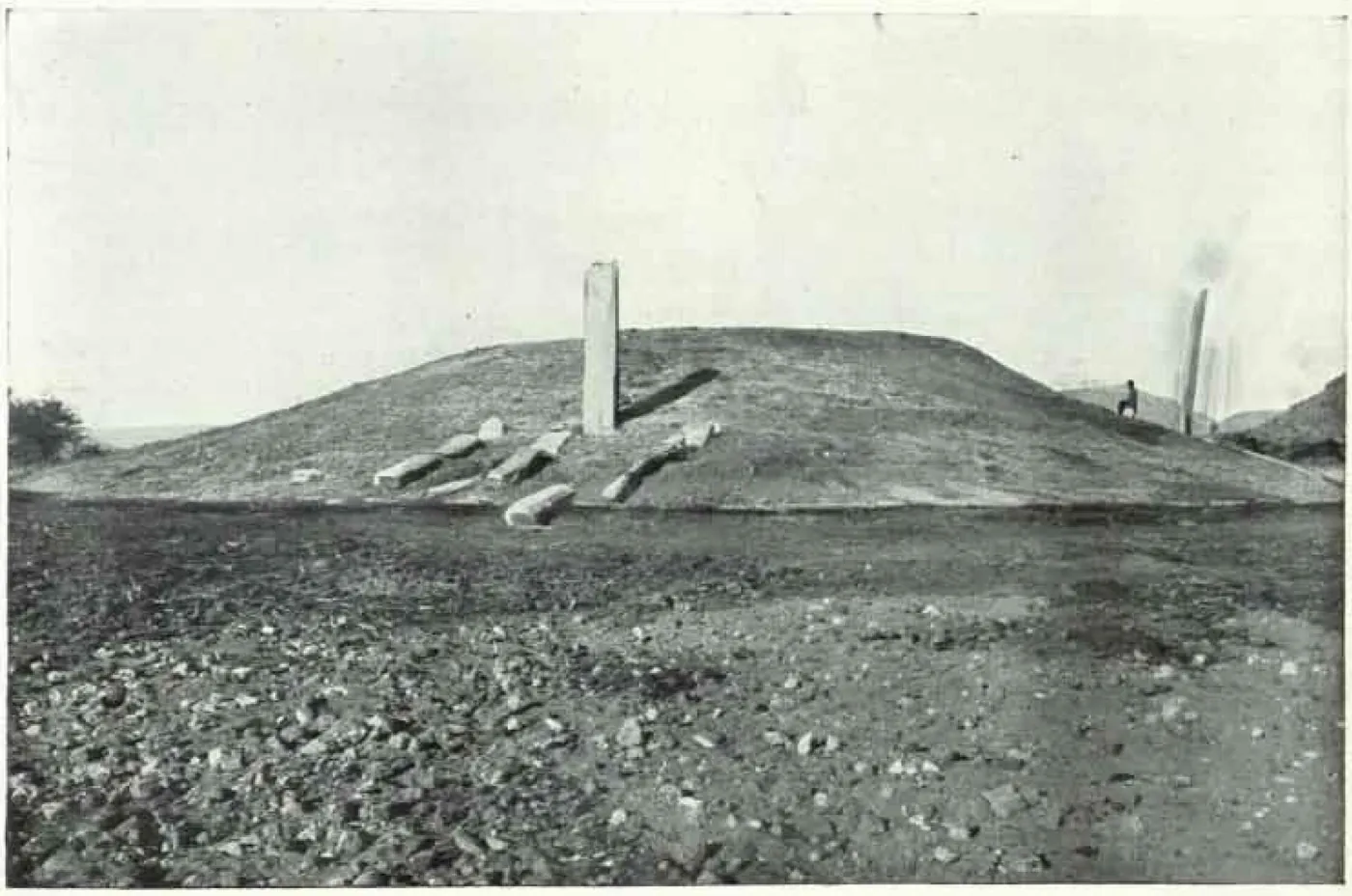
An early archaeological record of the capital’s material remains.
Credit: Archaeological Survey of India · Public domain · source
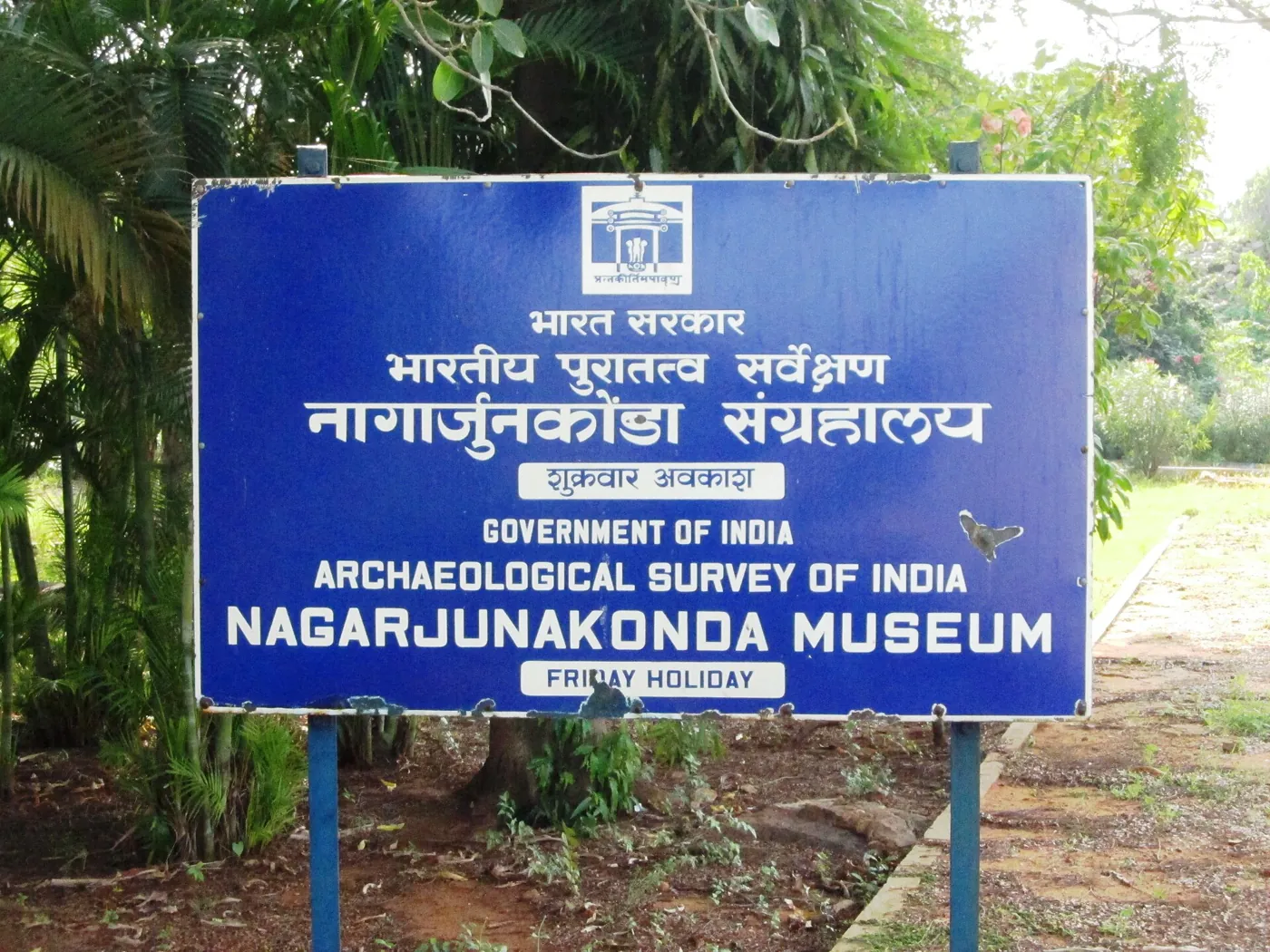
Finds preserved after the valley’s rescue excavations.
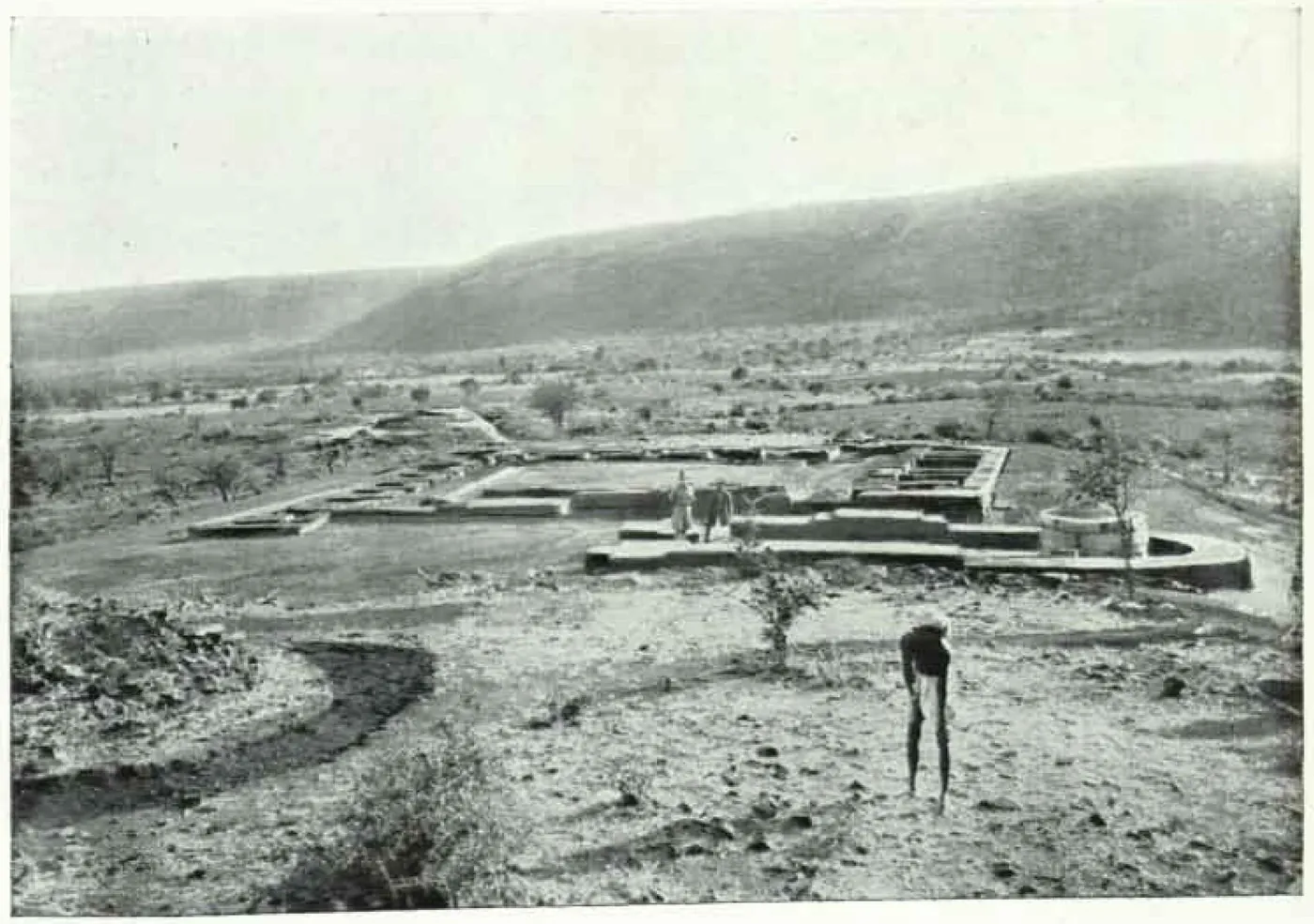
An early published view to compare with the relocated heritage landscape.
Credit: Archaeological Survey of India · Public domain · source
1. Regionalisation and the problem of evidence
The weakening of Satavahana authority opened space for regional houses rather than creating one successor state with unchanged borders. In the Andhra region, the Krishna valley and Vengi developed distinct political centres, while Pallava influence formed part of the southern context. Rivers connected productive land, settlements and routes, but they were not permanent political frontiers. An answer should therefore begin with a regional map and overlapping chronological ranges, not a list implying that every dynasty ruled the whole modern state.
Historical reconstruction depends heavily on inscriptions because continuous narrative accounts are scarce. A charter can identify a king, a beneficiary and an administrative transaction without revealing the complete extent of the kingdom. Regnal years must be reconciled with genealogies, script development and references to outside powers before they can be expressed as common-era dates. Apparent precision can conceal disputed assumptions. For APPSC answers, distinguish what a record directly states from the political interpretation historians build by comparing it with other evidence.
- Separate present-day boundaries from ancient spheres of influence.
- Use approximate dates where accession years remain disputed.
- Compare inscriptions with excavated settlement evidence.
Timeline
About 150–250 CE
Usual dating range for the Madhyamaka philosopher Nagarjuna.
About 3rd century CE
Ikshvaku power develops at Vijayapuri.
About 3rd–early 4th century CE
Royal and lay Buddhist gifts are recorded at Nagarjunakonda.
About 3rd–4th century CE
Jayavarman’s charter belongs to the post-Satavahana regional setting; precise dating varies.
About 4th century CE
Hastivarman of Vengi appears in Samudragupta’s campaign account.
About 4th–early 5th century CE
Anandagotra and Salankayana records illuminate regional rule.
About 5th–6th century CE
Vishnukundin influence expands across parts of the eastern Deccan.
About 5th–7th century CE
Krishna-region rock-cut architecture develops through multiple phases.
About 624 CE, conventionally
Eastern Chalukya Vengi supplies a new dynastic anchor.
1926
Nagarjunakonda discoveries become known to scholarship.
1954–60
ASI conducts intensive salvage excavation before reservoir submergence.
2. Vijayapuri and the religious dimensions of Ikshvaku kingship
The Ikshvakus established an important centre at Vijayapuri in the Nagarjunakonda valley during approximately the third and early fourth centuries CE. The principal recorded rulers include Chamtamula, Virapurushadatta, Ehuvala Chamtamula and Rudrapurushadatta. Their history becomes clearer when genealogy is considered alongside shrines, monasteries and the excavated settlement. The recurrence of Chamtamula in the sequence makes careful naming essential. Different absolute chronologies should not obscure the firmer identification of the capital or the existence of these rulers in the inscriptional record.
Chamtamula’s association with major Vedic sacrifices expresses a language of sovereignty and social prestige. It does not establish the religion of every inhabitant. Buddhist establishments simultaneously attracted donations from members of the royal household and other lay supporters. This combination is analytically important: the ritual commitments of a ruler, the choices of his relatives and the institutional life of a city are different levels of evidence. A balanced answer explains their coexistence instead of assigning one exclusive religious label to the entire kingdom.
- Locate Vijayapuri at Nagarjunakonda rather than Pedavegi.
- Distinguish the founding Chamtamula from Ehuvala Chamtamula.
- Interpret sacrifice as royal legitimation, not a population census.
Build an evidence-led APPSC answer
- 1. Locate the centre and distinguish ancient region from modern state.
- 2. Name the inscription, charter or monument supporting the claim.
- 3. Separate donor, dating ruler and religious beneficiary.
- 4. Explain political or social significance without overstating representativeness.
- 5. Close with chronological or interpretive limits where evidence is disputed.
3. Donor women and the social base of Buddhism
Chamtisiri’s gifts make royal women visible as participants in public religious life. Her relationship to Chamtamula as sister and to Virapurushadatta as aunt helps reconstruct networks through which resources and prestige circulated. Inscriptions on architectural members preserve donor identities alongside the reigning king’s date. Those functions must not be confused: a dedication dated in a king’s reign need not describe his expenditure. The Mahachaitya and associated establishments provide a setting in which kinship, religious merit and durable public commemoration intersected.
Bodhisiri’s evidence broadens the discussion beyond royal households and prevents female patronage from being treated simply as a palace programme. Lay support helped sustain Buddhist establishments and connected religious communities across places. Yet the visibility of named donors is socially selective. It demonstrates particular opportunities and forms of agency, not universal equality or the everyday condition of all women. For a mains answer, discuss access to resources and public recognition, then state the limits of generalising from elite or exceptional examples.
- Distinguish Chamtisiri from Bodhisiri.
- Identify the donor separately from the dating ruler.
- Connect agency with resources without assuming universal equality.
| House or theme | Source anchor | Strong inference | Limit |
|---|---|---|---|
| Ikshvakus | Nagarjunakonda inscriptions | Capital, rulers and donors | Absolute reign dates debated |
| Brihatphalayanas | Kondamudi plates | Jayavarman’s grant | Not a complete political narrative |
| Anandagotras | Sparse grants and stone record | Named rulers and donations | Genealogy and capital identification require care |
| Salankayanas | Regional charters and Prayaga eulogy | Vengi authority and external encounter | Conquest praise does not prove lasting annexation |
| Vishnukundins | Sanskrit grants and genealogies | Legitimation, gifts and alliances | Repeated names complicate numbering |
| Cave architecture | Undavalli and Mogalrajapuram | Form, imagery and relative phases | Not every patron is securely named |
| Modern preservation | ASI reports and museum displays | Documented rescue and relocation | Original landscape only partly preserved |
4. Nagarjuna: philosophical influence and uncertain biography
Nagarjuna, commonly placed around 150–250 CE, is central to the development of Madhyamaka within Mahayana Buddhism. His Mulamadhyamakakarika examines whether things can possess an independent inherent nature. The relationship between dependent arising and emptiness provides the most useful starting point: whatever depends on conditions cannot exist wholly through itself. This is not a denial that ordinary events occur or actions have consequences. Instead, it questions the move from practical experience to a claim that things possess self-sufficient, unchanging essences.
His importance to Andhra’s Buddhist memory must be distinguished from securely recoverable biography. Southern Indian associations are widely discussed, but later narratives do not establish every residence, royal connection or episode as a contemporary fact. The name Nagarjunakonda alone cannot prove that the philosopher personally taught at the excavated settlement. Likewise, later authors or alchemical traditions using the name Nagarjuna should not automatically be merged with him. Historical writing can recognise regional tradition while separately evaluating texts, inscriptions and chronological compatibility.
- Explain shunyata as the absence of inherent existence.
- Do not equate Madhyamaka with nihilism.
- Label regional biographical traditions as traditions.
5. Smaller houses, Vengi and the meaning of copper plates
Jayavarman’s Kondamudi charter anchors the history of the Brihatphalayanas and illustrates the importance of Prakrit copper-plate records. The Anandagotras, associated with names such as Damodaravarman and Attivarman, likewise depend on a small surviving body of inscriptions. These records matter because they document transactions rather than merely supplying ruler lists. They can disclose recipients, localities and privileges, but their survival is uneven. A solitary known king does not prove a one-reign dynasty, and a findspot does not automatically identify the issuing capital.
The Salankayanas occupied a recognisable Vengi setting, with Vengipura generally identified as Pedavegi near Eluru. Hastivarman’s appearance in Samudragupta’s Prayaga eulogy supplies an external reference that can be compared with regional grants. The eulogy, however, celebrates conquest and must be read as royal representation. Its treatment of southern rulers does not justify assuming that all their territories became permanently administered Gupta provinces. Combining local charters with external evidence produces a stronger reconstruction than treating either category as a complete, neutral political narrative.
- Pair Jayavarman with Kondamudi.
- Pair Vengipura with Pedavegi.
- Use Hastivarman as an external synchronism, not proof of permanent annexation.
6. Vishnukundin consolidation, alliance and administration
The Vishnukundins became a major force linking inland eastern Deccan areas with coastal Andhra during roughly the fifth and sixth centuries, with the transition from their dominance extending into the early seventh in conventional accounts. Their history also involves present-day Telangana, not only Andhra Pradesh. Names such as Madhavavarman and Govindavarman recur in the evidence. Competing genealogical reconstructions assign different numbers and dates to similarly named rulers, so an answer should make chronological caution explicit rather than conceal uncertainty behind an exact-looking reign list.
Sanskrit genealogies, sacrificial claims, matrimonial connections with the Vakatakas and religious grants helped represent and consolidate authority. Administration becomes visible through the naming of localities, recipients and privileges in charters. Such transactions linked royal favour with agrarian resources and intermediary groups, although individual exemptions cannot be assumed to apply everywhere. Chalukya expansion under Pulakeshin II subsequently transformed eastern Deccan politics. Kubja Vishnuvardhana’s establishment at Vengi marks the emergence of a new dynasty, conventionally anchored around 624 CE rather than an instantaneous cultural rupture.
- Avoid unsupported Madhavavarman numbering.
- Explain grants as instruments of resource allocation and legitimacy.
- Distinguish political replacement from institutional disappearance.
7. Rock-cut monuments and the wider cultural transition
Undavalli and Mogalrajapuram reveal the importance of Brahmanical sacred architecture around the Krishna corridor. Undavalli’s excavated façade, multiple levels and reclining Vishnu distinguish it from the smaller, damaged Mogalrajapuram group within Vijayawada. Both belong in discussion of early rock-cut traditions, commonly placed broadly within the fifth–seventh-century setting. Rock-cut construction means removing material from a rock mass to create architectural space, unlike assembling a structural temple from separate blocks. Pillars and halls can reproduce built forms even when carved from living rock.
Architectural resemblance is useful for dating but weaker than an inscription directly naming a patron. A cave’s surviving appearance can reflect additions, reworking and changing ritual use, making a single-builder explanation unsafe. The same caution applies to the formula of a movement from stupa to temple and from Prakrit to Sanskrit. Sanskrit became more visible in royal communication and temples attracted resources, but neither development proves that Buddhism or local speech vanished immediately. These were uneven changes in institutions and elite representation, not total replacement.
- Do not assign every cave phase to one ruler.
- Distinguish excavated architecture from structural building.
- Separate inscriptional language from population-wide spoken language.
8. Nagarjunakonda and the ethics of rescue archaeology
Modern archaeological work at Nagarjunakonda forms a separate chronology from the ancient history it recovered. Discoveries became known to scholarship in 1926, and early excavations associated with A. H. Longhurst and others established the site’s importance. The construction of the Nagarjuna Sagar project then threatened the valley with submergence. ASI’s major salvage programme of 1954–60, directed by R. Subrahmanyam, recorded a landscape containing Buddhist and Brahmanical structures as well as settlement evidence. Selected remains and antiquities were moved to safer locations.
The museum and reconstructed monuments preserved irreplaceable material but could not retain every original spatial relationship. A visitor’s present island experience therefore differs from the ancient city’s landscape. Excavation reports, plans and documentation are essential companions to displayed objects because they help restore associations disrupted by relocation. This case allows a mains answer to balance irrigation-led development with conservation needs without reducing the issue to a simple choice between progress and heritage. Saving selected monuments is valuable, but not identical to preserving an entire archaeological context.
- Remember 1954–60 as the principal salvage phase.
- Separate original location, relocated structure and museum display.
- Discuss preservation achievements alongside contextual loss.
Real-world case studies
A donor’s name changes the political story
A dedication dated during Virapurushadatta’s reign is not automatically a grant by him. Identifying Chamtisiri as donor changes the explanation from king-centred patronage to a study of household resources, kinship and female agency. Careful reading of the date and donor clauses therefore improves both political and social history.
A monument saved, a landscape transformed
Nagarjunakonda demonstrates both the achievement and the limits of rescue archaeology. Objects and selected structures survived a major development project, while original relationships among buildings and terrain became harder to experience. Conservation consequently requires documentation and contextual interpretation as well as the relocation of impressive remains.
Previous year questions
No source-linked PYQ is available here yet. Use the practice questions below.
Practice questions
Practice MCQ 1 · Easy
Which record is associated with Jayavarman?
- Kondamudi plates
- Aihole inscription
- Junagadh inscription
- Uttaramerur inscription
Practice MCQ 2 · Easy
Which statement about Vengipura is correct?
- It was another name for Nagarjunakonda
- It is generally identified with Pedavegi
- It was the Gupta imperial capital
- It is located in present-day Kerala
Practice MCQ 3 · Moderate
Which evidence supplies an external reference for Hastivarman of Vengi?
- A Roman itinerary
- A Chola temple list
- Samudragupta’s Prayaga eulogy
- A Portuguese travelogue
Practice MCQ 4 · Moderate
Which interpretation best expresses shunyata in Madhyamaka?
- All actions are impossible
- Nothing can be discussed conventionally
- Every object has an eternal essence
- Phenomena lack independent inherent existence
Practice MCQ 5 · Difficult
Why must Vishnukundin ruler numbering be used cautiously?
- All their kings had identical reign lengths
- Repeated names and competing genealogies produce different reconstructions
- Their inscriptions use only modern dates
- No royal name survives
Practice MCQ 6 · Moderate
Which statement correctly describes Nagarjunakonda’s modern preservation?
- 1954–60 was an ancient Ikshvaku reign
- All remains stand in their original positions
- Rescue excavation and relocation preserved selected evidence
- The reservoir predates the Buddhist monuments
Mains practice · Assess the role of inscriptions in reconstructing post-Satavahana Andhra.
- Contrast grants, donor records and eulogies.
- Use Kondamudi and Nagarjunakonda examples.
- Explain regnal years and genealogical problems.
- Discuss source bias and uneven survival.
- Combine epigraphy with archaeology.
Mains practice · Was the growth of Brahmanical kingship incompatible with Buddhist patronage in early Andhra?
- Explain Vedic legitimacy under the Ikshvakus.
- Identify royal women’s Buddhist gifts.
- Add non-royal donor networks.
- Distinguish royal identity from social practice.
- Reject an abrupt uniform replacement model.
Mains practice · Discuss cultural transition in early Andhra through language, architecture and preservation.
- Trace formal Prakrit–Sanskrit change cautiously.
- Compare cave excavation with structural building.
- Use Undavalli and Mogalrajapuram without inventing patrons.
- Explain the coexistence of religious institutions.
- Conclude with Nagarjunakonda’s rescue and contextual loss.
Further reading
Preparing for APPSC Group 1 or Group 2? See the APPSC Groups coaching course at Pragnya IAS Academy for fees, batches and registration.
Long study hours taking a toll? Try the free breathing exercise and self check-in in Pragnya’s student wellness programme for UPSC aspirants.