

Aftershocks, 2001 Gujarat earthquake - yellow star marks epicentre
Credit: USGS · Public domain · source

ഓഗസ്റ്റ് 15 നു മലപ്പുറം മേൽമുറിയിലുണ്ടായ വെള്ളപ്പൊക്കം
Credit: Akbarali · CC BY-SA 3.0 · source
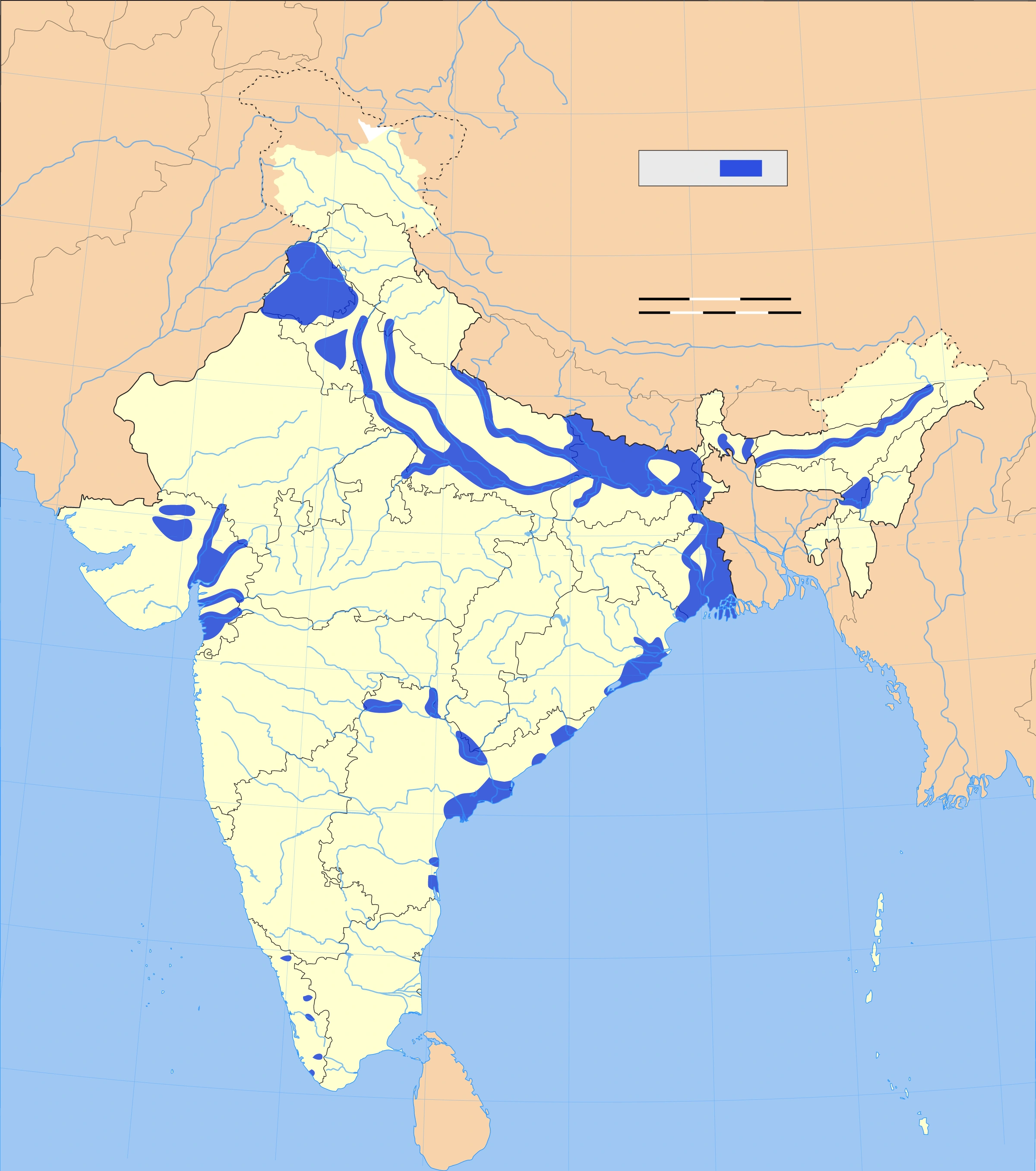
Map study
India flood-prone reference zones: relate plains to major river systems and monsoon rainfall. Not a live forecast or parcel-level risk map.
- Read the source legend and reference date before interpreting the map.
- Use spatial patterns to support topic revision; verify current official boundaries, designations and warnings separately.
Credit: Planemad · CC BY-SA 3.0 · sourceConverted to WebP on an opaque white background; proportionally resized without cropping. Original cartography and legend retained.
1. Meaning and place in the disaster cycle
Recovery addresses the medium- and long-term consequences of disasters while creating opportunities for disaster risk reduction. It includes restoration or improvement of livelihoods, health, economic activity, physical and social assets, and environmental systems. The objective is a functioning, safer society, not simply replacement of damaged buildings. Recovery planning should therefore begin before disasters through baseline inventories, contingency arrangements, institutional responsibilities and reconstruction standards.
Relief meets immediate survival needs, including food, water, shelter and emergency healthcare. Rehabilitation restores essential services and basic functioning, such as reopening schools, reconnecting water supply and restarting local enterprises. Reconstruction involves more durable rebuilding of housing, public facilities and economic infrastructure. Recovery is the broader framework connecting these activities with social, economic and environmental renewal.
These stages overlap. Debris clearance can create temporary employment while facilitating emergency access and reconstruction. Repairing irrigation may simultaneously protect food security and restore incomes. Conversely, providing prolonged temporary shelter without a transition plan can delay recovery. The duration depends on disaster severity, pre-existing inequalities, administrative capacity, resource availability and the possibility of repeated hazards.
- Early recovery: restore basic services, temporary livelihoods, local administration and safe access while humanitarian assistance continues.
- Long-term recovery: rebuild resilient settlements and infrastructure, restore economic security and ecosystems, and address lasting health and social impacts.
2. Build Back Better as a risk-reduction strategy
Build Back Better means using recovery to reduce exposure and vulnerability rather than reproducing pre-disaster risk. The Sendai Framework places it within Priority 4, alongside preparedness for effective response. Its application combines safer siting, risk-informed design, enforceable construction standards, livelihood diversification and strengthened institutions. ‘Better’ must be assessed through safety, accessibility and social outcomes, not merely the monetary value of new assets.
Physical measures include earthquake-resistant detailing, flood-compatible building design, strengthened drainage, cyclone-resistant roofs and redundancy in electricity, communications and water networks. Relevant Bureau of Indian Standards provisions and the National Building Code of India should inform reconstruction. Critical facilities require particular attention: a hospital that survives structurally but loses water or power cannot deliver essential care.
Recovery must also correct social vulnerabilities. Women may lack property titles needed for housing assistance; tenants and informal workers may be absent from official loss registers; persons with disabilities may face inaccessible shelters and reconstructed facilities. Transparent eligibility criteria, assisted documentation, accessible design and meaningful community participation are therefore risk-reduction measures.
Relocation is appropriate where residual risk cannot reasonably be reduced, but it is not automatically safer in a broader sense. A distant site may disrupt fishing, farming, schooling and social networks. Decisions require hazard assessment, consultation, secure tenure, basic services and livelihood access. Ecosystem restoration and safe debris management prevent reconstruction from generating fresh risks through wetland filling, uncontrolled quarrying or dumping.
- Avoid risk transfer: embankments, road raising or drainage changes should not increase flooding in neighbouring settlements.
- Avoid maladaptation: rebuilding quickly on unstable slopes or exposed floodplains may lock communities into repeated losses.
Risk-informed recovery process
- 1. Establish pre-disaster recovery arrangements and baseline information
- 2. Conduct rapid assessment and detailed needs assessment
- 3. Consult communities and prioritise risk-reducing interventions
- 4. Prepare a costed framework with responsibilities and safeguards
- 5. Mobilise finance and implement phased recovery
- 6. Audit quality, monitor outcomes and revise the programme
3. Assessment, prioritisation and recovery planning
An initial rapid assessment establishes urgent priorities, while a detailed Post-Disaster Needs Assessment supports a recovery programme. Damage refers to destruction of physical assets; losses concern changes in economic flows, such as foregone production or additional operating costs. Recovery needs estimate the resources and interventions necessary for restoration and risk reduction. These concepts are related but should not be treated as interchangeable.
Assessment should cover housing, health, education, agriculture, livelihoods, transport, water and sanitation, energy and ecosystems. Household surveys, administrative records, satellite imagery and community mapping should be triangulated. Data disaggregated by sex, age, disability, location and livelihood help identify exclusion. Valuation must recognise informal economic activity and unpaid care work, even where administrative records are weak.
A recovery framework converts assessed needs into priorities, financing arrangements, responsibilities and measurable results. Restore lifeline services first, while managing interdependencies: water pumping requires electricity, hospitals need transport access, and markets need functioning supply chains. Housing recovery should proceed alongside tenure resolution, technical support, services and employment rather than as an isolated construction programme.
Monitoring must extend beyond expenditure and numbers of completed houses. Useful indicators include service downtime, safe occupancy, school attendance, livelihood recovery, inclusion of vulnerable households, compliance with safety standards and beneficiary satisfaction. Independent technical audits, social audits and accessible grievance redressal can detect unsafe work, duplication and exclusion.
- Prepare a costed, phased plan with clear implementing agencies and operation-and-maintenance responsibilities.
- Update assessments as displaced populations return, hidden damage emerges or subsequent hazards alter priorities.
| Intervention | Primary purpose | Example |
|---|---|---|
| Relief | Meet immediate survival needs | Emergency food, drinking water and temporary shelter |
| Rehabilitation | Restore essential functioning | Reopening schools and restarting basic health services |
| Reconstruction | Rebuild damaged physical assets | Rebuilding bridges and permanent houses |
| Recovery | Restore and improve overall well-being and systems | An integrated housing, livelihood, health and infrastructure programme |
| Build Back Better | Embed risk reduction throughout recovery | Safer siting, accessible housing and resilient service networks |
4. Indian institutions, financing and implementation
The Disaster Management Act, 2005 provides the statutory framework for disaster management, including rehabilitation and reconstruction. The National Disaster Management Authority provides national policy and guidelines; state authorities guide state-level planning, while district authorities coordinate district-level implementation. Line departments, urban local bodies and panchayats are central to restoring services and rebuilding assets. The National Disaster Management Plan, revised in 2019, links recovery with Build Back Better.
State governments ordinarily lead recovery, supported by Union ministries and other partners. Dedicated recovery arrangements can improve coordination after major disasters, but should strengthen rather than bypass local institutions. Responsibilities for land, beneficiary selection, engineering approval, procurement, financing and maintenance must be explicit. Community organisations can support enumeration, monitor implementation and communicate local priorities.
Immediate relief and long-term recovery require different financing instruments. SDRF and NDRF assistance follows notified norms and does not reimburse every private loss. Reconstruction may require budget allocations, sectoral programmes, dedicated packages, insurance payouts and development assistance. The Fifteenth Finance Commission recommended distinct recovery-and-reconstruction windows within the disaster response financing structure, recognising that immediate relief alone is insufficient.
Convergence with eligible rural employment, housing, livelihood and infrastructure programmes can support recovery, subject to their rules. Financing should combine speed with accountability through traceable transfers, transparent procurement and risk-based audits. Insurance can improve liquidity but cannot replace public support, especially where coverage is low or vulnerable households cannot afford premiums.
- Provide predictable, staged assistance linked to verified progress without excluding households unable to finance initial construction.
- Publish eligibility rules and beneficiary lists with appropriate privacy safeguards and a functioning appeals mechanism.
5. Sectoral priorities, trade-offs and outcomes
Owner-driven housing reconstruction can improve local suitability and beneficiary control when supported by engineers, trained masons, safe designs and timely instalments. Contractor-led approaches may mobilise scale, but require strong quality control and user consultation. Neither model is universally superior. Land tenure, construction capacity, household preferences and the urgency of resettlement should determine the approach.
Livelihood recovery requires more than replacing tools. Farmers may need restored irrigation, livestock services and credit restructuring; small enterprises need working capital, electricity and customers. Cash assistance can support choice where markets function, while in-kind assistance may remain necessary where supply chains have collapsed. Restoration of anganwadis, schools and healthcare reduces care burdens and supports household economic recovery.
Mental health support, continuity of treatment, safe water and disease surveillance remain important after emergency operations end. Environmental recovery includes slope stabilisation, watershed repair and ecosystem restoration suited to local conditions. Ultimately, success means fewer people exposed to avoidable risk, stronger service continuity and restored dignity. The policy challenge is to balance rapid restoration with the time required for consultation, safer design and institutional reform.
- Core trade-offs: speed versus safety; relocation versus livelihood access; standardisation versus local suitability.
- A sound recovery programme treats affected people as decision-makers and partners, not passive recipients.
Real-world case studies
Gujarat earthquake, 2001: supported owner-driven reconstruction
Following the 26 January 2001 earthquake, Gujarat established the Gujarat State Disaster Management Authority and implemented a major reconstruction programme. Owner-driven rural housing reconstruction combined financial assistance with technical guidance and promotion of earthquake-resistant construction. The experience demonstrates that household choice can coexist with safety standards when trained workers, engineering support and inspections are available. Housing must nevertheless be assessed alongside livelihood restoration and settlement-level services.
Kerala floods, 2018: connecting recovery with resilience
After the 2018 floods and landslides, Kerala undertook a Post-Disaster Needs Assessment with international institutional support. The Rebuild Kerala Initiative and Rebuild Kerala Development Programme sought to connect recovery with resilient development, including water management, roads and institutional strengthening. The case highlights the need for basin-level planning and cross-departmental coordination rather than treating every damaged asset as an isolated replacement project.
Previous year questions
No source-linked PYQ is available here yet. Use the practice questions below.
Practice questions
Practice MCQ 1
With reference to disaster recovery assessment, consider the following statements: 1. Damage refers primarily to destruction of physical assets. 2. Losses may include interrupted production and additional operating costs. 3. Recovery needs must always equal the pre-disaster replacement value of damaged assets. Which of the statements given above are correct?
- A. 1 and 2 only
- B. 2 and 3 only
- C. 1 and 3 only
- D. 1, 2 and 3
Practice MCQ 2
Which of the following best illustrates Build Back Better after a flood?
- A. Rebuilding every structure at its original location without reassessment
- B. Prioritising construction expenditure over safety compliance
- C. Restoring housing with risk-informed siting, safe design and livelihood access
- D. Relocating all affected people far from the floodplain regardless of their preferences
Practice MCQ 3
Consider the following statements about disaster recovery in India: 1. Recovery activities can begin while emergency response continues. 2. SDRF and NDRF provide comprehensive compensation for all disaster-related private losses. 3. Local bodies and line departments have important recovery functions. Which of the statements given above are correct?
- A. 1 only
- B. 1 and 3 only
- C. 2 and 3 only
- D. 1, 2 and 3
Mains practice · Disaster recovery should restore development without recreating vulnerability. Discuss the institutional, financial and social measures needed to operationalise Build Back Better in India. Illustrate with examples. (250 words)
- Define recovery and connect Build Back Better to Sendai Priority 4.
- Explain risk-informed needs assessment, safer siting and resilient lifeline infrastructure.
- Discuss state leadership, line-department coordination and local-body capacity.
- Distinguish immediate relief finance from longer-term reconstruction requirements.
- Address tenure, tenants, informal livelihoods, gender, disability and participatory relocation.
- Use Gujarat earthquake reconstruction and Kerala flood recovery as illustrations.
- Conclude with outcome monitoring, quality assurance and grievance redressal.
Further reading
- UNDRR: Sendai Framework for Disaster Risk Reduction 2015–2030, Priority 4.
- UNDRR: Terminology on Disaster Risk Reduction, entries on recovery and Build Back Better.
- NDMA: National Disaster Management Plan, 2019.
- India Code: Disaster Management Act, 2005, as amended.
- Fifteenth Finance Commission: Report for 2021–26, disaster risk management financing.
- Government of Kerala: Kerala Post Disaster Needs Assessment, Floods and Landslides, August 2018.
- Ministry of Home Affairs, Disaster Management Division: disaster response fund guidelines and assistance norms.
Preparing for UPSC Civil Services? Get classroom teaching, answer-writing evaluation and mentorship at Pragnya IAS Academy, Ashok Nagar — see why aspirants choose us for IAS coaching in Hyderabad.